Announcements

10 Year Anniverary & New Releases Winners: Carrie Fancett Pagels' Butterfly Cottage - Melanie B, Dogwood Plantation - Patty H R, Janet Grunst's winner is Connie S., Denise Weimer's Winner is Kay M., Naomi Musch's winner is Chappy Debbie, Angela Couch - Kathleen Maher, Pegg Thomas Beverly D. M. & Gracie Y., Christy Distler - Kailey B., Shannon McNear - Marilyn R.
Showing posts with label Colonial History. Show all posts

Monday, December 13, 2021

Colonial History in the Caribbean: St. Croix Part 3 (another unexpected connection!)

by Shannon McNear

~*~*~

Some things are just too strange to be coincidence.

So this past summer, my husband's Air Guard unit took part in a joint exercise using St. Croix, part of the United States Virgin Islands, as its base. Someone came up with the idea of inviting spouses and/or family along, and thus I found myself flying out of country for the first time ever to a little island I didn't know I needed to visit.

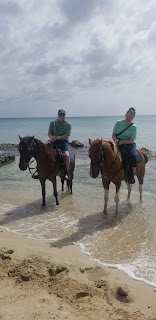
I'll admit, I don't really have a formal bucket list. But if I did, traveling out of country and then horseback riding on the beach would be two items on that list--and I was blessed to get to do both on this trip.

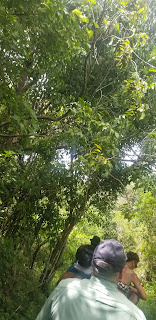
I've already covered two aspects of interesting colonial history associated with St. Croix, one connected with Denmark and one with our own Hamilton, but the one which got me most excited, and felt the most personal, was something I noticed while on that ride through the tropical forest on the island's west side.

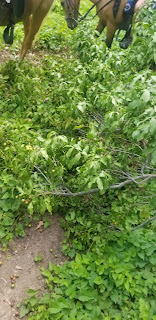
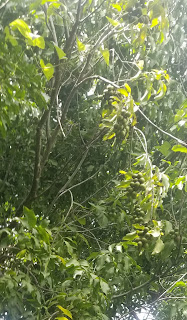
It was my first chance to go trail riding in years, and I was already geeking out over getting to be on horseback on a Caribbean island. Then, at a bend in the trail, I looked down and saw these little green apple-like fruits, growing on a small tree that had fallen alongside the trail.

A memory tickled, of an incident I'd read in John White's account of the Roanoke Colony's passage through the Caribbean.

And why were they passing through the Caribbean, you might wonder? I'm glad you asked. It's because during the Age of Exploration, seafaring men knew it was better to take advantage of ocean currents that swirl in a great, clockwise motion from the coast of Europe, southward past Spain and Africa, sweeping around to the Caribbean, and then northward again along the coast of the New World.

Ships often stopped at the various islands for provisioning. And so John White reports an incident that I allude to in my recently released novel Elinor:

The 22 [of June] we came to an anchor at an Island called Santa Cruz, where all the planters were set on land, staying there till the 25 of the same month. At our first landing on this Island, some of our women, and men, by eating a small fruit like green Apples, were fearfully troubled with a sudden burning in their mouths, and swelling of their tongues so big, that some of them could not speak. Also a child by sucking one of those women's breasts, had at that instant his mouth set on such a burning, that it was strange to see how the infant was tormented for the time: but after 24 hours it ware away of it self.

... In this Island we found no watering place, but a standing pond, the water whereof was so evil, that many of our company fell sick with drinking thereof: and as many as did but wash their faces with water, in the morning before the sun had drawn away the corruption, their faces did so burn and swell, that their eyes were shut up, and could see in five or six days, or longer. [They did later find a spring high on a rocky hill.]


A small fruit like green apples ... ? I piped up and asked the girl leading our ride what the fruits were, and she said, "Oh, that's manchineel, and they're poisonous!"


(Interestingly enough, the experience reported in this article mirrors John White's!)

Our guide went on to chat at little bit about this fruit you definitely want to avoid, and then went on to tell us that there was something else called a "ganip" that looked a bit like a small lime but was absolutely delicious. And before long, we ran across some.


At our guide's urging, we all collected a few. I hesitated--here I was, an adult of somewhat older persuasion and uncertain digestive sensitivity; would sampling this out in the wild be a mistake? But then I decided to take the risk. The skin was tender and popped easily when I bit the tiny fruit--about the size of a Scuppernong grape--and when I squeezed the juicy pulp into my mouth, it reminded me in texture and taste of something between a mango and a peach. There wasn't a lot of pulp surrounding the pit, but our guide was right about how good they tasted. I had several.

And fortunately, I never suffered any digestive distress, either.

A few articles about ganips:

https://en.wikipedia.org/wiki/Melicoccus_bijugatus

https://www.vinow.com/blog/nature/local-fruit-genips/

https://www.plantsandhealers.org/tropical-fruits-of-the-caribbean/

I wonder whether the English colonists thought they were getting ganips when they tried the manchineel?

But here was the thing. I'd completely forgotten whether John White had specified on which island this particular misadventure took place. But do you see it--Santa Cruz? That's the older name for St. Croix, the Spanish version of the name--and the people of the island still call themselves "Cruzan" after that name.

How cool to find that I'd walked shores where my Lost Colonists might have walked, ridden through a forest where they might have wandered.


Monday, November 22, 2021

Colonial History in the Caribbean: St. Croix Part 2 (an unexpected connection!)

 That time I got to take a trip I didn't know I needed, to a slightly obscure little island out on the Caribbean and toured a Danish colonial fort . . .

"What's your name, man?"

"Alexander Hamilton. My name is Alexander Hamilton! And there's a million things I haven't done, but just you wait--just you wait..."

 (Genius.com lyrics to the infamous song by Lin Manuel Miranda about the infamous Hamilton)

So yes, I rounded a corner at the fort and came face to face with these:


(You should be able to click on each photo and enlarge)


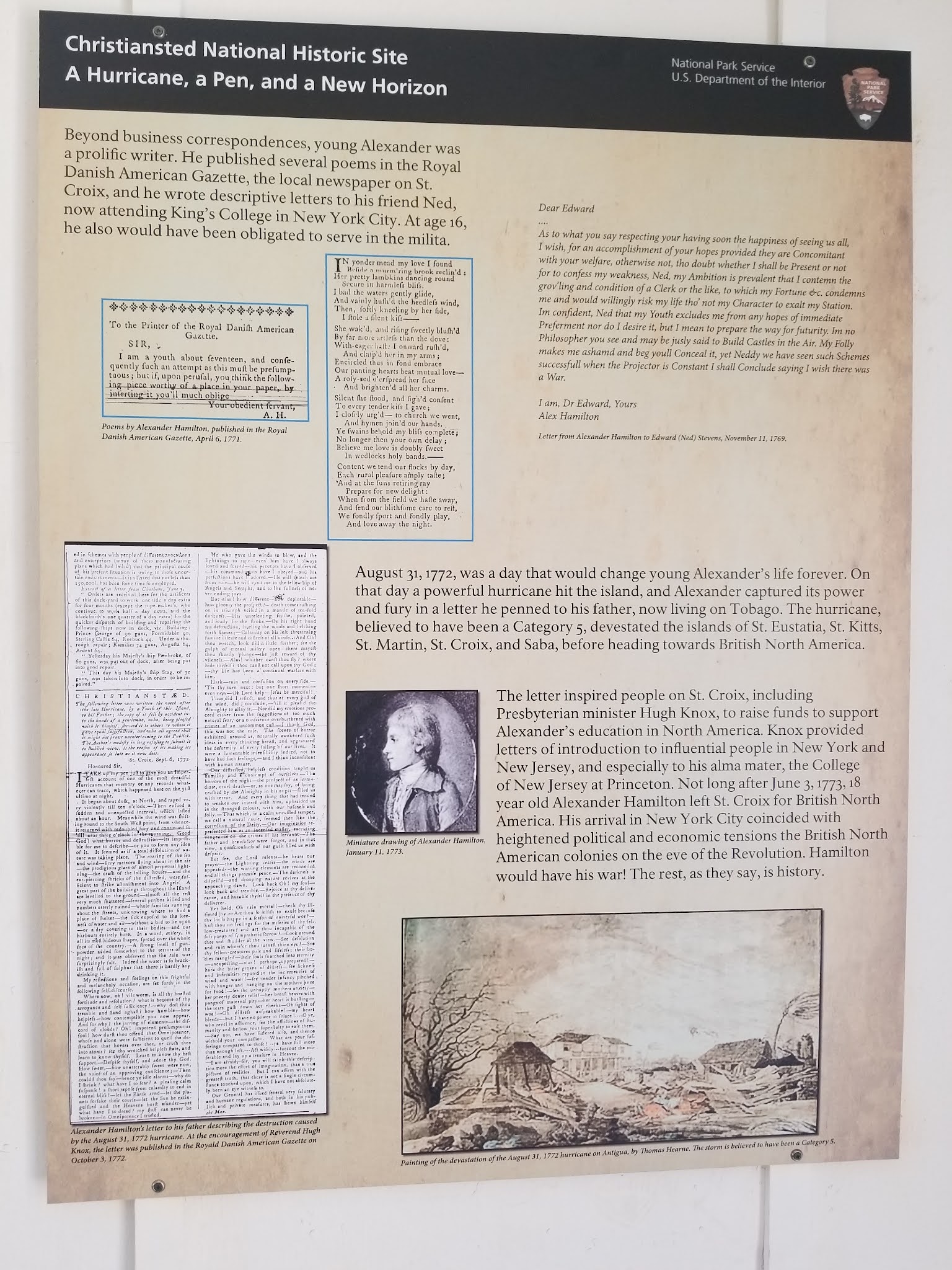
These four informational placards sketch out the story behind the story--of Hamilton's mother's early marriage, of her imprisonment right there in Fort Christiansvaern, and her relationship with Hamilton's father and return to St. Croix. The lyrics to the song "Alexander Hamilton" are actually pretty accurate. But something I caught from the display at the fort that the musical "Hamilton" doesn't really mention is the passionate faith young Alexander seemed to possess, heightened by the terrifying experience of living through a Category 5 hurricane there on St. Croix. (Lower sections of the fourth photo.) Can you imagine?

And this would not be the only unexpected connection with the American colonial era I would encounter on this beautiful island! Come back next month to read about the snippet of Lost Colony history I did not become aware of until later . . . 

Monday, October 11, 2021

Colonial History in the Caribbean: St. Croix

This summer, the opportunity arose for me to accompany my husband on a military trip to St. Croix, US Virgin Islands--my first time ever out of the country! Although St. Croix was never on my wishlist of places to visit, I am so glad I went!

Beyond the expected tourist vibe, this Caribbean island boasts an interesting slice of colonial history. It was, in fact, a colony of Denmark during the 1700's. St. Croix's two towns, Christiansted and Frederiksted, were named after Danish kings. We stayed in Christiansted, just steps away from the first Lutheran church built on the island (unfortunately not open to the public), and about a block further lay the Danish outpost of Fort Christiansvaern. Of course I went exploring ...

The old church is now called, simply, "The Steeple Building." A bronze plaque reports that construction began in 1750 and that this first Danish Lutheran Church was consecrated in 1753 as the Church of Our Lord of Sabaoth and served until the move to a new sanctuary in 1831. (Which I also saw and admired--and is still in use!) The church building was then used as a military bakery, storehouse, town hall, hospital, and school. It still, says the inscription, bears the aspect of 1796.

Coming from drought-stricken North Dakota, which usually has a vivid beauty of its own even in August, I found myself continually amazed at the fresh greens and striking blues of the island and the waters around it. There's a reason why "Caribbean blue" is a thing!

It's funny, too, how a history nerd like myself gets excited just over an 8th century fort and cannons. I mean, really, how many can you see before they all start looking alike? But there was something about the cheerful yellow of Fort Christianvaern, and the weight of history lurking in its halls ...


There were too many rooms of the fort to share, but some of the more interesting ones included the aresenal, still containing various artillery equipment, gear, and firearms:


Of course, like so many other places, the 18th century history of St. Croix was entangled with the practice of slavery. Sugar plantations comprised a large portion of the island's industry, and old sugar mills still stand scattered about--like this one on the boardwalk in Christiansted, now converted to a shop and restaurant by day.


In all, it felt a little like being on a "Pirates of the Caribbean" set, except for reminders that we remained firmly in the 21st century. (Among other things, the sanitizer dispensers literally in every nook and cranny!)


I also discovered two connections to American colonial history, right there on St. Croix ... but those will have to wait until next time!

(If you think you know at least one of them, do go ahead and post in the comments!)


Monday, June 15, 2020

The Earliest Colonial History

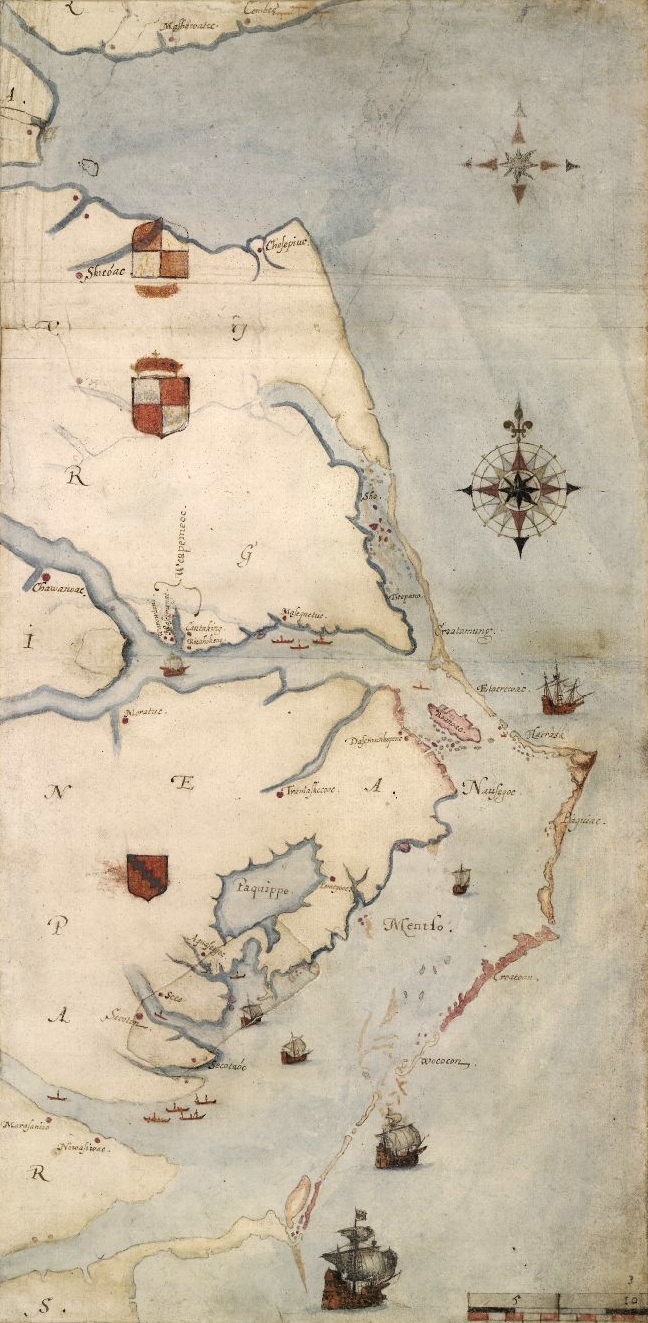
The coast of "Virginia," by John White
DISCLAIMER: Our country's own recent events might make us shy from terms such as "colonial," but I seek only to report history as described by contemporaries of whatever time period I am examining. In no way do I condone the actions of men (or women) who lived in those times. The fact is, certain events took place, and certain actions resulted from those events, and political corruption has always been a thing. Just within the past two weeks, while researching for this post and even while watching things for entertainment, I'm reminded that genocide was practiced even among those who considered themselves civilized (note the English subjugation of Ireland in the 1500's) and colonization was certainly not the sole purview of Europeans (note the Japanese takeover of Korea in the early 1900's). Making such observations might sound like I'm excusing the actions of (some of) my own forebears, but I assure you it is not. I only say so to address the belief that injustices are a primarily "white" problem. The entirety of history is just awful in so many ways.

So ... what do we think of, in the context of America, when someone says "Colonial History"? Most of us, I'm sure, think of the War for American Independence, possibly of Daniel Boone, and before that, of the Mayflower, Plymouth Rock, and Jamestown.

Our country's European roots go even further than that, however. Though the period between Columbus and the Mayflower is usually viewed as a misty void, the English quest to colonize the New World was first fueled by Queen Elizabeth I, who sought lands not already claimed by Christian rulers to add to the fame and fortunes of Britain.
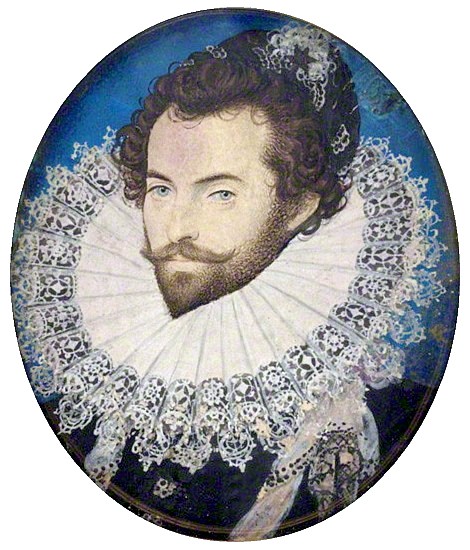
A very dapper Sir Walter Raleigh

After the 1583 voyage to Newfoundland by Sir Humphrey Gilbert ended in disaster (Gilbert perished at sea on his way home), the patent passed to his younger half brother, Sir Walter Raleigh. Wasting no time, Raleigh sent an expedition to what was then known as Virginia--named after Elizabeth herself, the "Virgin Queen." The first colonist--more a military endeavor than a serious permanent settlement yet--landed on Roanoke Island in 1585, on the Outer Banks of what is now North Carolina. Those original colonists returned to England shortly after, just missing their supply ship. This second wave left a contingent of 15 men to hold the area.

The next serious attempt at colonization took place in 1587, and the group of 117-some included women and children. These brave souls comprised what would later be called "the Lost Colony." A brief introduction to that story was provided by our own Janet Grunst, in her post "America's Oldest Unsolved Mystery."

More on that later, as over the next few months, I'll be looking at some of the key players in these early attempts at colonizing North America. :-)

Friday, September 27, 2019

Wonders of the Colonial Frontier: Congaree National Park

What did the colonial frontier look like?

Last month I quoted from the writings of John Henry Logan, describing what the South Carolina backcountry looked like when European settlers first arrived. Just a few weeks later, my son and daughter-in-law (then expecting baby #3 any day!) granted me a walk through Congaree National Park near Columbia, SC, as a Sunday-after-church attempt to "walk the baby out." (It didn't work. Baby girl delayed her appearance for 5 more days, but then arrived in one of THE sweetest births I've ever had the privilege to witness!)

Ahem. Excuse my Grammie sidetrack. I did spend most of the walk geeking out over what is billed as South Carolina's last remaining old-growth forest.

I took a ton of photos, but it was nearly impossible to capture just how tall and massive some of these trees are ...


The forest is comprised of beech, cypress, tupelo, oak, loblolly pine (where the famed "heart pine" came from), and so many others. The tupelos were noteworthy because the moss growing thickly on the lower trunks marks where the high-water line is during seasonal floods.


Also, remember my reference last month to canebrakes, and how the plant was a type of bamboo? WRONG. It's related to sugarcane ... bamboo is actually an invasive species not native to the American southeast. Can you imagine these, growing 20-30 feet high, as Logan described?


... wetlands, full of cypress and tupelo ...


... a very short video clip with my daughter Corrie reading about the largest loblolly pine ...


... the palmetto, for which South Carolina is named ...


... remember Logan's description of peavines, as high as a horse's withers? I spied ONE. A small one. But I was delighted to recognize it!


What's a visit to the forest without creepy-crawlies? I'd never seen a millipede this huge ...


And we were excited to see this luna moth ....

 Look close at the ruggedness of that forest floor--those are cypress knees, everywhere! Can you imagine walking or riding a horse through this? Definitely not terribly passable by wagon ...

And last but maybe not least, a quick clip of me surveying my surroundings. (Sound up ... )


Monday, August 12, 2019

Wonders of the Colonial Frontier: the Landscape of South Carolina

Early explorers of America found a wonderland whose description almost defies belief for those of us used to the tamed, populated landscapes of the eastern seaboard. A particular gem of reference exists in A History of the Upper Country of South Carolina by John Henry Logan, published in 1859. He writes,


The Great West here is, believe it or not, a reference to upstate South Carolina. Logan goes on to say,
It is well known that in the primitive history of the country, there were numerous prairies in the corresponding parts of Virginia and North Carolina.
He describes meadows full of peavines as tall as the back of a horse, and canebrakes (a variety of bamboo) extending for miles along the waterways. Cane, in fact, was used as a gauge for the richest soil for farming. If the cane only grew to the height of a man, it was passed over, but where it grew 20 to 30 feet, that was considered prime farmland. (Thus where the Long Cane District around Ninety Six, South Carolina, and others, got its name.) And anyone familiar with the hardwood and pine of the Carolinas--did you know those were more recent growth?


Logan says,
The partizan (sic) soldiers of the Revolution, in Upper Carolina, frequently spoke of this striking feature of the country. It sometimes favored their enterprises, but as often proved the cause of premature detection and defeat.
Even Cornwallis, while wintering around Winnsboro, South Carolina, in 1780-81 commented on the beauty of the landscape around him.


 The wildlife populating this country was just as wondrous--but that's another subject for another post!


Monday, February 11, 2019

Slavery in Colonial America: the Impact on Native Tribes

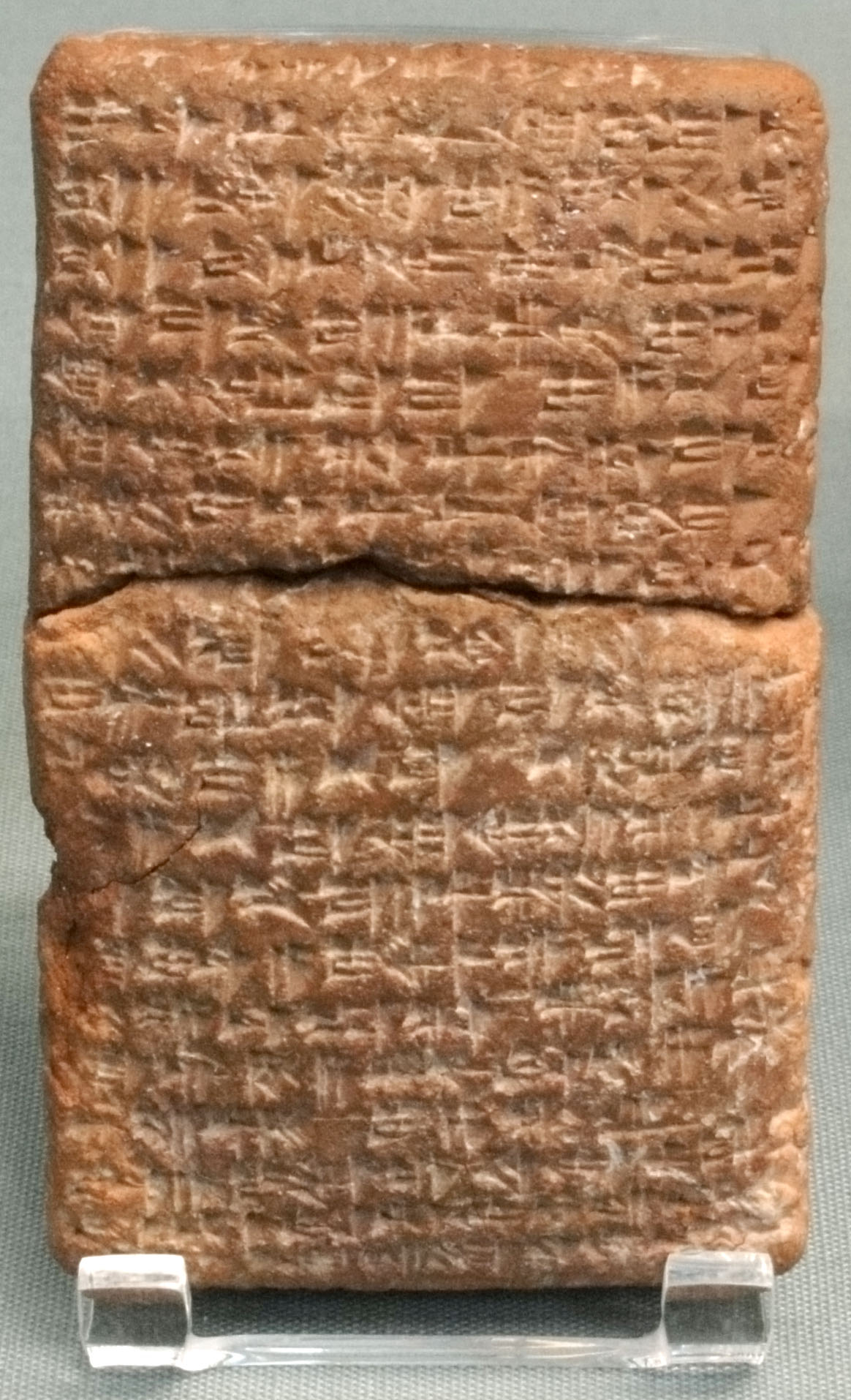
Fugitive slave treaty from 1480 BC
In my last post, I discussed the very difficult topic of slavery, an institution one cannot avoid in any study of our country’s history—indeed, of serious study of nearly any civilization. Though modern, reductionist history would blame the evils of chattel slavery (i.e., treating human beings as moveable property) solely on European colonization, beginning with Christopher Columbus, the institution existed as a fixture in Sumerian, Babylonian, and Egyptian cultures, as well as early South American and African societies.

So how does the practice of slavery touch the native peoples of North America, beyond the obvious influence of Columbus?

First, slavery was definitely practiced between native tribes, but not so much as an official institution as we understand from, say, the Civil War era. This excellent summary by author Christina Snyder explains it better than I could:

The history of American slavery began long before the first Africans arrived at Jamestown in 1619. Evidence from archaeology and oral tradition indicates that for hundreds, perhaps thousands, of years prior, Native Americans had developed their own forms of bondage. This fact should not be surprising, for most societies throughout history have practiced slavery. In her cross-cultural and historical research on comparative captivity, Catherine Cameron found that bondspeople composed 10 percent to 70 percent of the population of most societies, lending credence to Seymour Drescher’s assertion that “freedom, not slavery, was the peculiar institution.” If slavery is ubiquitous, however, it is also highly variable. Indigenous American slavery, rooted in warfare and diplomacy, was flexible, often offering its victims escape through adoption or intermarriage, and it was divorced from racial ideology, deeming all foreigners—men, women, and children, of whatever color or nation—potential slaves. Thus, Europeans did not introduce slavery to North America. Rather, colonialism brought distinct and evolving notions of bondage into contact with one another. At times, these slaveries clashed, but they also reinforced and influenced one another. Colonists, who had a voracious demand for labor and export commodities, exploited indigenous networks of captive exchange, producing a massive global commerce in Indian slaves. This began with the second voyage of Christopher Columbus in 1495 and extended in some parts of the Americas through the twentieth century. During this period, between 2 and 4 million Indians were enslaved. Elsewhere in the Americas, Indigenous people adapted Euro-American forms of bondage. In the Southeast, an elite class of Indians began to hold African Americans in transgenerational slavery and, by 1800, developed plantations that rivaled those of their white neighbors. The story of Native Americans and slavery is complicated: millions were victims, some were masters, and the nature of slavery changed over time and varied from one place to another. A significant and long overlooked aspect of American history, Indian slavery shaped colonialism, exacerbated Native population losses, figured prominently in warfare and politics, and influenced Native and colonial ideas about race and identity. [Indian Slavery, emphasis mine.]

Early in my study of the colonial era, I received the impression that the practice of enslaving Native Americans died out as the African slave trade gained momentum, but there is increasing evidence to the contrary.  One author’s study reveals that the slave trade among the Indians of the West was alive and well during the settlement and annexation of California. He also reveals how the Mormons found the same upon their arrival in Utah, and how attempts to “rescue” the victims of slavery only fed racial prejudice within Mormonism.

Cherokee delegation to Washington in 1866
A particularly startling aspect of the dynamics of slavery on native peoples surfaced in connection with the Cherokee and Seminoles, both of which were removed to Oklahoma Territory over the Trail of Tears. Apparently it was well known and accepted that many wealthy, landholding Cherokee owned black slaves, and took them along during the removal (see the quote above). Some Seminoles re-enslaved blacks who escaped to Florida, although it’s reported that their interpretation of slavery was more “fair” than that practiced to the north.

Time fails me to go deeply into any of these aspects, and I want to make it clear that as a historian and storyteller, I’m merely making observations, not offering a defense or pointing fingers in any way. In our own times, however, we must understand as much of the entire picture as possible. It is, after all, our mission here at Colonial Quills to educate about little-known aspects of our chosen span of history.

For more reading:
The Untold History of American Native Slavery (interesting site, with a ton of supporting and related articles)
America's Other Original Sin
... and just for fun, FACT CHECK: 9 Facts About Slavery


Monday, January 14, 2019

The Problem of Slavery

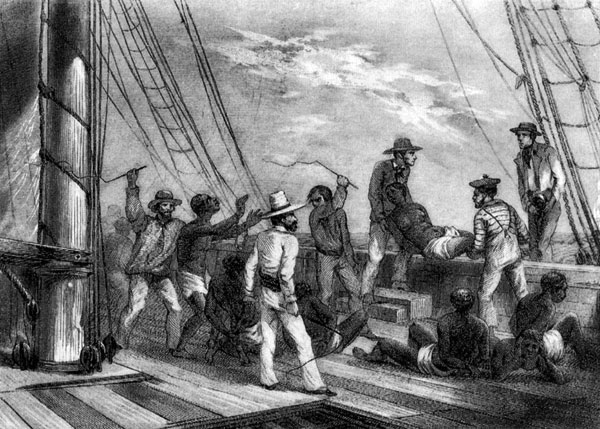
"Overboard," courtesy of the Bristol Radical History Group

Slavery. Just the word makes us cringe. Moderns very nearly lose their minds in the simplest of discussions over the subject, because of recent resurgence of racial tensions in our country. But for any student of colonial history—really, of any history at all—it’s absolutely unavoidable.

The first thing that comes to mind in relation to slavery is, of course, the American Civil War. I’m currently neck-deep in writing a story set right in the middle of the Civil War—which is still somewhat of a shock to me, since colonial America is still my favorite—but this means I’m having to grapple with the issue of slavery as never before. In considering how it relates to the colonial era, and all the problems we moderns tend to have even in merely discussing it, I’ve made some interesting observations about this terrible fixture of history.

To begin with, like many other aspects of history, slavery isn’t always taught in schools with the best of accuracy. Some are even under the impression that slavery actually originated with the European “invasion” of America. Well, not so. Slavery—the practice of forcibly taking and keeping human beings for profit, subjugation, or sacrifice—has been around nearly as long as humans themselves. The exact nature of slavery, or the purposes behind it, might have varied, but the practice most definitely did not start here in our country, or even with Europeans. Almost every major civilization practiced slavery of some kind of another, from the Romans to the Greeks and all the way back to the Egyptians and beyond, and then forward to our time, perpetrated as human trafficking or an act of war by extremist groups such as ISIS or Boko Haram.

Another problem of discussing such awful realities is a moral one, because we never want to appear that we’re condoning or justifying slavery in any form, but as historians we are obligated to acknowledge it as a very real cultural and societal force.

It was a strongly defining force in American history, for sure, as it was for many other nations. The case could be made that chattel slavery, the term simply used to refer to treating people as property, was first introduced to the Americas by Europeans, but slavery in various forms was certainly not a new thing to the native populations.

Christian slaves in Algiers, 1706
Slavery did, however, mean different things to different peoples. We tend to think of it in terms of permanence, with no way of escape or recourse in case of wrong, as was mostly the case of the American colonies (and later, specifically the South). But as I mentioned in previous posts, native customs of taking captives fell mostly into one of two categories: one, for vengeance, where many of these were killed as sacrifices, or two, in bereavement, where captives were adopted in place of deceased family members. It’s well documented, however, that both blacks and natives did practice chattel slavery, and at least one article discusses how many wealthy Cherokee took their black slaves along on the Trail of Tears. I uncovered so much on the various aspects of slavery during the colonial era that I’d like to take the next couple months to explore both its impact on native tribes, and abolitionist attitudes specific to the Revolutionary War. So—please stay tuned!

Monday, August 13, 2018

Who Were the Shawnee?


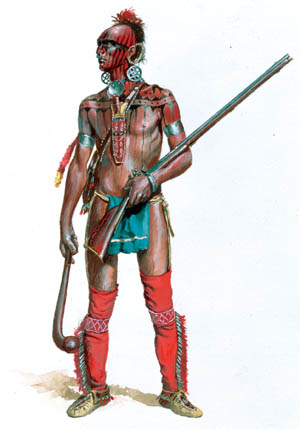
Artist's concept of a Shawnee warrior in the 1700's
Students of the colonial era are probably most familiar with the Iroquois Nation or the Cherokee, but the Shawnee were certainly a force to be reckoned with as well, especially when it came to settling the Ohio Valley. They have a bit of a reputation for fierceness, but—who exactly were they?

To begin with, the name “Shawnee” roots from a word that means “southerner” in many native languages. In the various migrations that occurred over North America, the tribe known as Shawnee were pushed southward by the Iroquois and settled for a while in South Carolina, eventually winding up as far south as Florida and Alabama. I found it interesting that there’s even a linguistic tie between Shawnee (Shaawanowi, from shawunogi—and understand that native spellings were as fluid as English ones in the time, mostly existing for the sake of capturing pronunciation) and the name Savannah, since according to at least one source that’s what the colonists of South Carolina called them. (Which is easy to see, if you soften the modern pronunciation and accent from emphasis on that hard short A in the second syllable, and consider how the Germanic V and W were often interchangeable.)

So who were the Shawnee, in the midst of other native tribes? Not only were they known as the “restless” people, with a loose social structure that probably evolved as a result of their wanderings, but they were known as proud, thoughtful, fiercely independent, in some cases shutting down the efforts of Christian missionaries before they could even get a good start. They regarded their own spirituality as superior to everyone else’s—including other native tribes, which is nothing new to human nature. William Penn, however, who took great care to treat native peoples with as much consideration and dignity as he would want shown himself, suggested that the Shawnee and others descended from some of the lost tribes of Israel. In addition to citing similarities to Hebrew in their language, he wrote:

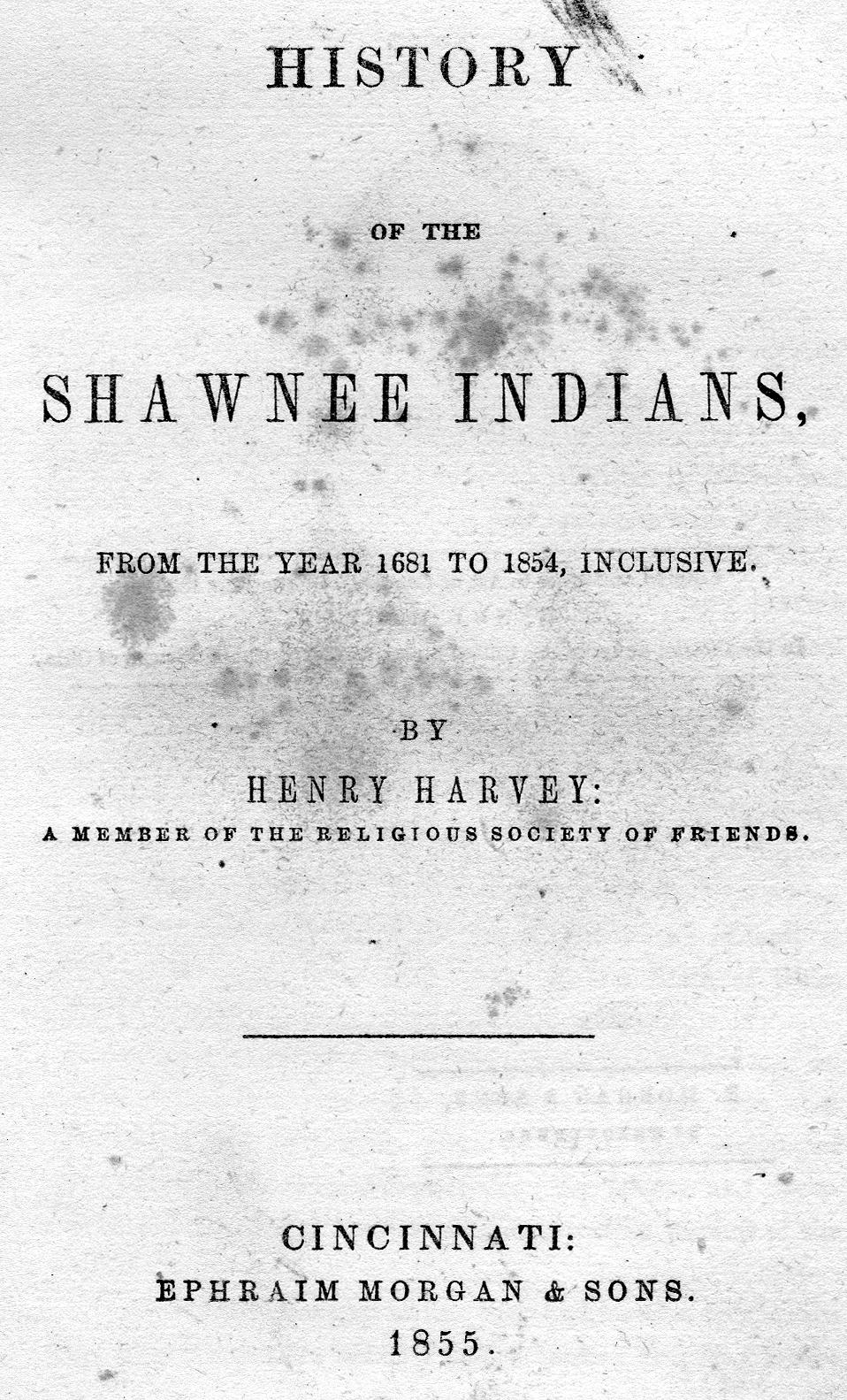
“For their original, I am ready to believe them of the Jewish race; I mean of the stock of the ten tribes, and that for the following reasons: First, they were to go to a land not planted or known, which to be sure, Asia and Africa were, if not Europe, and he that intended that extraordinary judgment upon them, might make the passage not uneasy to them, as it is not impossible in itself, from the easternmost part of Asia, to the westernmost part of America. In the next place, I find them of like countenance, and their children of so lively resemblance, that a man would think himself in Dukes’ Palace, or in Berry Street, in London, when he seeth them; but this not all: they agree in rites; they reckon by moons; they offer their first fruits; they have a kind of feast of tabernacles; they are said to lay their altar upon twelve stones; their mourning a year; customs of women, with many other things that do not now occur.” (History of the Shawnee Indians from the year 1681, to the year 1701, as cited by Henry Harvey)

Whether we also believe this could be true, or not, they were a remarkable people, a study as many native tribes were in contradictions but with their own code of honor that in some ways could be considered amazingly biblical. Flaws and admirable qualities alike, they are definitely a fascinating people!

~*~*~

For my upcoming release, The Cumberland Bride, set on the Wilderness Road into Kentucky in 1794, I did as much research on the Shawnee people as on the Wilderness Road itself, and found some great resources:

History of the Shawnee Indians, From the Year 1681 to 1854, Inclusive by Henry Harvey.

The Shawnees and the War for America, Colin G. Calloway.

Native American Tribes: The History and Culture of the Shawnee, by Charles River Editors

The Magic Moccasins: Life Among Ohio's Six Indian Tribes, Volume One, Delaware/Shawnee/Mingo, by Jane Barks Ross.


Monday, December 11, 2017

This Month in Colonial History: December


This is my last month bringing you the theme of “this month in colonial (and Federal) history.” Next month I have the joy and privilege of starting posts relevant to my upcoming release, The Counterfeit Tory in CQ’s long-awaited all-colonial novella collection, The Backcountry Bride (May 2018, Barbour Publishing). So, this month I’m going to do something a little different and add in events specific to the Southern Campaign of the American Revolution, particularly in South Carolina—some of which are featured in my novella, and one of which figures into my first full-length release coming in October.

Washington's Portrait, by Stuart
1 – Spanish garrisons driven out of Portugal in a nationalist revolution that will lead to Portugal’s independence. (1640)

1-19 – Continuation of “the Bloody Scout,” a six-week reign of terror by loyalist officer William “Bloody Bill” Cunningham and his men across the South Carolina backcountry, in retribution for the treatment of family and friends by the patriots. (1780) (This event forms the backdrop of my story The Counterfeit Tory.)

2 - Napoleon Bonaparte crowned Emperor of France. (Because that was an improvement on the French Revolution?) (1804)

3 - Birth of Gilbert Charles Stuart (1755-1828) near Narragansett, Rhode Island. Best known for portraits of George Washington, James Madison, James Monroe, and Thomas Jefferson.

4 - The Observer, now the oldest Sunday newspaper in the world, first published in Britain. (1791)

5 - Wolfgang Amadeus Mozart dies in poverty at age 35 in Vienna, Austria. (1791)

5 – Birth of Martin van Buren (1782-1862), the 8th U.S. President and first born a U.S. citizen, in Kinderhook, New York.

7 – Birth of Marie Tussaud (1761-1850) in Bern, Switzerland. Later famous for Madame Tussaud’s Wax Museum.

8 – Birth of Eli Whitney (1765-1825) in Westboro, Massachusetts. Assisted in his invention of the cotton gin by Caty Greene, widow of General Nathanael Greene.

9 – Birth of John Milton (1608-1674) in London.

10 – Birth of Thomas Gallaudet (1787-1851) in Philadelphia, Pennsylvania. Co-founded the American School for the Deaf in Hartford, Connecticut, in 1817.

12 – Birth of John Jay (1745-1829) in New York City. Diplomat and the first Chief Justice of the U.S. Supreme Court. With Alexander Hamilton and James Madison, he co-wrote the Federalist Papers.

13 - The Council of Trent, summoned by Pope Paul III, met to discuss doctrinal matters, including the rise of Protestantism. (1545)

13 - Francis Drake departed Plymouth, England, on his voyage around the world. (1577)

13 - New Zealand discovered by Dutch navigator Abel Tasman of the Dutch East India Company. (1642)

13 – Birth of Heinrich Heine (1797-1856) in Dusseldorf. “Best known for his statement made a hundred years before the advent of book-burning Nazis in Germany – ‘Where books are burned, human beings are destined to be burned too.’”

14 – The evacuation of the British from Charleston, South Carolina, after occupying the city for more than a year and a half. (1782)

14 - George Washington dies at Mount Vernon. (1799)

15 - The Bill of Rights takes effect following ratification by Virginia. (1791)

16 - Following the defeat of King Charles I in the English Civil War, Oliver Cromwell, leader of the Parliamentary forces, is declared Lord Protector of England. (1653)

16 - The Boston Tea Party! Colonial activists disguised as Mohawk Indians board British ships anchored in Boston Harbor and dump 342 containers of expensive tea into the water. (1773)

16 – Birth of Ludwig van Beethoven (1770-1827) in Bonn, Germany.

16 – Birth of Jane Austen (1775-1817) in Hampshire, England.

17 – Excommunication of King Henry VIII after he declares himself supreme head of the Church in England. (1538)

17 - The Continental Army, led by General George Washington, settles in for the winter at Valley Forge in Pennsylvania. (1777)

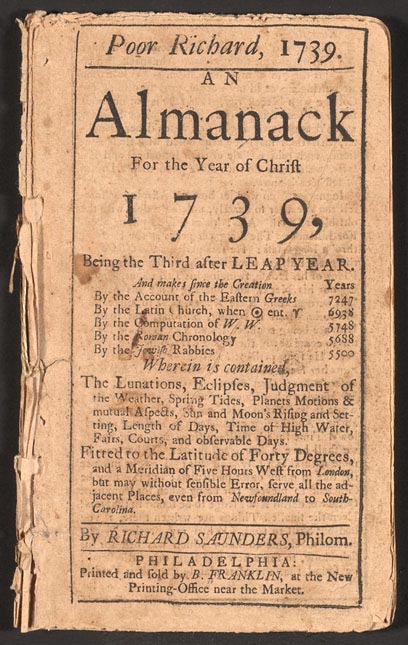
Poor Richard's Almanac
19 - Benjamin Franklin first published Poor Richard's Almanac containing weather predictions, humor, proverbs and epigrams, eventually selling nearly 10,000 copies per year. (1732)

19 – Birth of William Perry (1790-1855) in Bath, England. Famous for his Arctic expeditions and three attempts to find a Northwest Passage.

20 - The Virginia Company expedition to America began as three small ships, the Susan Constant, Godspeed and Discovery, departed London under the command of Captain Christopher Newport. (1606)

20 - Czar Peter the Great changes the Russian New Year from September 1 to January 1 as part of his reorganization of the Russian calendar. (1699)

20 – Attack on “Bloody Bill” Cunningham by General Andrew Pickens on the Edisto River, effectively ending “the Bloody Scout.” (1780)

22 – “Following a triumphant journey from New York to Annapolis, Maryland, George Washington, victorious Commander-in-Chief of the American Revolutionary Army, appeared before Congress and voluntarily resigned his commission.” (1783)

24 - Franz Joseph Gruber composed “Silent Night.” (1818)

24 – Birth of Benjamin Rush (1745-1813) on a plantation in Byberry, Pennsylvania. A signer of the Declaration of Independence, doctor, and humanitarian, whose writings on mental illness earned him the title “Father of Psychiatry.”

24 – Birth of Christopher "Kit" Carson (1809-1868) in Madison County, Kentucky.

25 - George Washington takes 2,400 of his men across the Delaware River for a surprise raid on 1,500 Hessians (German mercenaries) at Trenton, New Jersey. The Hessians surrendered after an hour, with nearly 1,000 taken prisoner by Washington, who suffered only six wounded. The victory provided a much-needed boost to American morale. (1776) (This incident figures into the backstory of my heroine’s father in The Cumberland Bride, releasing October 2018 from Barbour.)

25 – Birth of Isaac Newton (1642-1727) in Woolsthorpe, Lincolnshire, England.
Overlay of the Louisiana Purchase

27 – Birth of Johannes Kepler (1571-1630) in Wurttemberg, Germany. Considered the father of modern astronomy.

29 – Birth of Andrew Johnson (1808-1875), the 17th U.S. President, in Raleigh, North Carolina. Abraham Lincoln's vice president and President upon Lincoln's assassination in 1865.

30 - The Stars and Stripes flag raised over New Orleans as a sign of formal possession of the territory of Louisiana by the United States. (1803)

My thanks to The History Place, Holiday Insights, and the invaluable printed resource of Nothing But Blood and Slaughter: The Revolutionary War in the Carolinas by Patrick O'Kelley.

Monday, November 13, 2017

This Month In Colonial History ~ November

Welcome to this month's edition! Just one more month to go and then I'll be on to other interesting things ...

1 - Charles II of Spain dies and is succeeded by Philip V, kicking off the War of Spanish Succession. (1700)

1 - Mission San Juan Capistrano founded in California. (1776)

2 - Peter I proclaimed Emperor of all Russia. (1721)

Daniel Boone at age 84
2 - Birth of Daniel Boone (1734-1820) in Berks County, Pennsylvania.

2 – Birth of James K. Polk (1795-1849), 11th U.S. President, in Mecklenburg County, North Carolina. After serving from March 4, 1845 to March 3, 1849, he “declined to be a candidate for a second term, saying he was ‘exceedingly relieved’ at the completion of his presidency.”

3 - King Henry VIII is made Supreme Head over the Church of England. (1534)

5 - Guy Fawkes Day in Britain:  the anniversary of the failed "Gunpowder Plot" to blow up the Houses of Parliament and King James I in 1605.

5 - First issue of the New York Weekly Journal published by American printer and journalist John Peter Zenger. (1733)

8 - Cortes captures Aztec emperor Montezuma and thus conquers Mexico. (1519)

8 - Birth of astronomer and mathematician Edmund Halley (1656-1742) in London, who “sighted the Great Comet of 1682 (now named Halley's Comet) and foretold its reappearance in 1758. Halley's Comet appears once each generation with the average time between appearances being 76 years. It is expected to be visible again in 2061.”

10 - The U.S. Marine Corps is born in 1775! Established as part of the U.S. Navy, it became a separate unit on July 11, 1789.
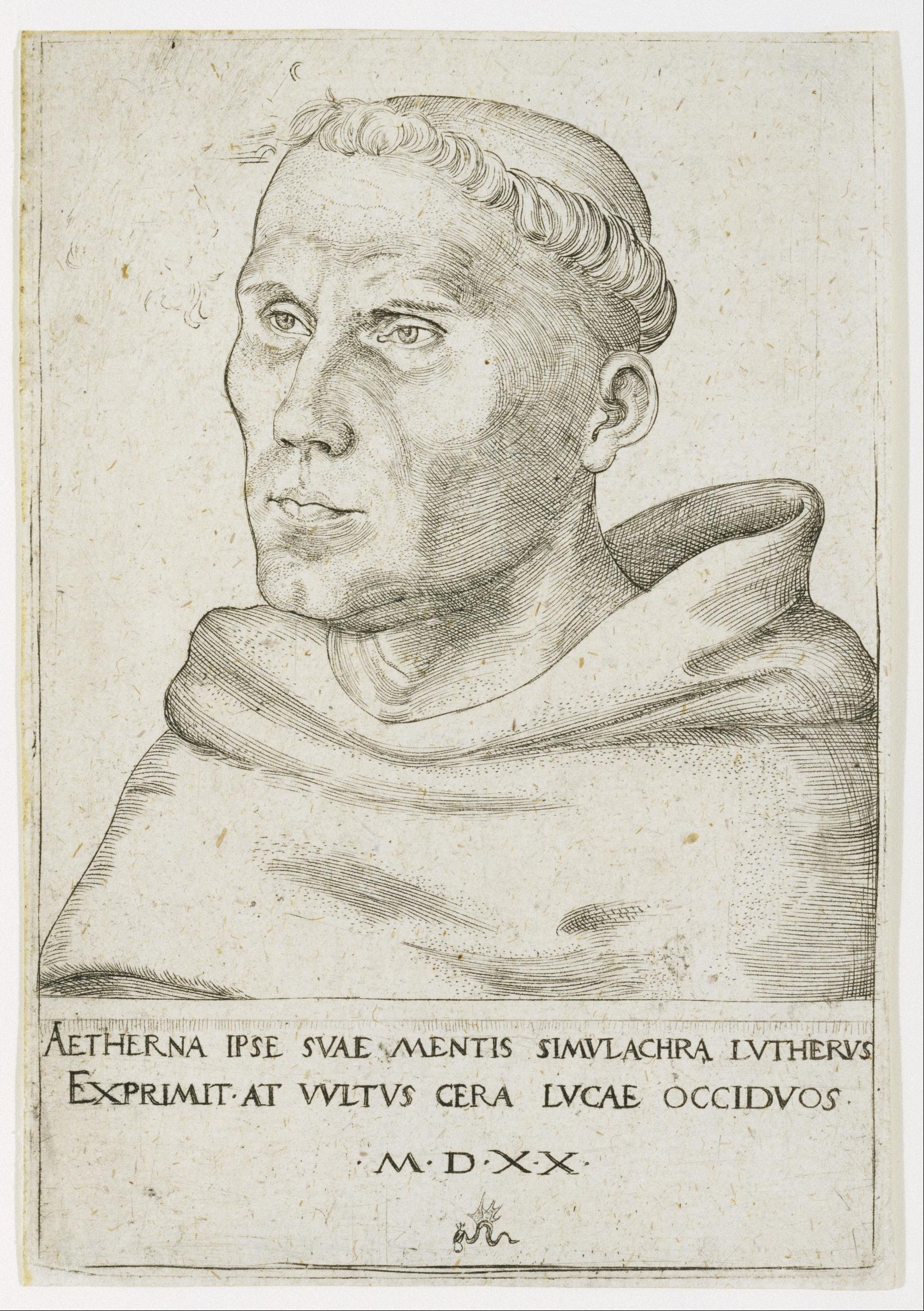
10 – Birth of Martin Luther (1483-1546) in Eisleben, Saxony.

11 - Birth of Abigail Adams (1744-1818) in Weymouth, Massachusetts.

11 – The signing of the Mayflower Compact by 41 Pilgrims, onboard the Mayflower, just off the Massachusetts coast. (1620)

14 - The first experimental blood transfusion takes place in Britain, utilizing two dogs. (...winning the weird science of the month award!) (1666)

14 - Scottish explorer James Bruce discovers the source of the Blue Nile on Lake Tana in northwest Ethiopia. (1770)

14 – Birth of Robert Fulton (1765-1815), inventor of the steamboat, in rural Pennsylvania.

15 - The Articles of Confederation were adopted by Continental Congress. (1777)

17 - Elizabeth I crowned Queen of England at the age of 25, “reigning until 1603 when she was 69. Under her leadership, England became a world power, defeating the Spanish Armada, and witnessed a golden age of literature featuring works by William Shakespeare, Edmund Spenser and others.” She defined the Colonial Era in ways few others have. (1558)

17 - New York Weekly Journal publisher John Peter Zenger is arrested and charged with libeling the colonial governor of New York, a year after the newspaper was established. (1734)

17 - The U.S. Congress meets for the first time in the new capital at Washington, D.C.; and President John Adams becomes the first occupant of the Executive Mansion, later renamed the White House. (1800)

17 - Birth of German mathematician August Mobius (1790-1868) in Schulpforte, Germany.

18 - First book in the English language, The Dictes and Sayengis of the Phylosophers, printed by William Caxton. (1477)

18 – Birth of German composer Carl Maria von Weber (1786-1826) in Eutin, Germany.

18 – Birth of Photography inventor Louis Daguerre (1789-1851) in Cormeilles, near Paris. Inventor of the daguerreotype, the first practical photographic process to produce lasting pictures.

19 - Puerto Rico discovered by Columbus during the second voyage to the New World. (1493)

19, 1703 – Death of the "Man in the Iron Mask," a prisoner of Louis XIV in the Bastille in Paris. Speculation abounds on this man’s identity:  was it Count Matthioli, who double-crossed Louis XIV, or possibly the brother of Louis XIV? (1703)

20 - New Jersey is the first state to ratify the Bill of Rights. (1789)

21 - The first free balloon flight takes place in Paris as Jean Francois Pilatre de Rozier and Marquis Francois Laurent d'Arlandes ascended in a Montgolfier hot air balloon. The flight lasts about 25 minutes and travels nearly six miles at a height of about 300 feet over Paris. Witnessed by Benjamin Franklin, among others. (1783)

22 - Portuguese navigator Vasco Da Gama, leading a fleet of four ships, is the first to sail round the Cape of Good Hope, searching for a sea route to India. (1497)

22 - Death of Edward Teach, AKA Blackbeard the pirate, off the coast of North Carolina after a long and prosperous career. (1718)

24 – Birth of Zachary Taylor (1784-1850) 12th U.S. President, in Orange County, Virginia. Only served as President from March 4, 1849 to July 9, 1850, when he died in the White House from illness.

25 – The last British troops leave New York City at the end of the Revolutionary War. (1783)

26 – Observance of the first American holiday, proclaimed by President George Washington to be Thanksgiving Day, a day of prayer and public thanksgiving in gratitude for the successful establishment of the new American republic. (1789)

26 - The first lion exhibited in America (1716)

26 – Birth of Harvard College founder John Harvard (1607-1638) in London.

27 – Birth of Anders Celsius (1701-1744) in Sweden. Inventor of the centigrade (Celsius) temperature scale commonly used in Europe.

28 - Portuguese explorer Ferdinand Magellan passed through the strait later named for him, located at the southern tip of South America, thus crossing from the Atlantic Ocean into the Pacific. (1520)
John Bunyan's magnum opus

28 - Panama declares independence from Spain and joins the fledgling nation of Gran Colombia. (1821)

28 – Birth of British artist and poet William Blake (1757-1827) in London.

28 - Birth of John Bunyan (1628-1688) in Elstow, Bedfordshire.

30 - The Battle of Narva takes place, where 8,000 Swedish troops under King Charles XII invade Norway, defeating a force of 50,000 Russians. (1700)

30 - Provisional peace treaty between Great Britain and the United States is signed, ending America's War of Independence. (The final treaty was signed in Paris on September 3, 1783.) It declared the U.S. "...to be free, sovereign and independent states..." and that the British Crown "...relinquishes all claims to the government, propriety and territorial rights of the same, and every part thereof." (1782)

My thanks as always to The History Place, Holiday Insights, Marine Corps University, and Wikipedia. :)