
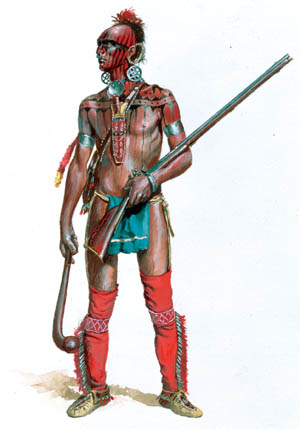
 |
| Artist's concept of a Shawnee warrior in the 1700's |
To begin with, the name “Shawnee” roots from a word that
means “southerner” in many native languages. In the various migrations that occurred
over North America, the tribe known as Shawnee were pushed southward by the
Iroquois and settled for a while in South Carolina, eventually winding up as
far south as Florida and Alabama. I found it interesting that there’s even a
linguistic tie between Shawnee (Shaawanowi, from shawunogi—and understand that
native spellings were as fluid as English ones in the time, mostly existing for
the sake of capturing pronunciation) and the name Savannah, since according to
at least one source that’s what the colonists of South Carolina called them. (Which
is easy to see, if you soften the modern pronunciation and accent from emphasis
on that hard short A in the second syllable, and consider how the Germanic V and
W were often interchangeable.)
So who were the Shawnee, in the midst of other native
tribes? Not only were they known as the “restless” people, with a loose social
structure that probably evolved as a result of their wanderings, but they were known
as proud, thoughtful, fiercely independent, in some cases shutting down the
efforts of Christian missionaries before they could even get a good start. They
regarded their own spirituality as superior to everyone else’s—including other
native tribes, which is nothing new to human nature. William Penn, however, who
took great care to treat native peoples with as much consideration and dignity as
he would want shown himself, suggested that the Shawnee and others descended
from some of the lost tribes of Israel. In addition to citing similarities to
Hebrew in their language, he wrote:
“For their original, I am ready to believe them of the
Jewish race; I mean of the stock of the ten tribes, and that for the following
reasons: First, they were to go to a land not planted or known, which to be
sure, Asia and Africa were, if not Europe, and he that intended that
extraordinary judgment upon them, might make the passage not uneasy to them, as
it is not impossible in itself, from the easternmost part of Asia, to the
westernmost part of America. In the next place, I find them of like
countenance, and their children of so lively resemblance, that a man would
think himself in Dukes’ Palace, or in Berry Street, in London, when he seeth
them; but this not all: they agree in rites; they reckon by moons; they offer
their first fruits; they have a kind of feast of tabernacles; they are said to
lay their altar upon twelve stones; their mourning a year; customs of women,
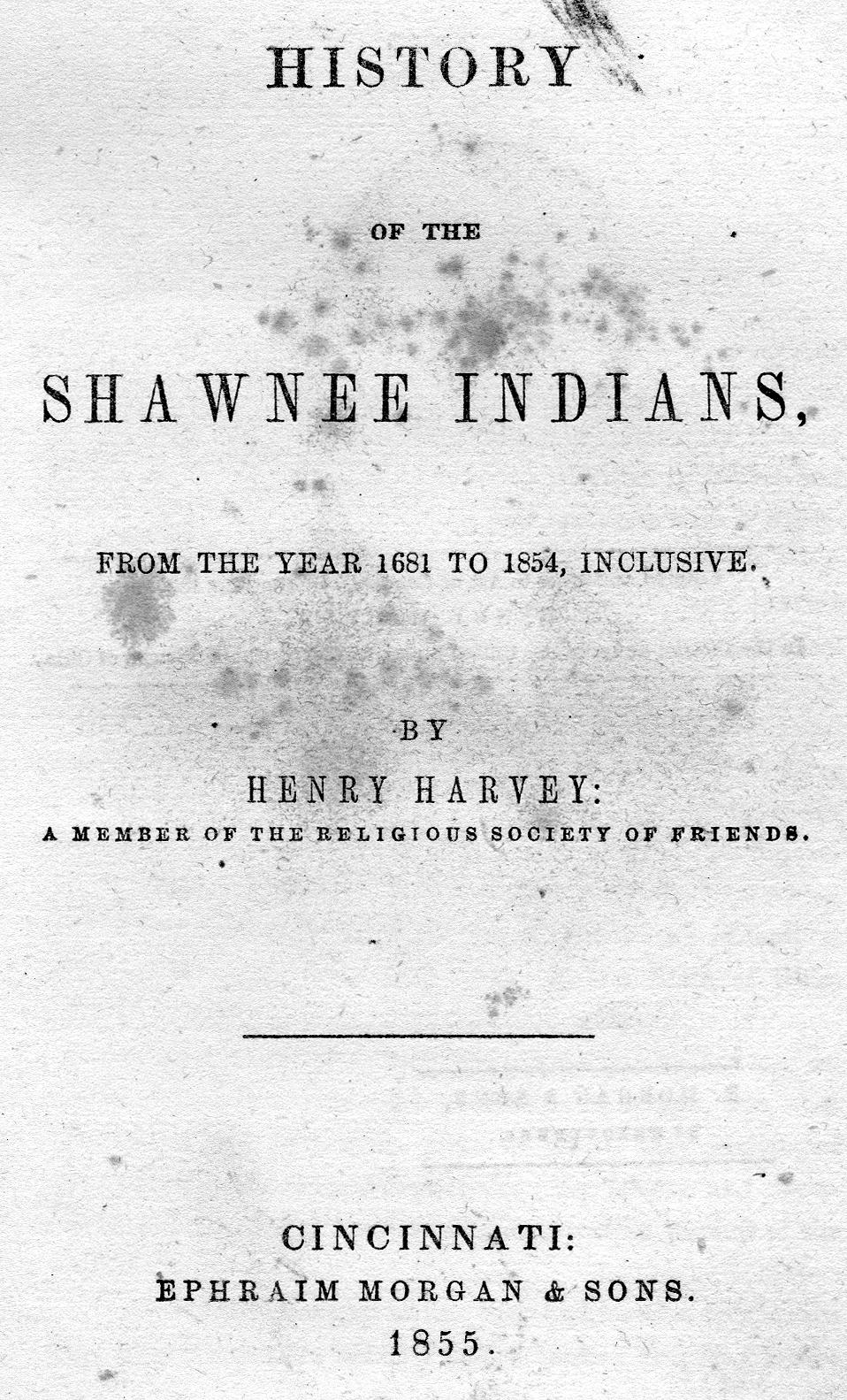
with many other things that do not now occur.” (History of the Shawnee Indians from
the year 1681, to the year 1701, as cited by Henry Harvey)
 Whether we also believe this could be true, or not, they
were a remarkable people, a study as many native tribes were in contradictions
but with their own code of honor that in some ways could be considered amazingly
biblical. Flaws and admirable qualities alike, they are definitely a fascinating people!
Whether we also believe this could be true, or not, they
were a remarkable people, a study as many native tribes were in contradictions
but with their own code of honor that in some ways could be considered amazingly
biblical. Flaws and admirable qualities alike, they are definitely a fascinating people!~*~*~
For my upcoming release, The
Cumberland Bride, set on the Wilderness Road into Kentucky in 1794, I did as much research on the Shawnee people as on the Wilderness
Road itself, and found some great resources:
 History of the Shawnee Indians, From the Year 1681 to 1854, Inclusive by Henry Harvey.
 The Shawnees and the War for America, Colin G. Calloway.
Native American Tribes: The History and Culture of the Shawnee, by Charles River Editors
The Magic Moccasins: Life Among Ohio's Six Indian Tribes, Volume One, Delaware/Shawnee/Mingo, by Jane Barks Ross.

