Announcements

10 Year Anniverary & New Releases Winners: Carrie Fancett Pagels' Butterfly Cottage - Melanie B, Dogwood Plantation - Patty H R, Janet Grunst's winner is Connie S., Denise Weimer's Winner is Kay M., Naomi Musch's winner is Chappy Debbie, Angela Couch - Kathleen Maher, Pegg Thomas Beverly D. M. & Gracie Y., Christy Distler - Kailey B., Shannon McNear - Marilyn R.
Showing posts with label historical fiction. Show all posts

Friday, April 1, 2022

A Little Remembering... A Little Prepping


I'm concerned. Concerned about the state of affairs internationally. Concerned about the lay of things within our own country. Concerned about where we are at spiritually and in the overall picture of things that God has had mapped out since time unfathomable.

We are not in a good place as far as the world goes, and we had better take notice, but I'm not about to go political (or quite theological) on you. Not so far as this post is concerned. But we are starting to experience supply-chain issues, inflation, and loss of production. This is leading me up to my decades-old curiosity about how things were done back in the day. Primarily I'm referring to storing food. These days some might consider me a (mild) prepper. Some might say I'm just using my common sense. Others might say, "We've been doing that since my great-grandpa fought in the Great War!"

I like to look back into the early years of American colonization and figure out how they did things back then and didn't all starve. Well, some did of course.

Let's have a look, and let's think about what we can do to stave off hardship during future shortages or simply times of personal hardship.
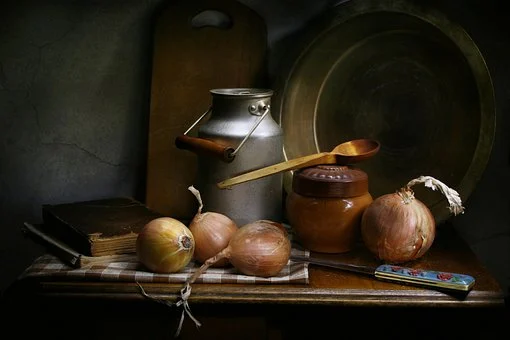

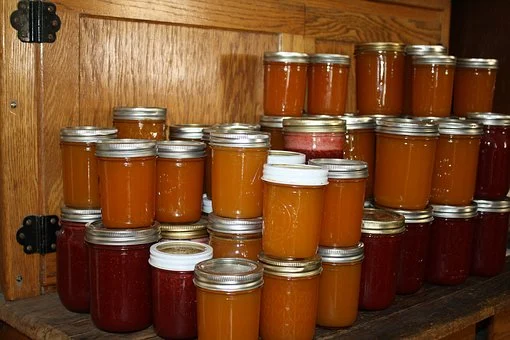
In early America, women were largely responsible for putting by. They were the ones who grew and gathered, then dried the herbs and vegetables, pickled the eggs, canned the fruit, stuffed the sausage, smoked the meat, rendered the fat, and so on. We think of having jams and jellies in our pantry as a luxury. They realized it was the best way to preserve fruit for winter--that and drying the food by spreading it in the sun, covered with a fine cloth to keep insects off, or else dried inside a slack oven. (That's an oven that's been heated and is cooling down.) I still haven't figured out how they kept mice and rodents out of their drying food or their smoked meat hanging from the rafters.
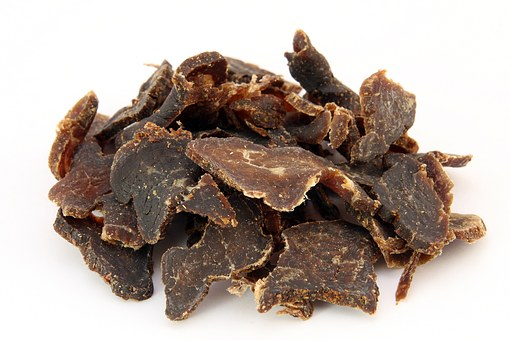

Speaking of meat, maybe you've noticed depleted meat departments in your local grocery store. I know I have. A couple weeks ago I went up to my local big name store and bought a huge pork tenderloin at a decent price. I brought it home, cubed up all but a normal roast-sized section, and canned it. I produced four quarts of pork out of that loin, plus one nice roast for the freezer. As I was canning, I popped the fat I'd trimmed off into a crockpot and rendered it so I'd have a little jar in the fridge for frying and greasing my bread pans.

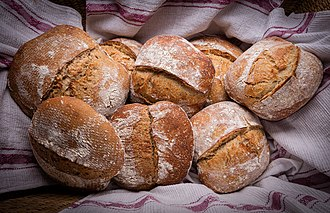
I've baked bread for years, but I've always depended on having yeast. I no longer expect to have it when I need it. So at my ripe age, my daughter-in-law is teaching me the finer points of baking with sour dough. The use of sour dough as a starter dates all the way back to ancient Egypt. Our average colonial housewife would have been quite adept at using it.

I've been putting up extra dry foods in canning jars with oxygen absorbers--things I saw run out on the store shelves in 2020 such as flour, oatmeal, dry beans, rice, potato flakes, and so on. Meanwhile I'll still plant a large garden and put up fruits and vegetables like I normally do.

Back in the day, even our American forefathers depended upon imports like molasses, spices, sugar, and rum for aiding in their food storage and preparation. Many on the frontier soon learned how to use maple sugar too. I've gotten away from a lot of sugar (not all, of course) as well as store-bought pectin when preserving. I've been enjoying more maple syrup and honey purchased from my neighbors. In those old days, people also use sugar in a process aptly called "sugaring" in which fruit was preserved by packing it in heavy syrup (sugar water). Meanwhile, other types of food such as cabbage, eggs, meats, and other vegetables could be pickled too. The pickling process also releases vitamin C which prevents scurvy. So eat your pickles! (I confess that recently I sat down with a plateful of pickled beets to enjoy while I watched a movie. Yummy!)

Learning about history isn't always just to help us picture the past, it's a way to give us knowledge and insight for the future--but of course you know that. Have you been going out of your way to "put by" a little extra lately?

Thinking back and planning ahead,

Naomi

www.naomimusch.com

Don't miss my three new releases in 2022! Each one nods to a different era from the past.

Monday, February 10, 2020

Criminals of Early America: the Harpes

Replica of the old jail in Danville, Kentucky
When studying historical figures, it's always interesting to try to figure out why people made the decisions they did. Some leave a clear enough record of their thoughts and feelings to give us at least an educated guess on their motivations. Others simply, as I state elsewhere, rise from the mists of history with no real clue to either their origin or inner workings of their mind.

With some of those, we really wouldn't want to see inside their minds, based on what we know of their actions.

The notorious Harpes are two such examples, in my opinion, billed as America's first known serial killers. It's a toss-up whether their criminal activities fit the serial killer mold or are better described as a murder spree, but regardless of what you call it, their thirst for blood and cruelty cast fear over the frontier for the better part of a year. Revenge killings, robbery, torture--they did it all, with no respect to age or gender.

Referred to as the Harpe brothers, Micajah (pronunciation up for grabs, based on phonetic spellings: Mi-CAY-uh or Mick-uh-juh/jer) and Wiley (often spelled Willey, so was it short for William? we may never know) were more likely cousins. They were often known as "Big" and "Little," Micajah being the elder and, of course, bigger, though Wiley was tall enough in his own right. Early records show the spelling of their last name as Harp, which may be short for Harper, their suspected birth name. Tradition and legend pegs them as sons of a pair of brothers who immigrated from Scotland, staunch Tories who lived in the North Carolina backcountry and probably participated in the Battle of Kings Mountain. I've observed elsewhere that if the boys were as young as estimated, then it's very likely that the brutality of partisan warfare, both during that battle and afterward, did imprint them with the cruelty they're later recorded as having indulged in.

Regardless of the reasons why, the end result was horrifying--two men whose respect for God and Scripture appears nominal and capricious at best, whose actions were defined more by a demonic enjoyment of inflicting pain than greed or even need.

They didn't even fit the profile of your usual highway robbers--men like Mason and his gang who chose piracy but took obvious pride in having a certain code of ethics. Robbery accompanied some of their murders, but certainly not all. A simple Google search reveals two-dozen-some websites which sketch many details of their misadventures, and most of which I list under sources for my upcoming release, The Blue Cloak. This story is best described as historical suspense meets true crime, with a thread of romance in the form of a fictional couple thrown together by the Harpes' reign of terror.

A particular area of interest for me as I researched the story was the plight of the Harpe women--two who were verifiably wives by law, and a third. All three women were heavily pregnant when the family surfaces on the Wilderness Road near Hazel Patch, Kentucky, in December 1798, and all three later gave birth in jail in Danville, Kentucky. By August 1799, only two of the three babies still survived. Many have condemned the women for not trying harder to get out of their situation, but I understood all too well the level of intimidation they must have been subjected to, how they surely felt they had no options while both men still lived.

Over the next couple of months, I want to look not only at how the justice system of the time dealt with such situations, but the possible, surprising link between the Harpes and a revival known as America's Second Great Awakening.

~~~

To read more: http://www.shannonmcnear.com/p/links.html

Friday, May 3, 2019

Pontiac and the Conspiracy that Shook an Empire

The French and Indian War, known also in Europe as the Seven-Years-war, was actually the fourth in a series of long and bloody clashes beginning in 1688 between European powers and their native American allies for control of a continent. The period from 1758-1763 we now call the French and Indian War followed King William’s War, Queen Anne’s War, and King George’s War. Collectively, they were known as the French and Indian wars.


In 1756 the most notable of these French and Indian Wars erupted. After six years of vicious fighting, the French abruptly abandoned many of their posts in the interior of the continent along the Ohio Valley and western Great Lakes. The swell of victory lay within England's grasp—except they did not realize that defeating the French did not mean the natives of that country would give up. Many tribes were not willing to hand over yet more of their ancestral lands to the Europeans for settlement and colonization.

Michilimackinac

Then emerged an Odawa leader who had fought alongside the French. His name was Pontiac, called Obwandiyag by the Odawa. He was born on a night of snow and rain, wind and thunder. It is said the elders of his tribe remarked that a great leader was being born. Little is known of his early life, but Pontiac grew to become an important war chief among the Odawa. He was furious when his French allies signed a treaty in 1763 handing over all their lands to the British. Pontiac believed that now the English would flood the country, building towns and pushing the Indians further off their ancestral lands. Pontiac believed the only way to stop this was for all the Indian nations to put aside their past disputes and join together to stop the English. He also hoped that the French would once again join in and help, for they had never shown the intense interest in colonization that the British did.


Indeed, he must have been a great leader and diplomat, for he brought together tribes that had been his peoples’ enemies for countless decades—the Huron, Shawnee, Munsee, Wyandotte, Seneca-Cayuga, Ojibwe, and Lenape—and convinced them that they must stand together against the English. The league of nations he gathered together became known as Pontiac’s Confederacy. In May of 1763, Pontiac’s Rebellion erupted with the siege of Fort Detroit and developed further as he began plucking off the British forts one by one, shaking the foundations of Britain's strength.

Pontiac's Rebellion (also called Pontiac's Conspiracy or Pontiac's War), however, was doomed to failure. In the autumn of 1764, the British military took the offensive, invading the Ohio Valley. Pontiac began to lose some of his followers. The British eventually resorted to negotiating with Pontiac to end hostilities, but the result was the exact opposite of what Pontiac hoped for, because it brought about a greater British military presence in the Ohio Valley and Great Lakes region. Pontiac was eventually assassinated by a Peoria warrior a few years later in the French town of Cahokia. Rumors have long circulated about his death.

I've long been interested in the history surrounding Pontiac's War. This coming November, 2019, will see the release of a new, 4-author, historical romance novella collection in which my story A TENDER SIEGE is set during Pontiac's War. The story follows one particular battle which I'll write about next time. Stay tuned here, and sign up for my newsletter for updates on that release.

You'll also want to stay in touch for a reminder about a FREE book download coming May 23-27 of my novel The Softest Breath, Echoes of the Heart, Book Two. (Book One is only $3.99) It's not a colonial era novel, but I hope you enjoy it. Mark your calendar!


Blessings for your May basket~ 


Monday, August 13, 2018

Who Were the Shawnee?


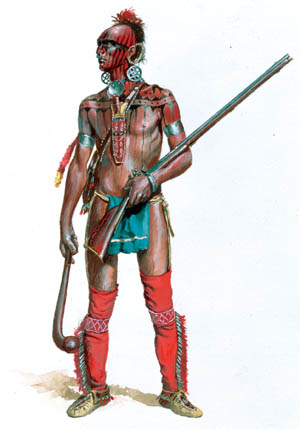
Artist's concept of a Shawnee warrior in the 1700's
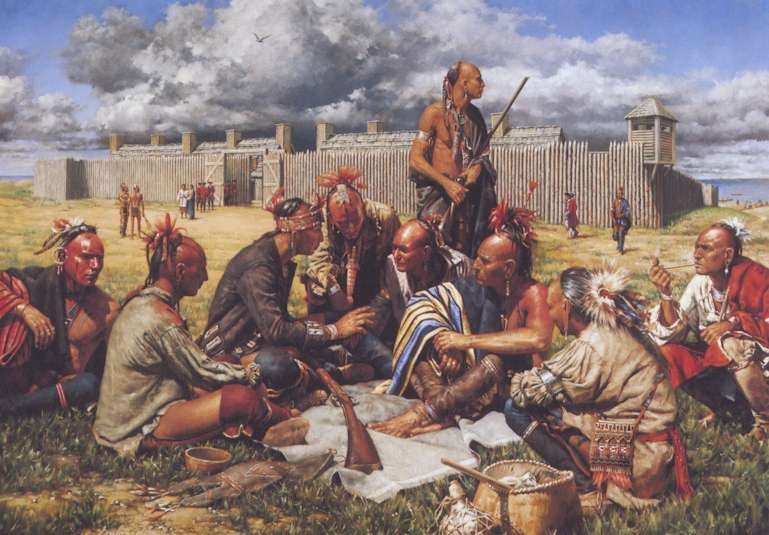
Students of the colonial era are probably most familiar with the Iroquois Nation or the Cherokee, but the Shawnee were certainly a force to be reckoned with as well, especially when it came to settling the Ohio Valley. They have a bit of a reputation for fierceness, but—who exactly were they?

To begin with, the name “Shawnee” roots from a word that means “southerner” in many native languages. In the various migrations that occurred over North America, the tribe known as Shawnee were pushed southward by the Iroquois and settled for a while in South Carolina, eventually winding up as far south as Florida and Alabama. I found it interesting that there’s even a linguistic tie between Shawnee (Shaawanowi, from shawunogi—and understand that native spellings were as fluid as English ones in the time, mostly existing for the sake of capturing pronunciation) and the name Savannah, since according to at least one source that’s what the colonists of South Carolina called them. (Which is easy to see, if you soften the modern pronunciation and accent from emphasis on that hard short A in the second syllable, and consider how the Germanic V and W were often interchangeable.)

So who were the Shawnee, in the midst of other native tribes? Not only were they known as the “restless” people, with a loose social structure that probably evolved as a result of their wanderings, but they were known as proud, thoughtful, fiercely independent, in some cases shutting down the efforts of Christian missionaries before they could even get a good start. They regarded their own spirituality as superior to everyone else’s—including other native tribes, which is nothing new to human nature. William Penn, however, who took great care to treat native peoples with as much consideration and dignity as he would want shown himself, suggested that the Shawnee and others descended from some of the lost tribes of Israel. In addition to citing similarities to Hebrew in their language, he wrote:

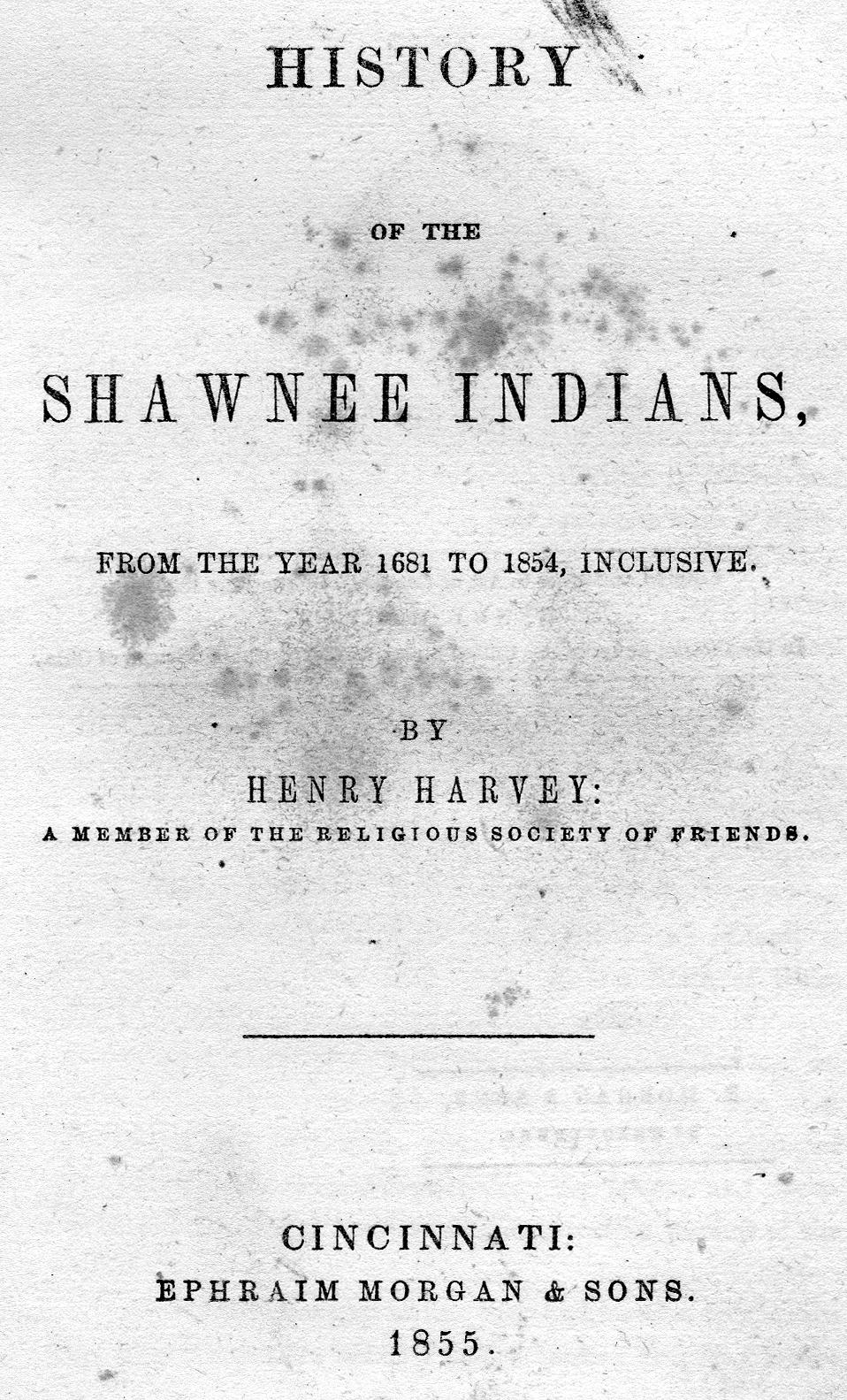
“For their original, I am ready to believe them of the Jewish race; I mean of the stock of the ten tribes, and that for the following reasons: First, they were to go to a land not planted or known, which to be sure, Asia and Africa were, if not Europe, and he that intended that extraordinary judgment upon them, might make the passage not uneasy to them, as it is not impossible in itself, from the easternmost part of Asia, to the westernmost part of America. In the next place, I find them of like countenance, and their children of so lively resemblance, that a man would think himself in Dukes’ Palace, or in Berry Street, in London, when he seeth them; but this not all: they agree in rites; they reckon by moons; they offer their first fruits; they have a kind of feast of tabernacles; they are said to lay their altar upon twelve stones; their mourning a year; customs of women, with many other things that do not now occur.” (History of the Shawnee Indians from the year 1681, to the year 1701, as cited by Henry Harvey)

Whether we also believe this could be true, or not, they were a remarkable people, a study as many native tribes were in contradictions but with their own code of honor that in some ways could be considered amazingly biblical. Flaws and admirable qualities alike, they are definitely a fascinating people!

~*~*~

For my upcoming release, The Cumberland Bride, set on the Wilderness Road into Kentucky in 1794, I did as much research on the Shawnee people as on the Wilderness Road itself, and found some great resources:

History of the Shawnee Indians, From the Year 1681 to 1854, Inclusive by Henry Harvey.

The Shawnees and the War for America, Colin G. Calloway.

Native American Tribes: The History and Culture of the Shawnee, by Charles River Editors

The Magic Moccasins: Life Among Ohio's Six Indian Tribes, Volume One, Delaware/Shawnee/Mingo, by Jane Barks Ross.


Monday, June 18, 2018

The Longhunters


One cannot read colonial-era stories for long without finding mention of the longhunters—or long hunters, depending upon the writer. But just who were these people?

Only known portrait of Daniel Boone during his lifetime (1820)
The era of the longhunter probably starts with the expedition led by Dr. Thomas Walker in 1750 along the frontier of Virginia, into what is now Tennessee and Kentucky by way of Cumberland Gap, who reported on a land of unbelievable richness, with buffalo and beaver and all kinds of other game whose hides and pelts brought a great deal of money out East, and in trade to England. It wasn’t long before various parties of men followed, venturing into the wilderness for “long hunts”—expeditions that, like Walker’s, could last from several months to more than a year. The most famous of the hardy (some might say foolhardy) men who set out on these hunts was Daniel Boone, but he was by no means the only one.

The era reached its peak during the 1760’s. Up until that time, politics between France and England, and resistance from native tribes, kept most from venturing west. Tensions were bad enough during the French and Indian War, and at the close of that conflict in 1763, King George made it essentially illegal to hunt west of the Appalachians without a trading license. The vast majority of hunters ignored his proclamation. One accounts says that Daniel Boone himself did not make his first trip west until 1769, after a visit by English trader John Finley, but others say his first long hunt was in 1750. I'm inclined to believe the latter. Boone’s adventures included capture by the Cherokee and Shawnee, having his pelts confiscated, probable adoption as a native, returning home after so long that his wife had given him up for dead, and the later loss of a son to Indian attack. None of this deterred him from making the hunting grounds his eventual home, and persuading others to join him there.

Other notable longhunters included James Harrod (for whom Harrodsburg, KY is named), Simon Kenton, Elisha Walden (also called Wallen/Walling, for whom Wallen’s Ridge at Cumberland Gap is named), Abraham and Isaac Bledsoe (yes, from the same real-life family I used in both Defending Truth and The Cumberland Bride), and Benjamin Cutbirth (almost certainly a mispronunciation and subsequent mispelling of Cuthbert).

1852 painting of Squire Boone Crossing the mountains
By the time the American Revolution ended, the heyday of the longhunter had passed. The unbelievable abundance of game across Kentucky and Tennessee had thinned considerably, probably less by hunting than pushed westward by the rising tide of settlers. And so the explorers and adventurers went further west, as well. In the process, the Boones and Bledsoes left a trail across Tennessee and into central Missouri of both place names and descendants.

More reading:

William Blevins, Long Hunter
Daniel Boone (and at Wiki)
Simon Kenton
Longhunters (at Wiki)
Bledsoe's Station in Tennessee


Friday, March 24, 2017

Author Interview with Pegg Thomas

Available in April of 2017, Pegg’s debut story, Embattled Hearts will be part of The Pony Express Romance Collection published by Barbour.

Alannah Fagan grew up learning how to take care of herself in the Kentucky wilderness. But when her mother’s death leaves her with a brutal stepfather, her only hope is escape. Together with Conn, her younger brother, she flees their westbound wagon train with no plan other than to survive. Stewart McCann is the middle son of a northern Virginia family with seven brothers. He moved west because he refused to take sides in the Civil War. But when a battered young woman and her brother take refuge at his Pony Express station, he finds himself in the middle of another type of battle. A battle for his heart.


Thank you for being with us today PEGG! I so enjoyed reading Embattled Hearts.

TR: What is your inspiration for Embattled Hearts?

PT: Thank you for hosting me!
I wish I had a really great answer for this, but I don’t. The story grew out of my research on the Pony Express. I knew I wanted to include the importance of the Pony Express in the Civil War effort. From there, it took turns I even I wasn’t expecting.

TR: Was there any traveling involved in your research, if so, where?

PT: In a backward sort of way. Horseshoe Station was located in an area of Wyoming I’d been through just a few years prior. I had some photos I’d taken, plus I found a hand-drawn picture of the station as it was in the 1860s.

TR: What was the most interesting or favorite thing you learned about the Pony Express?

PT: Most interesting in a weird sort of way was the original advertisement stating—right in print—that orphans were the preferred candidates for riders. Wow! Talk about transparency. You might not survive this, so if you’re an orphan, all the better.

TR: Do you have a favorite character?

PT: Absolutely, it's Cyclops. This horse is modeled—except for the one-eyed part—after my son’s first horse, Jason. He was an off-track thoroughbred, 16.2 hands, solid black, and one of the smartest horses I’ve ever known. I loved writing him into a story.

TR: Do you have a favorite scene?

PT: My favorite scene would be a spoiler. Here's one that tells a bit about the characters:

     If the blue-gray of her eye had been a lance, he'd be skewered to the wall behind the stove. That red hair of hers, wet and bedraggled as it was, warned of a temper loud and clear. He shook his head. What he knew about women would fit in a thimble and not crowd the finger. (Tweet This) Raised in a passel of boys on a remote tobacco plantation, he'd always thought of women as a foreign species. This one, however, looked more like a skinny grizzly bear with a bad grouch on.
     He stirred the mush until it bubbled and thickened, then set the frying pan on the table before scooping a pair of bowls and two spoons off the shelf. He also grabbed a pot of molasses. Maybe it would sweeten her up a bit.
     “Got any cream?” Conn's vivid green eyes held no animosity.
     Stewart grinned. The best way to a boy's heart was through his stomach. “Sorry.”
     Conn shrugged and filled his bowl. His sister remained behind the chair across the room, unmoved since she'd taken her post there. A blast of wind rattled the timbers that framed the cabin, followed by more ground-shaking thunder. She might relax if he left, but he wasn't about to go out in this storm.
     “Please, won't you sit and eat?” He pasted on what he hoped was a welcoming smile. Between her silent scowls and the threat of men coming after them, he'd be happy to see the pair ride off as soon as the weather cleared. But they had nothing to ride and apparently nothing to eat. Likely they didn't have a nickel between them either. He clenched his teeth to keep his smile in place.
     Her gaze flicked to the table and back to him, but she didn't move.
     What was he supposed to do? He couldn't make her eat. The way Conn slurped up the corn mush there wouldn't be any left if she didn't decide soon. She just stared at him. Then it dawned on him that he was staring at her. Oh. Maybe that was the problem.

TR: When did you first become interested in historical Colonial America? How has it impacted your writing? Do you usually blend factual historical events in with your fictional story

PT: I can’t remember ever not being interested in history. I remember visiting the Colonial Fort Michilimackinac as a kid and loving it. Since historical fiction is my favorite genre to read, it didn’t take any big leap to decide that’s what I wanted to write. And to me, historical fiction means there is real history in there. I’m always disappointed to pick up a book called historical fiction and find no historical content whatsoever.

TR: How important is it to you to have characters who live a godly life and a strong faith element woven within your storyline?

PT: My preferred story—mine or another author’s—is where the faith element is expressed in a very organic way throughout the story. I don’t like preachy writing. I don’t want to be beaten over the head with the Bible when I’m reading fiction. What I want to see is character growth and development, flawed characters who find their way to Christ, or hurting characters that find healing with Him.

TR: Just for fun question: Can you picture yourself and your horse, Trooper, speeding away from a Pony Express station across the wilderness toward the next Pony Express station? 

PT: My daredevil days are long behind me, and Trooper is now 25 years old. No, we don’t speed. We’re very happy just plodding along these days.

TR: What are you currently working on and when will it be released?

PT: I just finished In Sheep’s Clothing which is set in Colonial Connecticut Colony. My heroine is a spinner and weaver. The story takes place shortly after King William III signed the Wool Act. It will be published in the Bouquet of Brides Romance Collection in January of 2018.

TR: Anything else you would like to share?

PT: I do have some big news to share. I’ve accepted the Managing Editor position for Smitten, the Historical Romance imprint of Lighthouse Publishing of the Carolinas. It’s still a bit overwhelming, but I’m looking forward to the challenge. And I’ll still keep plugging away at my own stories too. That ought to keep me busy enough.  ;)

Readers can connect with me at:

Wednesday, February 11, 2015

Spinning Tales - Weaving a Novel

by Elaine Marie Cooper

Watching an expert spinster on a spinning wheel reminds me of how writers weave a story. Instead of using flax or wool to create yarn however, a writer uses words to form the sentences and chapters that, hopefully, will form a tale that draws readers to peruse the pages through the end.


A good writing desk is essential.


Proper illumination a must...


Toasty toes definitely makes the creative process a warmer experience.


And caffeine is a critical necessity.


Housework MUST be temporarily ignored ("What dust bunnies?")...


Colonial American music can be inspiring when writing about Colonial America...


...but not too loud.


Photos of  battlefields inspire visions of long again in autumn, when the forests were red and amber, and the scene not so peaceful.


Back then, the sounds of fife and drum were nearly drowned out by the blasts of cannon.


Yet in the midst of describing the horrors of war, love wove its way into the words and what seemed to be a story of death, was instead, birthed into a romance.

And thousands of words later, a tale of war is spun into a drama of affection, where love triumphs over hate. And a novel is born.


Elaine Marie Cooper is the author of Bethany's Calendar and Fields of the Fatherless. Please visit her website here


Wednesday, January 14, 2015

Laurel -- Susan F. Craft's New Historical Novel!

by Elaine Marie Cooper

I have been a fan of author Susan F. Craft since 2011 when I read her first Revolutionary War novel entitled, The Chamomile. I was completely swept away by the story as well as the intricate research that went into her debut novel. I anxiously awaited the release of the sequel, Laurel, which I am so pleased to say, is every bit as captivating as her first!

Her new novel releases this week and to celebrate, Susan is offering a copy to one of the commenters today at Colonial Quills. Without further ado, let me present Laurel.


What the story is about:


Desperate to rescue their kidnapped daughter, Lilyan and Nicholas Xanthakos trek two hundred miles through South Carolina mountains and backcountry wilderness, fighting outlaws, hunger, sleeplessness, and despair. When the trail grows cold, the couple battles guilt and personal shame; Lilyan for letting Laurel out of her sight, and Nicholas for failing to keep his family safe.

They track Laurel to the port of Charleston as post-Revolutionary War passions reach fever pitch.  There, Lilyan, a former patriot spy, is charged for the murder of a British officer. She is thrown into the Exchange Building dungeon and chained alongside prostitutes, thieves, and murderers. Separated from her husband, she digs deep inside to re-ignite the courage and faith that helped her survive the war.  Determined to free his wife at any cost, Nicholas finds himself forced back into a life of violence he thought he’d left behind.

Following a rumor that Laurel may be aboard a freighter bound for Baltimore, Lilyan and Nicholas secure passage on a departing schooner, but two days into the voyage, a storm blows their ship aground on Diamond Shoals. As the ship founders, both are swept overboard.

Will their love for each other and their faith sustain them as they await word of their missing child? Or is Laurel lost to them forever?


My review of Laurel:

The impeccable research of historical fiction author, Susan F. Craft, permeates every paragraph in the post-Revolutionary Era novel, Laurel.  The story of a young mother whose daughter is kidnapped, and the subsequent search, captivates a reader with both unforgettable characters and adventures that sweep a reader to another time and place. Craft is brilliant in her marriage of both fact and fiction, as she weaves a story that captures your attention from first page to last. Ms. Craft has a gift with her pen, creating words that are both breathtaking and beautiful.

I cannot wait for the third novel in the series entitled Cassia.


Author Bio:

Susan F. Craft writes historical romantic suspense. Her Revolutionary War novel, The Chamomile, won the Southern Independent Booksellers Alliance Okra Pick.  Susan recently retired after a 45-year career as a communications director, editor, and proofreader.  To assist authors to “get it right about horses in their works,” Susan worked with the Long Riders’ Guild Academic Foundation to compile A Writer's Guide to Horses that can be found at www.lrgaf.org. Forty-five years ago, she married her high school sweetheart, and they have two adult children, one granddaughter, and a granddog. An admitted history nerd, she enjoys researching for her novels, painting, singing, listening to music, and sitting on her porch watching the rabbits and geese eat her daylilies.  She has two post-Revolutionary War novels being released in 2015 by Lighthouse Publishing of the Carolinas—Laurel, in January, and its sequel Cassia in September. She is represented by Linda S. Glaz, Hartline Literary Agency.


Remember to leave a comment with your email address so that you can be notified if you are the winner of Laurel.