Announcements

10 Year Anniverary & New Releases Winners: Carrie Fancett Pagels' Butterfly Cottage - Melanie B, Dogwood Plantation - Patty H R, Janet Grunst's winner is Connie S., Denise Weimer's Winner is Kay M., Naomi Musch's winner is Chappy Debbie, Angela Couch - Kathleen Maher, Pegg Thomas Beverly D. M. & Gracie Y., Christy Distler - Kailey B., Shannon McNear - Marilyn R.
Showing posts with label Daughters of the Lost Colony. Show all posts

Monday, January 10, 2022

Yaupon tea: another small adventure in historical research


Some time back I wrote about my quest to find and try hyson tea, a variety popular during the colonial and Federal eras of our country's history (apparently Thomas Jefferson was a fan) and mentioned in the material accounts surrounding the Harpes. (It's good! Very much like other modern green teas.)

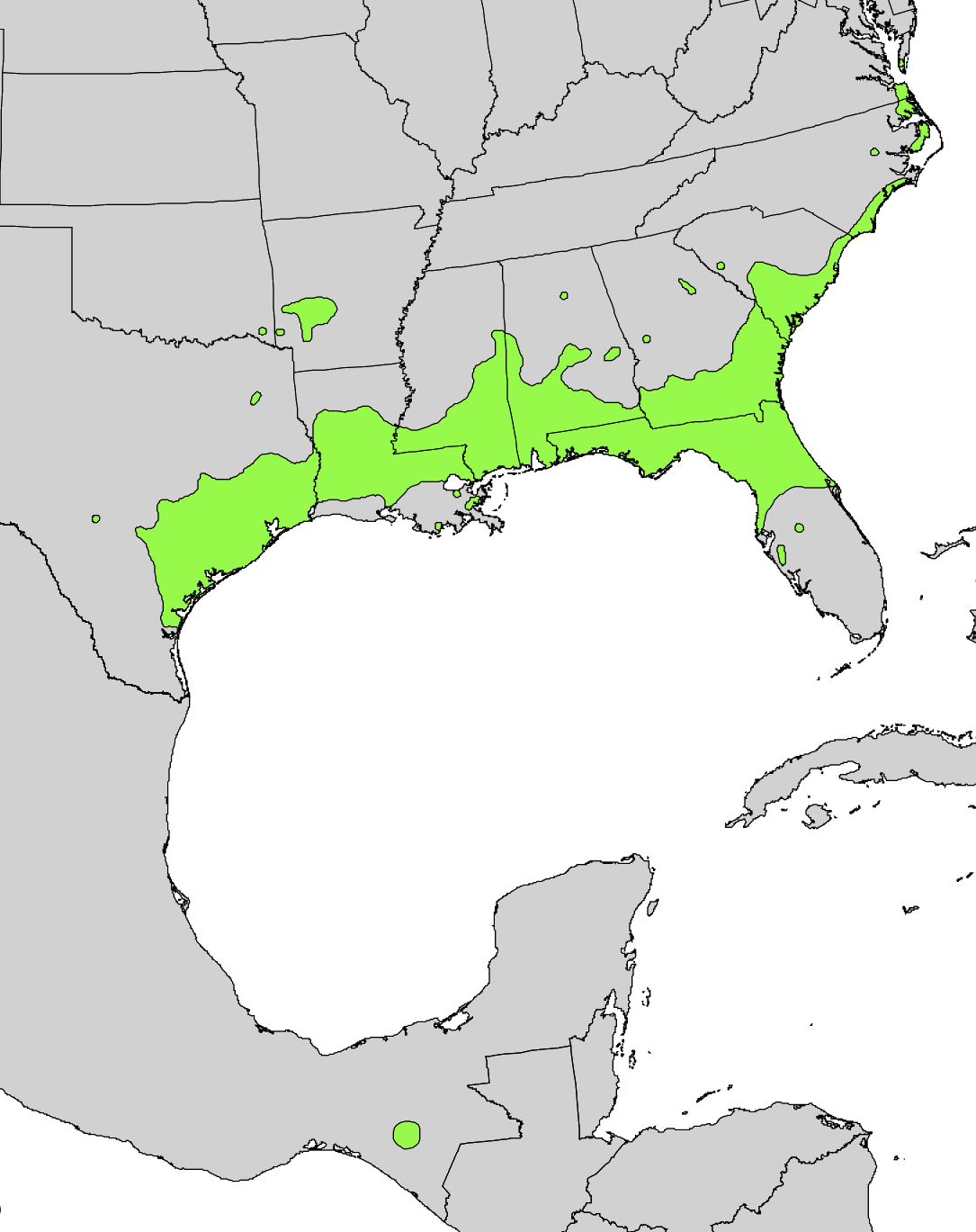
My latest research nerdiness led me to yaupon (YO-pahn), a type of holly which grows wild across the southern United States and the only known source of caffeine native to North America. The berries are poisonous (although by some accounts the native peoples would eat them after boiling for 8-9 hours) but the leaves were steeped and drunk for both social and ceremonial occasions.

(Photo credit: Wikipedia ... range distribution for yaupon)

Gift teas!
The plant would later be categorized Ilex vomitoria for its reputation as an emetic--native peoples would brew it for hours and drink it by the gallon as a stimulant and purgative. But prepared as a "normal" tea and consumed in smaller quantities, it's said to be packed with antioxidants, even more than traditional green teas. It's even rumored to help with high blood sugars and other health issues. At some point in my research months ago, I added a sampler pack to my Amazon gift list and then--forgot about it.

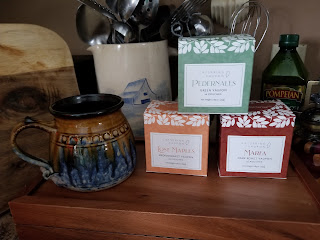
One of my dear daughters-in-law gifted me with the tea for Christmas, though, and so I was beyond excited to try it:  Yaupon by Catspring Tea in three varieties:  green, medium roast, and dark roast.

(Photo credit: mine)

Surprise! It really is as smooth as they claim. Because it doesn't contain tannins, it never develops that puckery taste and feeling black teas get from steeping too long. But warning--this is not a bedtime tea! A week or two ago I needed a cuppa to shake off an after-nap groggy feeling, and opted for the green tea (so far it's my favorite). Well, it was so efficient at banishing my sleepiness that I wound up being wide awake until well after midnight!

Yaupon may not be as high in caffeine as coffee (or so the websites say) but contains theobromine, a substance in chocolate. It's also one of those rare brews which tastes better as it ages!

So that's my experience with a now-obscure tea which was likely offered to English explorers and the Lost Colonists by their native hosts. It was almost certainly used as well in preparation for wartime and coming-of-age rites.

If you're interested in reading more about this staple beverage that once threatened the global tea trade, try any of these articles:


(Photo credit: Wikipedia ... Eastern bluebird feeding on yaupon berries)

Wednesday, December 15, 2021

Historical Christmas Party


All of us at Colonial Quills blog and Colonial American Christian Writers welcome you to our party! We also have a Facebook Event from 2-4 pm Eastern Time Wednesday, December 15, where you can show off your party gowns and interact with our authors even more! We're sharing that event with friends from the HHH blog, too, so one or more will join us in the afternoon! 


Shannon McNear

Greetings and salutations, gentle readers! I am so excited to get to share this story with all of you.

The daughter of a renowned English artist and explorer, Elinor White Dare journeys to the New World seeking a fresh start and a place to put down roots. What she finds will shake the very foundations of her faith and yet rebuild what she knows of God’s goodness and mercy, even in loss.

This "what if" historical explores the possible fate of the Lost Colony of Roanoke Island, the first attempt at English settlement in America, 20 years before Jamestown.

To celebrate the release of this novel, I am giving away a small "Reader's Retreat" gift bundle, with a signed copy of Elinor (or any of my other books of your choice) accompanied by an "adventure" journal, cranberry rose candle, and two other books by friends of mine, which I had signed at this past July's Mississippi River Readers Retreat. For a chance to win, please comment with your favorite place to curl up and read!

*~*~*~

Pegg Thomas

Merry Christmas!

I'm showcasing my newest release, Maggie's Strength, for today's party.

Maggie Kerr is a survivor. Taken captive at age eleven during the battle at Fort McCord, she's learned to adapt and to trust no one. Promised in marriage to a Huron warrior she fears, Maggie risks everything in a run for her freedom.

Content to ignore the rising animosity between the British and the Ottawa villagers he calls his friends, Baptiste Geroux plants his fields, limping behind his oxen and waiting for his brother to return from the west. Until the day a woman in danger arrives on his farm.

When more tribes join Pontiac in an all-out war, Maggie and Baptiste take refuge at Fort Detroit. He’s distrusted for being French. She’s scorned for being raised by the Hurons. Together they forge a fragile bond—until Maggie's past threatens their chance at happiness.
Follow me on my newsletter for updates and announcements! 

*~*~*~


Naomi Musch

Many happy returns of the season to one and all! I'm happy to hang out with you here today and over on the FB event page. My featured NEW book that releases in just a couple weeks is called Song for the Hunter, and I'm giving away a Kindle copy here on the blog.

30% off through Dec. 16 at the
publisher's site with the
code BESTFRIEND
Song for the Hunter is a sequel to my 2019 Selah and Book of the Year finalist Mist O'er the Voyageur. Here's a brief description of the story:

Métis hunter Bemidii Marchal has never played his flute to court a maiden but considers the possibility at Fort William’s Great Rendezvous. However, when rescuing his sister causes an influential man’s death, the hunter becomes the hunted. Bemidii flees to Lake Superior's Madeline Island. Carrying a secret, Camilla Bonnet travels into the wilderness with her husband where tragedy awaits. Left alone, she fears Bemidii but is forced to trust him. Friendship grows and turns to deeper feelings. Then Bemidii discovers more about the man he killed. Now the secret he hides might turn Camilla’s heart away—and demand his life.

You can read the first chapter on the publisher's site here: https://shoplpc.com/song-for-the-hunter/ or if you want to listen to me reading, you can hear the first few pages (not the whole chapter) on my Youtube channel: https://youtu.be/qtogfNVqTsQ

To enter for an e-copy of Song for the Hunter, just leave a comment about your Christmas plans--what you're excited about, what you're reading, your favorite food, anything! And don't forget to mention your interest in Song for the Hunter!

*~*~*~


Gabrielle Meyer

Merry Christmas, to one and all! I'm thrilled to be back at Colonial Quills sharing in the Christmas festivities. I can't wait to join everyone at the live Facebook party.

Today, I'll be chatting about my upcoming release, When the Day Comes. It will release on May 3, 2022 with Bethany House Publishers. Here's a little more about the story.

How will she choose, knowing all she must sacrifice?

Libby has been given a powerful gift: to live one life in 1774 Colonial Williamsburg and the other in 1914 Gilded Age New York City. When she falls asleep in one life, she wakes up in the other. While she's the same person at her core in both times, she's leading two vastly different lives.

In Colonial Williamsburg, Libby is a public printer for the House of Burgesses and the Royal Governor, trying to provide for her family and support the Patriot cause. The man she loves, Henry Montgomery, has his own secrets. As the revolution draws near, both their lives--and any hope of love--are put in jeopardy.

Libby's life in 1914 New York is filled with wealth, drawing room conversations, and bachelors. But the only work she cares about--women's suffrage--is discouraged, and her mother is intent on marrying her off to an English marquess. The growing talk of war in Europe only complicates matters.

But Libby knows she's not destined to live two lives forever. On her twenty-first birthday, she must choose one path and forfeit the other forever--but how can she choose when she has so much to lose in each life?

In honor of my new release, I would like to give away an advanced reader copy. They won't be available until February, but the winner will be one of the first to get a copy in the mail! I will choose a winner from among the comments on this blog post. Merry Christmas!

Be sure to follow me on Facebook and subscribe to my newsletter!

*~*~*~


Carrie Fancett Pagels 

Wishing you a very Happy Christmas, as my English ancestors would say! 

Did you know that at the end of my colonial novella, Mercy in a Red Cloak, there is a Christmas scene? This book, like my two 2021 releases Behind Love's Wall and Butterfly Cottage, is set at the Straits of Mackinac and on Mackinac Island! I do have an audiobook of Mercy in a Red Cloak, also, and will be giving away reader's choice of format, including audio code if preferred! And in 2021 my pre-War of 1812 book, Holt Medallion finalist The Steepchase, released in audiobook and I have audiobook codes for Christmas giveaway, too!


From all of us at Colonial Quills blog, we would like to thank you for your readership! You're a blessing to us and we pray our blog posts have blessed you as well!

The wreaths pictured in the post are from Colonial Williamsburg. We hope you'll allow us to serve you a cup of tea, or a cup of coffee or hot chocolate, and bring around some trays of Christmas treats for you to enjoy! 

The blessings of the season to you all!

Monday, December 13, 2021

Colonial History in the Caribbean: St. Croix Part 3 (another unexpected connection!)

by Shannon McNear

~*~*~

Some things are just too strange to be coincidence.

So this past summer, my husband's Air Guard unit took part in a joint exercise using St. Croix, part of the United States Virgin Islands, as its base. Someone came up with the idea of inviting spouses and/or family along, and thus I found myself flying out of country for the first time ever to a little island I didn't know I needed to visit.

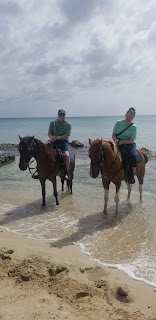
I'll admit, I don't really have a formal bucket list. But if I did, traveling out of country and then horseback riding on the beach would be two items on that list--and I was blessed to get to do both on this trip.

I've already covered two aspects of interesting colonial history associated with St. Croix, one connected with Denmark and one with our own Hamilton, but the one which got me most excited, and felt the most personal, was something I noticed while on that ride through the tropical forest on the island's west side.

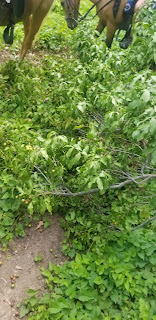
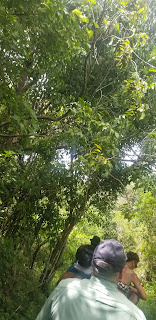
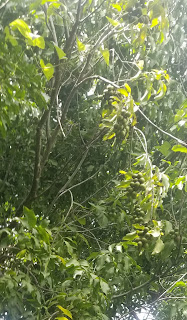
It was my first chance to go trail riding in years, and I was already geeking out over getting to be on horseback on a Caribbean island. Then, at a bend in the trail, I looked down and saw these little green apple-like fruits, growing on a small tree that had fallen alongside the trail.

A memory tickled, of an incident I'd read in John White's account of the Roanoke Colony's passage through the Caribbean.

And why were they passing through the Caribbean, you might wonder? I'm glad you asked. It's because during the Age of Exploration, seafaring men knew it was better to take advantage of ocean currents that swirl in a great, clockwise motion from the coast of Europe, southward past Spain and Africa, sweeping around to the Caribbean, and then northward again along the coast of the New World.

Ships often stopped at the various islands for provisioning. And so John White reports an incident that I allude to in my recently released novel Elinor:

The 22 [of June] we came to an anchor at an Island called Santa Cruz, where all the planters were set on land, staying there till the 25 of the same month. At our first landing on this Island, some of our women, and men, by eating a small fruit like green Apples, were fearfully troubled with a sudden burning in their mouths, and swelling of their tongues so big, that some of them could not speak. Also a child by sucking one of those women's breasts, had at that instant his mouth set on such a burning, that it was strange to see how the infant was tormented for the time: but after 24 hours it ware away of it self.

... In this Island we found no watering place, but a standing pond, the water whereof was so evil, that many of our company fell sick with drinking thereof: and as many as did but wash their faces with water, in the morning before the sun had drawn away the corruption, their faces did so burn and swell, that their eyes were shut up, and could see in five or six days, or longer. [They did later find a spring high on a rocky hill.]


A small fruit like green apples ... ? I piped up and asked the girl leading our ride what the fruits were, and she said, "Oh, that's manchineel, and they're poisonous!"


(Interestingly enough, the experience reported in this article mirrors John White's!)

Our guide went on to chat at little bit about this fruit you definitely want to avoid, and then went on to tell us that there was something else called a "ganip" that looked a bit like a small lime but was absolutely delicious. And before long, we ran across some.


At our guide's urging, we all collected a few. I hesitated--here I was, an adult of somewhat older persuasion and uncertain digestive sensitivity; would sampling this out in the wild be a mistake? But then I decided to take the risk. The skin was tender and popped easily when I bit the tiny fruit--about the size of a Scuppernong grape--and when I squeezed the juicy pulp into my mouth, it reminded me in texture and taste of something between a mango and a peach. There wasn't a lot of pulp surrounding the pit, but our guide was right about how good they tasted. I had several.

And fortunately, I never suffered any digestive distress, either.

A few articles about ganips:

https://en.wikipedia.org/wiki/Melicoccus_bijugatus

https://www.vinow.com/blog/nature/local-fruit-genips/

https://www.plantsandhealers.org/tropical-fruits-of-the-caribbean/

I wonder whether the English colonists thought they were getting ganips when they tried the manchineel?

But here was the thing. I'd completely forgotten whether John White had specified on which island this particular misadventure took place. But do you see it--Santa Cruz? That's the older name for St. Croix, the Spanish version of the name--and the people of the island still call themselves "Cruzan" after that name.

How cool to find that I'd walked shores where my Lost Colonists might have walked, ridden through a forest where they might have wandered.


Monday, March 8, 2021

John White: Artist For the New World and First Governor of Virginia

"The pictures of sondrye things," the inscription reads, "collected and counterfeited [copied] according to the truth in the voyage made by Sir Walter Raleigh knight for the discovery of La Virginea. In the 27th yeare of the most happie reigne of our Soveraigne lady Queene Elizabeth. And in the yeare of Lord God 1585."

These are the words and hand of John White, appointed first as professional artist and mapmaker to three separate voyages to the New World.


We know him best as first Governor of Virginia, the name given to territory claimed on behalf of the Virgin Queen, Elizabeth, but his first experience in the New World was in 1577, on an expedition led by Martin Frobisher to what is now known as Newfoundland. A single watercolor survives of that adventure, showing the English explorers under attack by Inuit warriors. One of those warriors, as well as an Inuit woman and child, were carried back to England and put on display. White sketched and later colored portraits of these unfortunate people, and I was delighted to find images of all in the online archives of the British Museum.

It has been commented that White not only portrayed the indigenous peoples of the New World with a realism uncharacteristic of the era, but with sensitivity and grace.

Don't you just love the face of the baby peeking out of his (her?) mother's hood?


In 1584 and 1585, White accompanied two other expeditions, both to Virginia. His map of the coast was remarkably accurate, by modern standards:


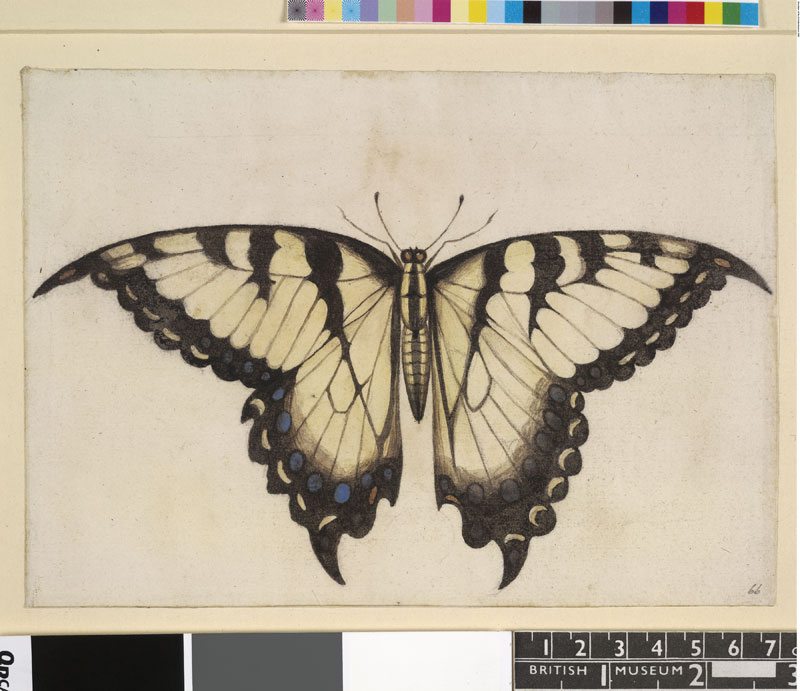
Dozens of his watercolor sketches also survive of various flora and fauna, presumably of England as well as the New World. The man had an amazing eye for detail, and the patience to reproduce it for the world to see.


Once again, however, it's his portraits of the people of the New World--of what would become North Carolina, here--that I find most arresting. Charged with "painting to life" the land and peoples, he did so, capturing faces and scenes from the Caribbean up through Florida as well as the dress and manners of the Carolina Algonquin peoples. In so doing, he provides the only view we have of this time and region.

He sketches and paints with so much realism, in fact, that it's somewhat problematic for modern sensibilities. This Algonquin woman, identified by White as "one of the wyves of Wyngyno," a weroance or chief of Secotan, stands in a pose that every woman ever will easily recognize. Thomas Harriot, a prominent scientist and mathematician who worked alongside White during the 1585 expedition, described it as "maydenlike modestye." Indigenous manner of dress accommodates the bare essentials of modesty, at least in summertime, but only barely. I can imagine what they must have thought of the English with their many layers! We know from their writings that the English regarded them to varying degrees as very much lesser peoples.

Interestingly, though, some--Harriot included--felt the Algonquin peoples had much to teach the English, not the least of all that they ate much more healthfully and without the excess the English were prone to. In his written account, A Briefe and True Report of the New Found Land of Virginia, first published in 1590 with woodcut prints of White's sketches, Harriot commented that the only area where they seemed deficient was their understanding of spiritual things, and told of his efforts to explain to them the basics of Christianity. He also speaks in scathing terms of those who went to the New World only to look for gold and silver and cared for nothing else, or who were of delicate upbringing and could not handle the primitive conditions of the New World.
For those who read my last post on our visit to Roanoke Island Festival Park, these next two prints illustrate what the park attempts to bring to life in their Algonquin life displays:

"The broyling of their fish over the flame of fier"


... and the town of Secotan, a coastal Algonquin community:


The complaint is made that Harriot's writings, and White's work as well, was only carried out with an eye to the economic feasibility of supporting an English colony in the New World, but both men could be credited with seeing the Algonquins as a people in their own right and worthy of respect and dignity, even when others did not.

For John White, this respect served him well as Governor of Virginia, however short-lived was his time there in 1587. We know from his own account how grieved he was to leave, and how intensely he desired his colonists to live with love and friendship with the Croatoan people and their neighbors.

For further study:


All images © The Trustees of the British Museum. Shared under a Creative Commons Attribution-NonCommercial-ShareAlike 4.0 International (CC BY-NC-SA 4.0) licence.

Monday, January 11, 2021

Researching the 16th Century: Fort Raleigh National Historic Site

In a year full of uncertainty and isolation, I was blessed to not only sign another book contract, but also do onsite research for the story. Daughters of the Lost Colony: Elinor is scheduled for a December 2021 release. This was not a story I expected to get to tell--but I am so excited to present it to y'all!

After writing already about the Lost Colony and where recent research indicates they went after leaving Roanoke Island, I'll be sharing more bits and pieces of the story: key players in the Lost Colony saga and maybe even some of the political aspects of the era.

But first, the setting itself.

An important part of research for me is to walk the ground where my characters walked, when possible. To get a taste of what a particular area might have looked, smelled, and felt like, especially in a historical context. So after my niece's wedding in July, near Boston, my daughters and I headed to the Outer Banks of North Carolina. My journey took me in reverse order from history, with Buxton on Hatteras Island being our first stop, but Fort Raleigh National Historic Site is properly the first location to be covered chronologically. It's where Ralph Lane of the disastrous 1585-86 expedition built an earthenworks fort, and where the 1587 expedition landed, originally just to check on the 15-some men left to hold an English presence in the New World but then temporarily settling there after being informed their navigator would take them no further. The actual site of the resulting village and its palisade fort is unknown, but archaeological research found the location of Lane's fort, and a reconstruction was commissioned in the 1950's.

Informational plackards at the site explain that it's obvious the fort would have been too small to shelter an entire settlement. The exact site of the village Lane and his men built then abandoned, and the 15 occupied for however long, is unknown, but that would be where the Lost Colony first took up residence, so I had fun imagining what this area might have looked like with a cluster of English cottages nearby. 


The ampitheater belonging to the modern-day Lost Colony drama production is also located here, so we poked about there as well. It provides a lovely view of the ocean, and the currently unused Elizabethan-inspired buildings added to the atmosphere of historical mystery. And of course the ever-gorgeous maritime forest of pine and oak possess a charm all their own!


Outside the entrance to the ampitheater lies the beginning of a walking trail, with paths leading down to the beach. We didn't have time for the whole route, but a side path led us to a spot where I wanted to linger and linger, overlooking Albemarle Sound. You can bet my imagination ran wild here!


It isn't hard to envision what those first English explorers might have seen when first setting foot here, how enchanted they must have been with the fragrance of the pines and the tallness of the trees, and how strange and yet a part of the forest the native people might have appeared . . .

And how those same people might have felt, seeing their first Europeans, with their equally strange clothing and armor . . .

To be continued!