Announcements

10 Year Anniverary & New Releases Winners: Carrie Fancett Pagels' Butterfly Cottage - Melanie B, Dogwood Plantation - Patty H R, Janet Grunst's winner is Connie S., Denise Weimer's Winner is Kay M., Naomi Musch's winner is Chappy Debbie, Angela Couch - Kathleen Maher, Pegg Thomas Beverly D. M. & Gracie Y., Christy Distler - Kailey B., Shannon McNear - Marilyn R.
Showing posts with label Shawnee Indians. Show all posts

Monday, September 10, 2018

Myths and Facts Surrounding Indian Captivity

When I started researching the experiences of white captives among native tribes, I’m not sure what I expected. Most of what I knew already was drawn from Calico Captive, a story based on real-life people during the French & Indian War, which painted a not-entirely-unflattering picture of native (and French-Canadian) life. Over the years I did gather that motivations for taking captive varied both depending upon the tribe, the times, and the individual. Some were taken captive as slaves (more on this in a later post), some for adoption into the tribe, and some for revenge and/or human sacrifice. And the treatment of captives varied dramatically depending upon the intended purpose for that captive.

Some myths I ran across as I researched:

Native Americans (“Indians”) were all brutal, ignorant heathens. Research has revealed that while their code of honor was different from ours, and seemingly random brutality often took place alongside seemingly random kindness, a sense of honor and high standard of behavior did indeed exist among native peoples.

Native Americans were all honorable, noble people whom whites of the time greatly misunderstood. Plenty of misunderstanding happened from both sides, but make no mistake, the code of honor and morality among native tribes clashed with Christian sensibilities in many ways. Greed, pride, pettiness, abuse, and all other human vices flourished among native peoples as surely as they did among European settlers.

White (or other) captives were always treated badly. Eyewitness accounts prove otherwise. When natives took captives intended for adoption, they treated said captives with remarkable kindness. Captives intended for slavery or sacrifice were a different matter entirely. The contradiction inherent in the kindness extended one or more captives in a group while brutality was dealt others still boggles the modern mind, but it happened often. One account I read told of a woman taken captive, heavy with child and a toddler in tow, after her older children had been killed and scalped before her eyes. While on the journey back to her captors’ home, the toddler was considered a liability at some point and also killed, but when the woman went into labor, accommodations were made for her delivery and recovery. Jonathan Alder witnessed the death of his older brother, but he himself was spared and eventually adopted by a Shawnee and Mingo couple. Jemima Boone (daughter of Daniel Boone) and her friend spoke after their recovery of the kindness of their captors, as well, which leads me to the next myth ...

Indians always rape female captives. Patently untrue. I’m sure there were exceptions, but in nearly all accounts I’ve read, there were strict rules about how and when native men took white captive women as their wives, in a culture where courtship and marriage seemed to be handled much more casually than in ours.

A couple of facts I learned:

While native peoples seemed to consider the killing of an enemy a light matter indeed, when they chose to adopt a captive, they usually accepted that one into their tribe and family with a whole heart. Once the adoption ceremony was complete—which often involved a protracted scrubbing-down and change of clothing—the captive was considered family, with no difference between him and a blood-born child.

Some captives returned to their old lives, but some did not, and were happy in that choice. (Whether such behavior constitutes Stockholm Syndrome, as some would suggest, is up for debate, and I won't get into that here. I'm only recording observations.) Alder lived some 20 years with the native peoples, after his capture at age 9. He did eventually return to white society, in a process that can only be described as a slow drift, for reasons that he never fully explains. His Indian wife grew unhappy with the changes and eventually left him, and a few years later he courted and married a white woman, and raised a family with her.

I’ve only scratched the surface here, but I’d love to hear more myths and facts as you think of them!

~*~*~*~
A pair of sources I've found helpful and/or interesting:

http://sites.rootsweb.com/~varussel/indian/index.html (Emory L. Hamilton’s unpublished manuscript Indian Atrocities Along The Clinch, Powell and Holston Rivers of Southwest Virginia, 1773-1794)

A History of JonathanAlder: His Captivity and Life with the Indians, edited by Larry L. Nelson, which I drew heavily from while researching for my upcoming release, The Cumberland Bride.

Monday, August 13, 2018

Who Were the Shawnee?


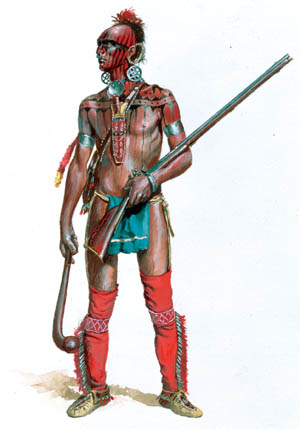
Artist's concept of a Shawnee warrior in the 1700's
Students of the colonial era are probably most familiar with the Iroquois Nation or the Cherokee, but the Shawnee were certainly a force to be reckoned with as well, especially when it came to settling the Ohio Valley. They have a bit of a reputation for fierceness, but—who exactly were they?

To begin with, the name “Shawnee” roots from a word that means “southerner” in many native languages. In the various migrations that occurred over North America, the tribe known as Shawnee were pushed southward by the Iroquois and settled for a while in South Carolina, eventually winding up as far south as Florida and Alabama. I found it interesting that there’s even a linguistic tie between Shawnee (Shaawanowi, from shawunogi—and understand that native spellings were as fluid as English ones in the time, mostly existing for the sake of capturing pronunciation) and the name Savannah, since according to at least one source that’s what the colonists of South Carolina called them. (Which is easy to see, if you soften the modern pronunciation and accent from emphasis on that hard short A in the second syllable, and consider how the Germanic V and W were often interchangeable.)

So who were the Shawnee, in the midst of other native tribes? Not only were they known as the “restless” people, with a loose social structure that probably evolved as a result of their wanderings, but they were known as proud, thoughtful, fiercely independent, in some cases shutting down the efforts of Christian missionaries before they could even get a good start. They regarded their own spirituality as superior to everyone else’s—including other native tribes, which is nothing new to human nature. William Penn, however, who took great care to treat native peoples with as much consideration and dignity as he would want shown himself, suggested that the Shawnee and others descended from some of the lost tribes of Israel. In addition to citing similarities to Hebrew in their language, he wrote:

“For their original, I am ready to believe them of the Jewish race; I mean of the stock of the ten tribes, and that for the following reasons: First, they were to go to a land not planted or known, which to be sure, Asia and Africa were, if not Europe, and he that intended that extraordinary judgment upon them, might make the passage not uneasy to them, as it is not impossible in itself, from the easternmost part of Asia, to the westernmost part of America. In the next place, I find them of like countenance, and their children of so lively resemblance, that a man would think himself in Dukes’ Palace, or in Berry Street, in London, when he seeth them; but this not all: they agree in rites; they reckon by moons; they offer their first fruits; they have a kind of feast of tabernacles; they are said to lay their altar upon twelve stones; their mourning a year; customs of women, with many other things that do not now occur.” (History of the Shawnee Indians from the year 1681, to the year 1701, as cited by Henry Harvey)

Whether we also believe this could be true, or not, they were a remarkable people, a study as many native tribes were in contradictions but with their own code of honor that in some ways could be considered amazingly biblical. Flaws and admirable qualities alike, they are definitely a fascinating people!

~*~*~

For my upcoming release, The Cumberland Bride, set on the Wilderness Road into Kentucky in 1794, I did as much research on the Shawnee people as on the Wilderness Road itself, and found some great resources:

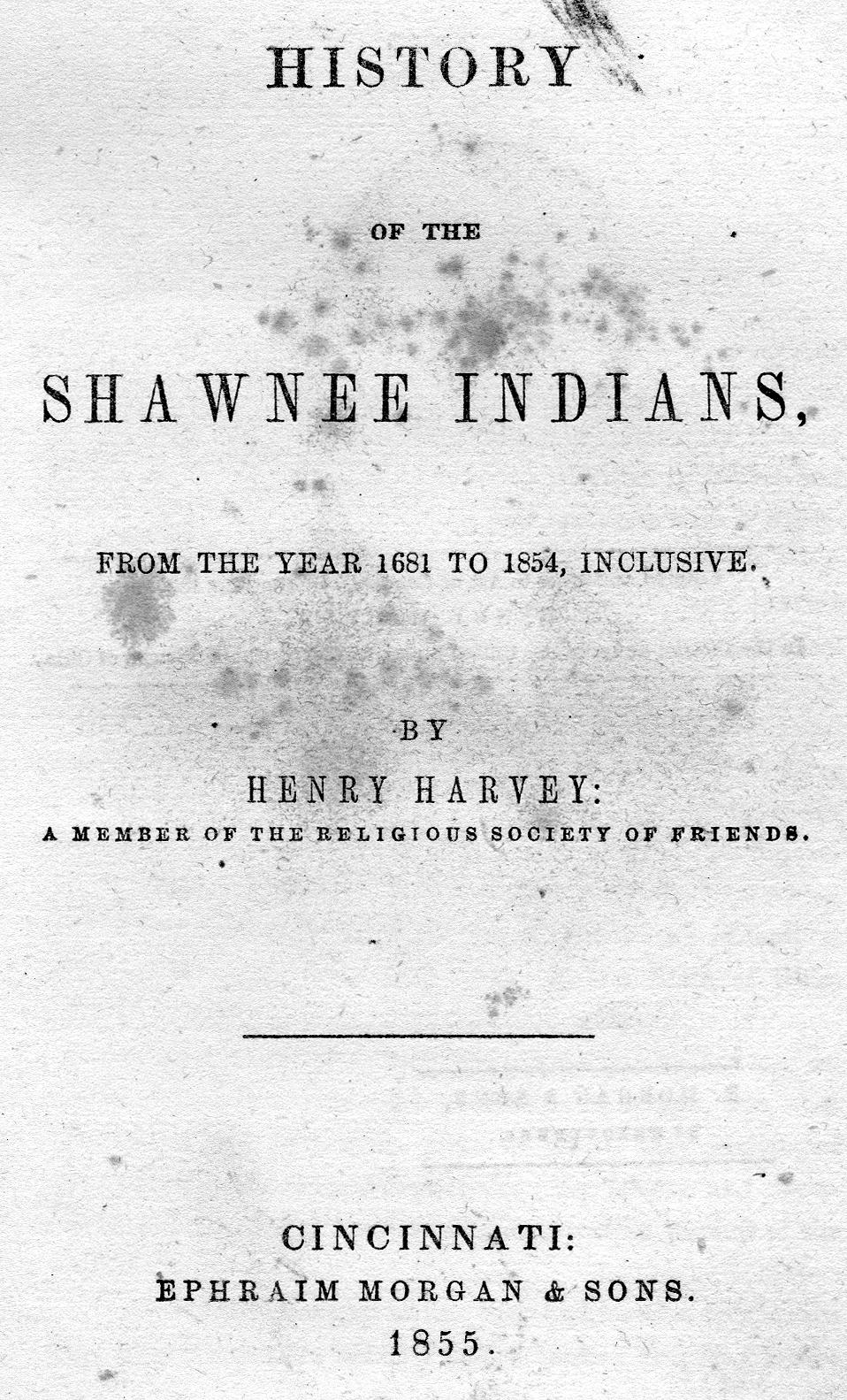
History of the Shawnee Indians, From the Year 1681 to 1854, Inclusive by Henry Harvey.

The Shawnees and the War for America, Colin G. Calloway.

Native American Tribes: The History and Culture of the Shawnee, by Charles River Editors

The Magic Moccasins: Life Among Ohio's Six Indian Tribes, Volume One, Delaware/Shawnee/Mingo, by Jane Barks Ross.


Friday, March 9, 2018

THE AMAZING JOURNEY OF MARY DRAPER INGLES

I forgot the housework, neglected needed sleep and sort-of supervised the youngsters. That was my experience many years ago when I first read James Alexander Thom’s Follow the River. The fictional account of the true story of Mary Draper Ingles capture and captivity by the Shawnee in 1755, and eventual escape and journey home was one of those books that was impossible to put down. This twenty-three-year-old woman’s story demanded I do further research to learn more about her.

The Ingles and Draper families migrated to and settled in Draper’s Meadows on the western frontier of the Virginia colony, what is now Blacksburg, Virginia. Mary Draper was only eighteen when she married twenty-one-year-old William Ingles.

On July 30, 1755, Mary was at their cabin with their two young boys and William was harvesting in the fields when Shawnee warriors killed or captured most of the inhabitants of Drapers Meadows. Mary, her sons and her injured sister-in-law Bettie were captured and forced to travel further west. Mary’s sons were taken from her and adopted into the Shawnee tribe and taken to another village. Bettie was given to a warrior and traveled to another site.

Mary and another captive referred to as “Old Dutch woman” traveled another one hundred miles to a Shawnee village west to current day Cincinnati, Ohio. The two women were given the latitude to roam about freely and search for food. Mary Ingles was respected among the tribe for her indomitable spirit and her skills as a seamstress. She made shirts for the natives.

Mary’s journey with the Shawnee Indians is noted by the red line,
her return east is noted with the blue line her return east.
attributed to: Blue Ridge Country Magazine
In October of 1755, the two women escaped under the guise of foraging for food. They headed off along the Ohio River on almost a five-hundred-mile journey back to southwest Virginia with only two blankets and a tomahawk. Their forty-three-day odyssey through treacherous wilderness and Mary’s eventual return home is spellbinding.  
Mary’s story doesn’t end there. She and William had several more children and moved to the New River near Radford, Virginia where they built a home, an inn, and operated a ferry crossing. Over a period of years, the Ingles searched and found one of their sons purchasing him from the Shawnee tribe. Will died in 1782 and Mary lived in their log cabin and operated the ferry until she died in 1815 at the age of eighty-three. Will and Mary Ingles descendants of still own and inhabit their land.


A bronze sculpture of Mary Draper Ingles
by sculptor Matt Langford stands in front of
the Boone County, Kentucky Public Library Main Branch. 
attributed to: Blue Ridge Country Magazine

Mary Draper Ingles story is a testament to the strength of the human spirit and the courage and fortitude of the women who helped settle our country.

Wednesday, February 12, 2014

The Amish in Colonial America

I was raised as a Mennonite by parents who grew up Amish, and I have a multitude of Amish relatives. With the continuing interest in this conservative denomination and the popularity of Amish romances, I thought it might be interesting to take a look at the origins of the Amish church in America, especially their main settlement in the mid 1700s, the Northkill Amish Church, named for the creek that wound through it.

Northkill Marker
For the past few years I’ve spent considerable time researching the lives of my Hochstetler ancestors for the novel a cousin, author Bob Hostetler, and I have coauthored, releasing March 1. Titled Northkill, the story focuses on the family of Jacob Hochstetler, whose farm came under attack during the French and Indian War. The story of the Hochstetler massacre is well known in the Amish and Mennonite communities, and a plaque marks the site of the farm where it happened, near present-day Shartlesville, Pennsylvania. We were determined to make our fictional depiction of this story as accurate as possible 257 years later, which meant not only doing intensive research, but also mentally, emotionally, and spiritually living in their time. Writing Northkill has been a fascinating and emotional journey, all the more so because as direct descendents of the story’s main characters we owe our very existence to them.

The Amish came to America because of severe persecution in Europe during the 16th and 17th centuries due to their insistence on believers’ baptism and opposition to military service. They were drawn to Pennsylvania by William Penn’s assurances of religious freedom and economic opportunity denied them in Europe. The Northkill Creek area in Berks County was opened for settlement in 1736, and that year a couple of Amish families settled there, with others following the next year. My great-great-great-great-great grandfather and grandmother, with two small children, were part of a group that landed at Philadelphia on November 9, 1738, aboard the ship Charming Nancy.

They soon joined other members of their church in the Northkill settlement 75 miles northwest of Philadelphia. Additional groups immigrated to the area in 1742, and again in 1749, when Bishop Jacob Hertzler arrived to provide leadership for the growing congregation. The earliest known organized Amish church in America, it included nearly 200 families at its height. It remained the largest Amish settlement in America into the 1780s, when it slowly declined as families moved westward in search of better farmland.

The Northkill settlement lay at the foot of the Blue Mountain, the legal boundary of English settlements according to treaties with the Native Americans. However, white settlers persisted in crossing the mountains into territory claimed by the French and their native allies. Hostilities finally broke out in 1754, with the French enlisting the Indians to attack the border settlements. During the French and Indian War over 200 settlers were killed in Berks County alone. The Indian attack against my ancestors’ farm early on the morning of September 20, 1757, was one of those horrific incidents.

On Monday, September 19, the Hochstetler family hosted an apfelschnitzen (apple cutting) frolic for the young people of the church. The youth traditionally stayed late into the evening to enjoy games and courting, but their guests finally left and the family went to bed. In the dark hours of Tuesday morning, the oldest son still living at home, Jacob Jr., roused when the family’s dog set up a clamor. When he opened the door, 17-year-old Jacob was shot in the leg by a member of a war party composed of Delaware and Shawnee warriors who surrounded the house.

The family managed to barricade themselves inside. Because the Amish hold fast to the commandment not to kill, Jacob made what must have been a truly wrenching decision that they wouldn’t shoot at their attackers despite the hunting rifles at hand and his sons’ desperate pleas. When the Indians set fire to the house, Jacob, his wife, three sons, and a young daughter were forced to take refuge in the cellar. During the terrifying hours that followed, they repeatedly beat out flaming embers while the house burned above their heads.

Artist's Depiction of Attack on Hochstetler Farm
At last dawn brightened the sky. Seeing through a narrow window in the foundation that the Indians had withdrawn and believing themselves safe, the family hurriedly forced their way out, barely escaping the flames. But one of the warriors, a young man called Tom Lyons, had lingered in the orchard to pick ripe peaches. When he saw them emerge from the blazing structure, he called the rest of the war party back, and they fell upon their defenseless victims.

The mother, the wounded son, and the young daughter were killed and scalped. Jacob and two sons, Joseph, 15 years old, and Christian, 11, were carried away into captivity. Their journey, described in a remarkable deposition preserved in the papers of British Colonel Henry Bouquet after Jacob’s dramatic escape, will be the subject of book 2 of the series, The Return. It will cover the captives’ lives among the Indian clans the French gave them to, Jacob’s harrowing escape and his efforts to find his boys, Joseph and Christian’s forced return home after the war, and their difficulty in assimilating into a culture they had largely forgotten, while reestablishing a relationship with the father whose decision had torn apart their lives.

The story of my ancestors is a deeply moving account of obedience, hope, and endurance, and of God’s unfailing faithfulness to His people even in the worst of trials. In the centuries since the attack, our family has been extraordinarily blessed. Jacob’s descendants have spread throughout the world and their accomplishments span a wide range of endeavors. My ancestors’ example daily inspires me to faithful discipleship, and my hope and prayer is that it will equally inspire readers in their walk with the Lord.

For more information, visit my Northkill blog.