Announcements

10 Year Anniverary & New Releases Winners: Carrie Fancett Pagels' Butterfly Cottage - Melanie B, Dogwood Plantation - Patty H R, Janet Grunst's winner is Connie S., Denise Weimer's Winner is Kay M., Naomi Musch's winner is Chappy Debbie, Angela Couch - Kathleen Maher, Pegg Thomas Beverly D. M. & Gracie Y., Christy Distler - Kailey B., Shannon McNear - Marilyn R.
Showing posts with label Southern Campaign. Show all posts

Monday, April 9, 2018

The Sieges of Savannah and Charleston, or How the British Left the Colonies

The Siege of Charleston, 1780
In 1779, the British turned their attention from New England and the northeast colonies to what is now termed the Southern Campaign—and they started with Savannah, Georgia. Having taken that in December, they moved north to Charles Towne—Charleston of today—and laid siege to it for six weeks before that mighty port city buckled.

After the surrender at Yorktown, the British forces hunkered down in Charleston and Savannah, but made no further move to withdraw. As Patrick O’Kelley says, “Though the war was near the end, the fighting continued. Old scores needed to be settled, and this had to be done while there was still a war going on. The British in Savannah and Charlestown had to find food for the soldiers and for the refugees huddled near the walls of the cities. The Patriots knew that the sooner they could get the British to leave the two cities, the sooner the war would end, so they opposed any foraging parties coming out of the cities. This led to some intense fighting in the last days of the war.”

The siege of Charleston lasted from 1781 until December 1782. The retaking of Savannah had begun in January 1782 when Major General Anthony Wayne made a bold push against the British in Georgia. The British, thinking they were outnumbered (though they weren’t, by far), fell back to Savannah, and though Wayne did his best to play up the fears of the British, they held onto that city until July.

Last page of the Treaty of Paris, 1783
In the meantime, Greene had his own troubles with troops becoming mutinous in the face of nakedness and hunger. William Moultrie describes how every scrap of cloth was needed to hang about men’s waists, and this in an age where a man was considered “undressed” if he didn’t wear a waistcoat over shirt and breeches. Another officer asked if soldiers could be expected to do their duty, clothed in rags and fed on rice. Even partisan leader Francis Marion, the famed “Swamp Fox,” grew so weary of the constant fight that after one incident in September, he refused to put any more of his men’s lives on the line, so close to the expected departure of the enemy. In one case he and his men even stood guard on behalf of a British foraging party, presumably as much out of compassion as anything.

On July 11, the British officially evacuated from Savannah. Troops headed for Charleston and New York. Many loyalist refugees eventually went south to Florida. The British would drag their feet getting out of Charleston until December 14. British regulars and loyalists dispersed not only back to Britain, but to the Caribbean and Nova Scotia. (Many of Tarleton’s Green Dragoons were given holdings in Nova Scotia, but it was a rather austere location.)

Map of US and territories after the Treaty of Paris
The day after the British fleet sailed from Charleston, the Maryland Line of the Continentals decided their enlistment was over, but Greene told them firmly that the war was not yet finished. That would not happen until the signing of the Treaty of Paris on September 3, 1783, but the fighting in the Carolinas had ended at last.

At least where the British were concerned. Tensions and conflict would continue with the native tribes for years to come. And having cut their losses in the American colonies, the British had already focused their meager energies elsewhere in the world. This marked the end, however, of the colonial era in United States history.

(My thanks as usual to O'Kelley for his excellent work, Nothing But Blood and Slaughter: The Revolutionary War in the Carolinas.)

Monday, March 12, 2018

"After the Surrender"

Last page of the Treaty of Paris
So, in October 1781, Cornwallis surrendered to Washington at Yorktown, Virginia, and the Revolution was over. Right?

Not quite.

It would be nearly three more years before the signing of the Treaty of Paris, formally ending the American War for Independence. And in the meantime, the partisan conflict that I discussed last month would continue to rage, especially in the Southern theatre.

In addition to the Bloody Scout (the name given for William Cunningham’s rampages during the late fall and winter of 1781), several other notable skirmishes took place. My best source focuses almost exclusively on the Carolinas, but the war continued to affect relations between people for many long years in other areas of the country as well. The British continued to foment uprising among the native tribes from forts held in the upper Ohio Valley, and those loyalists who preferred not to leave America had a tough struggle either to hold onto their lands or to make a way for themselves, often further west (Kentucky, Tennessee, Georgia) or even south (Spanish-held Florida).

Plenty of conflicts happened in the first year after the British surrendered, however. One incident involved the Chickamauga in Tennessee seeking to continue trading goods with the British, holed up in Savannah, Georgia, and fighting continued with the Cherokee. Others took place in North Carolina, in lingering clashes between loyalists and patriots. Still others happened at sea. And Cunningham made a few forays into the South Carolina backcountry, but none as widespread as before.

Finally, then, the Continental army grew impatient with the British presence in Savannah and Charleston, and laid siege to both in turn … but more about those in my next post. :-)

Monday, February 12, 2018

Nothing but Blood and Slaughter


The Battle of Guilford Courthouse, North Carolina
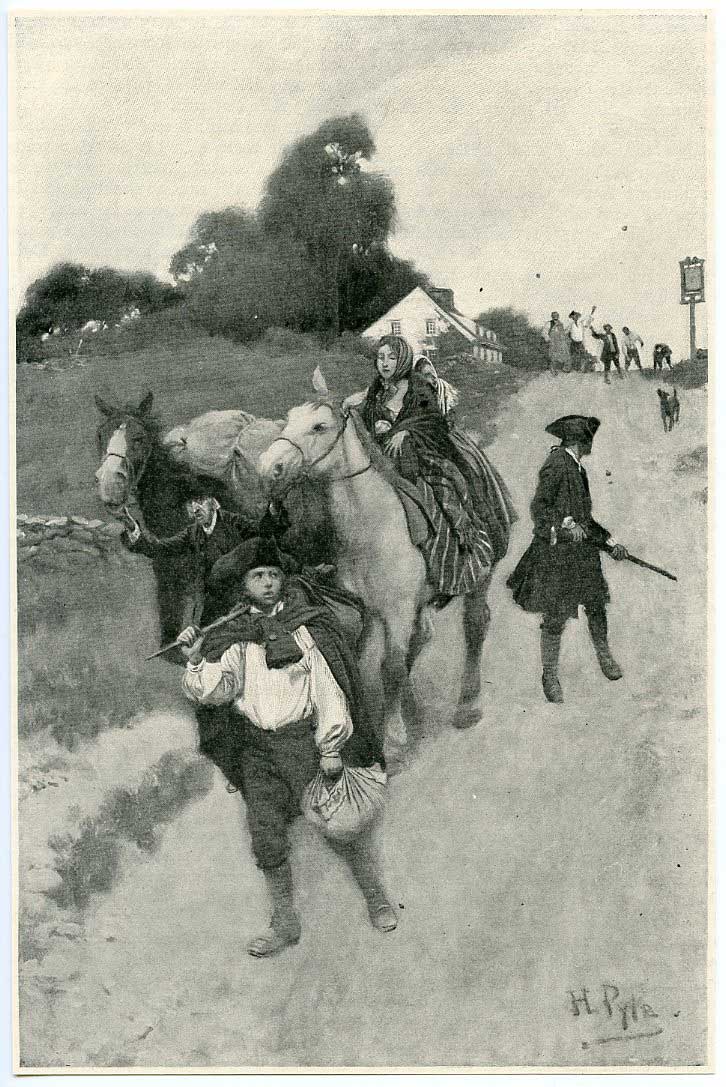
One cannot study the American Revolution for long before stumbling over the ugly reality of partisan conflict—family and neighbors divided by politics and loyalties and the necessity of war.

I say “necessity” because sides weren’t necessarily chosen by ideals, but whatever seemed best in order to protect one’s family and/or holdings. Sometimes it was a matter of whichever side offended a person the most, or how driven by vengeance one might be, as we saw in the case of William Cunningham.

Though the stance of the Tory has often been painted as that of a coward, often those who chose loyalty to the crown felt that rebellion was the coward’s
way, and irresponsible, if not outright ungodly. Scriptures such as Romans 13:1 seemed to them to point toward unconditional obedience to the king.

The Whigs, on the other hand, felt that King George overstepped his God-given authority. In fact, many of the Protestant groups, such as the Scots-Irish Presbyterians of the South Carolina backcountry, believed he was actually usurping the place of Christ in the Church, and for that reason alone should be resisted with utmost fervor. (Thus the Presbyterian Rebellion of 1780.) Add to that the insult of things such as the Stamp Act, which from the British perspective was merely to defray the mounting cost of defending the colonies from invaders (i.e., during the French and Indian War), and many saw the unrest in the colonies as a powder keg, ready to explode.

At the least, is it any wonder that in the absence of regional lines being drawn, as in the later War Between the States, the conflict turned so bitter between family and neighbors?

When the British launched the Southern Campaign from Savannah northward, they expected quick support and an easy quelling of the rebellion, but what they found was a mess of infighting and loyalties that swayed either way, depending upon the outcome of various battles. After the Siege of Charleston, however, they made a steady push into the Carolina backcountry that remained successful for a while, and were greatly encouraged by the complete rout of Continental forces during the Battle of Camden. General Horatio Gates of the Continental forces was later court-martialed for fleeing the battlefield, mostly ahead of his own troops, and General Nathanael Greene was given command in his place. When he arrived on the scene several months later, this normally unflappable former Quaker had this to say about the situation, and one can almost hear his exasperation:

Nothing but blood and slaughter has prevailed among the Whigs and tories, and their inveteracy against each other must, if it continues, depopulate this part of the country.

Greene’s concerns were well founded. At the least, the constant depredations from both sides led to much want and near famine. (And thus the title of one of my favorite resources on the Revolutionary War in the Carolinas.)

Tory Refugees by Howard Pyle
Such situations, where both sides devolve into mere taking vengeance back and forth, also make it very hard to delineate between a “right” side and a “wrong.” Patriotic Americans can appreciate afresh the freedom we enjoy while understanding at what bitter cost it came, and Christians can take it a step further and recognize that our country came to be, not necessarily by military strength or purity of cause, but by the very grace and mercy of God.

And I find it interesting, as a student of history, that not much has ever changed where human nature is concerned. Greene’s remarks about the partisan conflict in the Carolinas are echoed in the lyrics of a song from a much later, but similar conflict, this one between Catholic and Protestant in Ireland:

But centuries of hatred have ears that cannot hear.
An eye for an eye was all that filled their minds
And another eye for another eye till everyone is blind.
(“There Were Roses,” Tommy Makem)

Friday, January 26, 2018

Bloody Bill Cunningham, Terror of the South Carolina Backcountry

Artist's rendering of the Battle of Kings Mountain
Some time ago I wrote about Col. Banastre Tarleton of the British Legion, and how he might not have been the bad boy that so many accounts claim, but today I introduce a man who almost certainly deserved every bit of bad press he got.

Captain William Cunningham of the South Carolina backcountry was the son, nephew, and cousin to staunch loyalists at the beginning of the Revolutionary War, but being the strong-minded, contrary sort, he joined the rebel side. (That’s loyalist terminology for what we call patriots.) That lasted until first, Cunningham was refused a promotion he thought he deserved, and second, he was assigned to a location he didn’t care for. After his second attempt to resign from the Continental Army, he was court martialed for insubordination and sentenced to a whipping.

Sent home in disgrace and facing threats on his life, Cunningham fled to St. Augustine. Two years later, word reached him that patriot militia had turned his family out of their house, treating his aged father roughly and whipping his disabled brother so severely that he died. Furious, Cunningham returned to South Carolina on foot and went straight to the man responsible for his family’s suffering, Captain William Ritchie, where as the story goes, he shot Capt. Ritchie at dinner, in front of his family.

Afterward, Cunningham promptly joined the British cause. His exploits soon earned him the rank of major and later, captain, and he’s recorded as being present at the Battle of King’s Mountain. Notably fearless and an expert horseman, he was so much admired by his peers that even his enemies speak of him in tones of awe, decades later.

SC Districts from 1775 to 1784
The truly bone-chilling accounts, however, start just after the surrender of Cornwallis at Yorktown, which took place October 1781. Slipping past patriot patrols in small groups, after the British withdrawal to Charleston, Cunningham led a fairly sizeable band of men—anywhere from 80 to 300, and I lean toward the latter—on a series of raids against the patriot populace. This quickly became a campaign of vengeance on those who had committed the gravest offenses against the Tories or their families. The first incident happened at Turner’s Station on Cloud’s Creek in the upper Ninety-Six District, where Cunningham and his men surprised and surrounded a patriot force that had been harassing loyalists. A shot fired prematurely while negotiations were being made for surrender tipped Cunningham’s temper over the edge, and most of them were slaughtered.

His reign of terror over the South Carolina backcountry would later be referred to as the Bloody Scout, with the term “scout” referring to their roaming the countryside rather than a person. The moniker “Bloody Bill” would likewise not be coined until later, like Tarleton’s nickname of “Bloody Ban.” With Cunningham’s habit, however, of pinning down his enemies, then deliberately putting them to death with a singleminded fury that is legendary even today, he stands head and shoulders above Tarleton in infamy. No other figure is attributed with such habitual, wholesale slaughter, to my knowledge, and even the Waxhaws Massacre had its extenuating circumstances.

The Bloody Scout was more or less brought to a halt one frosty morning when a mounted force led by Andrew Pickens attacked one of the camps Cunningham had spread out over the banks of the Edisto River, and with the alarm raised, the other camps fled and dispersed, eventually making their way back to Charleston. There’s evidence of one more skirmish leading to slaughter not far from Charleston, which historians feel was likely the work of Cunningham, as well, but after that time his raids were never as effective as before.


This stretch of obscure RevWar history provides the setting of my next novella, The Counterfeit Tory, which releases May 1 as part of the CQ-authored Backcountry Brides Collection from Barbour. Jed Wheeler from The Highwayman returns on a mission to infiltrate William Cunningham’s troops in the hopes of bringing him down. The big question for Jed is, can he accomplish this without getting killed, himself?

[My thanks to Patrick O'Kelley for Nothing but Blood and Slaughter, his extensive work on every military action in the Carolinas during the Revolution; and to carolana.com, diceylangston.com, and Wikipedia for maps and cross-checking of facts.]

Monday, December 11, 2017

This Month in Colonial History: December


This is my last month bringing you the theme of “this month in colonial (and Federal) history.” Next month I have the joy and privilege of starting posts relevant to my upcoming release, The Counterfeit Tory in CQ’s long-awaited all-colonial novella collection, The Backcountry Bride (May 2018, Barbour Publishing). So, this month I’m going to do something a little different and add in events specific to the Southern Campaign of the American Revolution, particularly in South Carolina—some of which are featured in my novella, and one of which figures into my first full-length release coming in October.

Washington's Portrait, by Stuart
1 – Spanish garrisons driven out of Portugal in a nationalist revolution that will lead to Portugal’s independence. (1640)

1-19 – Continuation of “the Bloody Scout,” a six-week reign of terror by loyalist officer William “Bloody Bill” Cunningham and his men across the South Carolina backcountry, in retribution for the treatment of family and friends by the patriots. (1780) (This event forms the backdrop of my story The Counterfeit Tory.)

2 - Napoleon Bonaparte crowned Emperor of France. (Because that was an improvement on the French Revolution?) (1804)

3 - Birth of Gilbert Charles Stuart (1755-1828) near Narragansett, Rhode Island. Best known for portraits of George Washington, James Madison, James Monroe, and Thomas Jefferson.

4 - The Observer, now the oldest Sunday newspaper in the world, first published in Britain. (1791)

5 - Wolfgang Amadeus Mozart dies in poverty at age 35 in Vienna, Austria. (1791)

5 – Birth of Martin van Buren (1782-1862), the 8th U.S. President and first born a U.S. citizen, in Kinderhook, New York.

7 – Birth of Marie Tussaud (1761-1850) in Bern, Switzerland. Later famous for Madame Tussaud’s Wax Museum.

8 – Birth of Eli Whitney (1765-1825) in Westboro, Massachusetts. Assisted in his invention of the cotton gin by Caty Greene, widow of General Nathanael Greene.

9 – Birth of John Milton (1608-1674) in London.

10 – Birth of Thomas Gallaudet (1787-1851) in Philadelphia, Pennsylvania. Co-founded the American School for the Deaf in Hartford, Connecticut, in 1817.

12 – Birth of John Jay (1745-1829) in New York City. Diplomat and the first Chief Justice of the U.S. Supreme Court. With Alexander Hamilton and James Madison, he co-wrote the Federalist Papers.

13 - The Council of Trent, summoned by Pope Paul III, met to discuss doctrinal matters, including the rise of Protestantism. (1545)

13 - Francis Drake departed Plymouth, England, on his voyage around the world. (1577)

13 - New Zealand discovered by Dutch navigator Abel Tasman of the Dutch East India Company. (1642)

13 – Birth of Heinrich Heine (1797-1856) in Dusseldorf. “Best known for his statement made a hundred years before the advent of book-burning Nazis in Germany – ‘Where books are burned, human beings are destined to be burned too.’”

14 – The evacuation of the British from Charleston, South Carolina, after occupying the city for more than a year and a half. (1782)

14 - George Washington dies at Mount Vernon. (1799)

15 - The Bill of Rights takes effect following ratification by Virginia. (1791)

16 - Following the defeat of King Charles I in the English Civil War, Oliver Cromwell, leader of the Parliamentary forces, is declared Lord Protector of England. (1653)

16 - The Boston Tea Party! Colonial activists disguised as Mohawk Indians board British ships anchored in Boston Harbor and dump 342 containers of expensive tea into the water. (1773)

16 – Birth of Ludwig van Beethoven (1770-1827) in Bonn, Germany.

16 – Birth of Jane Austen (1775-1817) in Hampshire, England.

17 – Excommunication of King Henry VIII after he declares himself supreme head of the Church in England. (1538)

17 - The Continental Army, led by General George Washington, settles in for the winter at Valley Forge in Pennsylvania. (1777)
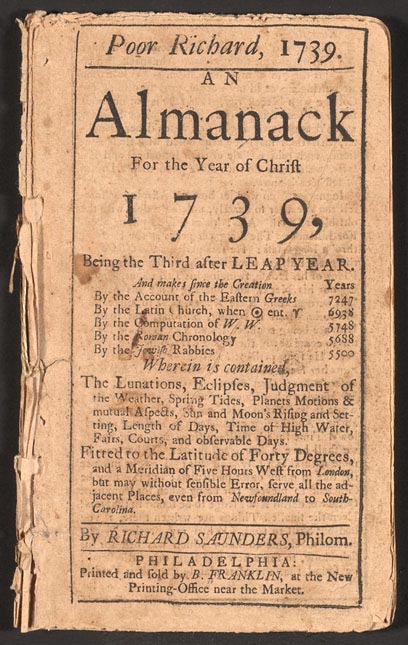
Poor Richard's Almanac
19 - Benjamin Franklin first published Poor Richard's Almanac containing weather predictions, humor, proverbs and epigrams, eventually selling nearly 10,000 copies per year. (1732)

19 – Birth of William Perry (1790-1855) in Bath, England. Famous for his Arctic expeditions and three attempts to find a Northwest Passage.

20 - The Virginia Company expedition to America began as three small ships, the Susan Constant, Godspeed and Discovery, departed London under the command of Captain Christopher Newport. (1606)

20 - Czar Peter the Great changes the Russian New Year from September 1 to January 1 as part of his reorganization of the Russian calendar. (1699)

20 – Attack on “Bloody Bill” Cunningham by General Andrew Pickens on the Edisto River, effectively ending “the Bloody Scout.” (1780)

22 – “Following a triumphant journey from New York to Annapolis, Maryland, George Washington, victorious Commander-in-Chief of the American Revolutionary Army, appeared before Congress and voluntarily resigned his commission.” (1783)

24 - Franz Joseph Gruber composed “Silent Night.” (1818)

24 – Birth of Benjamin Rush (1745-1813) on a plantation in Byberry, Pennsylvania. A signer of the Declaration of Independence, doctor, and humanitarian, whose writings on mental illness earned him the title “Father of Psychiatry.”

24 – Birth of Christopher "Kit" Carson (1809-1868) in Madison County, Kentucky.

25 - George Washington takes 2,400 of his men across the Delaware River for a surprise raid on 1,500 Hessians (German mercenaries) at Trenton, New Jersey. The Hessians surrendered after an hour, with nearly 1,000 taken prisoner by Washington, who suffered only six wounded. The victory provided a much-needed boost to American morale. (1776) (This incident figures into the backstory of my heroine’s father in The Cumberland Bride, releasing October 2018 from Barbour.)

25 – Birth of Isaac Newton (1642-1727) in Woolsthorpe, Lincolnshire, England.
Overlay of the Louisiana Purchase

27 – Birth of Johannes Kepler (1571-1630) in Wurttemberg, Germany. Considered the father of modern astronomy.

29 – Birth of Andrew Johnson (1808-1875), the 17th U.S. President, in Raleigh, North Carolina. Abraham Lincoln's vice president and President upon Lincoln's assassination in 1865.

30 - The Stars and Stripes flag raised over New Orleans as a sign of formal possession of the territory of Louisiana by the United States. (1803)

My thanks to The History Place, Holiday Insights, and the invaluable printed resource of Nothing But Blood and Slaughter: The Revolutionary War in the Carolinas by Patrick O'Kelley.

Monday, November 14, 2016

Nathanael Greene: The Fighting Quaker

Anyone who studies history soon finds herself picking favorites. I have several from the Revolutionary Era, but none draws my admiration quite so much as General Nathanael Greene, who was given command of the Continental Army after the debacle of Camden under Horatio Gates. (See also my article Heroes, Rogues, and Villains.)

The first thing I found fascinating was Greene’s background. Sometimes dubbed the Fighting Quaker, he came from a family who were considered pillars of the community in Rhode Island. Nathanael himself always tended to be very un-Quaker-like in his craving for classical learning even while he applied himself to learning a trade. Later, this turned to interest in military matters—strictly forbidden in Quaker pacifist beliefs— and an involvement in his local militia. Both he and his brother were expelled from Meeting after their attendance of a military parade. 

His famed sensibility and wisdom led to his being elected to the Rhode Island General Assembly, and later being appointed as Major General and then Quartermaster-General of the Continental Army. Greene was rather deprecating about the position, preferring a more active role and stating that no one in history ever distinguished themselves as quartermaster, but he applied himself with remarkable dedication and the same conscientiousness he gave everything else. It was his job, then, to feed and provide for the starving troops that terrible winter in Valley Forge, and their survival was likely to his credit.

After the disaster at the Battle of Camden, Washington hand picked Greene to succeed Horatio Gates as general of the Continental Army in the South. He not only scraped together the ragtag army, patiently but relentlessly trained the militia to withstand fire in battle, but also drew from his personal funds to feed and clothe them. His determination paid off, and the Continental Army once more became a force to be reckoned with, winning few actual battles but costing the British so much that they were forced to retreat time after time from what should have been a technical win. The most notable example of this was the Battle of Guilford Courthouse, where a full third of Cornwallis’s forces were killed, and by some accounts up to half of his officers.

Just a month or so before Guilford Courthouse comes one of my favorite accounts of Greene:

In the morning Cornwallis brought up the rest of his command and had a full view of Greene’s camp across the river. Cornwallis had his cannon brought up and began firing into the camp. The only target they could hit was a cabin where Greene had set up his headquarters. The round shot splintered the walls and shingles, but did no real damage. During the cannonade Greene calmly sat inside the cabin and wrote orders. (Patrick O’Kelley, Nothing But Blood and Slaughter Vol. 3)

The next thing that caught my imagination, after the calm determination that made him such a favorite of George Washington, was the scandalous love he held for his young wife, Catharine (also known as Caty) ... but more on that, and her, next time.


Monday, January 12, 2015

Dispelling Colonial Myths: "Bloody Ban" or, Why does it matter?


The infamous Ban Tarleton
Was Banastre Tarleton really the monster he's portrayed to be?

Sometimes, deconstructing myth can be hard and cruel. I've found often that people would rather hold onto their suppositions and prejudices than look at the other side of an issue--or accept evidence for another view. And it's astonished me how fact can get embellished into legend, and either romanticized or demonized, not very long after the fact.

The more I read, the more I realize that some myths will never be completely dispelled. People's opinions are sometimes literally set in stone, and so many will continue believing the idea that the patriot cause was completely righteous, and the British one completely corrupt.

I suppose that starting at the outset from a British/loyalist point of view skews one’s perspective at the outset. But I found it interesting, at the least, to find all the evidence that calls into question popular accounts of various historical events.

Enter Oatmeal for the Foxhounds.** Oh, the things one finds online! And warning, if you’re staunchly anti-British when it comes to RevWar history, you may not appreciate what amounts to a Ban Tarleton fansite, but I found it an amazingly rich resource for many of the events and important figures of the time (see in particular the “Friends, Enemies and Comrades” page). The full text of Tarleton’s own “Campaigns” is found here, as well.

The very name of Banastre Tarleton evokes some of the RevWar's wildest stories. He’s accused of everything from the immoral (a supposed claim to ravishing more women than anyone) to the macabre (digging up the corpse of an enemy for the purpose of gloating over him). The accusations of cruelty were just the beginning. But the site’s own intro says it very well:

It is human nature to want to fit the past into tidy storybook patterns, to reduce it to tales with clear-cut morals populated by heroes and villains. But if we search into the history behind the idealized heroes of myth, legend and folklore, more often than not we find only flawed and ordinary individuals, struggling to survive the sweep of events....

Years ago, in the pages of a novel set during the American Revolution, I stumbled across a less famous victim of the power of folklore: Lieutenant Colonel Banastre Tarleton, Commandant of the British Legion. Nicknamed "the Green Dragoon" by his twentieth-century biographer1, Tarleton served under Lord Cornwallis during the Revolution's Southern Campaign, where his aggressive fighting style and gift for fluid, hit-and-run warfare earned him a dark place in local legend. Predictably, he was presented as the novel's "villain," but I found him so entertaining that I was drawn to investigate the history behind the myths of "Bloody Ban."

The young man who waited, buried and often forgotten in the pages of historical research, had little in common with the black-hearted villain immortalized in Revolutionary War myths as "the Butcher of the Carolinas." A devil-may-care charmer, the real Ban Tarleton quickly became one of my favorite historical figures, and so he remains. He was a fearless and ferocious cavalry leader, capable of showing his enemies both chivalry and ruthlessness. Away from the battlefield, he was a witty, hyper-sociable little rogue who made friends by the carriageload. (After the war, that list of friends grew to include many of his former enemies such as the Duc de Lauzun, Lafayette, Thaddeus Kosciusko and possibly even Thomas Jefferson.)

While Tarleton was far from a saint, he was just as far from being a monster, and he deserves a better accounting than he is normally given by popular "history." I was inspired to start work on this website when his reputation has been tarred-and-feathered yet again by the movie The Patriot, whose producers cite him as the template for their elegant but antisocial villain, Colonel William Tavington. ... There are vague similarities between their names, they each show plenty of panache when leading a cavalry column, and they share a fondness for fluffy black hats. Beyond that, the resemblance between them is nothing more than a figment of the Hollywood imagination. [Historian Dr. M. M. Gilchrist, AKA Doc M, has more to say on this subject.]

It’s understandable, on one hand, how one side would need all the proof they could get to show that their side was the righteous one ... even if their proof was unsubstantiated. But it’s so true that history is written by the victors ... and skewed by the victors. It’s my opinion, as writers, even or maybe especially as novelists, we owe it to our readers to understand as much as humanly possible of the motivations of all sides of a particular conflict, and of the nuances in how a particular event is reported.

But I digress. :-)

The first question to answer, possibly, is that of Tarleton’s supposed cruelty and brutality. The practice of looting and burning of local wealth is a well-documented military strategy, practiced widely by both sides during the American War for Independence. (Don’t you just love that term? I heard it just recently for the first time.)

Consider this footnote on the page addressing the Colonel Richardson story on Oatmeal For The Foxhounds:

It is all too common for authors to personify the British in the Carolinas as a gang of mindless pyromaniacs who ran around trampling crops and burning buildings for the sheer, bloody heck of it. Needless to say, this is ridiculous. In fact a) they did a lot less of it than legend claims and b) when they did it, there were solid reasons for it. (I would never say "good solid reasons" because in the long run it worked very heavily against them -- but they weren't blessed with the 20/20 hindsight we bring to the situation when we look back on its results from 200 years later.)
It is a basic military goal to keep supplies away from your enemies. In this situation, that meant that the crops and goods of people known to be in open rebellion against the Crown were subject to forfeiture. (Proclamations to this effect had been circulated.) Whenever possible, this "punishment" took the form of confiscation, because the British army desperately needed the supplies themselves. It was Cornwallis's policy to leave a portion of the property and goods for the use of the wife and children of the rebel involved, so they would not be made to suffer. (The Wickwires present a lengthy discussion of how the system was designed to work, as well as why and how it generally failed.)

In other cases -- normally when confiscation was impractical -- forfeiture took the form of destruction. There was a war on, after all, and from the British perspective the rebels were armed terrorists.

The destruction or confiscation of property was a form of punishment used by both sides. For instance, Lawrence E. Babits, A Devil of a Whipping, The Battle of Cowpens (Chapel Hill, N.C. & London: University of North Carolina Press; 1998), p48, has this comment to make on Daniel Morgan's army shortly before the battle of Cowpens: "Morgan's men plundered [Alexander] Chesney's property of everything usable, including grain, trees, clothing, and blankets. ... By camping on a Loyalist's property, Morgan punished Chesney, intimidated other Tories, and lessened his army's impact on local patriots."

One of the points The Patriot actually got right was Ben Martin's speech about the consequences of starting a war that would be fought in your own back yard. The cost can be heavy.

In addition to serving as a punishment, the destruction of rebel property had another aspect which many writers overlook. It robbed the enemy of building materials such as finished lumber and also of strong points which could be fortified. We tend to underestimate the value of finished materials nowadays, but especially in remote locations, they were rare and hard to replace. (Yes, they had plenty of trees, but they needed time and sawmills to turn raw wood into lumber.) There are cases recorded of buildings (including a church) being disassembled and their raw materials used to construct fortifications. And areas were sometimes accepted or rejected for military purposes based on the presence or absence of defensible buildings. (http://home.golden.net/~marg/bansite/banecdotes/85richardson.html#n2)

So was Tarleton worse than anyone else at the time, or was he just extraordinarily efficient in carrying out his assigned mission in the field? Other accounts speak of his quickness to condemn the misbehavior of his dragoons, and of his deference when dealing with the property of Thomas Jefferson.

If you’re interested in reading more about the various legends that have grown up around Tarleton, I would refer you to the Banecdotes page.

Did Tarleton consider his hounds to be military equipment? :-)
**Why "Oatmeal for the Foxhounds"? The phrase comes from a requisition written by Tarleton requesting feed for the hounds brought along on campaign. Apparently fox hunting was considered a good sport to keep officers and their horses conditioned during periods of inactivity in wartime ...

Monday, October 13, 2014

Dispelling Colonial Myths: the Waxhaws Massacre


Historical marker photo, courtesy of royalprovincial.com
Anyone who researches the Southern Campaign of the Revolution long enough will run across that rallying cry of the patriot side: “Tarleton’s Quarter!” The uninitiated might say, who was Tarleton and why are we discussing coins? Seriously, though, the phrase tracks back to a military engagement right after the breaking of the Siege of Charleston.

Reports on this battle later fueled what I can only term Revolutionary propaganda.

Lt. Col. Banastre Tarleton will have his own article next month, but for now suffice it to say that he was a rising star in the British army, unremarkable during the northern part of the war, but later distinguished himself in a handful of skirmishes in the countryside around Charleston. The battle at Waxhaws was  relatively minor, all things considered.

But the British were brutal, they said. Tarleton ignored any pleas for surrender, they said.

It was a massacre, they said.

And thus the term “Tarleton’s Quarter” was born, and became the rallying cry all across the Carolinas. But what really happened?            

Banastre Tarleton, by Joshua Reynolds
Essentially, Tarleton was sent upstate with a mounted detachment of the British Legion to pursue South Carolina governor John Rutledge, who had escaped Charleston. Word was that he’d taken refuge with “rebel” leader Abraham Buford, whose forces had been mustered out of Virginia for the aid of Charleston, but turned back after the city surrendered. In the blistering heat of late May 1780 in South Carolina, Tarleton led his forces—a mix of cavalry and mounted infantry, and at least one 3-pound cannon—on an impossible dash into the South Carolina backcountry, covering more than 100 miles in 54 hours.

As they neared, Tarleton devised a plan to delay Buford. He sent an officer ahead with a flag of truce to offer terms of surrender—the same terms General Clinton had offered Charleston, as this was a fairly standard operating procedure before a battle—but greatly exaggerated his numbers (he told Buford they had 700 men). Even then, Buford refused. Some say this was his first tactical error. Surrender would not have been any more disgraceful than what just occurred at Charleston, but it’s possible Buford felt he couldn’t surrender without at least attempting a fight. With a detachment of his own men too far away to help, and knowing he was outnumbered, Buford stopped and formed up his troops in a single line. At least one of his fellow officers said this was his second tactical error.

We might be tempted to say, a battle is a battle, but I’ve learned in my research that this is not so—any more than we can say “a dress is a dress” when dealing with style and modesty and historical accuracy. Certain things went into making good decisions about whether to fight or not (are we outnumbered? does the lay of the land favor us?) and how to carry out the battle. Buford should have arranged his troops differently, for one—and then his last and possibly gravest error was to tell his forces to hold their fire. This works when you have infantry (men on foot) but not for cavalry. The single volley of fire had little effect before the line of Tarleton’s cavalry swept over the line, shattering their formation.

Some of Buford’s men started trying to surrender, and Buford himself attempted to raise a white flag, but some of his men were still fighting, with at least one shooting at Tarleton himself. In the heat and passion of battle—both sides were exhausted and doubtless half out of their heads with the intensity of the early summer sun—Tarleton’s horse was killed, trapping him underneath. The men of his detachment (he’d divided his forces into three sections and was leading the left flank), thought their leader had fallen in battle and went into a frenzy. By the time Tarleton got out from under his horse and got his men under control, enough damage had been done to create the rumor of brutality and massacre.

Military analysts later point out that the officers in charge of the center and right flanks maintained control of their men, and the fighting was soon halted in their quarter. The losses were indeed heavy—113 killed, 150 wounded, 53 captured compared to the British losses of 5 killed and 13 wounded. But later reports of “all wounded dying” or the British executing all their prisoners were rubbish. The British provided for the care of their own and enemy wounded alike, setting up a nearby church as a hospital and summoning doctors from neighboring communities. All the wounded were paroled (released to go home when they were recovered enough). Enough reports exist of civility of behavior by Tarleton and his men after things had calmed down, that it throws the hysteria that followed after into serious question.

Considering what we know today of the psychological impact of war, and the shock it must have been to the backcountry folk for this first battle to arrive on their doorsteps, it’s probably no wonder the event became the rallying cry all the way to the Overmountain settlements, or that they immediately began referring to this young British officer as “Bloody Tarleton.”

The Blood Be Upon Your Head by Jim Piecuch
After my research debunking a popular reenactment myth, I wasn’t as surprised as I might have been to find that reports about this battle differed widely, but I was dismayed ... and disappointed. It begs the question, who do you believe when reading historical accounts, even primary accounts?

For more reading on this subject, and a fascinating look into the early months of the Southern Campaign, I recommend The Blood Be Upon Your Head: Tarleton and the Myth of Buford’s Massacre by Jim Piecuch. (You can find this in many local bookstores in the Carolinas, or Google it ... almost anywhere is better than Amazon for purchasing this one, I think!) A much shorter read, covering several of the salient points, can be found at the Oatmeal for the Foxhounds site: the Waxhaws “Massacre.” (More about this site later!)


Monday, September 8, 2014

The Southern Campaign of the Revolution: Myth and the Mists of Time


Before I continue my mini-series on colonial myths, I’d like to offer an overview of the Southern Campaign of the American Revolution. How many know what that refers to? Unless you’re a serious American Revolution buff, chances are you don’t.
Kershaw-Cornwallis house, Camden, SC, British headquarters 1780-81
The history taught in schools is sketchy at best, and sometimes  riddled with myth. Where the Revolution is concerned, we’re familiar with the Boston Massacre, Lexington and Concord, the Declaration of Independence, Valley Forge, and Yorktown. What happened in between is fuzzy at best, or missing completely.

We also know individual legends like George Washington and the cherry tree, Betsy Ross, and Molly Pitcher. We’ve also heard of Benedict Arnold’s treachery, and we know the difference between Whig and Tory.

The average person is willing to let their knowledge of history be informed solely by grade-school textbooks, or films like The Patriot. Those of us who have an interest in blogs like this one, on the other hand, thirst to know more ... to get the facts right. :-)

I shared already how a common reenactor myth sparked a story idea, then sent me in search of solid provenance for said story.  As I got deeper into the research, it took my breath away at how little I knew of the Revolution as a whole.

Like the fact that the whole second half of the war took place in the southern colonies.
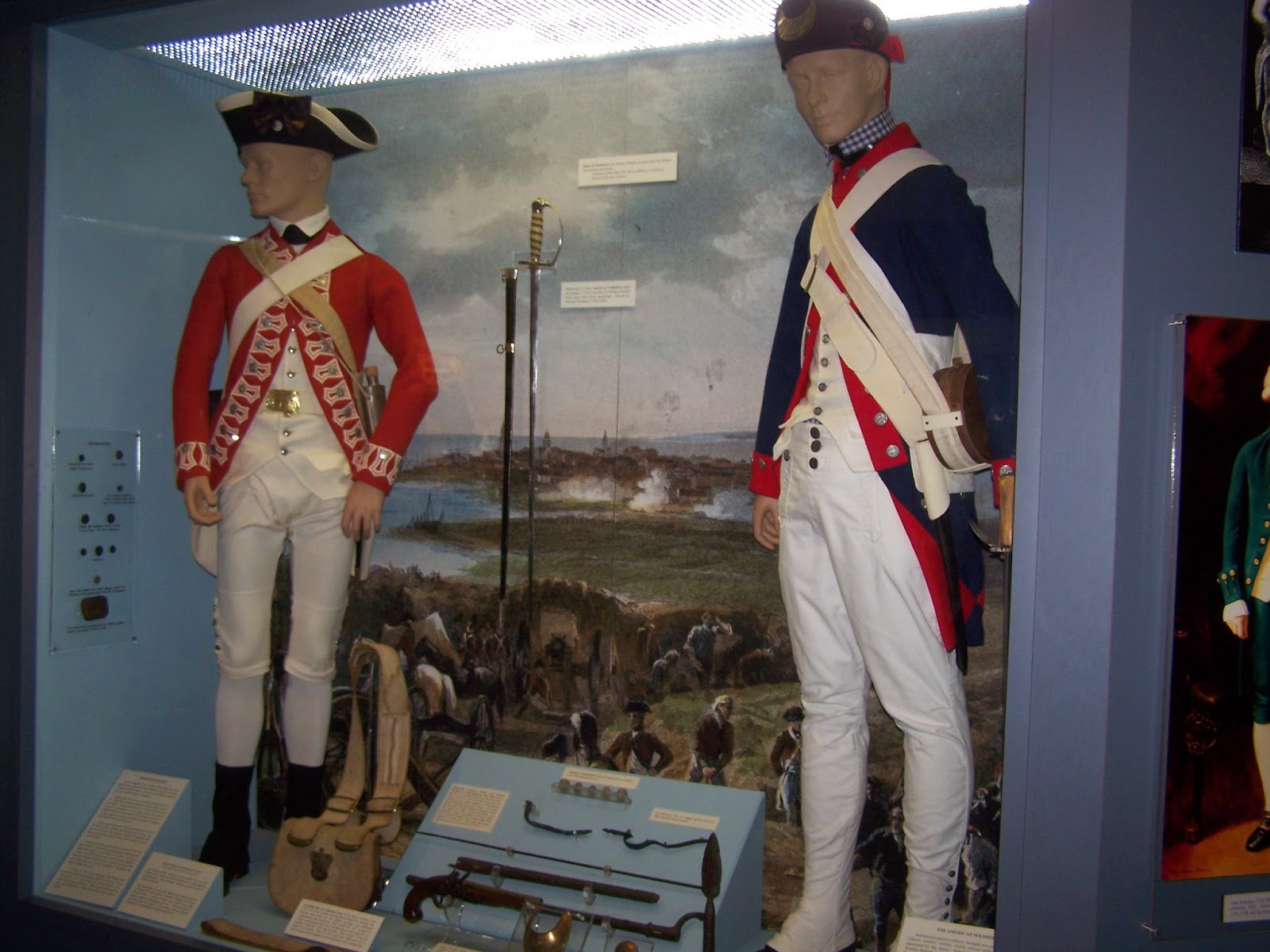
Siege of Charleston display at the Charleston Museum
The war had gone as far as it could in the northern colonies—the British held New York, Boston, and Philadelphia, the major cities. The British cast their eye to the South—for the second time, since an attempt at taking Charleston had failed in 1776. (Much is made of that in Charleston colonial history, in fact, with barely a mention of later events.) This time the effort began with Savannah, Georgia, a lesser port than Charleston, but also an easier target. Savannah fell to the British in late 1779, and the British then turned their sights on Charleston, arguably the most important port and the richest city in the colonies. With a combined offensive on land and sea, the British caught Charleston in a pinch and held it under siege for nearly two long months, March-May 1780.

When the city fell, May 12, 1780, Lord Earl Cornwallis was left to implement the next stage of the "Southern strategy": push into the backcountry while holding Savannah and Charleston. A good part of the populace was believed to be loyalist, but not as many as the British counted on. Their initial plan to establish a network of outposts went smoothly enough at first, but then trouble flared in the backcountry of South Carolina in particular, around Camden, with what became known as the Presbyterian Rebellion. (The trouble was chiefly among the Scotch-Irish Protestant population.)

General Washington sent a force southward, headed by Horatio Gates, and in August 1780 the two armies met just north of Camden, in the wee hours of a moonlit night. Fighting broke out at dawn, and a hot battle turned into a complete rout of the Continental forces, many of them unseasoned militia. Gates was summarily fired after having fled ahead of his troops, and Continental commissary officer Nathanael Greene, a former Quaker, was assigned the task of regrouping the Continental forces and finding ways of making the militia function under fire.

Greene, it turned out, had a genius for logistics—literally, wearing out the British army. Rather than win the war by military might, or number of battles won, he employed a strategy of cutting off supply lines and making it untenable for the British to hold their various outposts.

The force that turned the tide of a war ...
The patriot militia and Continentals won a few of their battles, notably Kings Mountain in October 1780 (a huge surprise, for being mostly Overmountain men untrained in battle) and Cowpens in January 1781 (where Greene found a way to persuade the militia to stand in the face of fire). Others weren’t a dead loss but also not a clear-cut victory on either side, such as Hobkirk Hill in May 1780 (the second battle at Camden) and Eutaw Springs in September 1781. Some were a nightmarish, bloody ordeal on both sides, like Guilford Courthouse in March 1781. Cornwallis reached too far and subjected himself and his troops to an awful, bloody race through North Carolina in the spring of 1781, which after Guilford Courthouse led to the British army limping off to Wilmington, North Carolina, until a fresh press northward to Yorktown, Virginia. By the time October 1781 rolled around, all British troops had withdrawn from South Carolina outposts and were holed up in Charleston. The British cause in the colonies was pretty well finished, and Cornwallis had little choice at Yorktown but to surrender.

These two years comprised possibly the bloodiest and most brutal of the war. Greene is quoted as saying, “Nothing but blood and slaughter has prevailed among the Whigs and Tories, and their inveteracy against each other must, if it continues, depopulate this part of the country.” The Southern Campaign is, I believe, what earned the Revolution the nickname of America’s first civil war. Not much calm and reason here, but passion and fury and vengeance, neighbor against neighbor and brother against brother.

Links of interest:

North Carolina Digital History's War in the South
Southern Campaigns of the American Revolution

All photos mine.