Announcements

10 Year Anniverary & New Releases Winners: Carrie Fancett Pagels' Butterfly Cottage - Melanie B, Dogwood Plantation - Patty H R, Janet Grunst's winner is Connie S., Denise Weimer's Winner is Kay M., Naomi Musch's winner is Chappy Debbie, Angela Couch - Kathleen Maher, Pegg Thomas Beverly D. M. & Gracie Y., Christy Distler - Kailey B., Shannon McNear - Marilyn R.
Showing posts with label Nathanael Greene. Show all posts

Monday, April 9, 2018

The Sieges of Savannah and Charleston, or How the British Left the Colonies

The Siege of Charleston, 1780
In 1779, the British turned their attention from New England and the northeast colonies to what is now termed the Southern Campaign—and they started with Savannah, Georgia. Having taken that in December, they moved north to Charles Towne—Charleston of today—and laid siege to it for six weeks before that mighty port city buckled.

After the surrender at Yorktown, the British forces hunkered down in Charleston and Savannah, but made no further move to withdraw. As Patrick O’Kelley says, “Though the war was near the end, the fighting continued. Old scores needed to be settled, and this had to be done while there was still a war going on. The British in Savannah and Charlestown had to find food for the soldiers and for the refugees huddled near the walls of the cities. The Patriots knew that the sooner they could get the British to leave the two cities, the sooner the war would end, so they opposed any foraging parties coming out of the cities. This led to some intense fighting in the last days of the war.”

The siege of Charleston lasted from 1781 until December 1782. The retaking of Savannah had begun in January 1782 when Major General Anthony Wayne made a bold push against the British in Georgia. The British, thinking they were outnumbered (though they weren’t, by far), fell back to Savannah, and though Wayne did his best to play up the fears of the British, they held onto that city until July.

Last page of the Treaty of Paris, 1783
In the meantime, Greene had his own troubles with troops becoming mutinous in the face of nakedness and hunger. William Moultrie describes how every scrap of cloth was needed to hang about men’s waists, and this in an age where a man was considered “undressed” if he didn’t wear a waistcoat over shirt and breeches. Another officer asked if soldiers could be expected to do their duty, clothed in rags and fed on rice. Even partisan leader Francis Marion, the famed “Swamp Fox,” grew so weary of the constant fight that after one incident in September, he refused to put any more of his men’s lives on the line, so close to the expected departure of the enemy. In one case he and his men even stood guard on behalf of a British foraging party, presumably as much out of compassion as anything.

On July 11, the British officially evacuated from Savannah. Troops headed for Charleston and New York. Many loyalist refugees eventually went south to Florida. The British would drag their feet getting out of Charleston until December 14. British regulars and loyalists dispersed not only back to Britain, but to the Caribbean and Nova Scotia. (Many of Tarleton’s Green Dragoons were given holdings in Nova Scotia, but it was a rather austere location.)

Map of US and territories after the Treaty of Paris
The day after the British fleet sailed from Charleston, the Maryland Line of the Continentals decided their enlistment was over, but Greene told them firmly that the war was not yet finished. That would not happen until the signing of the Treaty of Paris on September 3, 1783, but the fighting in the Carolinas had ended at last.

At least where the British were concerned. Tensions and conflict would continue with the native tribes for years to come. And having cut their losses in the American colonies, the British had already focused their meager energies elsewhere in the world. This marked the end, however, of the colonial era in United States history.

(My thanks as usual to O'Kelley for his excellent work, Nothing But Blood and Slaughter: The Revolutionary War in the Carolinas.)

Monday, February 12, 2018

Nothing but Blood and Slaughter


The Battle of Guilford Courthouse, North Carolina
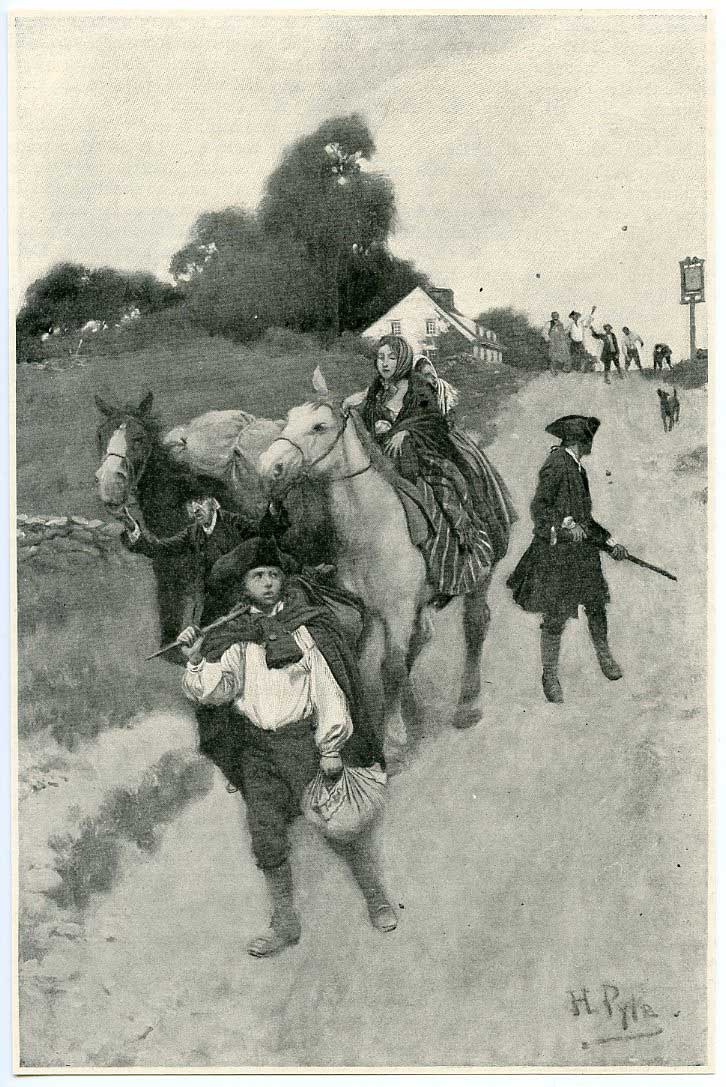
One cannot study the American Revolution for long before stumbling over the ugly reality of partisan conflict—family and neighbors divided by politics and loyalties and the necessity of war.

I say “necessity” because sides weren’t necessarily chosen by ideals, but whatever seemed best in order to protect one’s family and/or holdings. Sometimes it was a matter of whichever side offended a person the most, or how driven by vengeance one might be, as we saw in the case of William Cunningham.

Though the stance of the Tory has often been painted as that of a coward, often those who chose loyalty to the crown felt that rebellion was the coward’s
way, and irresponsible, if not outright ungodly. Scriptures such as Romans 13:1 seemed to them to point toward unconditional obedience to the king.

The Whigs, on the other hand, felt that King George overstepped his God-given authority. In fact, many of the Protestant groups, such as the Scots-Irish Presbyterians of the South Carolina backcountry, believed he was actually usurping the place of Christ in the Church, and for that reason alone should be resisted with utmost fervor. (Thus the Presbyterian Rebellion of 1780.) Add to that the insult of things such as the Stamp Act, which from the British perspective was merely to defray the mounting cost of defending the colonies from invaders (i.e., during the French and Indian War), and many saw the unrest in the colonies as a powder keg, ready to explode.

At the least, is it any wonder that in the absence of regional lines being drawn, as in the later War Between the States, the conflict turned so bitter between family and neighbors?

When the British launched the Southern Campaign from Savannah northward, they expected quick support and an easy quelling of the rebellion, but what they found was a mess of infighting and loyalties that swayed either way, depending upon the outcome of various battles. After the Siege of Charleston, however, they made a steady push into the Carolina backcountry that remained successful for a while, and were greatly encouraged by the complete rout of Continental forces during the Battle of Camden. General Horatio Gates of the Continental forces was later court-martialed for fleeing the battlefield, mostly ahead of his own troops, and General Nathanael Greene was given command in his place. When he arrived on the scene several months later, this normally unflappable former Quaker had this to say about the situation, and one can almost hear his exasperation:

Nothing but blood and slaughter has prevailed among the Whigs and tories, and their inveteracy against each other must, if it continues, depopulate this part of the country.

Greene’s concerns were well founded. At the least, the constant depredations from both sides led to much want and near famine. (And thus the title of one of my favorite resources on the Revolutionary War in the Carolinas.)

Tory Refugees by Howard Pyle
Such situations, where both sides devolve into mere taking vengeance back and forth, also make it very hard to delineate between a “right” side and a “wrong.” Patriotic Americans can appreciate afresh the freedom we enjoy while understanding at what bitter cost it came, and Christians can take it a step further and recognize that our country came to be, not necessarily by military strength or purity of cause, but by the very grace and mercy of God.

And I find it interesting, as a student of history, that not much has ever changed where human nature is concerned. Greene’s remarks about the partisan conflict in the Carolinas are echoed in the lyrics of a song from a much later, but similar conflict, this one between Catholic and Protestant in Ireland:

But centuries of hatred have ears that cannot hear.
An eye for an eye was all that filled their minds
And another eye for another eye till everyone is blind.
(“There Were Roses,” Tommy Makem)

Friday, July 14, 2017

THE BATTLE OF GUILFORD COURTHOUSE

March 15, 1781

Guilford Courthouse Visitor's Center
Last spring, when I was traveling in North Carolina, I was able to visit the site of the Battle of Guilford Courthouse, now Greensboro. It is a battle that figures in my current work in progress so I was eager to wander through the battlefield and visitor’s center.


Nathaniel Greene

General Nathaniel Greene was in charge of the Continental Army’s Southern Department. After the Battle of Cowpens in January of 1781, where 300 British were killed or wounded and another 525 were taken prisoner, General Cornwallis was determined to destroy Greene's army.

Cornwallis and his troops pursued the Americans across North Carolina. Greene had already reconnoitered and led them to the area near Guilford Courthouse.
Greene waited until additional Virginia militia reinforcements arrived and then positioned them in three successive defensive lines.

The first line was made up of untested North Carolina militia that would fire at the British while they crossed the open fields.

Less than half a mile further east, Greene situated his second line, the Virginia militia in dense woods which would provide cover for them and dispel the British formations.

Green placed his third line of 1,400 Continentals 500 yards further back on top of a small ridge and behind another cleared field.
Map of the Guilford Court House Battleground, based on c. 2006 National Park Service map

General Cornwallis
The British army was already tired after a twelve mile march that morning when they crossed Horsepen creek and readied for the attack. The Americans first attacked from a rail fence about 150 yards in front of the advancing British redcoats downing dozens of them.  The British continued their approach for 100 more yards, where they began to fire and charged.

The inexperienced North Carolina militia, who had been told they could disband, fled
The Guilford Courthouse woods in March
into the woods. When the British pursued them they were met by the second line, the Virginia militia. The fighting became splintered, much of it hand-to-hand combat.

The British were then met by Greene’s last line and in the open fields the advantage went back and forth between the two armies. Greene’s cavalry joined the fight.

Seeing his soldiers were being attacked from the front and flank by infantry and cavalry, Cornwallis directed that grapeshot be fired at the American horsemen, also placing his own troops in harm’s way. It halted the American cavalry charge and the infantry was also driven back. Additional British troops entered the woods and more hand-to hand combat ensued.

When Greene learned that British infantrymen were advancing from the rear, he ordered his troops to disengage and withdraw. The weather turned stormy as Greene’s exhausted and hungry men marched to a camp fifteen miles away.

In the ninety minute battle, the British though outnumbered more than two to one, defeated the American forces.  However, they lost over a quarter of their men.


Monument to General Nathaniel Greene

Cornwallis gave up the pursuit and retreated toward Wilmington on the North Carolina Coast while Greene headed to South Carolina. Later, Cornwallis, hoping to draw Greene to follow him, headed to Virginia. The stage was being set for Cornwallis’s eventual defeat at Yorktown.

Monday, December 19, 2016

Caty Greene: Darling of the Continental Army


Maj. Gen. & Mrs. Greene, date unknown
Last month I talked about Nathanael Greene, Revolutionary War general and former Quaker, and his crucial role in winning the war for independence for the colonies. Equally fascinating is his young wife, Catharine Littlefield Greene, or "Caty" for short.

Caty lost her mother at the tender age of 10, and in order to give her proper feminine influence, her father sent her to live with her aunt and uncle. She met Nathanael when she was 17, married him at 19 (he was not quite 32), then less than a year later had to surrender her hopes for a happy domestic life to his involvement in the cause of independence.

She made the most of it, however, and traveled whenever she could to be with him in the field--even during the terrible winter at Valley Forge. Famous for her charm and wit, she became a favorite with George and Martha Washington, and her presence helped fuel the effort to maintain a semblance of social normalcy for the Continental officers. It's said that she was so much a favorite with George Washington that he claimed her as a dance partner for hours at a time, on more than one occasion.

Caty's vivacious nature, while making her the darling of wartime society, left her wide open to rumors of infidelity. Caty made light of the accusations, brushing them off with vague answers that left room for the flirtations that happened sometimes under Nathanael's very nose--and it was common and somewhat socially acceptable during that era for women and men to "carry on" in public, up to a certain point.

The rumors were never really substantiated, however. To all appearances, Caty remained devoted to her husband and insisted even on journeying to him all the way from Philadelphia to South Carolina early in 1782, after Greene had largely exhausted the strength of the British forces and the surrender at Yorktown had taken place. Four of their six children were born during the war, although Nathanael was not free to rejoin his family until sometime in 1783.

Even then, her hopes for a peaceful family life were disappointed. Greene had essentially fed and clothed the Continental Army out of his own pockets during the Southern Campaign and at the close of the war found himself in dire financial straits. As partial compensation, Congress awarded him the estate of Mulberry Grove near Savannah, Georgia, and both Nathanael and Caty set to learning how to run a Southern plantation.

In June of 1786, tragedy struck. Nathanael Greene fell ill from sunstroke after being out too long surveying a neighbor's fields, and died a few days later. Both Caty and their mutual friend Anthony Wayne, who was present during Nathanael's illness and death, were devastated, but Caty did not give up. She determined to make plantation successful

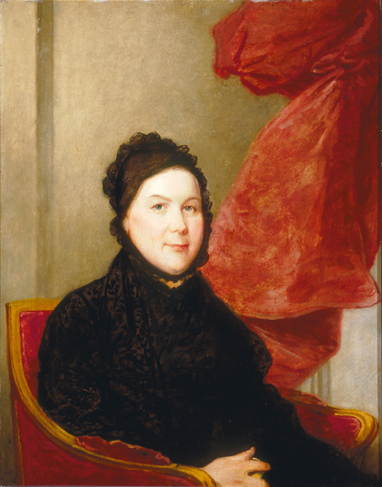
Catharine Greene Miller in 1809
She remained close friends with the Washingtons and others, and used her connections to appeal to Congress for support as a general's widow. In the meantime, her children's tutor, Phineas Miller, helped her manage the plantation. Caty also invited the neighbor children's tutor, a young man named Eli Whitney, to move to Mulberry Grove and pursue his inventions. Many insist that she was instrumental in his success with the cotton gin, which revolutionized cotton production.

In 1796, she married Phineas Miller, with the Washingtons in attendance. Mulberry Grove fell upon hard times and had to be sold, and Caty and Phineas moved to another holding originally given to Nathanael, an estate called Dungeness on Cumberland Island, Georgia. Phineas died in 1803; and in 1814, Caty followed.

The ironies of history amaze me. This couple from middle-class beginnings in Rhode Island had such an impact on our country's future and on the South in particular. If Nathanael had not died unexpectedly of sunstroke and left Caty to carve out her own future, would she have encouraged Eli Whitney in his progress on the cotton gin? If Caty had not first fueled and supported Nathanael's passion to win this country's independence, would he have had such heart for the long agony of the American Revolution in general, and the Southern Campaign in particular? We may never know, but the brief glimpses of their lives have provided an endless source of fascination for me.

Monday, November 14, 2016

Nathanael Greene: The Fighting Quaker

Anyone who studies history soon finds herself picking favorites. I have several from the Revolutionary Era, but none draws my admiration quite so much as General Nathanael Greene, who was given command of the Continental Army after the debacle of Camden under Horatio Gates. (See also my article Heroes, Rogues, and Villains.)

The first thing I found fascinating was Greene’s background. Sometimes dubbed the Fighting Quaker, he came from a family who were considered pillars of the community in Rhode Island. Nathanael himself always tended to be very un-Quaker-like in his craving for classical learning even while he applied himself to learning a trade. Later, this turned to interest in military matters—strictly forbidden in Quaker pacifist beliefs— and an involvement in his local militia. Both he and his brother were expelled from Meeting after their attendance of a military parade. 

His famed sensibility and wisdom led to his being elected to the Rhode Island General Assembly, and later being appointed as Major General and then Quartermaster-General of the Continental Army. Greene was rather deprecating about the position, preferring a more active role and stating that no one in history ever distinguished themselves as quartermaster, but he applied himself with remarkable dedication and the same conscientiousness he gave everything else. It was his job, then, to feed and provide for the starving troops that terrible winter in Valley Forge, and their survival was likely to his credit.

After the disaster at the Battle of Camden, Washington hand picked Greene to succeed Horatio Gates as general of the Continental Army in the South. He not only scraped together the ragtag army, patiently but relentlessly trained the militia to withstand fire in battle, but also drew from his personal funds to feed and clothe them. His determination paid off, and the Continental Army once more became a force to be reckoned with, winning few actual battles but costing the British so much that they were forced to retreat time after time from what should have been a technical win. The most notable example of this was the Battle of Guilford Courthouse, where a full third of Cornwallis’s forces were killed, and by some accounts up to half of his officers.

Just a month or so before Guilford Courthouse comes one of my favorite accounts of Greene:

In the morning Cornwallis brought up the rest of his command and had a full view of Greene’s camp across the river. Cornwallis had his cannon brought up and began firing into the camp. The only target they could hit was a cabin where Greene had set up his headquarters. The round shot splintered the walls and shingles, but did no real damage. During the cannonade Greene calmly sat inside the cabin and wrote orders. (Patrick O’Kelley, Nothing But Blood and Slaughter Vol. 3)

The next thing that caught my imagination, after the calm determination that made him such a favorite of George Washington, was the scandalous love he held for his young wife, Catharine (also known as Caty) ... but more on that, and her, next time.


Monday, February 9, 2015

Heroes, Rogues, and Villains

Greene Monument at Guilford Courthouse, NC
 Amongst the discussions surrounding the recent History Channel miniseries “Sons of Liberty,” I saw disappointment expressed over the language used by various characters. One poster responded, essentially, that they are human, they are fallen. We may admire their deeds as founders of our country, but don’t think for a moment that meant they were sinless.

However you feel about History Channel's politically correct portrayal of figures such as Sam and John Adams, it’s true that many of the key players in the American Revolution were a mixed bag, morally. My last post was devoted to deconstructing popular opinion on one of them, the infamous “Bloody Ban,” Banastre Tarleton of the British Legion, but truth is that so many men of his time were neither half as evil nor half as righteous as popular history now portrays.

One of the odd benefits of initially studying the Revolution from the British perspective is that if there was any dirty laundry on those of the Continental side, they would have aired it. It was interesting overall to see who emerged as true men of honor, and who were ... not so much.

So I present you with a rough sketch of who, by admittedly my own subjective eye, could be categorized as heroes ... and rogues ... and then out-and-out villains.

HEROES

First up is our revered first President, George Washington. I was surprised—and quite relieved—that as bits of gossip surfaced about other prominent men and women, none did regarding him. True, his past isn’t entirely uncheckered ... there was one uncomfortable matter during the French & Indian War ... but by the time the RevWar rolled around, the worst that could be found was criticism regarding his accepting the position of Commander in Chief of the rebellion's armies. (King George shouldered his own share of criticism on the other side of the pond, for engaging those pesky rebels to start with.) His relationship with wife Martha was loving and constant, he did not drink or eat to dissipation, and while he is recorded as resorting to mild profanity in a moment of extreme frustration on the field of battle, well ... he was also human.

John Adams on left, Staten Is. Peace Conference
Second was John Adams. (Brother Samuel, somewhat of a hothead, could fall into the category of rogue.) Though some have charged him with thinking a bit too highly of himself, his faith—and his devotion to wife Abigail—shines strong and authentic even from the accounts of his enemies. From Wikipedia:

Throughout this life, Adams was opposed to slavery, never owned a slave, and was quite proud of the fact.[4] After the Boston Massacre, with anti-British feelings in Boston at a boiling point, he provided a principled, controversial, and successful legal defense of the accused British soldiers, because he believed in the right to counsel and the "protect[ion] of innocence".[5]

Third—and don’t shoot me for this—Charles Cornwallis, Earl of the realm and general of the British army. This is a man around whom scandal is conspicuously absent—whose devotion to his dying wife drew him home again to England, with the war still in full swing, then grief for her drove him back, just in time to head up the Southern Campaign in Henry Clinton’s wake. He found the Carolina backcountry enchanting, and though shocked at the viciousness of the partisan warfare shredding the very fabric of society, he endeavored to tread the line between English gentleman, and general of the army whose job it was to enforce order and loyalty to the Crown. Too bad he was so prone to unwise decisions when it came to war strategy, especially his insistence in pushing across North Carolina during the early spring of 1781 ... and I have to take points off for his calling in sick the day he was to surrender to Washington at Yorktown, and sending his second in command instead. Still, he was steps above being classed as a rogue or villain.
General Nathanael Greene

Fourth—no mention of heroes would be complete with mention of Nathanael Greene. General of the Continental forces after the complete rout of Gates at the Battle of Camden, he was raised a Quaker but later was read out of meeting for his interest in the militia and brewing revolt. Passionately and unfashionably devoted to a wife around whom rumors and scandal swirled, but who despite everything went to amazing lengths to join her husband on the field, when she could. All that aside, Greene was famous for his cool under fire, his brilliance at strategy, his patience in completely wearing out the British army.


ROGUES

These are the ones who, on either side, might not have been perfectly honorable, but you couldn’t help admire their panache, or they were considered darlings by their superiors. Yes, I believe Tarleton fits more closely here than the last category, but he’s joined by ...

Henry “Light Horse Harry” Lee—the Continentals’ counterpart to Tarleton. Yes, really. He was quite the fire-eater, just as hotheaded as Ban Tarleton but looked upon with a kinder eye because he was Washington’s “pet,” while Ban was the favorite of Cornwallis. Consider the possible humor—and exasperation?—in the tone of this note from General Washington:

The measure you propose of putting deserters from our Army to immediate death would probably tend to discourage the practice[, but] I think that the part of your proposal which respects cutting off their heads and sending them to the Light Troops had better be omitted. (July 9, 1779)

“Mad” Anthony Wayne, General of the Continental forces, so nicknamed for a slightly crazy but wildly successful night attack on the British in 1779. So did he, or did he not, have something going on with Caty Greene? We may never know. He was, despite gossip and rumors, brave in battle and a devoted friend to the Greenes, present when Nathanael died tragically after the war, and remaining a source of support for Caty.

John Andre, self portrait
Daniel Morgan, another Continental general ... a crusty old veteran if there ever was one. Flogged once for punching an officer during the F&I War. Ignored Greene's orders to not engage Tarleton directly, but gave that lad a "devil of a whipping" at the battle of Cowpens. Among other things we know of him personally, there’s no record of a legal marriage between him and the woman he considered his wife, and he suffered in later years from severe sciatica in his back and legs. That alone might account for the crankiness.

John Andre ... another young, dashing figure—handsome, witty, talented British officer who managed to be in the wrong place at the wrong time, captured by the Continentals and hung as a spy. It’s reported that he went bravely to his death.


VILLAINS

General Henry Clinton of the British
Benedict Arnold, famed Continental officer turned traitor ... dude, we get that your father was a drunk and a loser. We understand having the drive to better yourself. But letting jealousy and envy drive you to betray men who loved and trusted you ... okay, maybe just trusted, because personally speaking you were probably far too prickly to inspire actual love. But you were never really respected by the other side, either. Fail, good sir! Epic fail.

Henry Clinton, General of the British forces ... touchy, opinionated, sure that anything in the colonies was at his personal disposal. Including, and maybe especially, his landlady. Guilty of constant criticism of his superiors (General Howe) and bickering with those under him (General Cornwallis), and giving not very good military advice at times.

Continental General, Charles Lee
James Wemyss, officer of the British ... the one who most likely deserved the later hatred focused on Tarleton. Maybe some of the wild tales surrounding him were merely legend, as well, but some report that even Cornwallis, who gave the order to subdue the rebel populace in South Carolina, disapproved of Wemyss’ unholy zeal in carrying it out, and the methods he employed. (There is some evidence, as well, that some of these tales belong rather to loyalist Christian Huck, who met his end at Williamson’s Plantation in South Carolina, after earning the particular fury of the local Presbyterian population.)

And lastly, Continental general, Charles Lee. (No relation to the Lees of Virginia.) Pompous, self-serving, constantly critical of Washington. Lee gave up all his holdings in England to throw in his lot with the revolution, and thought he deserved payment for it. (Washington agreed to serve for no pay, only having his expenses covered.) In fact, he'd expected Washington's job and didn't get it. So, he might have fought for the Patriot side, even though he wasn't American-born, but he didn't like anybody, and nobody really liked him.


Agree? Disagree? Anyone care to add to this very short list? :-)

All images from Wikipedia and/or public domain.

Monday, September 8, 2014

The Southern Campaign of the Revolution: Myth and the Mists of Time


Before I continue my mini-series on colonial myths, I’d like to offer an overview of the Southern Campaign of the American Revolution. How many know what that refers to? Unless you’re a serious American Revolution buff, chances are you don’t.
Kershaw-Cornwallis house, Camden, SC, British headquarters 1780-81
The history taught in schools is sketchy at best, and sometimes  riddled with myth. Where the Revolution is concerned, we’re familiar with the Boston Massacre, Lexington and Concord, the Declaration of Independence, Valley Forge, and Yorktown. What happened in between is fuzzy at best, or missing completely.

We also know individual legends like George Washington and the cherry tree, Betsy Ross, and Molly Pitcher. We’ve also heard of Benedict Arnold’s treachery, and we know the difference between Whig and Tory.

The average person is willing to let their knowledge of history be informed solely by grade-school textbooks, or films like The Patriot. Those of us who have an interest in blogs like this one, on the other hand, thirst to know more ... to get the facts right. :-)

I shared already how a common reenactor myth sparked a story idea, then sent me in search of solid provenance for said story.  As I got deeper into the research, it took my breath away at how little I knew of the Revolution as a whole.

Like the fact that the whole second half of the war took place in the southern colonies.
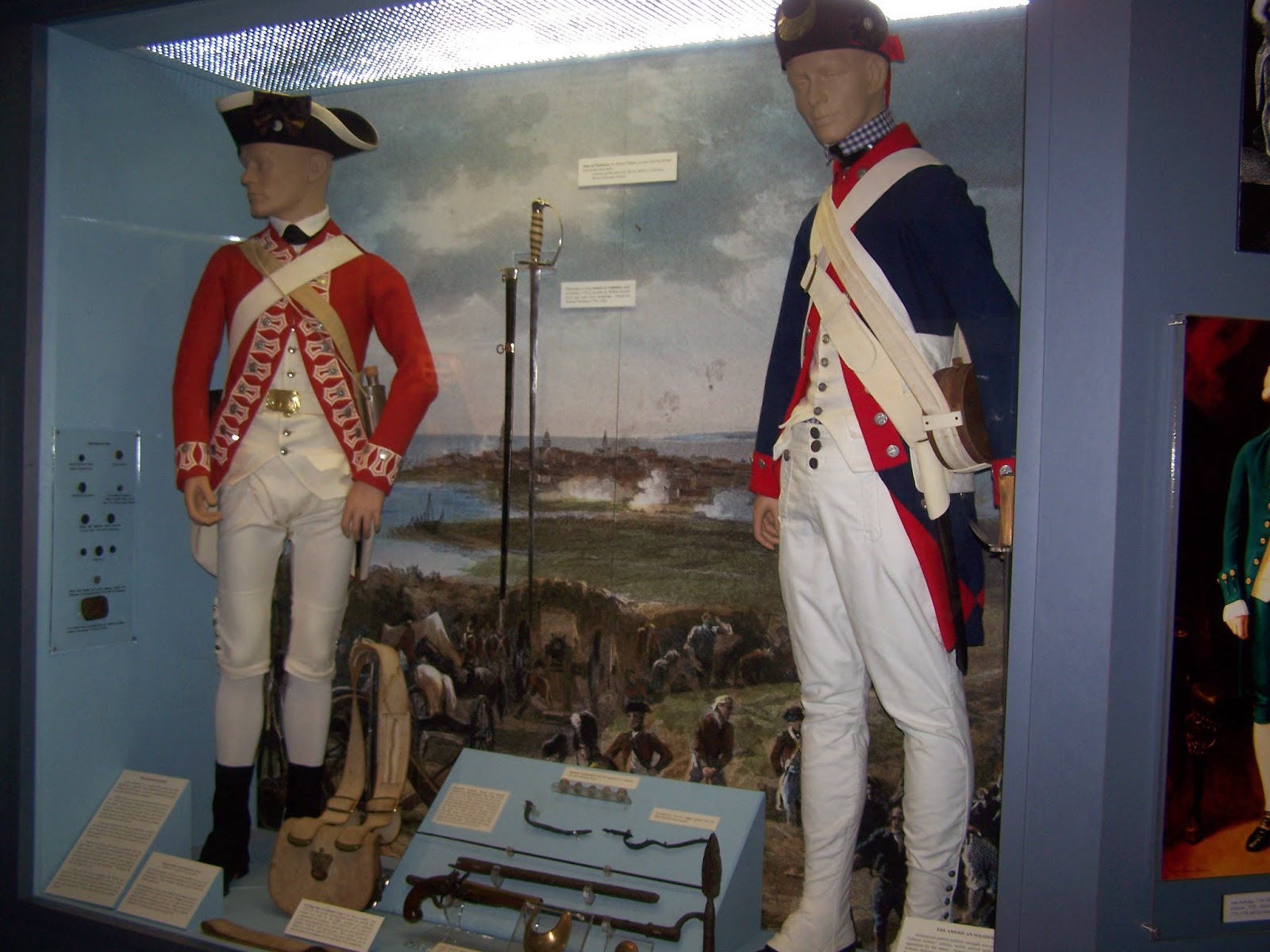
Siege of Charleston display at the Charleston Museum
The war had gone as far as it could in the northern colonies—the British held New York, Boston, and Philadelphia, the major cities. The British cast their eye to the South—for the second time, since an attempt at taking Charleston had failed in 1776. (Much is made of that in Charleston colonial history, in fact, with barely a mention of later events.) This time the effort began with Savannah, Georgia, a lesser port than Charleston, but also an easier target. Savannah fell to the British in late 1779, and the British then turned their sights on Charleston, arguably the most important port and the richest city in the colonies. With a combined offensive on land and sea, the British caught Charleston in a pinch and held it under siege for nearly two long months, March-May 1780.

When the city fell, May 12, 1780, Lord Earl Cornwallis was left to implement the next stage of the "Southern strategy": push into the backcountry while holding Savannah and Charleston. A good part of the populace was believed to be loyalist, but not as many as the British counted on. Their initial plan to establish a network of outposts went smoothly enough at first, but then trouble flared in the backcountry of South Carolina in particular, around Camden, with what became known as the Presbyterian Rebellion. (The trouble was chiefly among the Scotch-Irish Protestant population.)

General Washington sent a force southward, headed by Horatio Gates, and in August 1780 the two armies met just north of Camden, in the wee hours of a moonlit night. Fighting broke out at dawn, and a hot battle turned into a complete rout of the Continental forces, many of them unseasoned militia. Gates was summarily fired after having fled ahead of his troops, and Continental commissary officer Nathanael Greene, a former Quaker, was assigned the task of regrouping the Continental forces and finding ways of making the militia function under fire.

Greene, it turned out, had a genius for logistics—literally, wearing out the British army. Rather than win the war by military might, or number of battles won, he employed a strategy of cutting off supply lines and making it untenable for the British to hold their various outposts.

The force that turned the tide of a war ...
The patriot militia and Continentals won a few of their battles, notably Kings Mountain in October 1780 (a huge surprise, for being mostly Overmountain men untrained in battle) and Cowpens in January 1781 (where Greene found a way to persuade the militia to stand in the face of fire). Others weren’t a dead loss but also not a clear-cut victory on either side, such as Hobkirk Hill in May 1780 (the second battle at Camden) and Eutaw Springs in September 1781. Some were a nightmarish, bloody ordeal on both sides, like Guilford Courthouse in March 1781. Cornwallis reached too far and subjected himself and his troops to an awful, bloody race through North Carolina in the spring of 1781, which after Guilford Courthouse led to the British army limping off to Wilmington, North Carolina, until a fresh press northward to Yorktown, Virginia. By the time October 1781 rolled around, all British troops had withdrawn from South Carolina outposts and were holed up in Charleston. The British cause in the colonies was pretty well finished, and Cornwallis had little choice at Yorktown but to surrender.

These two years comprised possibly the bloodiest and most brutal of the war. Greene is quoted as saying, “Nothing but blood and slaughter has prevailed among the Whigs and Tories, and their inveteracy against each other must, if it continues, depopulate this part of the country.” The Southern Campaign is, I believe, what earned the Revolution the nickname of America’s first civil war. Not much calm and reason here, but passion and fury and vengeance, neighbor against neighbor and brother against brother.

Links of interest:

North Carolina Digital History's War in the South
Southern Campaigns of the American Revolution

All photos mine.

Wednesday, June 25, 2014

The Battle of Eutaw Springs: last bloodbath of the Revolution

Eutaw monument
The monument reads: “This stone marks the field whereon was fought the Battle of Eutaw, Sept 8, 1781, between a force of the United States under Major General Nathanael Greene and a force of Great Britain under Colonel Stuart. Neither side was victorious, but the fight was beneficial to the American cause. Erected by Eutaw Chapter, DAR 1912.”

"Victory in Defeat" placard
Whether either side was victorious or not is up for discussion. The rule is generally, whoever is left holding the field, and both sides withdrew, then the Continentals returned the next day to occupy. It was, indeed, beneficial to the American cause, as the last major blow struck the British a month before the surrender at Yorktown.

A hot, hazy day on Lake Moultrie
The last portion of the American Revolution, referred to as the Southern Campaign, is little discussed in classroom history. This last significant battle has been virtually forgotten, and the battlefield now lies largely under water.

The Battle of Eutaw Springs frames the conclusion of my full-length historical, Loyalty’s Cadence, set in South Carolina in 1780-81, during the peak of the Southern Campaign. My darling husband indulged me on a research trip for our 25th anniversary two summers ago, so the day found us exploring the Eutaw Springs battlefield, during 97-degree midday heat. Such a lovely, peaceful place now, like many battlefields. The heat was perfect for evoking the day of the actual battle, which being early September in inland South Carolina likely rivaled our July weather.

layout of battle lines

The key players on the American side include General Nathanael Greene (who stepped up to the plate after Gates was routed at Camden a year before), Henry "Lighthorse Harry" Lee (father to Robert E. Lee), and William Washington (nephew of George Washington). The players on the British side include Stewart and Majoribanks (pronounced "Marshbanks" according to some sources--sounds like a British thing to do, yes? everybody say "Wer-ster-sherrr" with me ...). The really big names are absent--General Cornwallis and Banastre Tarleton are away up north, still recovering from the terrible starvation march of early 1781. They're about to be beseiged at Yorktown. Lord Rawdon, who Cornwallis left in charge after Camden, has retreated to the Lowcountry because of bad health. Since Rawdon abandoned Camden in May, and then Ninety-Six in June, General Greene has been stalking the British and Loyalist flanks, harrying them, cutting off supply lines, driving as much loyalist/British influence as he can out of the backcountry, toward Charleston.

participating forces
As September 8, 1781, dawned, the British knew Greene was out there, but they didn't know how close. (A little like what happened at Camden, in that respect.) Greene had camped just a few miles from the current British outpost, a plantation located on Eutaw Creek, not far from the British supply depot at Biggin Creek in Moncks Corner. Greene's force went on the march at 4 AM. When an unsuspecting foraging party happened upon the front lines, the first shots were fired, alerting the British camp.

how the tide of battle shifted
They leaped into action, in some cases even leaving breakfast on the fire. The placards show the original lines as the British formed up to meet Greene, then fell back, taking shelter in the house, gardens, and the scrub oak thickets nearby. As Greene's men overran the British camp, they fell upon the spoils--including the stores of rum that the British had missed in their frantic attempt before fleeing to dispose of their supplies. Thirst, fueled by sudden intoxication, drove Greene's men to greater fury. But unable to sustain the pace, and held off from reaching fresh water by the pockets of hidden British and loyalists, they eventually fell back.

It was a long battle, at least three hours, probably closer to four. Once Greene's men withdrew, the British and loyalists crawled from their hiding places. Stewart returned briefly to assess the damage, then made an official retreat, the down the road toward Charleston. Dead and wounded were left behind, since it was an accepted courtesy that whatever force eventually held a field would tend the casualties from both sides--and Stewart had lost about a third of his force. Eyewitnesses state that the field was such a mess, blood pooled ankle-deep in some places.

Greene's men found a pond fifteen miles up the road in which to slake their thirst. After reorganizing, they'd return to the field and claim final "victory," despite the wounding and capture of William Washington. Stewart of the British side also sustained wounds, but the gravest was that of Major Majoribanks, who was left to be cared for at the Ravenel home on the way to Charleston, but died six weeks later.

Costly it was on both sides, the battle was the final nail in the coffin of the British, before Yorktown.

As I walked the grounds that hot July day, a breeze from the water stirred the trees--just a breath, here and there. I looked up the road and thought of the British retreating ... peered out over the fingerlet of Lake Moultrie, which swallowed Eutaw Creek years ago, and and tried to envision the house and gardens.

Even on such a beautiful day, it wasn't hard to imagine puddles of spilled life, here and there.