Announcements

10 Year Anniverary & New Releases Winners: Carrie Fancett Pagels' Butterfly Cottage - Melanie B, Dogwood Plantation - Patty H R, Janet Grunst's winner is Connie S., Denise Weimer's Winner is Kay M., Naomi Musch's winner is Chappy Debbie, Angela Couch - Kathleen Maher, Pegg Thomas Beverly D. M. & Gracie Y., Christy Distler - Kailey B., Shannon McNear - Marilyn R.
Showing posts with label Catharine Greene. Show all posts

Monday, December 19, 2016

Caty Greene: Darling of the Continental Army


Maj. Gen. & Mrs. Greene, date unknown
Last month I talked about Nathanael Greene, Revolutionary War general and former Quaker, and his crucial role in winning the war for independence for the colonies. Equally fascinating is his young wife, Catharine Littlefield Greene, or "Caty" for short.

Caty lost her mother at the tender age of 10, and in order to give her proper feminine influence, her father sent her to live with her aunt and uncle. She met Nathanael when she was 17, married him at 19 (he was not quite 32), then less than a year later had to surrender her hopes for a happy domestic life to his involvement in the cause of independence.

She made the most of it, however, and traveled whenever she could to be with him in the field--even during the terrible winter at Valley Forge. Famous for her charm and wit, she became a favorite with George and Martha Washington, and her presence helped fuel the effort to maintain a semblance of social normalcy for the Continental officers. It's said that she was so much a favorite with George Washington that he claimed her as a dance partner for hours at a time, on more than one occasion.

Caty's vivacious nature, while making her the darling of wartime society, left her wide open to rumors of infidelity. Caty made light of the accusations, brushing them off with vague answers that left room for the flirtations that happened sometimes under Nathanael's very nose--and it was common and somewhat socially acceptable during that era for women and men to "carry on" in public, up to a certain point.

The rumors were never really substantiated, however. To all appearances, Caty remained devoted to her husband and insisted even on journeying to him all the way from Philadelphia to South Carolina early in 1782, after Greene had largely exhausted the strength of the British forces and the surrender at Yorktown had taken place. Four of their six children were born during the war, although Nathanael was not free to rejoin his family until sometime in 1783.

Even then, her hopes for a peaceful family life were disappointed. Greene had essentially fed and clothed the Continental Army out of his own pockets during the Southern Campaign and at the close of the war found himself in dire financial straits. As partial compensation, Congress awarded him the estate of Mulberry Grove near Savannah, Georgia, and both Nathanael and Caty set to learning how to run a Southern plantation.

In June of 1786, tragedy struck. Nathanael Greene fell ill from sunstroke after being out too long surveying a neighbor's fields, and died a few days later. Both Caty and their mutual friend Anthony Wayne, who was present during Nathanael's illness and death, were devastated, but Caty did not give up. She determined to make plantation successful
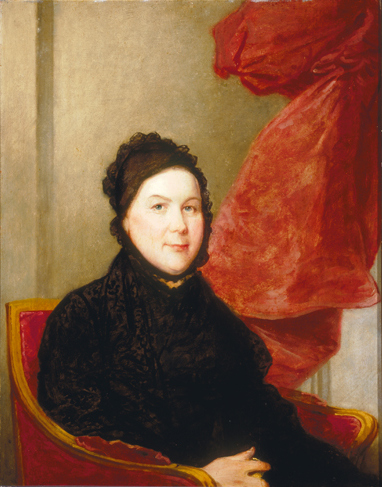
Catharine Greene Miller in 1809
She remained close friends with the Washingtons and others, and used her connections to appeal to Congress for support as a general's widow. In the meantime, her children's tutor, Phineas Miller, helped her manage the plantation. Caty also invited the neighbor children's tutor, a young man named Eli Whitney, to move to Mulberry Grove and pursue his inventions. Many insist that she was instrumental in his success with the cotton gin, which revolutionized cotton production.

In 1796, she married Phineas Miller, with the Washingtons in attendance. Mulberry Grove fell upon hard times and had to be sold, and Caty and Phineas moved to another holding originally given to Nathanael, an estate called Dungeness on Cumberland Island, Georgia. Phineas died in 1803; and in 1814, Caty followed.

The ironies of history amaze me. This couple from middle-class beginnings in Rhode Island had such an impact on our country's future and on the South in particular. If Nathanael had not died unexpectedly of sunstroke and left Caty to carve out her own future, would she have encouraged Eli Whitney in his progress on the cotton gin? If Caty had not first fueled and supported Nathanael's passion to win this country's independence, would he have had such heart for the long agony of the American Revolution in general, and the Southern Campaign in particular? We may never know, but the brief glimpses of their lives have provided an endless source of fascination for me.

Monday, November 14, 2016

Nathanael Greene: The Fighting Quaker

Anyone who studies history soon finds herself picking favorites. I have several from the Revolutionary Era, but none draws my admiration quite so much as General Nathanael Greene, who was given command of the Continental Army after the debacle of Camden under Horatio Gates. (See also my article Heroes, Rogues, and Villains.)

The first thing I found fascinating was Greene’s background. Sometimes dubbed the Fighting Quaker, he came from a family who were considered pillars of the community in Rhode Island. Nathanael himself always tended to be very un-Quaker-like in his craving for classical learning even while he applied himself to learning a trade. Later, this turned to interest in military matters—strictly forbidden in Quaker pacifist beliefs— and an involvement in his local militia. Both he and his brother were expelled from Meeting after their attendance of a military parade. 

His famed sensibility and wisdom led to his being elected to the Rhode Island General Assembly, and later being appointed as Major General and then Quartermaster-General of the Continental Army. Greene was rather deprecating about the position, preferring a more active role and stating that no one in history ever distinguished themselves as quartermaster, but he applied himself with remarkable dedication and the same conscientiousness he gave everything else. It was his job, then, to feed and provide for the starving troops that terrible winter in Valley Forge, and their survival was likely to his credit.

After the disaster at the Battle of Camden, Washington hand picked Greene to succeed Horatio Gates as general of the Continental Army in the South. He not only scraped together the ragtag army, patiently but relentlessly trained the militia to withstand fire in battle, but also drew from his personal funds to feed and clothe them. His determination paid off, and the Continental Army once more became a force to be reckoned with, winning few actual battles but costing the British so much that they were forced to retreat time after time from what should have been a technical win. The most notable example of this was the Battle of Guilford Courthouse, where a full third of Cornwallis’s forces were killed, and by some accounts up to half of his officers.

Just a month or so before Guilford Courthouse comes one of my favorite accounts of Greene:

In the morning Cornwallis brought up the rest of his command and had a full view of Greene’s camp across the river. Cornwallis had his cannon brought up and began firing into the camp. The only target they could hit was a cabin where Greene had set up his headquarters. The round shot splintered the walls and shingles, but did no real damage. During the cannonade Greene calmly sat inside the cabin and wrote orders. (Patrick O’Kelley, Nothing But Blood and Slaughter Vol. 3)

The next thing that caught my imagination, after the calm determination that made him such a favorite of George Washington, was the scandalous love he held for his young wife, Catharine (also known as Caty) ... but more on that, and her, next time.