Announcements

10 Year Anniverary & New Releases Winners: Carrie Fancett Pagels' Butterfly Cottage - Melanie B, Dogwood Plantation - Patty H R, Janet Grunst's winner is Connie S., Denise Weimer's Winner is Kay M., Naomi Musch's winner is Chappy Debbie, Angela Couch - Kathleen Maher, Pegg Thomas Beverly D. M. & Gracie Y., Christy Distler - Kailey B., Shannon McNear - Marilyn R.
Showing posts with label North Carolina. Show all posts

Monday, August 9, 2021

The CORA Tree

The CORA Tree, Hatteras Island, North Carolina

Anyone familiar with the history of the Lost Colony of Roanoke Island has heard how John White, the colony's governor (and artist for earlier expeditions), sent back to England for supplies but unable to return for three years, found the carved inscriptions on a tree and then one of the posts surrounding the palisade at the abandoned town site. "CRO," one read, and then more fully, "CROATOAN," clearly indicating where the colonists had moved in his absence. White knew very well that Croatoan referred to another island about fifty miles to the south--what is now the southernmost stretch of Hatteras Island--and the people who lived there.) It was made into this big mystery because people forgot for a while (maybe willfully) that this was an actual location name.

Theories abound, of course, on what happened to the colonists from there. It's generally agreed that at least some moved inland, and one historian theorizes, drawing from records of Spanish voyages between 1587 and 1590 (the colony's arrival on Roanoke to White's return), that at least one major hurricane hit the Outer Banks and forced any survivors to relocate.

What if "CRO" was not the only clue the Lost Colonists left for White, or others, to find them?

In my research over the past year, I kept running across mention of the CORA Tree--an ancient oak located on Hatteras Island, North Carolina, rivaling the Angel Oak in Charleston, South Carolina, in age. The most persistent legend to explain the four letters carved into this tree involves a young woman accused of being a witch who, as she's tied to the tree in preparation for being burned, disappears in a flash of lightning that left only her name carved there.

Uh huh.

Another theory emerges. What if CORA was early colonial shorthand for yet another region and/or people group of the time, just as CRO was?

On John White's famed Pars Virginia map, a region due west and a little south of Croatoan bears the label Cwareuuoc, often shortened to Coree, which very easily could have been shortened to CORA. Croatoan itself derived from the native Kuh-rah-wo-tain, and another group, Secotan, from Suh-kwoh-tain. So it seemed very plausible to me that there might be a connection there.

Naturally, I wanted to see the tree for myself, so on my last research trip to Hatteras earlier this year, I determined to find it. Bless my husband for indulging these little scavenger hunts!

To my surprise, we found the tree right without any trouble--a single oak, located on a grassy median on a quiet residential street, a few blocks away from the waterfront. We parked and got out.

The letters are still there, and fairly legible:


Y'all know this was more than enough to delight this history nerd's heart! Sadly I didn't get more than a couple of good photos--it took a video to even remotely capture the sprawling splendor of this beauty, which did indeed remind me of the Angel Oak in miniature.

One commentator says that this being a water oak, it's highly unlikely this tree is the 300+ years old it's purported to be. But the Angel Oak is at least that old. And while the question is always asked, How do we know it is, I would counter with, Well, how do we know it isn't?

Here is where history bleeds into the speculative, which happens a lot. In this case, though, I'm okay with that, because it makes for some interesting early colonial story fodder.


Monday, February 8, 2021

Researching the 16th Century: Roanoke Island Festival Park

 Another photo-heavy post, so be patient as they load ...


The morning of our second day on North Carolina's Outer Banks, on my quest for on-site research for my upcoming Lost Colony novel Elinor, my daughters and I visited the Roanoke Island Festival Park. Despite the indoor museum areas being closed due to COVID-19 restrictions, I found the open areas extremely interesting and helpful. A walking path leads visitors through a reconstructed indigenous Algonquin village, complete with a ton of informational placards and recordings of words spoken in the native language and native folk stories. I wanted to linger, of course, much longer than the time we actually had.

One of the things that made this so fun is having studied the work of John White, an English artist of some renown for having accompanied three of the first expeditions to the New World, whose illustrations and portraits of native life and people provide the only visual window we have of this time. They've done an amazing job of bringing White's watercolors to life, showing details such as how fish were broiled above large, open fires, to reproduction longhouses and various furnishings.

(And yes, this is the same John White who was later appointed Governor of the new colony, whose granddaughter was the first English child born on American shores.)


Above, my youngest daughter gets into the spirit of reenacting historical trade between Algonquins and the English, beckoning us into the longhouse while reading from one of the signs discussing the importance and details of trade. :-)

Below, I snapped probably a dozen photos of the inside of a longhouse and the details of its construction, but this will give you a good idea of what it looks like.


Sidetracking from the native town area, we walked down to the waterfront, where a beautiful 16th century reproduction ship lay at the dock. My attention was, predictably, torn between the ship and the scenery stretching on both sides.


A few shots of the Elizabeth II, which we enjoyed getting to explore as much as they would allow, again, given pandemic restrictions. (Better photos of the entire ship are are the park website and Facebook page.)


An intriguing little sign I found hanging inside the ship ... good advice for anyone!


We then returned to the Indian town, where my girls were intrigued by the model of a dugout canoe ...
 

A model of one of the fishing weirs commonly used by the Algonquin peoples out in the bay to trap and catch fish ...
And again my youngest literally gets into the fun by pretending to paddle away in the canoe. :-)

After that, we entered the English settlement area, where among other items of interest, we found a winsome young blacksmith plying his trade. I always find this sort of thing far too fascinating, but with a family meeting to make in another part of the state, we had to say our goodbyes and move on.


The display of a native garden and nearby platform was also interesting. The Algonquin would employ young boys to sit and keep watch over the garden, to make sure deer, raccoon, bears, and other critters wouldn't steal their livelihood. Cultivated crops included the usual corn, peas or beans, and squash, with parsnips, persimmons, strawberries, mulberries, grapes, prickly pear fruit, chestnuts, and acorns also gathered from the wild. Their diet was far more varied than one might expect!

This is definitely a site I'd like to return to when I have more time. In the meantime, they have a lot of interesting reading at both the main website and Facebook page, and it proved an extremely helpful resource, even on a very rushed research trip!


Monday, January 11, 2021

Researching the 16th Century: Fort Raleigh National Historic Site

In a year full of uncertainty and isolation, I was blessed to not only sign another book contract, but also do onsite research for the story. Daughters of the Lost Colony: Elinor is scheduled for a December 2021 release. This was not a story I expected to get to tell--but I am so excited to present it to y'all!

After writing already about the Lost Colony and where recent research indicates they went after leaving Roanoke Island, I'll be sharing more bits and pieces of the story: key players in the Lost Colony saga and maybe even some of the political aspects of the era.

But first, the setting itself.

An important part of research for me is to walk the ground where my characters walked, when possible. To get a taste of what a particular area might have looked, smelled, and felt like, especially in a historical context. So after my niece's wedding in July, near Boston, my daughters and I headed to the Outer Banks of North Carolina. My journey took me in reverse order from history, with Buxton on Hatteras Island being our first stop, but Fort Raleigh National Historic Site is properly the first location to be covered chronologically. It's where Ralph Lane of the disastrous 1585-86 expedition built an earthenworks fort, and where the 1587 expedition landed, originally just to check on the 15-some men left to hold an English presence in the New World but then temporarily settling there after being informed their navigator would take them no further. The actual site of the resulting village and its palisade fort is unknown, but archaeological research found the location of Lane's fort, and a reconstruction was commissioned in the 1950's.

Informational plackards at the site explain that it's obvious the fort would have been too small to shelter an entire settlement. The exact site of the village Lane and his men built then abandoned, and the 15 occupied for however long, is unknown, but that would be where the Lost Colony first took up residence, so I had fun imagining what this area might have looked like with a cluster of English cottages nearby. 


The ampitheater belonging to the modern-day Lost Colony drama production is also located here, so we poked about there as well. It provides a lovely view of the ocean, and the currently unused Elizabethan-inspired buildings added to the atmosphere of historical mystery. And of course the ever-gorgeous maritime forest of pine and oak possess a charm all their own!


Outside the entrance to the ampitheater lies the beginning of a walking trail, with paths leading down to the beach. We didn't have time for the whole route, but a side path led us to a spot where I wanted to linger and linger, overlooking Albemarle Sound. You can bet my imagination ran wild here!


It isn't hard to envision what those first English explorers might have seen when first setting foot here, how enchanted they must have been with the fragrance of the pines and the tallness of the trees, and how strange and yet a part of the forest the native people might have appeared . . .

And how those same people might have felt, seeing their first Europeans, with their equally strange clothing and armor . . .

To be continued!

Monday, March 12, 2018

"After the Surrender"

Last page of the Treaty of Paris
So, in October 1781, Cornwallis surrendered to Washington at Yorktown, Virginia, and the Revolution was over. Right?

Not quite.

It would be nearly three more years before the signing of the Treaty of Paris, formally ending the American War for Independence. And in the meantime, the partisan conflict that I discussed last month would continue to rage, especially in the Southern theatre.

In addition to the Bloody Scout (the name given for William Cunningham’s rampages during the late fall and winter of 1781), several other notable skirmishes took place. My best source focuses almost exclusively on the Carolinas, but the war continued to affect relations between people for many long years in other areas of the country as well. The British continued to foment uprising among the native tribes from forts held in the upper Ohio Valley, and those loyalists who preferred not to leave America had a tough struggle either to hold onto their lands or to make a way for themselves, often further west (Kentucky, Tennessee, Georgia) or even south (Spanish-held Florida).

Plenty of conflicts happened in the first year after the British surrendered, however. One incident involved the Chickamauga in Tennessee seeking to continue trading goods with the British, holed up in Savannah, Georgia, and fighting continued with the Cherokee. Others took place in North Carolina, in lingering clashes between loyalists and patriots. Still others happened at sea. And Cunningham made a few forays into the South Carolina backcountry, but none as widespread as before.

Finally, then, the Continental army grew impatient with the British presence in Savannah and Charleston, and laid siege to both in turn … but more about those in my next post. :-)

Monday, May 30, 2016

Tryon Palace and the Women Who Wouldn't Say No.


Appointed by the King, Lt. Governor Wiliam Tryon came to North Carolina in 1764 and traveled the colony for almost a year until he became Governor. New Bern was a busy, sheltered port town and the center of the area’s naval supply business. If you’ve ever wondered why North Carolina is the Tar Heel state, this is why---the abundant pine forests supplied tar and turpentine which are fundamental for shipbuilding and upkeep. When, in 1766, the North Carolina colony Tryon chose New Bern as its capital, Tryon decided it needed a governor’s mansion worthy of the king himself. A year later, master builder John Hawks came from England to begin the building of an impressive red brick and white marbled trimmed home that would serve as political meeting place and family home.

Small farmers in the west, and the heavily Scottish population, weren’t keen on the taxes taken to build a grand English home. Fifteen thousand pounds at the time! (about fifteen million now). Many just weren’t happy to have English rule, and things culminated in The Regulators’ War in 1771.
By this time, Tryon had left to become Governor in New York, and Josiah Martin took residence. With revolution the talk of the colonies, Governor Martin asked for arms to equip his loyalist citizens. The arrival of cannon rankled the revolutionaries and Martin had to slip out of town under the cover of night.

During the war, North Carolina moved its capital to Raleigh and Tryon Palace fell to ruin in later decades. Parts of it were used by the locals, occasionally for dances, or as a hospital, but in 1798 a good portion of the building burned leaving only the stable intact. Torn down and forgotten, the grounds of the palace eventually became U.S. Rt 70.

Then the Colonial Dames stepped in. If you didn't know, The Colonial Dames is a national society with thousands of members. But I'm referring to some mighty fierce ladies on a mission.
Mrs. Reynolds of Winston-Salem, a president of the DAR began a fund for restoration. In 1935, the federal government created protection for such sites by declaring them National Historic Sites.

Another go-getter, journalist Gertrude Carraway, also in the DAR and a New Bern native fought to have Tryon Palace named a National Historic Site. The National Park Service agreed but offered no funding for the restoration. The Garden Club of North Carolina joined in with a heavy state-wide lobby to restore the palace and its gardens.

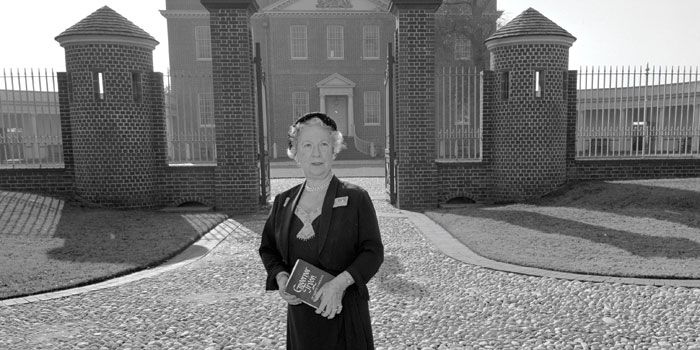
And another… Mrs. Maude Latham was a major financial supporter. Together with Mrs. Carraway and a Mr. and Mrs. Kellenberger, the Tryon Palace Commission was born. Mrs. Carraway hunted down the original plans of the palace used by the architect John Hawks. Mrs. Latham created a trust fund with $100,000 of her money.

Just as things were about to start, Pearl Harbor brought the country in to war. Mrs. Latham didn’t give up. She added another 150,000 to the pot and then bequeathed her entire estate worth one million dollars.  In 1952, almost twenty years after the project began, work began.  The comission stayed busy as well, purchasing back lots that were originally part of the property, and the Kellenbergers and Mrs. Carraway hunted down every piece of Tryon’s or Martin’s furniture they could find (Martin had made a detailed inventory of every piece of furniture and other belongings!). Rather than use reproductions, they traveled the country and Europe to purchase pieces matching the inventory—an estimated 3 million of them purchased entirely by private funding of nearly seventy thousand dollars.

Tryon Park was rebuilt as an exact reproduction of the original building and its grounds are fully restored. On the day in 1958, when it reopened, the Tryon Palace committee turned it over to the state of North Carolina. Mrs. Carraway personally trained all the staff. By then, she knew more about each piece of furniture, each brick and each person to live in or visit the mansion than anyone else. In 1962, she was declared her The North Carolinian of the Year — describing her as “a woman who refused to compromise with anything short of perfection.” Today the North Carolina History Museum is built next door, and Tryon Palace received 249,000 visitors in 2015. Volunteers are the bulk of the staff—a whopping 800 people who spend time caring for the collections, doing tours, and hosting events.

I recently visited this incredible place and was as much in awe of these women as of the palace and gardens. And New Bern is a lovely, small city. Have you visited? If not, I hope you get a chance to!

TRYON PALACE WEBSITE


Mrs. Gertrude Carraway


Debra E. Marvin tries not to run too far from real life but the imagination born out of being an only child has a powerful draw. Besides, the voices in her head tend to agree with all the sensible things she says. She is a member of American Christian Fiction Writers, Sisters in Crime, and serves on the board of Bridges Ministry in Seneca Falls, NY. In 2015, she released her first two novellas, “Alarmingly Charming” in Austen in Austen Vol 1 from WhiteFire Publishing, and “Desert Duet” from Forget Me Not Romances, after many unpublished contest successes including two finals for the Daphne DuMaurier award. Debra works as a program assistant at Cornell University, and enjoys her family and grandchildren, obsessively buying fabric, watching British programming and traveling with her childhood friends.
Coming soon - Starlight Serenade set in 1930, Flagstaff Arizona


Wednesday, September 16, 2015

Off the Beaten Path: Southport, NC by Carrie Fancett Pagels


This summer I've used some travel opportunities to do research for the blog on colonial spots that are off the beaten path. One such place is near Cape Fear, North Carolina--Southport, which was a colonial era seaport of some note! Southport is approached from the Atlantic Ocean, which then empties into a river west of Cape Fear, providing some protection from storms. This spot is at the very southern tip of North Carolina coast. Beyond, is North Myrtle Beach,  in South Carolina. Although the sign, above, indicates the city was established in 1792, the town has even earlier history. See the image below. For those of you who believe the Sioux tribes were always out West, make note of the far left on the timeline.


From the River Walk in Southport, you can view large ships coming into the very deep channel of the Cape Fear River. Nowadays it is regularly dredged so that shipping companies can go upriver to dock, but when I was there, I could really imagine pirates scooting up that river and could imagine people on the banks shivering in terror!


Below is a cargo ship going upriver! It was shocking that it could be that close to shore!


The beautiful small town has a real hometown feel. Note the patriotic bunting on the lovely homes below.


This was a great place to visit! Watch for an upcoming post on another place to visit in Southport!  It has a colonial influence, too! I got several story ideas and research done while in this area and it was well worth the time we spent investigating.

Question: Have you ever visited someplace and then wanted to either read or write a story set there? Where was it?

 Bio: Carrie Fancett Pagels is the award-winning and Amazon Christian Historical Romance bestselling author of The Christy Lumber Camp Series. Her latest release, Lilacs for Juliana is now available in both ebook and paperback formats.

Monday, September 8, 2014

The Southern Campaign of the Revolution: Myth and the Mists of Time


Before I continue my mini-series on colonial myths, I’d like to offer an overview of the Southern Campaign of the American Revolution. How many know what that refers to? Unless you’re a serious American Revolution buff, chances are you don’t.
Kershaw-Cornwallis house, Camden, SC, British headquarters 1780-81
The history taught in schools is sketchy at best, and sometimes  riddled with myth. Where the Revolution is concerned, we’re familiar with the Boston Massacre, Lexington and Concord, the Declaration of Independence, Valley Forge, and Yorktown. What happened in between is fuzzy at best, or missing completely.

We also know individual legends like George Washington and the cherry tree, Betsy Ross, and Molly Pitcher. We’ve also heard of Benedict Arnold’s treachery, and we know the difference between Whig and Tory.

The average person is willing to let their knowledge of history be informed solely by grade-school textbooks, or films like The Patriot. Those of us who have an interest in blogs like this one, on the other hand, thirst to know more ... to get the facts right. :-)

I shared already how a common reenactor myth sparked a story idea, then sent me in search of solid provenance for said story.  As I got deeper into the research, it took my breath away at how little I knew of the Revolution as a whole.

Like the fact that the whole second half of the war took place in the southern colonies.
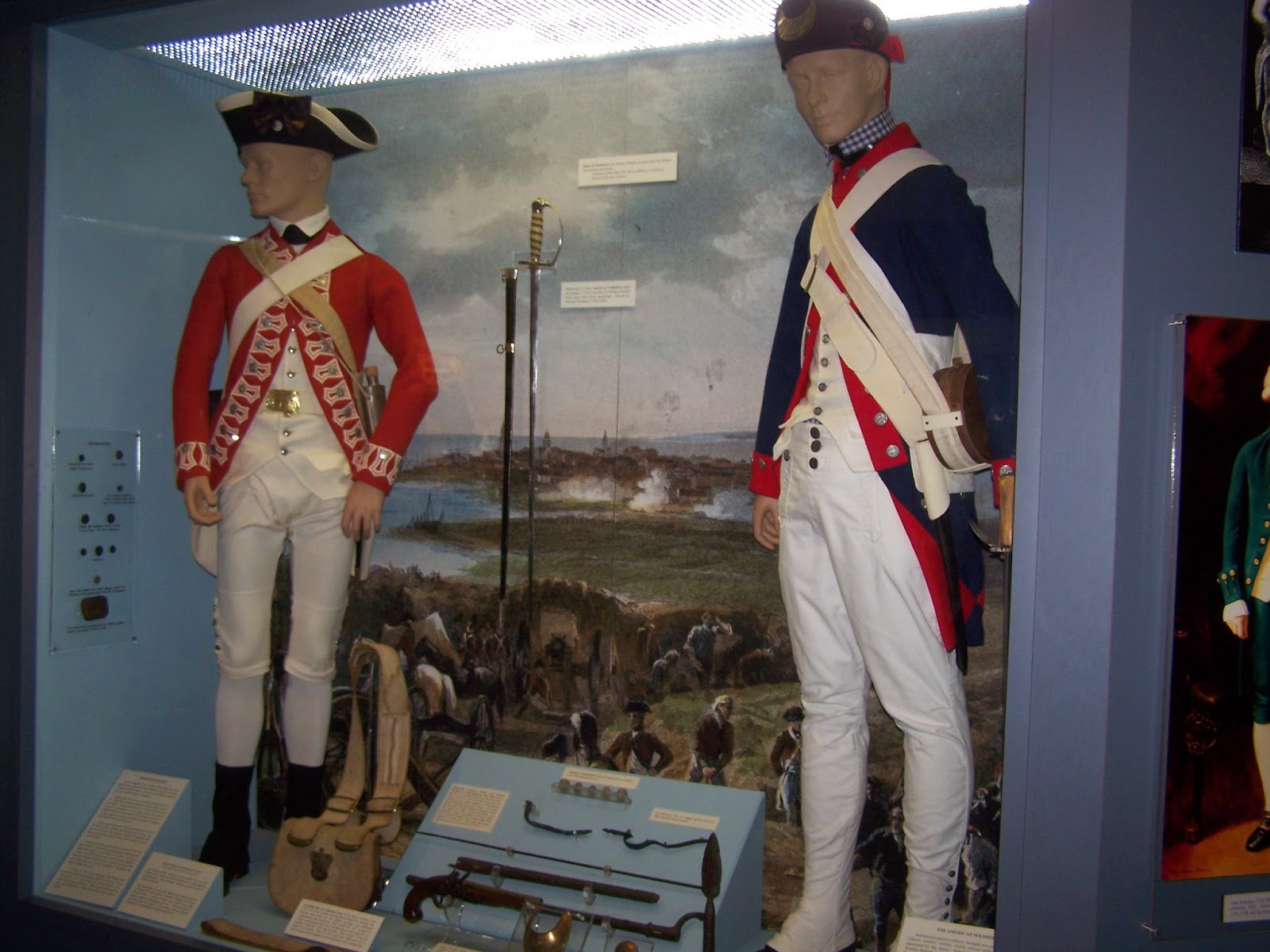
Siege of Charleston display at the Charleston Museum
The war had gone as far as it could in the northern colonies—the British held New York, Boston, and Philadelphia, the major cities. The British cast their eye to the South—for the second time, since an attempt at taking Charleston had failed in 1776. (Much is made of that in Charleston colonial history, in fact, with barely a mention of later events.) This time the effort began with Savannah, Georgia, a lesser port than Charleston, but also an easier target. Savannah fell to the British in late 1779, and the British then turned their sights on Charleston, arguably the most important port and the richest city in the colonies. With a combined offensive on land and sea, the British caught Charleston in a pinch and held it under siege for nearly two long months, March-May 1780.

When the city fell, May 12, 1780, Lord Earl Cornwallis was left to implement the next stage of the "Southern strategy": push into the backcountry while holding Savannah and Charleston. A good part of the populace was believed to be loyalist, but not as many as the British counted on. Their initial plan to establish a network of outposts went smoothly enough at first, but then trouble flared in the backcountry of South Carolina in particular, around Camden, with what became known as the Presbyterian Rebellion. (The trouble was chiefly among the Scotch-Irish Protestant population.)

General Washington sent a force southward, headed by Horatio Gates, and in August 1780 the two armies met just north of Camden, in the wee hours of a moonlit night. Fighting broke out at dawn, and a hot battle turned into a complete rout of the Continental forces, many of them unseasoned militia. Gates was summarily fired after having fled ahead of his troops, and Continental commissary officer Nathanael Greene, a former Quaker, was assigned the task of regrouping the Continental forces and finding ways of making the militia function under fire.

Greene, it turned out, had a genius for logistics—literally, wearing out the British army. Rather than win the war by military might, or number of battles won, he employed a strategy of cutting off supply lines and making it untenable for the British to hold their various outposts.

The force that turned the tide of a war ...
The patriot militia and Continentals won a few of their battles, notably Kings Mountain in October 1780 (a huge surprise, for being mostly Overmountain men untrained in battle) and Cowpens in January 1781 (where Greene found a way to persuade the militia to stand in the face of fire). Others weren’t a dead loss but also not a clear-cut victory on either side, such as Hobkirk Hill in May 1780 (the second battle at Camden) and Eutaw Springs in September 1781. Some were a nightmarish, bloody ordeal on both sides, like Guilford Courthouse in March 1781. Cornwallis reached too far and subjected himself and his troops to an awful, bloody race through North Carolina in the spring of 1781, which after Guilford Courthouse led to the British army limping off to Wilmington, North Carolina, until a fresh press northward to Yorktown, Virginia. By the time October 1781 rolled around, all British troops had withdrawn from South Carolina outposts and were holed up in Charleston. The British cause in the colonies was pretty well finished, and Cornwallis had little choice at Yorktown but to surrender.

These two years comprised possibly the bloodiest and most brutal of the war. Greene is quoted as saying, “Nothing but blood and slaughter has prevailed among the Whigs and Tories, and their inveteracy against each other must, if it continues, depopulate this part of the country.” The Southern Campaign is, I believe, what earned the Revolution the nickname of America’s first civil war. Not much calm and reason here, but passion and fury and vengeance, neighbor against neighbor and brother against brother.

Links of interest:

North Carolina Digital History's War in the South
Southern Campaigns of the American Revolution

All photos mine.

Wednesday, June 4, 2014

Mordecai Park, in North Carolina by Carrie Fancett Pagels


Mordecai House

I have a pictorial tour for you today of historic Mordecai Park in North Carolina.  I had the privilege of visiting here recently when my cousin's wedding reception was held on these grounds.  The nice thing about this place is that it is like you get a mini-trip to a historic street from the late 18th to early 19th centuries! The Mordecai house was built in 1785 and is in Raleigh. This was once one of the largest plantations in the county, according to their website.
Side and back of the Mordecai mansion

17th President Andrew Johnson's home. Note the cool fish scale shingles!

Andrew Johnson's home with fish scale roof


Close up of small attorney's office. It really gives you a sense of what it might have been like to be a person in the early 1800's approaching a lawyer's office building.  Quite different than today!


This is a side view of an early 19th century office building. I like this because I have a story that I could use this for description in. Again, the sense of proportion is interesting because of the columns but also the small size of the office. Wish I could have gone inside but it wasn't open that day.

Columns from front of early 19th Century office
Here's a link to Historic Mordecai Park (click here.)

Do you do road trips for research?  Have you ever been someplace like this where you get enough "flavor" to transport you back to an earlier place in time for your story?  As a reader, do you like to visit places that may be similar to the setting in the book you are reading?