Announcements

10 Year Anniverary & New Releases Winners: Carrie Fancett Pagels' Butterfly Cottage - Melanie B, Dogwood Plantation - Patty H R, Janet Grunst's winner is Connie S., Denise Weimer's Winner is Kay M., Naomi Musch's winner is Chappy Debbie, Angela Couch - Kathleen Maher, Pegg Thomas Beverly D. M. & Gracie Y., Christy Distler - Kailey B., Shannon McNear - Marilyn R.
Showing posts with label Research. Show all posts

Monday, January 10, 2022

Yaupon tea: another small adventure in historical research


Some time back I wrote about my quest to find and try hyson tea, a variety popular during the colonial and Federal eras of our country's history (apparently Thomas Jefferson was a fan) and mentioned in the material accounts surrounding the Harpes. (It's good! Very much like other modern green teas.)

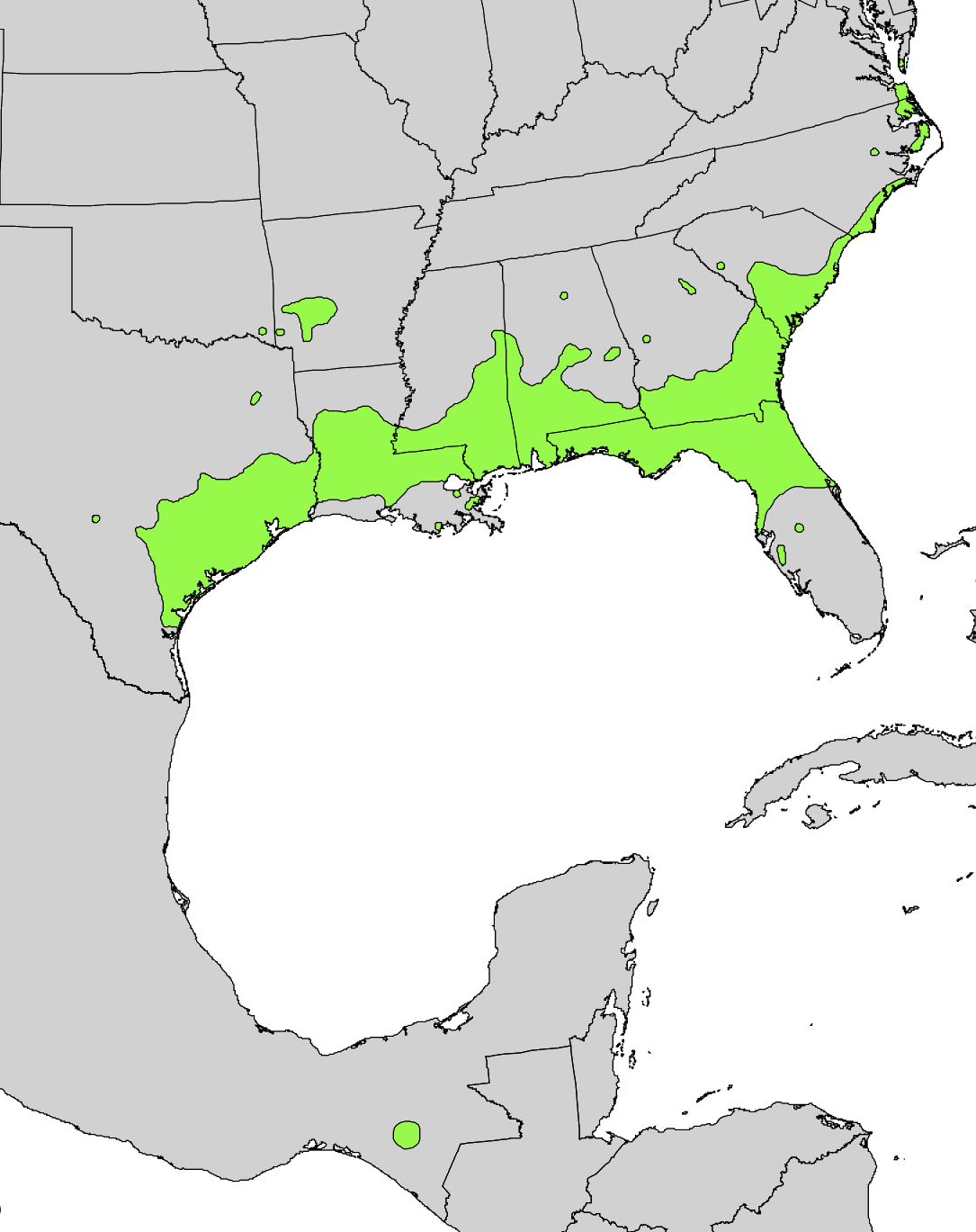
My latest research nerdiness led me to yaupon (YO-pahn), a type of holly which grows wild across the southern United States and the only known source of caffeine native to North America. The berries are poisonous (although by some accounts the native peoples would eat them after boiling for 8-9 hours) but the leaves were steeped and drunk for both social and ceremonial occasions.

(Photo credit: Wikipedia ... range distribution for yaupon)

Gift teas!
The plant would later be categorized Ilex vomitoria for its reputation as an emetic--native peoples would brew it for hours and drink it by the gallon as a stimulant and purgative. But prepared as a "normal" tea and consumed in smaller quantities, it's said to be packed with antioxidants, even more than traditional green teas. It's even rumored to help with high blood sugars and other health issues. At some point in my research months ago, I added a sampler pack to my Amazon gift list and then--forgot about it.

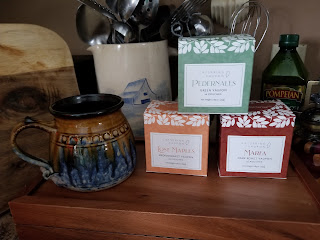
One of my dear daughters-in-law gifted me with the tea for Christmas, though, and so I was beyond excited to try it:  Yaupon by Catspring Tea in three varieties:  green, medium roast, and dark roast.

(Photo credit: mine)

Surprise! It really is as smooth as they claim. Because it doesn't contain tannins, it never develops that puckery taste and feeling black teas get from steeping too long. But warning--this is not a bedtime tea! A week or two ago I needed a cuppa to shake off an after-nap groggy feeling, and opted for the green tea (so far it's my favorite). Well, it was so efficient at banishing my sleepiness that I wound up being wide awake until well after midnight!

Yaupon may not be as high in caffeine as coffee (or so the websites say) but contains theobromine, a substance in chocolate. It's also one of those rare brews which tastes better as it ages!

So that's my experience with a now-obscure tea which was likely offered to English explorers and the Lost Colonists by their native hosts. It was almost certainly used as well in preparation for wartime and coming-of-age rites.

If you're interested in reading more about this staple beverage that once threatened the global tea trade, try any of these articles:


(Photo credit: Wikipedia ... Eastern bluebird feeding on yaupon berries)

Monday, August 17, 2020

Historic Boston (just the highlights! pt.1)

Attending family events, and maybe even doing book research, in the time of corona, is a rare and beautiful thing. Not that I'm saying I've done any of that recently. But I just happen to have found these photos on my phone and would love to share some visual bits of history with y'all ...


We didn't have much time, and what we did get to visit seemed rather haphazard. The first day was a drive-around tour that included Bunker Hill, then the USS Constitution (Old Ironsides) and a drive over to the North End of Boston, up State Street from the wharf to the site of the Boston Massacre. The second day, we walked around the North End and wound up taking the tour of the Old North Church. Remember my previous posts on colonial churches?? More on that one later!

But for now, here are a few highlights of Bunker Hill, one of the first actions of the American Revolution (possibly THE first action) ...

(This post is photo-heavy but I want to make sure some of these are big enough to read!)


This is technically Charlestowne, but the Boston area is BEAUTIFUL, y'all!

My brother, the Marine Corps colonel, shares my love of history, and gave us a running narrative of the Battle of Bunker Hill ... and it definitely took place on a real hill!


We'd come to Boston for a family wedding, but how can a history nerd refuse the chance to splash her toes in the waters of the past, when the opportunity presented itself? With all my study of the Southern Campaign of the American Revolution, standing here on Bunker Hill felt like the completion of something I'd begun years ago--you know, the FIRST half of RevWar history that everyone usually focuses on! :-

More to come ...

Monday, June 18, 2018

The Longhunters


One cannot read colonial-era stories for long without finding mention of the longhunters—or long hunters, depending upon the writer. But just who were these people?

Only known portrait of Daniel Boone during his lifetime (1820)
The era of the longhunter probably starts with the expedition led by Dr. Thomas Walker in 1750 along the frontier of Virginia, into what is now Tennessee and Kentucky by way of Cumberland Gap, who reported on a land of unbelievable richness, with buffalo and beaver and all kinds of other game whose hides and pelts brought a great deal of money out East, and in trade to England. It wasn’t long before various parties of men followed, venturing into the wilderness for “long hunts”—expeditions that, like Walker’s, could last from several months to more than a year. The most famous of the hardy (some might say foolhardy) men who set out on these hunts was Daniel Boone, but he was by no means the only one.

The era reached its peak during the 1760’s. Up until that time, politics between France and England, and resistance from native tribes, kept most from venturing west. Tensions were bad enough during the French and Indian War, and at the close of that conflict in 1763, King George made it essentially illegal to hunt west of the Appalachians without a trading license. The vast majority of hunters ignored his proclamation. One accounts says that Daniel Boone himself did not make his first trip west until 1769, after a visit by English trader John Finley, but others say his first long hunt was in 1750. I'm inclined to believe the latter. Boone’s adventures included capture by the Cherokee and Shawnee, having his pelts confiscated, probable adoption as a native, returning home after so long that his wife had given him up for dead, and the later loss of a son to Indian attack. None of this deterred him from making the hunting grounds his eventual home, and persuading others to join him there.

Other notable longhunters included James Harrod (for whom Harrodsburg, KY is named), Simon Kenton, Elisha Walden (also called Wallen/Walling, for whom Wallen’s Ridge at Cumberland Gap is named), Abraham and Isaac Bledsoe (yes, from the same real-life family I used in both Defending Truth and The Cumberland Bride), and Benjamin Cutbirth (almost certainly a mispronunciation and subsequent mispelling of Cuthbert).

1852 painting of Squire Boone Crossing the mountains
By the time the American Revolution ended, the heyday of the longhunter had passed. The unbelievable abundance of game across Kentucky and Tennessee had thinned considerably, probably less by hunting than pushed westward by the rising tide of settlers. And so the explorers and adventurers went further west, as well. In the process, the Boones and Bledsoes left a trail across Tennessee and into central Missouri of both place names and descendants.

More reading:

William Blevins, Long Hunter
Daniel Boone (and at Wiki)
Simon Kenton
Longhunters (at Wiki)
Bledsoe's Station in Tennessee


Monday, August 8, 2016

Georgian vs. Regency? A Novelist's Primer

King George III of England (Wiki)
Nothing yanks a historically discerning reader out of a story faster than to find inaccuracies about small things they're familiar with. The goofs are easier to forgive when it's an author you love, or when you know that author is writing outside her usual time period, but it still can make for a painful read.

Or when you know some simple research would have remedied the situation.

A recent read brought home to me some very significant differences between what we think of as the Georgian era and the Regency era, differences that are very easily overlooked if you spend more "time" in one era than the other. According to Wikipedia:

The Georgian era of British history is a period which takes its name from, and is normally defined as spanning the reigns of the first four Hanoverian kings of Great Britain who were all named George: George I, George II, George III and George IV. The era covers the period from 1714 to 1830, with the sub-period of the Regency defined by the Regency of George IV as Prince of Wales during the illness of his father George III.
Technically, then, because the Regency era lay within the Georgian, I should say the differences I'm seeing are between the early and the late Georgian.

The first and most basic differences were those of clothing. The fashionable silhouette for a woman went from a tightly-bound, conical torso with the artificially wide or padded hips and bum to a more natural, flowing look reminiscent of the Greeks and Romans. Most of the changes happened between 1785-90, so if you're most familiar with Regency wear but you're writing before that time, here are a few things to remember about women's clothing:
  • Foundational wear was referred to as shift and stays, not chemise and corset. Until just after the American Revolution, stays were highly supportive and kept a woman's torso in a roughly conical shape, pushing a woman's bosom upward and not emphasizing curves as we know them. It was considered accepted during dress occasions for a woman's upper bosom to remain exposed. Only later did stays/corsets take on the hourglass shape most people are familiar with.
  • "Dress" referred either to one's clothing in general, or to the act of getting dressed. It did not, to my knowledge, refer to an actual woman's garment until later. During the Colonial era, a woman's garment was a "gown."
  • Bodices pinned down the front, for the most part. They did NOT lace up the back. Fit was less of an issue then, if, say, a woman needed to borrow her best friend's gown.
  • Sleeves covered to just past the elbow, because, well, a woman of repute just did not show their elbows. (One can see how the later styles of small, puffy sleeves could be considered shocking.)
Men's clothing had a few things to remember as well:
  • A man's shirt had extra-long tails that tucked forward and back, doubling as underwear. So the popular "period" trope of men walking around shirtless, in just their breeches, did not happen. 
  • Men were considered "naked" in just a shirt, or a shirt and breeches, or for that matter anything not covering the torso properly with a waistcoat and neck stock.
  • Overall, menswear suffered fewer changes than womenswear between the early and late Georgian era. One notable difference was hairstyles, the shift from locks long enough to curl, powder, and pull back in a queue, to a shorter, distinctively "windblown" style. The stylish RevWar era gentleman on either side of the pond would not be running his hand through his curls. :)
Oh, and nobody wore "bloomers" until sometime in the 19th century.

Miscellaneous:
Almack's in London ... obviously Regency era clothing :) (Wiki)
  • The "Season" in London. I've been trying to find a firm date on when this became a "thing" and the nearest I can tell is that it began to evolve sometime in the 17th century, but possibly not firmly entrenched into the grain of society until the advent of Almack's (a social club unique to its time in that it admitted both men and women) around 1765, or its rebuilding around 1800. What I have been able to find points to a shift from a debutante's being presented at court to securing vouchers from Almack's as a marker of one's social standing. So the whole "coming out" in London even during the time of the American Revolution may still hold water.
  • Dances:  Couples did not waltz until late 1700's, early 1800's. Former CQ contributor Dina Sleiman writes of the waltz, "It gained popularity on the European continent by around 1780, but was still scorned in respectable circles in England and the United States. It wasn’t until the Prince Regent introduced the waltz at a ball in 1816 that it was accepted in England."
 So these are just a few items, mostly off the top of my head, that I noticed while reading an otherwise very enjoyable author. No, I'm not going to say who. :) Maybe she was just under a serious deadline and didn't have time to stop for research?


Monday, February 2, 2015

A Tale of Two Germans - Review By Carrie Fancett Pagels

Souls for Sale, Nonfiction book

Souls for Sale: Two German Redemptioners Come to Revolutionary America—The Life Stories of John Frederick Whitehead and Johann Carl Büttner, Edited by Susan E. Klepp, Farley Grubb, and Anne Pfaelzer de Ortiz, Pennsylvania State University Press, 2006.

Book Description (from Amazon): In 1773, John Frederick Whitehead and Johann Carl Büttner, two adolescent Germans, were placed on board the same ship headed to colonial America. With few options in Germany, each had been recruited by the labor contractors known popularly as soulsellers—men who traded in human cargo. On arrival in America they were sold to different masters, and, years later, each wrote a memoir of his experiences. These two autobiographies are valuable historical records of immigrant attitudes, perceptions, and goals. Despite their shared voyage to America and similar condition as servants, their backgrounds and personalities differed. Their divergent interpretations of their experiences provide rich firsthand insights into the transatlantic migration process, work and opportunity in colonial America, and the fates of former bound servants.

Souls for Sale presents these parallel accounts—Whitehead's published for the first time—to illustrate the condition of German redemptioners and to examine the religious, economic, familial, and literary contexts that shaped their memoirs. The editors provide helpful introductions to the works as well as notes to guide the reader.


Comments and Review by Carrie Fancett Pagels
In the coming months, I will be contributing several posts on Palatinaters—German immigrants from the Palatinate duchies during the 18th century. I’d been investigating some genealogical links to the Palatinate and found this book. My ancestor John Adam Rousch (Johannes Rausch), hailed from the Palatinate, as did a great many immigrants who crossed the ocean to Pennsylvania in the mid 18th century. From all appearances, Johannes’ family purchased their fares and I’ve found nothing showing he was forced into servitude to pay for his transport. His experiences inspired me to write a fiction (totally fiction other than a few similarities!) I initially entitled Souls' Journey: Escape from Versailles. I found that ironic when I located this nonfiction book, afterwards, with similar way of looking at the whole business of indentured servitude.

In the nonfiction book Souls for Sale, one of the men is from a wealthier background. Each account of Büttner and Whitehead is a separate narrative about experience as a redemptioner, or an indentured servant whose passage was paid to America in return for years spent paying off the debt.  The Penn State book is the first to combine both accounts, which makes for fascinating comparative reading.  While there are some commonalities, it is the differences in their experiences that I found especially intriguing and which would be helpful to those either writing about 18th century German immigrants or male indentured servants in general during that time. These two men came to America several decades after the hero in my upcoming novel but much of the information appeared relevant.

One of the things I enjoyed about reading the men's accounts was their lyrical language. Whitehead in particular has a poetic voice. Sadly, today, we don't write with the same level of vocabulary as in previous centuries or even at the same level as we did in the United State even one century ago. The word choices, although some arcane, are not difficult to decipher, also.

Highly recommend!

Available on Barnes and Noble’s and Amazon’s websites (note although over $30 in paperback it is well worth it if you are researching and writing about this era and topic)

Question: Do you have an 18th century immigrant ancestor from the German duchies? What do you know about him or her?


Carrie Fancett Pagels is the founder of Colonial American Christian Writers Group and blog administrator of Colonial Quills. Her European and colonial novel,  Saving the Marquise’s Granddaughter, will be published by the White Rose imprint of Pelican Book Group in 2015. The hero is from the Palatinate duchy and departs to Pennsylvania in the mid 1740’s, as a redemptioner. 


Monday, October 13, 2014

Dispelling Colonial Myths: the Waxhaws Massacre


Historical marker photo, courtesy of royalprovincial.com
Anyone who researches the Southern Campaign of the Revolution long enough will run across that rallying cry of the patriot side: “Tarleton’s Quarter!” The uninitiated might say, who was Tarleton and why are we discussing coins? Seriously, though, the phrase tracks back to a military engagement right after the breaking of the Siege of Charleston.

Reports on this battle later fueled what I can only term Revolutionary propaganda.

Lt. Col. Banastre Tarleton will have his own article next month, but for now suffice it to say that he was a rising star in the British army, unremarkable during the northern part of the war, but later distinguished himself in a handful of skirmishes in the countryside around Charleston. The battle at Waxhaws was  relatively minor, all things considered.

But the British were brutal, they said. Tarleton ignored any pleas for surrender, they said.

It was a massacre, they said.

And thus the term “Tarleton’s Quarter” was born, and became the rallying cry all across the Carolinas. But what really happened?            

Banastre Tarleton, by Joshua Reynolds
Essentially, Tarleton was sent upstate with a mounted detachment of the British Legion to pursue South Carolina governor John Rutledge, who had escaped Charleston. Word was that he’d taken refuge with “rebel” leader Abraham Buford, whose forces had been mustered out of Virginia for the aid of Charleston, but turned back after the city surrendered. In the blistering heat of late May 1780 in South Carolina, Tarleton led his forces—a mix of cavalry and mounted infantry, and at least one 3-pound cannon—on an impossible dash into the South Carolina backcountry, covering more than 100 miles in 54 hours.

As they neared, Tarleton devised a plan to delay Buford. He sent an officer ahead with a flag of truce to offer terms of surrender—the same terms General Clinton had offered Charleston, as this was a fairly standard operating procedure before a battle—but greatly exaggerated his numbers (he told Buford they had 700 men). Even then, Buford refused. Some say this was his first tactical error. Surrender would not have been any more disgraceful than what just occurred at Charleston, but it’s possible Buford felt he couldn’t surrender without at least attempting a fight. With a detachment of his own men too far away to help, and knowing he was outnumbered, Buford stopped and formed up his troops in a single line. At least one of his fellow officers said this was his second tactical error.

We might be tempted to say, a battle is a battle, but I’ve learned in my research that this is not so—any more than we can say “a dress is a dress” when dealing with style and modesty and historical accuracy. Certain things went into making good decisions about whether to fight or not (are we outnumbered? does the lay of the land favor us?) and how to carry out the battle. Buford should have arranged his troops differently, for one—and then his last and possibly gravest error was to tell his forces to hold their fire. This works when you have infantry (men on foot) but not for cavalry. The single volley of fire had little effect before the line of Tarleton’s cavalry swept over the line, shattering their formation.

Some of Buford’s men started trying to surrender, and Buford himself attempted to raise a white flag, but some of his men were still fighting, with at least one shooting at Tarleton himself. In the heat and passion of battle—both sides were exhausted and doubtless half out of their heads with the intensity of the early summer sun—Tarleton’s horse was killed, trapping him underneath. The men of his detachment (he’d divided his forces into three sections and was leading the left flank), thought their leader had fallen in battle and went into a frenzy. By the time Tarleton got out from under his horse and got his men under control, enough damage had been done to create the rumor of brutality and massacre.

Military analysts later point out that the officers in charge of the center and right flanks maintained control of their men, and the fighting was soon halted in their quarter. The losses were indeed heavy—113 killed, 150 wounded, 53 captured compared to the British losses of 5 killed and 13 wounded. But later reports of “all wounded dying” or the British executing all their prisoners were rubbish. The British provided for the care of their own and enemy wounded alike, setting up a nearby church as a hospital and summoning doctors from neighboring communities. All the wounded were paroled (released to go home when they were recovered enough). Enough reports exist of civility of behavior by Tarleton and his men after things had calmed down, that it throws the hysteria that followed after into serious question.

Considering what we know today of the psychological impact of war, and the shock it must have been to the backcountry folk for this first battle to arrive on their doorsteps, it’s probably no wonder the event became the rallying cry all the way to the Overmountain settlements, or that they immediately began referring to this young British officer as “Bloody Tarleton.”

The Blood Be Upon Your Head by Jim Piecuch
After my research debunking a popular reenactment myth, I wasn’t as surprised as I might have been to find that reports about this battle differed widely, but I was dismayed ... and disappointed. It begs the question, who do you believe when reading historical accounts, even primary accounts?

For more reading on this subject, and a fascinating look into the early months of the Southern Campaign, I recommend The Blood Be Upon Your Head: Tarleton and the Myth of Buford’s Massacre by Jim Piecuch. (You can find this in many local bookstores in the Carolinas, or Google it ... almost anywhere is better than Amazon for purchasing this one, I think!) A much shorter read, covering several of the salient points, can be found at the Oatmeal for the Foxhounds site: the Waxhaws “Massacre.” (More about this site later!)


Wednesday, June 4, 2014

Mordecai Park, in North Carolina by Carrie Fancett Pagels


Mordecai House

I have a pictorial tour for you today of historic Mordecai Park in North Carolina.  I had the privilege of visiting here recently when my cousin's wedding reception was held on these grounds.  The nice thing about this place is that it is like you get a mini-trip to a historic street from the late 18th to early 19th centuries! The Mordecai house was built in 1785 and is in Raleigh. This was once one of the largest plantations in the county, according to their website.
Side and back of the Mordecai mansion

17th President Andrew Johnson's home. Note the cool fish scale shingles!

Andrew Johnson's home with fish scale roof


Close up of small attorney's office. It really gives you a sense of what it might have been like to be a person in the early 1800's approaching a lawyer's office building.  Quite different than today!


This is a side view of an early 19th century office building. I like this because I have a story that I could use this for description in. Again, the sense of proportion is interesting because of the columns but also the small size of the office. Wish I could have gone inside but it wasn't open that day.

Columns from front of early 19th Century office
Here's a link to Historic Mordecai Park (click here.)

Do you do road trips for research?  Have you ever been someplace like this where you get enough "flavor" to transport you back to an earlier place in time for your story?  As a reader, do you like to visit places that may be similar to the setting in the book you are reading?

Friday, November 15, 2013

Adventures in Historically Accurate Costuming, Part 3


Reed for boning, unbleached linen, twill tape ... ready!
So, as things turned out, I wound up in our hometown-to-be the first weekend of November and missed attending the RevWar event in Camden. Finishing out my 18th century ensemble has been put on hold for now, but I’ll talk about my experience with doing a fully boned pair of stays ...

I explained how the cardboard mockup gave me severe cramping across my lower back and hips. I’ve wondered, with my history of back issues (an injury at age 15 made chiropractic care a near necessity over the years), how much of wearing stays was the 18c way of dealing with chronic pain, since at that point they were as much about support as shape, especially among working classes. Infants and children wore specially made stays as well, because society during that era believed that developing bodies needed the support.

Inside of the stays...center is front
Determined to get a rudimentary pair of stays made, I ordered ash boning reed (essentially the same thing used for splining on caned chair seats) and a few other supplies. The wood boning is preferable to other materials because of its flexibility and breathability—using all plastic or metal poses the danger of overheating during summertime wear. For the fabric, I needed three layers: outside, interfacing, and lining. I cut the outer layer from a rough, unbleached linen, the interfacing from white linen left over from my shift, and the lining from the unbleached linen. (I should have switched the interfacing and lining.) I’d made a mockup of cheap muslin and tried it on, and found that it fit well enough I could pretty much just cut out the pieces according to the original pattern. So much for the cardboard mockup being accurate. :-)

Outside of stays
It was also recommended that I not assemble the stays as directed by the pattern (each layer as one), but by pattern piece, sewing the layers together on the boning channels before assembling them as a whole. Also, I made the stays front-lacing as well as back lacing, so I edged the front and back openings alike, following the directions for the back.

Lacing holes--I've hand stitched the edges of one, but not the others!
After sewing in channels and and assembling the two halves of the stays, I inserted one length of boning into each, and made holes down the front and back openings for the lacing (not cutting the fabric, but poking a fine knitting needle through, then a thicker one, and using a heavy embroidery needle to pull the twill tape through the holes for lacings). At that point, there wasn't time to finish out the stays before trying them out for my book launch party.

Pattern for pockets, and other goodies
The fit was amazing! Just enough support and shaping that I shouldn’t have to alter the dress much, if at all. And they are comfortable enough for several hours’ wear, without pain. (No photos of this part, sadly!) I did discover that I'll need to beef up the boning--two lengths per channel--for strength and rigidity. I'll also need to attach the lining before trimming the edges and attaching the binding, which I hear can be a job all its own, depending upon whether I use linen or soft leather. I'm told the soft chamois pieces sold at auto parts stores work great for this.

Pattern for cap
After the book launch party, I’d planned to continue construction on the ensemble—finishing the stays, adding a colonial ladies’ cap and possibly pockets—but all that came to a grinding halt in favor of preparations for my husband to travel to his new job and then my last-minute househunting trip out there. But I have plans to complete the ensemble, after our move.

Any questions on the process? Details you want to ask about? I’m happy to share or clarify!