Announcements

10 Year Anniverary & New Releases Winners: Carrie Fancett Pagels' Butterfly Cottage - Melanie B, Dogwood Plantation - Patty H R, Janet Grunst's winner is Connie S., Denise Weimer's Winner is Kay M., Naomi Musch's winner is Chappy Debbie, Angela Couch - Kathleen Maher, Pegg Thomas Beverly D. M. & Gracie Y., Christy Distler - Kailey B., Shannon McNear - Marilyn R.
Showing posts with label Savannah. Show all posts

Monday, April 9, 2018

The Sieges of Savannah and Charleston, or How the British Left the Colonies

The Siege of Charleston, 1780
In 1779, the British turned their attention from New England and the northeast colonies to what is now termed the Southern Campaign—and they started with Savannah, Georgia. Having taken that in December, they moved north to Charles Towne—Charleston of today—and laid siege to it for six weeks before that mighty port city buckled.

After the surrender at Yorktown, the British forces hunkered down in Charleston and Savannah, but made no further move to withdraw. As Patrick O’Kelley says, “Though the war was near the end, the fighting continued. Old scores needed to be settled, and this had to be done while there was still a war going on. The British in Savannah and Charlestown had to find food for the soldiers and for the refugees huddled near the walls of the cities. The Patriots knew that the sooner they could get the British to leave the two cities, the sooner the war would end, so they opposed any foraging parties coming out of the cities. This led to some intense fighting in the last days of the war.”

The siege of Charleston lasted from 1781 until December 1782. The retaking of Savannah had begun in January 1782 when Major General Anthony Wayne made a bold push against the British in Georgia. The British, thinking they were outnumbered (though they weren’t, by far), fell back to Savannah, and though Wayne did his best to play up the fears of the British, they held onto that city until July.

Last page of the Treaty of Paris, 1783
In the meantime, Greene had his own troubles with troops becoming mutinous in the face of nakedness and hunger. William Moultrie describes how every scrap of cloth was needed to hang about men’s waists, and this in an age where a man was considered “undressed” if he didn’t wear a waistcoat over shirt and breeches. Another officer asked if soldiers could be expected to do their duty, clothed in rags and fed on rice. Even partisan leader Francis Marion, the famed “Swamp Fox,” grew so weary of the constant fight that after one incident in September, he refused to put any more of his men’s lives on the line, so close to the expected departure of the enemy. In one case he and his men even stood guard on behalf of a British foraging party, presumably as much out of compassion as anything.

On July 11, the British officially evacuated from Savannah. Troops headed for Charleston and New York. Many loyalist refugees eventually went south to Florida. The British would drag their feet getting out of Charleston until December 14. British regulars and loyalists dispersed not only back to Britain, but to the Caribbean and Nova Scotia. (Many of Tarleton’s Green Dragoons were given holdings in Nova Scotia, but it was a rather austere location.)

Map of US and territories after the Treaty of Paris
The day after the British fleet sailed from Charleston, the Maryland Line of the Continentals decided their enlistment was over, but Greene told them firmly that the war was not yet finished. That would not happen until the signing of the Treaty of Paris on September 3, 1783, but the fighting in the Carolinas had ended at last.

At least where the British were concerned. Tensions and conflict would continue with the native tribes for years to come. And having cut their losses in the American colonies, the British had already focused their meager energies elsewhere in the world. This marked the end, however, of the colonial era in United States history.

(My thanks as usual to O'Kelley for his excellent work, Nothing But Blood and Slaughter: The Revolutionary War in the Carolinas.)

Monday, February 15, 2016

Colonial Architecture in Georgia

by Denise Weimer
deniseweimerbooks.webs.com


As Georgia got a late start to the other colonies, it’s not surprising that few 1700s buildings dot our landscape today. Begun in 1732 by James Oglethorpe as a relocation destination for those in England’s debtors’ prisons and a refuge for persecuted Protestants, Georgia received its royal charter in 1752. Savannah and Augusta flourished as its earliest cities. 
Christian Camphor House
In towns, the first permanent dwellings reflected the colonists’ memories of home: side-gabled houses with a chimney at one end or New England saltbox style, with the side-gabled roof extending at a gentle pitch above an attached rear shed (example: Christian Camphor House, 1760-7, Savannah). In the country and on the ever-westering frontier, single pen log homes like the Big Holly Cabin in Clarkesville (see example), or double-pen with a connecting breezeway known as “dogtrot” style, became common. Frontiersmen constructed these most commonly of heart pine, but sometimes of poplar or cypress on the coast. Sometimes the logs were only hewn on one side and were pegged together if square-head nails proved unavailable. English settlers often used dovetail notching, while Cherokee cabins used saddle notching. Chinking consisted of dried mud, pebbles and horsehair.

Big Holly Cabin

Finer Georgia homes of the late 1700s represented several styles:
·         Georgian Colonial emphasized symmetry and box shape, often featuring five windows across the top with shutters and a paneled front door framed by simple columns, often flattened. A gambrel roof included front and rear porches. (Example: 1797 Ezekiel Harris House, Harrisburg; and 1771 stucco over brick “Olde Pink House” aka James Habersham Jr. House, Savannah.)

Olde Pink House
Ezekiel Harris House
·         Federal Colonial also featured a prominent square or rectangular shape with Palladian or Venetian windows and an interior, curved, iron-railed stair. (Example: 1790 Grey House built by Jacob Callaway near Washington.)

·        
Wild Heron Plantation
Plantation Plain homes were two rooms wide and one room deep, situated on a raised brick basement with a pitched shed roof over the front and sometimes rear porch. (Example: 1756 Wild Heron Plantation, outside Savannah.) Most Plantation Plain homes were constructed 1790-1850, with most examples remaining in Piedmont Georgia.
·         One unique style of Colonial architecture exists near Augusta, Georgia in 1791 Meadow Garden, home to George Walton, the Son of Liberty who at 26 became the youngest signer of the Declaration of Independence. The militia colonel wounded in the Siege of Savannah retired to his two-and-a-half-story retreat on a brick basement in Sands Hill Cottage style similar to those in the Summerville area of Augusta. (See example.)


Meadow Garden


·        Another unique form of Colonial architecture stands as a solid reminder of the vanished Quaker settlement at Wrightsborough, the 1785 Old Rock House built by Thomas Ansley in Delaware Valley style. (See example.)

Looking for your own piece of Colonial Georgia? Buy the Georgia Trust endangered-listed 1798 Smith-Turner House for a mere $65,000 in Lexington, not far from this writer’s area. (See example.) But bring a little pocket change for this fixer-upper! 
Smith-Turner House - Buy Me!

Monday, September 8, 2014

The Southern Campaign of the Revolution: Myth and the Mists of Time


Before I continue my mini-series on colonial myths, I’d like to offer an overview of the Southern Campaign of the American Revolution. How many know what that refers to? Unless you’re a serious American Revolution buff, chances are you don’t.
Kershaw-Cornwallis house, Camden, SC, British headquarters 1780-81
The history taught in schools is sketchy at best, and sometimes  riddled with myth. Where the Revolution is concerned, we’re familiar with the Boston Massacre, Lexington and Concord, the Declaration of Independence, Valley Forge, and Yorktown. What happened in between is fuzzy at best, or missing completely.

We also know individual legends like George Washington and the cherry tree, Betsy Ross, and Molly Pitcher. We’ve also heard of Benedict Arnold’s treachery, and we know the difference between Whig and Tory.

The average person is willing to let their knowledge of history be informed solely by grade-school textbooks, or films like The Patriot. Those of us who have an interest in blogs like this one, on the other hand, thirst to know more ... to get the facts right. :-)

I shared already how a common reenactor myth sparked a story idea, then sent me in search of solid provenance for said story.  As I got deeper into the research, it took my breath away at how little I knew of the Revolution as a whole.

Like the fact that the whole second half of the war took place in the southern colonies.
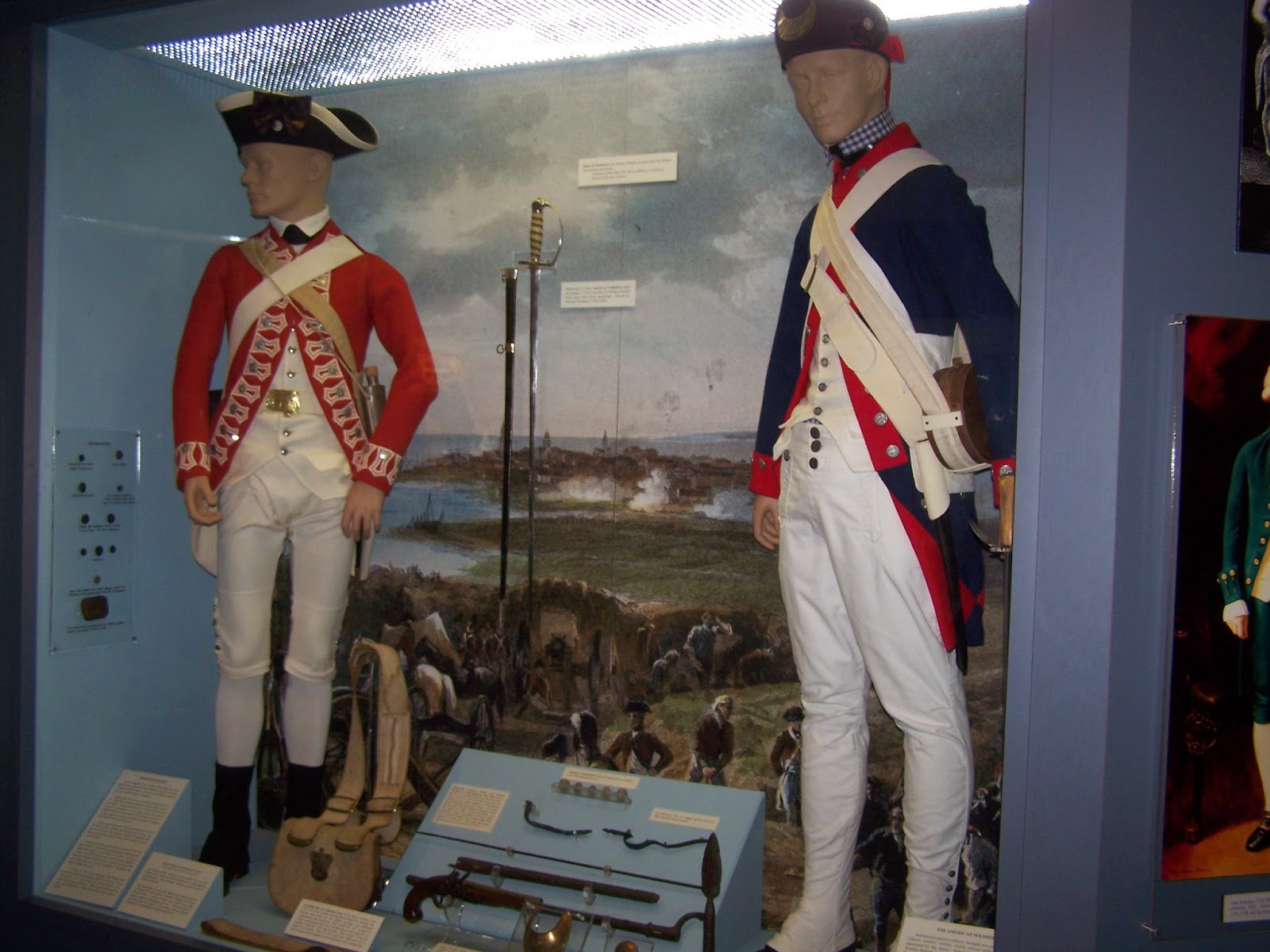
Siege of Charleston display at the Charleston Museum
The war had gone as far as it could in the northern colonies—the British held New York, Boston, and Philadelphia, the major cities. The British cast their eye to the South—for the second time, since an attempt at taking Charleston had failed in 1776. (Much is made of that in Charleston colonial history, in fact, with barely a mention of later events.) This time the effort began with Savannah, Georgia, a lesser port than Charleston, but also an easier target. Savannah fell to the British in late 1779, and the British then turned their sights on Charleston, arguably the most important port and the richest city in the colonies. With a combined offensive on land and sea, the British caught Charleston in a pinch and held it under siege for nearly two long months, March-May 1780.

When the city fell, May 12, 1780, Lord Earl Cornwallis was left to implement the next stage of the "Southern strategy": push into the backcountry while holding Savannah and Charleston. A good part of the populace was believed to be loyalist, but not as many as the British counted on. Their initial plan to establish a network of outposts went smoothly enough at first, but then trouble flared in the backcountry of South Carolina in particular, around Camden, with what became known as the Presbyterian Rebellion. (The trouble was chiefly among the Scotch-Irish Protestant population.)

General Washington sent a force southward, headed by Horatio Gates, and in August 1780 the two armies met just north of Camden, in the wee hours of a moonlit night. Fighting broke out at dawn, and a hot battle turned into a complete rout of the Continental forces, many of them unseasoned militia. Gates was summarily fired after having fled ahead of his troops, and Continental commissary officer Nathanael Greene, a former Quaker, was assigned the task of regrouping the Continental forces and finding ways of making the militia function under fire.

Greene, it turned out, had a genius for logistics—literally, wearing out the British army. Rather than win the war by military might, or number of battles won, he employed a strategy of cutting off supply lines and making it untenable for the British to hold their various outposts.

The force that turned the tide of a war ...
The patriot militia and Continentals won a few of their battles, notably Kings Mountain in October 1780 (a huge surprise, for being mostly Overmountain men untrained in battle) and Cowpens in January 1781 (where Greene found a way to persuade the militia to stand in the face of fire). Others weren’t a dead loss but also not a clear-cut victory on either side, such as Hobkirk Hill in May 1780 (the second battle at Camden) and Eutaw Springs in September 1781. Some were a nightmarish, bloody ordeal on both sides, like Guilford Courthouse in March 1781. Cornwallis reached too far and subjected himself and his troops to an awful, bloody race through North Carolina in the spring of 1781, which after Guilford Courthouse led to the British army limping off to Wilmington, North Carolina, until a fresh press northward to Yorktown, Virginia. By the time October 1781 rolled around, all British troops had withdrawn from South Carolina outposts and were holed up in Charleston. The British cause in the colonies was pretty well finished, and Cornwallis had little choice at Yorktown but to surrender.

These two years comprised possibly the bloodiest and most brutal of the war. Greene is quoted as saying, “Nothing but blood and slaughter has prevailed among the Whigs and Tories, and their inveteracy against each other must, if it continues, depopulate this part of the country.” The Southern Campaign is, I believe, what earned the Revolution the nickname of America’s first civil war. Not much calm and reason here, but passion and fury and vengeance, neighbor against neighbor and brother against brother.

Links of interest:

North Carolina Digital History's War in the South
Southern Campaigns of the American Revolution

All photos mine.