Announcements

10 Year Anniverary & New Releases Winners: Carrie Fancett Pagels' Butterfly Cottage - Melanie B, Dogwood Plantation - Patty H R, Janet Grunst's winner is Connie S., Denise Weimer's Winner is Kay M., Naomi Musch's winner is Chappy Debbie, Angela Couch - Kathleen Maher, Pegg Thomas Beverly D. M. & Gracie Y., Christy Distler - Kailey B., Shannon McNear - Marilyn R.
Showing posts with label General Horatio Gates. Show all posts

Monday, November 25, 2019

The Painter of the Revolution

John Trumbull, self-portrait ca. 1802
Before a practical method of photography developed around the mid 1800s, the only way people had of “seeing” the past was through written descriptions and works of art. There’s much that can’t be conveyed in words, however, and we would have no idea of what the Founders of our Republic and the military leaders, battles, and landscapes of the Revolutionary War period actually looked like if it weren’t for contemporary sketches, drawings, paintings, and sculptures. In fact, one artist, a veteran of that war, became famous as the “Painter of the Revolution”. Today we’re greatly indebted to John Trumbull for his vivid and accurate depictions of the people, places, and events of a time so crucial to the existence of our nation.

Trumbull was born in Lebanon, Connecticut, in 1756, the youngest of six children of Jonathan Trumbull, Sr., and Faith Robinson Trumbull, both descendants of Puritans who were early settlers in the colony. His father was governor of Connecticut from 1769 to 1784. Although blinded in the left eye by a childhood accident, Trumbull entered the junior class at Harvard College in 1771 at the age of 15. During that period, he visited John Singleton Copley’s studio and was inspired to become a painter. After graduating in 1773, he taught school but joined the Continental Army when the colonies revolted against the British in 1775.

General George Washington at Trenton
by John Trumbull, 1792
While stationed at Boston, Trumbull provided sketches of both British and American lines and works and was a witness to the Battle of Bunker Hill. He served briefly as aide de camp to General George Washington, and in June 1776 was appointed deputy adjutant general to General Horatio Gates at the rank of colonel. In 1777 he resigned because of a dispute over the dating of his officer’s commission—a common cause of dissention among officers back then.

Deciding on a career in art, he traveled to London in 1780, where Benjamin Franklin introduced him to another American artist, Benjamin West. While studying under him, Trumbull openly supported the American cause, not a wise policy with the war still ongoing! The news of British agent Major John André’s capture and subsequent hanging as a spy by the Americans reached London, evoking public outrage and spurring the government to have him arrested in retaliation since he had been an officer in the Continental Army of similar rank to André. Trumbull was imprisoned for seven months, until West’s intervention secured his release.

Declaration of Independence by John Trumbull, 1819
Trumbull returned to the United States, but when the peace treaty was ratified in 1783, he returned to London to again study under West. Over the next few years he made portrait sketches of French officers in Paris for his painting Surrender of Lord Cornwallis. He also began the early composition of Declaration of Independence, painting small portraits of the signers and copying previous portraits for those who had died, which he later used to piece together the larger painting.

Trumbull was elected a Fellow of the American Academy of Arts and Sciences in 1791 and served as its president. In 1794 he acted as John Jay’s secretary in London during negotiations for a treaty with Great Britain that settled America’s main boundary with Canada. A couple of years later he was appointed to a commission that mediated the claims of American and British merchants that remained from the war. He married Sarah Hope Harvey, an English amateur painter while there, but his attempts to make a living painting portraits in London had little success, and a studio in New York City met with similar results. Then in 1817 Congress commissioned him to paint four large pictures for the Rotunda of the U.S. Capitol, where they hang today: General George Washington Resigning His Commission, Surrender of Lord Cornwallis, Surrender of General Burgoyne, and Declaration of Independence. He completed the series in 1824, basing it on the small originals of these scenes that he painted years earlier.

Surrender of Lord Cornwallis by John Trumbull, 1820
By far the largest single collection of Trumbull’s works is held by Yale University. The collection was originally housed in a neoclassical art gallery he designed on Yale’s Old Campus. Among his portraits are ones of General Washington, George Clinton, Alexander Hamilton, John Jay, John Adams, and many others, some at full length. He also completed several self-portraits and was painted by Gilbert Stuart and other well-known artists.

Trumbull published his autobiography in 1841. He died 2 years later, on November 10, 1843, in New York City at the age of 87. He and his wife were interred beneath the Art Gallery at Yale University, which he had designed, but when the collection was moved to Street Hall in 1867, their remains were reinterred on those grounds.

I love to study the works of artists throughout the ages. In fact, I’d find it hard to write historical novels without having access to such works. How do images created by artists throughout history spark your imagination and enable you to understand and even identify with people, places, and events of previous times? Please share!

Wednesday, May 20, 2015

History of the Saratoga Monument


by Elaine Marie Cooper

For years in the early 1800’s, the grassy bluff overlooking the Hudson River in Schuylerville, New York, looked like an ordinary field. But the residents of the area knew differently. On October 17, 1777, it was the site where British General John Burgoyne surrendered to the American Army after the Battle of Saratoga—and the course of history changed as the Revolution began its victorious turn toward the birth of a new nation.

While other historic locales often had granite rocks of remembrance, the site of the surrender in Saratoga was left unmarked. Several citizens of New York State bemoaned the lack of a monument and determined to erect one.


On October 17, 1856 (the 79th anniversary of the surrender), a group of patriotic gentleman met in the town of Schuylerville to discuss a plan. After a small celebration including a banquet, the group organized a Saratoga Monument Association, with the intent to erect “a fitting memorial on the site of Burgoyne’s surrender.”

The outbreak of the Civil War in 1861 cast a gloom over the country and suspended all planning for a Saratoga Monument. It wasn’t until 1872 that the association was able to reconvene. In the meantime, several of the association’s original trustees had died—but the dream of creating a monument had not.


New members joined the cause and petitions were sent to the legislatures of the original thirteen colonies asking for their support. An architect designed a plan for the monument and a letter was sent to Congress requesting an appropriation of funds for this memorial to celebrate the upcoming centennial of the battle.

A petition to the Senate and assembly of the State of New York earnestly entreated support for “considerations of high patriotic duty…to commemorate the centennial anniversary of the great victory.” It was hoped that the laying of the corner stone might take place at that time.

Years of effort were finally accomplished on October 17, 1877, when a two-mile procession, replete with civic, masonic and military pageantry, marched to the site of the surrender where, in front of 40,000 viewers, the cornerstone for the Saratoga Monument was laid.


When the ground was broken during the memorial’s construction, the architect discovered two bullets from the 1777 battle within a foot of each other. While excavating the same area, workmen dug up two cannon balls.

Finally in 1883, the completed granite obelisk rose to its full height of 155 feet. It is an impressive sight both from a distance and up close. The four sides have arched alcoves, one for each heroic American officer who led at Saratoga in 1777. The niche facing west has a statue of sharpshooter, Colonel Daniel Morgan. The eastern alcove holds a likeness of General Phillip Schuyler and the northern niche, General Horatio Gates. Only the southern alcove is empty, representing Benedict Arnold who was a hero in Saratoga but turned traitor during the American Revolution. It is often said that if Arnold had died of the wounds he received in that battle, he would today be remembered as a hero. Instead his name is synonymous with being a turncoat.


The Saratoga Monument is now overseen by the National Park Service and is open for visitors during the summer months. For more information about visiting the monument and the Saratoga battlefield, you can visit their website here


Elaine Marie Cooper is the author of the award-winning historic novel, Fields of the Fatherless. Her upcoming novel, Saratoga Letters, will be released by Lighthouse Publishing of the Carolinas in 2016. You can visit her website/blog here.


Monday, September 8, 2014

The Southern Campaign of the Revolution: Myth and the Mists of Time


Before I continue my mini-series on colonial myths, I’d like to offer an overview of the Southern Campaign of the American Revolution. How many know what that refers to? Unless you’re a serious American Revolution buff, chances are you don’t.
Kershaw-Cornwallis house, Camden, SC, British headquarters 1780-81
The history taught in schools is sketchy at best, and sometimes  riddled with myth. Where the Revolution is concerned, we’re familiar with the Boston Massacre, Lexington and Concord, the Declaration of Independence, Valley Forge, and Yorktown. What happened in between is fuzzy at best, or missing completely.

We also know individual legends like George Washington and the cherry tree, Betsy Ross, and Molly Pitcher. We’ve also heard of Benedict Arnold’s treachery, and we know the difference between Whig and Tory.

The average person is willing to let their knowledge of history be informed solely by grade-school textbooks, or films like The Patriot. Those of us who have an interest in blogs like this one, on the other hand, thirst to know more ... to get the facts right. :-)

I shared already how a common reenactor myth sparked a story idea, then sent me in search of solid provenance for said story.  As I got deeper into the research, it took my breath away at how little I knew of the Revolution as a whole.

Like the fact that the whole second half of the war took place in the southern colonies.
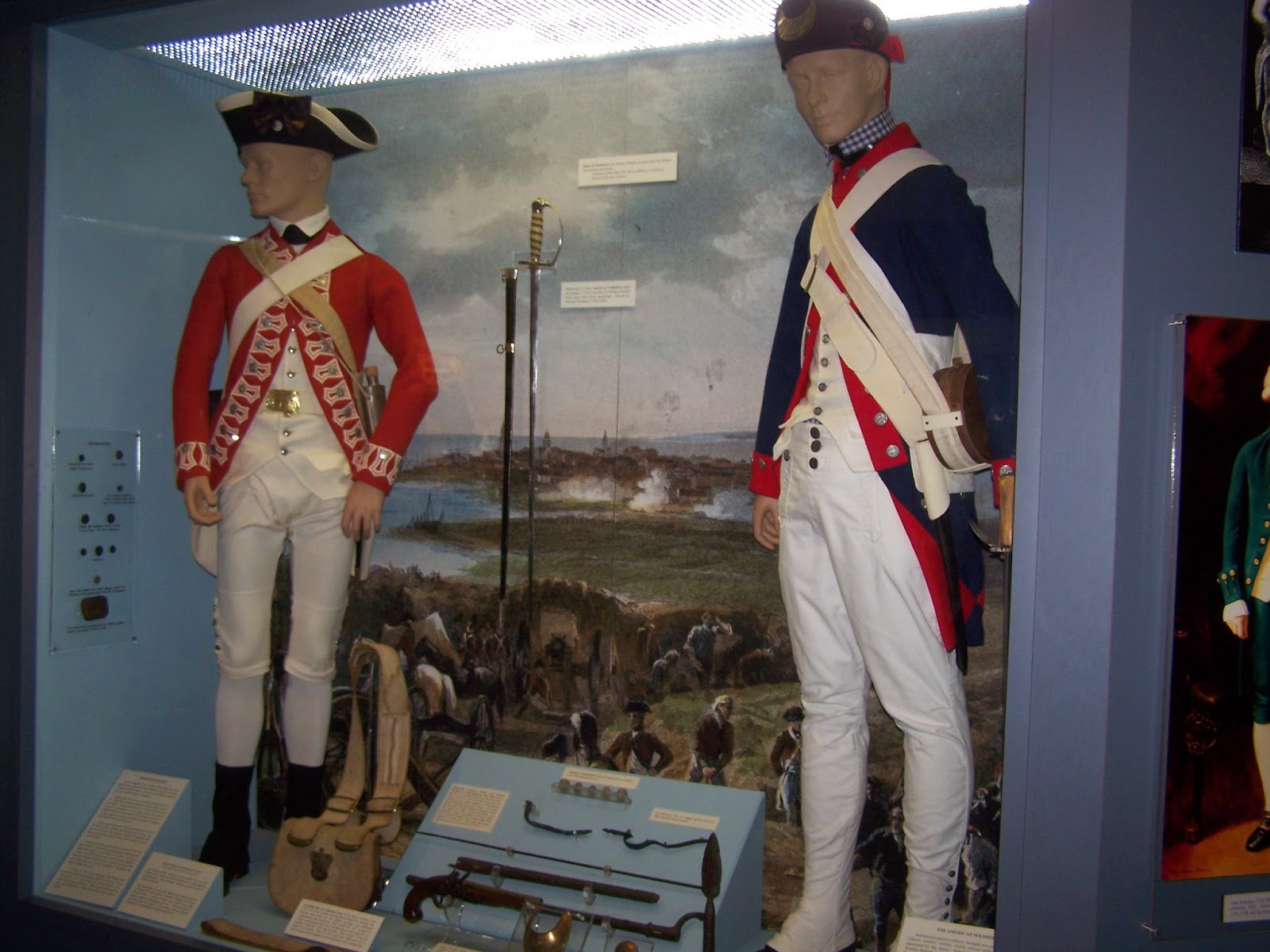
Siege of Charleston display at the Charleston Museum
The war had gone as far as it could in the northern colonies—the British held New York, Boston, and Philadelphia, the major cities. The British cast their eye to the South—for the second time, since an attempt at taking Charleston had failed in 1776. (Much is made of that in Charleston colonial history, in fact, with barely a mention of later events.) This time the effort began with Savannah, Georgia, a lesser port than Charleston, but also an easier target. Savannah fell to the British in late 1779, and the British then turned their sights on Charleston, arguably the most important port and the richest city in the colonies. With a combined offensive on land and sea, the British caught Charleston in a pinch and held it under siege for nearly two long months, March-May 1780.

When the city fell, May 12, 1780, Lord Earl Cornwallis was left to implement the next stage of the "Southern strategy": push into the backcountry while holding Savannah and Charleston. A good part of the populace was believed to be loyalist, but not as many as the British counted on. Their initial plan to establish a network of outposts went smoothly enough at first, but then trouble flared in the backcountry of South Carolina in particular, around Camden, with what became known as the Presbyterian Rebellion. (The trouble was chiefly among the Scotch-Irish Protestant population.)

General Washington sent a force southward, headed by Horatio Gates, and in August 1780 the two armies met just north of Camden, in the wee hours of a moonlit night. Fighting broke out at dawn, and a hot battle turned into a complete rout of the Continental forces, many of them unseasoned militia. Gates was summarily fired after having fled ahead of his troops, and Continental commissary officer Nathanael Greene, a former Quaker, was assigned the task of regrouping the Continental forces and finding ways of making the militia function under fire.

Greene, it turned out, had a genius for logistics—literally, wearing out the British army. Rather than win the war by military might, or number of battles won, he employed a strategy of cutting off supply lines and making it untenable for the British to hold their various outposts.

The force that turned the tide of a war ...
The patriot militia and Continentals won a few of their battles, notably Kings Mountain in October 1780 (a huge surprise, for being mostly Overmountain men untrained in battle) and Cowpens in January 1781 (where Greene found a way to persuade the militia to stand in the face of fire). Others weren’t a dead loss but also not a clear-cut victory on either side, such as Hobkirk Hill in May 1780 (the second battle at Camden) and Eutaw Springs in September 1781. Some were a nightmarish, bloody ordeal on both sides, like Guilford Courthouse in March 1781. Cornwallis reached too far and subjected himself and his troops to an awful, bloody race through North Carolina in the spring of 1781, which after Guilford Courthouse led to the British army limping off to Wilmington, North Carolina, until a fresh press northward to Yorktown, Virginia. By the time October 1781 rolled around, all British troops had withdrawn from South Carolina outposts and were holed up in Charleston. The British cause in the colonies was pretty well finished, and Cornwallis had little choice at Yorktown but to surrender.

These two years comprised possibly the bloodiest and most brutal of the war. Greene is quoted as saying, “Nothing but blood and slaughter has prevailed among the Whigs and Tories, and their inveteracy against each other must, if it continues, depopulate this part of the country.” The Southern Campaign is, I believe, what earned the Revolution the nickname of America’s first civil war. Not much calm and reason here, but passion and fury and vengeance, neighbor against neighbor and brother against brother.

Links of interest:

North Carolina Digital History's War in the South
Southern Campaigns of the American Revolution

All photos mine.

Friday, April 12, 2013

With Fire and Sword


With Fire and Sword – The Battle of King’s Mountain 1780 was written by Wilma Dykeman for the National Park Service. (approx. 82 pgs.)


           “Wilma Dykeman is a novelist, historian, and chronicler of the south-eastern mountain country. Among her books are The French Broad (in the Rivers of America series), The Border States, and Tennessee: A Bicentennial History, all dealing with the land and people for which the Battle of King’s Mountain was fought.” So states the foreward for this booklet, probably published as a handbook for museums located in the areas discussed throughout this compelling non-fiction story.     
Dykeman, an accomplished author, begins her tale of the Battle of King’s Mountain by lulling us into a sense of serenity as she describes the lovely mid-autumn harvest time of the southern highlands, the Cumberland Gap, and the lives of the “overmountain” people. All the while, she builds an underlying tension as she discusses the characters of men who will clash, claiming a harvest of lives on both sides of the battle.
          It’s about the strengths and weaknesses of both Patriot and British alike; in those character flaws that the battle will be won or lost. It is in the misguided decisions of Cornwallis, Gates and Tarleton that build the foundation for the battle to come, where lesser-known, but courageous men like Ferguson, the British soldier-prodigy, meets the fiercely independent patriot militias of Shelby, Chronicle and McDowell.  
The characters discussed and the decisions they made which inexorably led to the events on King’s Mountain in the autumn of 1780 will make for riveting reading, whether you’re a writer, student, history buff, or just enjoy a good adventure story. This booklet can be found on Amazon. 
I don’t know how it happened to end up in a book sale in northern New York, but I saw it on the shelf of my local library and had to have it!
My rating: 4 ½ Stars out of 5.  (Why not five? It’s too short!)

Wednesday, August 29, 2012

General Baron de Kalb and The Battle of Camden, SC


General Baron de Kalb
By Susan F. Craft

General Baron DeKalb was born in Germany in 1721. He served with distinction  in the French Army during the War of Austrian Succession and the Seven Years’ War.
In 1768 on behalf of France, he traveled to America on a covert mission to determine the level of discontent amongst colonists.
In 1777, he returned with his protégé, the Marquis de Lafayette, and joined the Continental Army.
On August 16, 1780, five miles north of Camden, SC, British forces under Lt. General Charles, Lord Cornwallis defeated the American forces under the command of Major General Horatio Gates.
Gates had over 4,000 men, but only 2,000 were effective for combat. Many succumbed to the heat and also the night before, the men had been fed green corn, causing many to suffer bowel problems.
Lt. General Lord Cornwallis
Cornwallis had around 2,100 men. Six hundred were Loyalist militia and Volunteers of Ireland, and 1,500 were regular troops. Cornwallis also had the infamous and highly experienced Tarleton's Legion, around 250 cavalry and 200 infantry.
The British troops opened the battle by firing a volley into the militia, followed by a bayonet charge. The militia, lacking bayonets, panicked and ran away. The panic spread to the North Carolina militia, and they also fled.  Gates bolted with the first of the militia to run from the field and took refuge 60 miles away in Charlotte, NC. Before he ran, he ordered his right flank under General Baron de Kalb to attack the British militia.
Under de Kalb, the Continentals fought hard, but they numbered only 600 to 2,000 British troops. Cornwallis ordered Tarleton's cavalry to charge the rear of the Continental line. The cavalry charge broke up the formation of the Continental troops.
De Kalb tried to rally his men but was fatally wounded.
After only one hour of combat, the Americans were utterly defeated, suffering over 2,000 casualties. Tarleton's cavalry pursued and harried the retreating Continental troops for 20 miles.
The Battle of Camden, SC
The terrible route for the Americans at the Battle of Camden strengthened the British hold on the Carolinas that were already reeling from the capture of Charleston, SC, by General Sir Henry Clinton in January 1780.
Here’s how Andrew, a character in my novel, The Chamomile, described General de Kalb.
You see, General de Kalb wasn’t one of those officers that puts space between him and his men. He was one of us. Most times when we traveled, he didn’t ride his horse, but marched along beside us. Came around each night and shared the food and fire. Slept on the ground with us. And stories? He could tell some of the best stories. Knew how to share silence too.
At Camden, we were pretty much beaten. Six hundred of us to their two thousand. De Kalb sent his horse to the back of the lines early on, so he could fight side by side with us on foot. Time after time we charged, reformed, and charged again with the general leading the way.
Someone laid his head open with a saber. He was shot. Bayoneted. Cut many times. But he still led one more charge. When the general finally fell, we closed ranks around him. Then Tarleton brought in his dragoons. We fought as long as we could, until most of us broke and ran.
I was running for the woods with the rest of them, but I turned in time to see British soldiers headed toward the general to finish him off. They would have, too, but his aide, Chevalier de Buysson, threw his body on top of him and yelled, "No! No! It’s de Kalb. Brigadier General de Kalb."

Cornwallis ordered his own surgeons to try and save de Kalb.
Death of de Kalb
Here is de Kalb’s response, “I thank you sir for your generous sympathy, but I die the death I always prayed for; the death of a soldier fighting for the rights of man.”
When the general died three days later, Cornwallis found out he was a Mason, same as himself. He had him buried with full military and Masonic honors.
Years later, on a tour of South Carolina, President George Washington visited the grave of DeKalb and is reported to have said the following, “So there lies the brave de Kalb; the generous stranger who came from a distant land to fight our battles and to water with his blood the tree of our liberty. Would to God he had lived to share with us its fruits.”