Announcements

10 Year Anniverary & New Releases Winners: Carrie Fancett Pagels' Butterfly Cottage - Melanie B, Dogwood Plantation - Patty H R, Janet Grunst's winner is Connie S., Denise Weimer's Winner is Kay M., Naomi Musch's winner is Chappy Debbie, Angela Couch - Kathleen Maher, Pegg Thomas Beverly D. M. & Gracie Y., Christy Distler - Kailey B., Shannon McNear - Marilyn R.
Showing posts with label loyalists. Show all posts

Monday, February 12, 2018

Nothing but Blood and Slaughter


The Battle of Guilford Courthouse, North Carolina
One cannot study the American Revolution for long before stumbling over the ugly reality of partisan conflict—family and neighbors divided by politics and loyalties and the necessity of war.

I say “necessity” because sides weren’t necessarily chosen by ideals, but whatever seemed best in order to protect one’s family and/or holdings. Sometimes it was a matter of whichever side offended a person the most, or how driven by vengeance one might be, as we saw in the case of William Cunningham.

Though the stance of the Tory has often been painted as that of a coward, often those who chose loyalty to the crown felt that rebellion was the coward’s
way, and irresponsible, if not outright ungodly. Scriptures such as Romans 13:1 seemed to them to point toward unconditional obedience to the king.

The Whigs, on the other hand, felt that King George overstepped his God-given authority. In fact, many of the Protestant groups, such as the Scots-Irish Presbyterians of the South Carolina backcountry, believed he was actually usurping the place of Christ in the Church, and for that reason alone should be resisted with utmost fervor. (Thus the Presbyterian Rebellion of 1780.) Add to that the insult of things such as the Stamp Act, which from the British perspective was merely to defray the mounting cost of defending the colonies from invaders (i.e., during the French and Indian War), and many saw the unrest in the colonies as a powder keg, ready to explode.

At the least, is it any wonder that in the absence of regional lines being drawn, as in the later War Between the States, the conflict turned so bitter between family and neighbors?

When the British launched the Southern Campaign from Savannah northward, they expected quick support and an easy quelling of the rebellion, but what they found was a mess of infighting and loyalties that swayed either way, depending upon the outcome of various battles. After the Siege of Charleston, however, they made a steady push into the Carolina backcountry that remained successful for a while, and were greatly encouraged by the complete rout of Continental forces during the Battle of Camden. General Horatio Gates of the Continental forces was later court-martialed for fleeing the battlefield, mostly ahead of his own troops, and General Nathanael Greene was given command in his place. When he arrived on the scene several months later, this normally unflappable former Quaker had this to say about the situation, and one can almost hear his exasperation:

Nothing but blood and slaughter has prevailed among the Whigs and tories, and their inveteracy against each other must, if it continues, depopulate this part of the country.

Greene’s concerns were well founded. At the least, the constant depredations from both sides led to much want and near famine. (And thus the title of one of my favorite resources on the Revolutionary War in the Carolinas.)
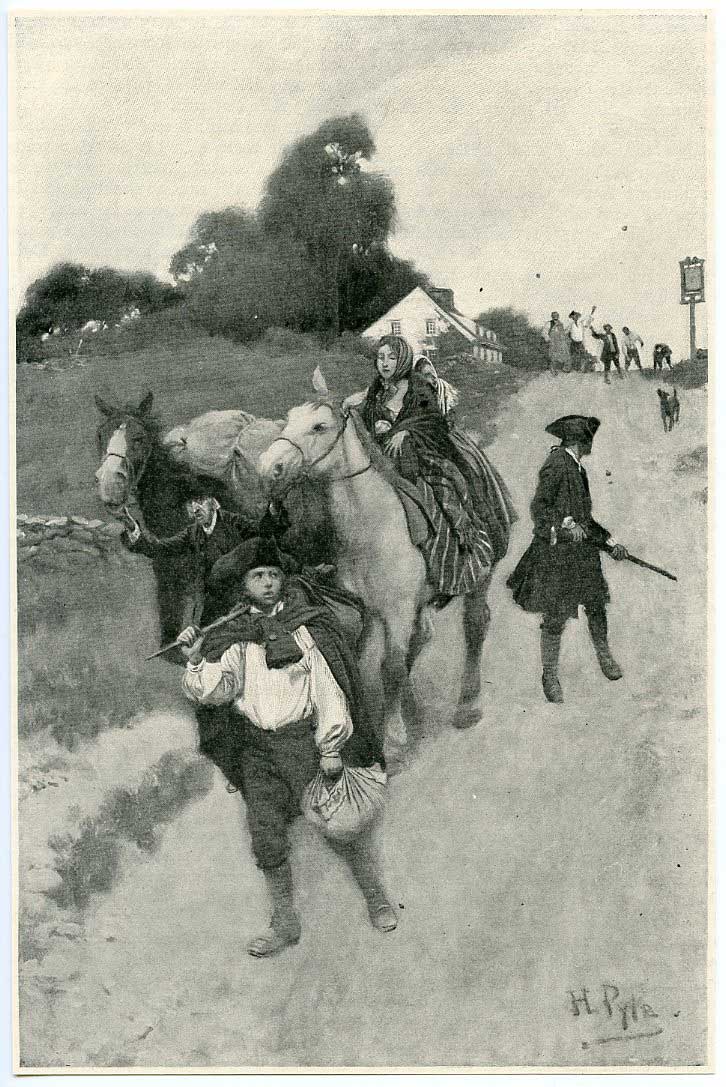
Tory Refugees by Howard Pyle
Such situations, where both sides devolve into mere taking vengeance back and forth, also make it very hard to delineate between a “right” side and a “wrong.” Patriotic Americans can appreciate afresh the freedom we enjoy while understanding at what bitter cost it came, and Christians can take it a step further and recognize that our country came to be, not necessarily by military strength or purity of cause, but by the very grace and mercy of God.

And I find it interesting, as a student of history, that not much has ever changed where human nature is concerned. Greene’s remarks about the partisan conflict in the Carolinas are echoed in the lyrics of a song from a much later, but similar conflict, this one between Catholic and Protestant in Ireland:

But centuries of hatred have ears that cannot hear.
An eye for an eye was all that filled their minds
And another eye for another eye till everyone is blind.
(“There Were Roses,” Tommy Makem)

Monday, April 11, 2016

The Loyalist Dilemma

For the eighteenth-century Christian, it was no light thing to contemplate overthrowing the government as one knew it. Consider with me these verses from Romans 13:
Let every soul be subject unto the higher powers. For there is no power but of God: the powers that be are ordained of God.
Whosoever therefore resisteth the power, resisteth the ordinance of God: and they that resist shall receive to themselves damnation.
For rulers are not a terror to good works, but to the evil. Wilt thou then not be afraid of the power? do that which is good, and thou shalt have praise of the same:
For he is the minister of God to thee for good. But if thou do that which is evil, be afraid; for he beareth not the sword in vain: for he is the minister of God, a revenger to execute wrath upon him that doeth evil.
Wherefore ye must needs be subject, not only for wrath, but also for conscience sake.
For for this cause pay ye tribute also: for they are God's ministers, attending continually upon this very thing.
Render therefore to all their dues: tribute to whom tribute is due; custom to whom custom; fear to whom fear; honour to whom honour. (KJV)
Read that first line again. Serious stuff, there, for those who had to choose between loyalty to the Crown and the cause of freedom.

British Legion Dragoon, 1780 (Don Troiani)
I’ve said elsewhere that much is made in American history of the righteous patriot, the heathen British, and the cowardly Tory. We can certainly find enough examples in those three groups to stereotype ... except that to begin with, many perfectly God-fearing people chose loyalty to the Crown (thus the terms “Loyalist” and “royalist”) out of Christian conviction.

Many also held a very valid fear that if the colonies overthrew the rule of Britain, chaos and anarchy would ensue. For several years after the Revolution ended, this certainly seemed to be a possible outcome.

And cowardice? In an age when neighbor turned against neighbor and brother against brother, and tarring and feathering was the punishment of choice, either side could be perilous. Even when people tried to hold their convictions in silence, out of mere self-preservation, they could be misunderstood and targeted.

American Provincial Corps
There's no typical profile of who chose loyalty and who didn’t. In addition to religious reasons, one article suggests that sides were chosen because of social status, although there were as many poor Tories as rich. Some chose loyalty because they recognized the colonies’ debt to Great Britain—after all, a colonist paid a fraction in taxes as the average Englishman, and Britain had spent thousands in defense of the colonies against the French. (Who ironically threw their lot in with the colonies during the American Revolution.)

A hard one to figure out was the loyalty of former Jacobites. These Scots folk had fought the Crown on behalf of their “rightful king” James and later, his son Charles. They felt King George, of Germanic descent from Hanover and not really English at all, was the usurper. Why on earth would they choose loyalty to him, with the opportunity for freedom within reach? For many, it was a matter of personal honor. After Culloden, when the last Jacobite uprising was put down and the Scots warriors and their families deported to the colonies, many were required to sign an oath of support to the Crown. Many were afraid of breaking said oath when the cause of American freedom rolled around. (And naturally, because these kinds of contradictions fascinate me, I had to work it into a story ...)

Native Americans tended to side with the Crown, as well, which had enacted laws in an attempt to contain European settlement across the Appalachian Mountains (thus why the Overmountain conflict, which led to Kings Mountain, was also such a contradiction). Also, because the British offered freedom to slaves of African descent, many blacks chose loyalty. One could argue that the Crown was motivated more by a desire to undermine the local economy than any kind of moral conviction, however, and many of the colonists who sided with “rebellion” weren’t very supportive of slavery as a whole, either, but that's another discussion for another time.

I found a handful of links with some interesting summary and commentary that pretty well lines up with what I’ve found over several years of research on the subject:

The On-Line Institute for Advanced Loyalist Studies is a great site for anyone wanting hard stats, from history to military info to geneaology and reenacting.

US History--the Loyalists and Loyalist (American Revolution):  both shortish overviews of the subject. Lots of interesting information.

There’s also one person’s take on the current refugee crisis, in light of history, specifically from the viewpoint of Canada. Did you know that much of Canada’s English-speaking population descended from America’s displaced Loyalists? Tens of thousands of emigrants fled at the close of the Revolution, many from New York and many from the Carolinas and Georgia. Some went to the West Indies, some to England, but many found homes in the region of Nova Scotia and Prince Edward Island, including Tarleton’s Green Dragoons. A community of former African slaves later resettled in Sierra Leone.

And lastly, don’t read this one if you’re easily upset. :-) http://www.redcoat.me.uk/ It's a fascinating overview of early American history from the British viewpoint, and hilarious depending upon your sense of humor, but definitely over-the-top.

Rather reminds me of much political discussion today. :-)

Wednesday, March 16, 2016

American Politics: A History of Invective, Chicanery, and Mudslinging


The 2016 presidential campaign season has been exceptionally entertaining of late—not to mention disgusting, enraging, and outright maddening. So when I ran across this article that I originally posted in this space on October 31, 2012 (and we thought that campaign was appalling!), I decided it was just too applicable not to post again, with a couple of minor updates. I apologize for the rerun, but since several years have passed I hope it entertains you again as much as it did me!

Every presidential campaign season I ruminate on the history of American politics, and since the current primary race is so, um, interesting—and we haven’t even gotten to the main event yet—I thought this would be a timely and lively topic to revisit. We hear a lot of complaints about personal attack ads and dirty tricks, especially from the politicians who are themselves most guilty of using them. But you don’t have to do much digging to discover that political chicanery is a time-honored American tradition that has been exercised with glee since America was still a collection of British colonies on the course toward revolution. So let’s take a quick tour of some of the more egregious examples from our nation’s history.

Political parties didn’t exist in this country until we were well on the way to revolution. At that point, the division between those who supported the British and those who opposed them spawned the Loyalists, or Tories, and the Patriots, or Whigs. There was no such thing as neutrality between the two points of view. Anyone who didn’t support one side was automatically consigned to the opposition. Where Patriots held sway, mobs often forced Loyalists out of their homes, denying them legal counsel and trial. Loyalists might be jailed, have their property confiscated, their citizenship revoked, and even be exiled. Where Loyalists held power, Patriots suffered similar treatment. At times someone of the wrong political persuasion was even tarred and feathered and run out of town on a rail.

Mobs played a big part in colonial politics, particularly in Boston, where Dr. Joseph Warren helped to refine mob rule into an art form. But mobs were a force to be reckoned with throughout the colonies. In June 1775, one placed the home of New Hampshire’s last royal governor, John Wentworth, under siege, demanding he turn over his guest, John Fenton, who had urged acceptance of the latest British proposals to avert the crisis. When Fenton understandably refused to comply, the crowd wheeled a cannon in front of the mansion and beat on the walls with clubs until the hapless offender finally gave himself up. Fearing for his and his family’s safety, that night the governor fled with his wife and young child to the fort in Portsmouth harbor, ending decades of British rule in that colony. Nothing like the direct approach to changing your government!

From America's earliest days as a democracy, name-calling and character assassination has been a highly popular tactic, such as when Davy Crockett accused Martin Van Buren of secretly wearing women’s corsets. In 1828, when John Quincy Adams and Andrew Jackson vied for president, Jackson’s campaign nicknamed Adams The Pimp, based on a rumor that as the American ambassador to Russia he had forced a young woman into an affair with a Russian nobleman. Adams’ supporters responded by circulating a pamphlet claiming that Jackson's mother had been a prostitute brought to this country by British soldiers, and that Jackson was the offspring of her marriage to a mulatto!

The name-calling in the 1800 presidential election between Thomas Jefferson and John Adams, however, takes the prize for no-holds-barred mudslinging. Some of the charges and counter-charges are cited in this hilarious YouTube video. You might want to also check out some of the others that show up on the sidebar for additional entertainment. And you thought our modern politics was bad!

In 1840, American politician Thomas Elder wrote to a friend that “Passion and prejudice properly aroused and directed do about as well as principle and reason in any party contest.” Every campaign season we see the proof of that claim.

So what do you think about the current presidential election? Has the political scene improved any since this article was posted in 2012 or has it degraded even further? What are your main (nonpartisan only!) gripes about American political campaigns? What, if anything, can be done to change things?
~~~
J. M. Hochstetler is the daughter of Mennonite farmers, an author, editor, and publisher, and a lifelong student of history. Her novel Northkill, Book 1 of the Northkill Amish Series coauthored with Bob Hostetler, won ForeWord Magazine’s 2014 INDYFAB Book of the Year Bronze Award for historical fiction. Her American Patriot Series is the only comprehensive historical fiction series on the American Revolution. One Holy Night, a contemporary retelling of the Christmas story, was the Christian Small Publishers 2009 Book of the Year.