Announcements

10 Year Anniverary & New Releases Winners: Carrie Fancett Pagels' Butterfly Cottage - Melanie B, Dogwood Plantation - Patty H R, Janet Grunst's winner is Connie S., Denise Weimer's Winner is Kay M., Naomi Musch's winner is Chappy Debbie, Angela Couch - Kathleen Maher, Pegg Thomas Beverly D. M. & Gracie Y., Christy Distler - Kailey B., Shannon McNear - Marilyn R.
Showing posts with label Anthony Wayne. Show all posts

Monday, April 9, 2018

The Sieges of Savannah and Charleston, or How the British Left the Colonies

The Siege of Charleston, 1780
In 1779, the British turned their attention from New England and the northeast colonies to what is now termed the Southern Campaign—and they started with Savannah, Georgia. Having taken that in December, they moved north to Charles Towne—Charleston of today—and laid siege to it for six weeks before that mighty port city buckled.

After the surrender at Yorktown, the British forces hunkered down in Charleston and Savannah, but made no further move to withdraw. As Patrick O’Kelley says, “Though the war was near the end, the fighting continued. Old scores needed to be settled, and this had to be done while there was still a war going on. The British in Savannah and Charlestown had to find food for the soldiers and for the refugees huddled near the walls of the cities. The Patriots knew that the sooner they could get the British to leave the two cities, the sooner the war would end, so they opposed any foraging parties coming out of the cities. This led to some intense fighting in the last days of the war.”

The siege of Charleston lasted from 1781 until December 1782. The retaking of Savannah had begun in January 1782 when Major General Anthony Wayne made a bold push against the British in Georgia. The British, thinking they were outnumbered (though they weren’t, by far), fell back to Savannah, and though Wayne did his best to play up the fears of the British, they held onto that city until July.

Last page of the Treaty of Paris, 1783
In the meantime, Greene had his own troubles with troops becoming mutinous in the face of nakedness and hunger. William Moultrie describes how every scrap of cloth was needed to hang about men’s waists, and this in an age where a man was considered “undressed” if he didn’t wear a waistcoat over shirt and breeches. Another officer asked if soldiers could be expected to do their duty, clothed in rags and fed on rice. Even partisan leader Francis Marion, the famed “Swamp Fox,” grew so weary of the constant fight that after one incident in September, he refused to put any more of his men’s lives on the line, so close to the expected departure of the enemy. In one case he and his men even stood guard on behalf of a British foraging party, presumably as much out of compassion as anything.

On July 11, the British officially evacuated from Savannah. Troops headed for Charleston and New York. Many loyalist refugees eventually went south to Florida. The British would drag their feet getting out of Charleston until December 14. British regulars and loyalists dispersed not only back to Britain, but to the Caribbean and Nova Scotia. (Many of Tarleton’s Green Dragoons were given holdings in Nova Scotia, but it was a rather austere location.)

Map of US and territories after the Treaty of Paris
The day after the British fleet sailed from Charleston, the Maryland Line of the Continentals decided their enlistment was over, but Greene told them firmly that the war was not yet finished. That would not happen until the signing of the Treaty of Paris on September 3, 1783, but the fighting in the Carolinas had ended at last.

At least where the British were concerned. Tensions and conflict would continue with the native tribes for years to come. And having cut their losses in the American colonies, the British had already focused their meager energies elsewhere in the world. This marked the end, however, of the colonial era in United States history.

(My thanks as usual to O'Kelley for his excellent work, Nothing But Blood and Slaughter: The Revolutionary War in the Carolinas.)

Monday, December 19, 2016

Caty Greene: Darling of the Continental Army


Maj. Gen. & Mrs. Greene, date unknown
Last month I talked about Nathanael Greene, Revolutionary War general and former Quaker, and his crucial role in winning the war for independence for the colonies. Equally fascinating is his young wife, Catharine Littlefield Greene, or "Caty" for short.

Caty lost her mother at the tender age of 10, and in order to give her proper feminine influence, her father sent her to live with her aunt and uncle. She met Nathanael when she was 17, married him at 19 (he was not quite 32), then less than a year later had to surrender her hopes for a happy domestic life to his involvement in the cause of independence.

She made the most of it, however, and traveled whenever she could to be with him in the field--even during the terrible winter at Valley Forge. Famous for her charm and wit, she became a favorite with George and Martha Washington, and her presence helped fuel the effort to maintain a semblance of social normalcy for the Continental officers. It's said that she was so much a favorite with George Washington that he claimed her as a dance partner for hours at a time, on more than one occasion.

Caty's vivacious nature, while making her the darling of wartime society, left her wide open to rumors of infidelity. Caty made light of the accusations, brushing them off with vague answers that left room for the flirtations that happened sometimes under Nathanael's very nose--and it was common and somewhat socially acceptable during that era for women and men to "carry on" in public, up to a certain point.

The rumors were never really substantiated, however. To all appearances, Caty remained devoted to her husband and insisted even on journeying to him all the way from Philadelphia to South Carolina early in 1782, after Greene had largely exhausted the strength of the British forces and the surrender at Yorktown had taken place. Four of their six children were born during the war, although Nathanael was not free to rejoin his family until sometime in 1783.

Even then, her hopes for a peaceful family life were disappointed. Greene had essentially fed and clothed the Continental Army out of his own pockets during the Southern Campaign and at the close of the war found himself in dire financial straits. As partial compensation, Congress awarded him the estate of Mulberry Grove near Savannah, Georgia, and both Nathanael and Caty set to learning how to run a Southern plantation.

In June of 1786, tragedy struck. Nathanael Greene fell ill from sunstroke after being out too long surveying a neighbor's fields, and died a few days later. Both Caty and their mutual friend Anthony Wayne, who was present during Nathanael's illness and death, were devastated, but Caty did not give up. She determined to make plantation successful

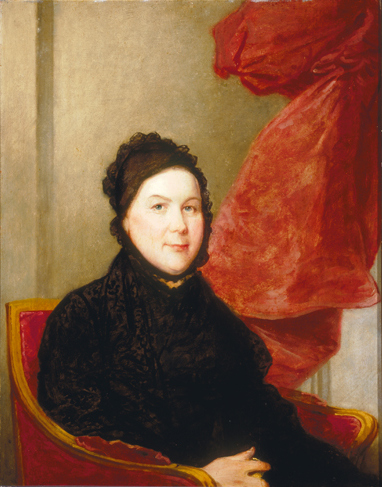
Catharine Greene Miller in 1809
She remained close friends with the Washingtons and others, and used her connections to appeal to Congress for support as a general's widow. In the meantime, her children's tutor, Phineas Miller, helped her manage the plantation. Caty also invited the neighbor children's tutor, a young man named Eli Whitney, to move to Mulberry Grove and pursue his inventions. Many insist that she was instrumental in his success with the cotton gin, which revolutionized cotton production.

In 1796, she married Phineas Miller, with the Washingtons in attendance. Mulberry Grove fell upon hard times and had to be sold, and Caty and Phineas moved to another holding originally given to Nathanael, an estate called Dungeness on Cumberland Island, Georgia. Phineas died in 1803; and in 1814, Caty followed.

The ironies of history amaze me. This couple from middle-class beginnings in Rhode Island had such an impact on our country's future and on the South in particular. If Nathanael had not died unexpectedly of sunstroke and left Caty to carve out her own future, would she have encouraged Eli Whitney in his progress on the cotton gin? If Caty had not first fueled and supported Nathanael's passion to win this country's independence, would he have had such heart for the long agony of the American Revolution in general, and the Southern Campaign in particular? We may never know, but the brief glimpses of their lives have provided an endless source of fascination for me.