Announcements

10 Year Anniverary & New Releases Winners: Carrie Fancett Pagels' Butterfly Cottage - Melanie B, Dogwood Plantation - Patty H R, Janet Grunst's winner is Connie S., Denise Weimer's Winner is Kay M., Naomi Musch's winner is Chappy Debbie, Angela Couch - Kathleen Maher, Pegg Thomas Beverly D. M. & Gracie Y., Christy Distler - Kailey B., Shannon McNear - Marilyn R.
Showing posts with label historic town. Show all posts

Monday, May 30, 2016

Tryon Palace and the Women Who Wouldn't Say No.


Appointed by the King, Lt. Governor Wiliam Tryon came to North Carolina in 1764 and traveled the colony for almost a year until he became Governor. New Bern was a busy, sheltered port town and the center of the area’s naval supply business. If you’ve ever wondered why North Carolina is the Tar Heel state, this is why---the abundant pine forests supplied tar and turpentine which are fundamental for shipbuilding and upkeep. When, in 1766, the North Carolina colony Tryon chose New Bern as its capital, Tryon decided it needed a governor’s mansion worthy of the king himself. A year later, master builder John Hawks came from England to begin the building of an impressive red brick and white marbled trimmed home that would serve as political meeting place and family home.

Small farmers in the west, and the heavily Scottish population, weren’t keen on the taxes taken to build a grand English home. Fifteen thousand pounds at the time! (about fifteen million now). Many just weren’t happy to have English rule, and things culminated in The Regulators’ War in 1771.
By this time, Tryon had left to become Governor in New York, and Josiah Martin took residence. With revolution the talk of the colonies, Governor Martin asked for arms to equip his loyalist citizens. The arrival of cannon rankled the revolutionaries and Martin had to slip out of town under the cover of night.
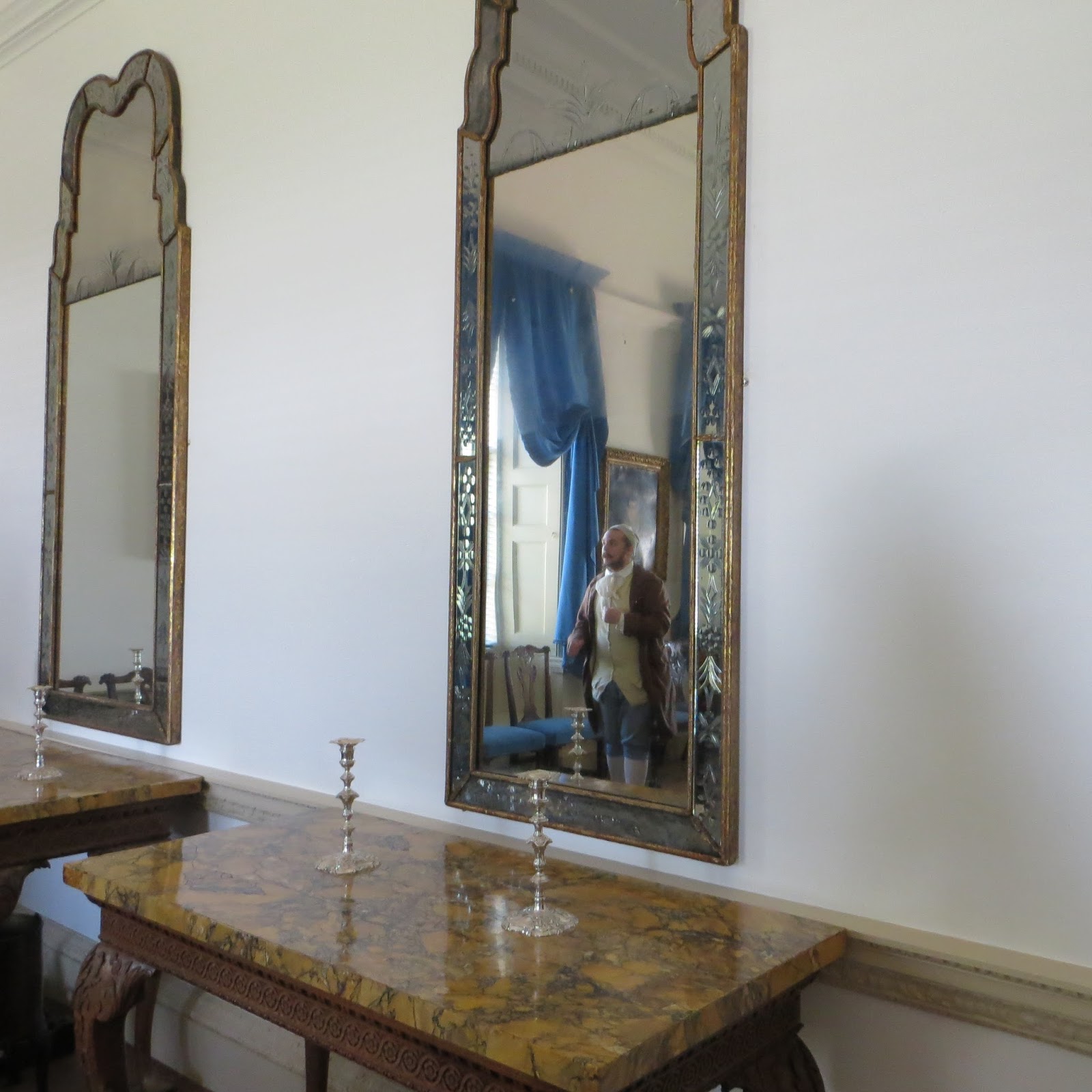
During the war, North Carolina moved its capital to Raleigh and Tryon Palace fell to ruin in later decades. Parts of it were used by the locals, occasionally for dances, or as a hospital, but in 1798 a good portion of the building burned leaving only the stable intact. Torn down and forgotten, the grounds of the palace eventually became U.S. Rt 70.

Then the Colonial Dames stepped in. If you didn't know, The Colonial Dames is a national society with thousands of members. But I'm referring to some mighty fierce ladies on a mission.
Mrs. Reynolds of Winston-Salem, a president of the DAR began a fund for restoration. In 1935, the federal government created protection for such sites by declaring them National Historic Sites.

Another go-getter, journalist Gertrude Carraway, also in the DAR and a New Bern native fought to have Tryon Palace named a National Historic Site. The National Park Service agreed but offered no funding for the restoration. The Garden Club of North Carolina joined in with a heavy state-wide lobby to restore the palace and its gardens.

And another… Mrs. Maude Latham was a major financial supporter. Together with Mrs. Carraway and a Mr. and Mrs. Kellenberger, the Tryon Palace Commission was born. Mrs. Carraway hunted down the original plans of the palace used by the architect John Hawks. Mrs. Latham created a trust fund with $100,000 of her money.

Just as things were about to start, Pearl Harbor brought the country in to war. Mrs. Latham didn’t give up. She added another 150,000 to the pot and then bequeathed her entire estate worth one million dollars.  In 1952, almost twenty years after the project began, work began.  The comission stayed busy as well, purchasing back lots that were originally part of the property, and the Kellenbergers and Mrs. Carraway hunted down every piece of Tryon’s or Martin’s furniture they could find (Martin had made a detailed inventory of every piece of furniture and other belongings!). Rather than use reproductions, they traveled the country and Europe to purchase pieces matching the inventory—an estimated 3 million of them purchased entirely by private funding of nearly seventy thousand dollars.

Tryon Park was rebuilt as an exact reproduction of the original building and its grounds are fully restored. On the day in 1958, when it reopened, the Tryon Palace committee turned it over to the state of North Carolina. Mrs. Carraway personally trained all the staff. By then, she knew more about each piece of furniture, each brick and each person to live in or visit the mansion than anyone else. In 1962, she was declared her The North Carolinian of the Year — describing her as “a woman who refused to compromise with anything short of perfection.” Today the North Carolina History Museum is built next door, and Tryon Palace received 249,000 visitors in 2015. Volunteers are the bulk of the staff—a whopping 800 people who spend time caring for the collections, doing tours, and hosting events.

I recently visited this incredible place and was as much in awe of these women as of the palace and gardens. And New Bern is a lovely, small city. Have you visited? If not, I hope you get a chance to!

TRYON PALACE WEBSITE
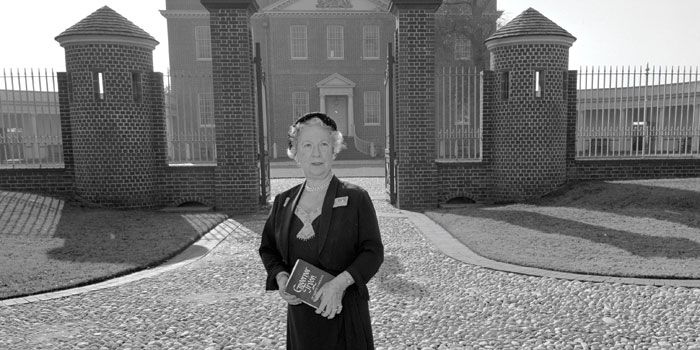

Mrs. Gertrude Carraway


Debra E. Marvin tries not to run too far from real life but the imagination born out of being an only child has a powerful draw. Besides, the voices in her head tend to agree with all the sensible things she says. She is a member of American Christian Fiction Writers, Sisters in Crime, and serves on the board of Bridges Ministry in Seneca Falls, NY. In 2015, she released her first two novellas, “Alarmingly Charming” in Austen in Austen Vol 1 from WhiteFire Publishing, and “Desert Duet” from Forget Me Not Romances, after many unpublished contest successes including two finals for the Daphne DuMaurier award. Debra works as a program assistant at Cornell University, and enjoys her family and grandchildren, obsessively buying fabric, watching British programming and traveling with her childhood friends.
Coming soon - Starlight Serenade set in 1930, Flagstaff Arizona


Monday, May 12, 2014

Archaeology at Colonial Dorchester, South Carolina

Hard at work, hoping for some cool finds
So, I wrote last time about Colonial Dorchester State Park, the site of a star fort built during the French & Indian War and of a trading town located upriver from Charleston, on the Ashley River. This time I'll share some highlights from a homeschoolers' field trip our family attended quite a few years ago.

Sifting the dirt pulled from the digging site
Musket ball and belt buckle
The town surrounding Fort Dorchester was abandoned soon after the British's fiery withdrawal to Charles Towne back in 1781, and the name Dorchester was later co-opted for a town further north. Oddly enough, unlike most of the Charleston area, the site was never built over. In recent years, ownership of the lands changed from industrial to state parks, and the relatively pristine nature of the site makes for prime archaeological finds.

The staff working the site were friendly and enthusiastic about the kids helping with the dig. The process is fairly simple but methodical:  the choice of a plot, careful digging with small tools so as not to damage artifacts, sifting the buckets of dirt lifted from the individual plots through fine screens, then laying their finds out on trays for inspection.
I see ... artifacts!

Digging with the bell tower in the background
Our dig site was the town's former market square. The finds might include fragments of brick, fragments of iron from tools or gear, musket or rifle balls, clay pipe fragments, and pieces from pottery or porcelain dishes. Previous finds included shoe and belt buckles, weapons, and larger dishes and drinking vessels, such as the mostly intact tankard I mentioned in my previous post. (It was creamware pottery with GR--Georgius Rex, denoting the reign of King George--imprinted in clay on the side, only missing its handle.)
Moss-covered brick, all that remains of the town

Click on the various photos here to see our actual finds more closely. The blue tray displays items found by my oldest daughter and second-oldest son, while the ball and buckle on the left were found by one of the other children on our field trip. That beautiful fragment of porcelain is my favorite! There's also a piece of iron (not sure what that was from, maybe the bit from a horse's bridle or a tool?), broken glass, a section of clay pipe stem, and the ubiquitous fragments of brick.

Late April in Charleston is already bright and hot, as you can see by the scrunching of the kids' faces. Still, they were very into it, which was a good thing, since I was doing this vicariously through them. :-) (I still had littles to watch while the older ones played, er, dug in the dirt.)

I'm not sure whether the park still does this or not, but they used to have Saturday digs open to the public, with participation welcomed by any and all who care to come check it out. We'd always intended to go back for the digs but never made it on those days. Still, it remained a favorite place for quick family outings.

My daughter managed a few shots on one such trip, back in 2012, of the exposed house foundations open for viewing at the site. I'm always astonished at how small the rooms were in colonial homes. Of course, even the wealthy of that time owned far less "stuff" than we moderns.

Outlines of the house foundation, pictured above

I'm also struck by the contrast this beautiful, tranquil place must be to the bustling town that once was. I've itched to go back and participate in a dig for myself, to experience the thrill of unearthing those fragments of tangible history.

Photo credits: Breanna McNear

Monday, April 14, 2014

Colonial Dorchester, South Carolina


Colonial Dorchester—formerly known as Old Fort Dorchester—is a researcher’s dream. A practically untouched historic site, never built over in spite of burgeoning suburbs. A visitor can stand inside a church tower built in the 1750’s, read gravestones of folks whose descendents still live in the area (one of my daughter’s fellow ballet classmates), walk the perimeter of a fort held in turns by the British and American forces in the Revolution. View the exposed foundations of houses that haven’t been occupied in more than 200 years.

A cool, shady spot on the upper Ashley River, where it’s more a creek than a river. Once, however, it was a bustling town on the road from the backcountry to Charleston.

The Bell Tower of St. George's, Colonial Dorchester
Dorchester was founded in 1697 by Congregationalists as a sister town to Dorchester, Massachusetts. Unlike Childsbury, which had its primary purpose as a trading town, this one was specifically a missionary endeavor--a colonial church plant. The town’s own church was located up the road somewhat (the White Meeting House, named for the minister who supported their move), but in 1706 the Anglican church decided to flex her muscles and  build St. George’s right in the middle of town. In 1751 the bell tower was added, the only structure besides the fort still standing after the earthquakes the area has endured.


According to sources (page 1 of the same document is linked above), many of the town's inhabitants moved inland to Georgia in 1752-56, citing a growing population and the area’s unhealthiness. In addition to the intense heat, the town was located on a river between two creeks, so malaria was prevalent. At this point, say the sources, the history of this town ceases to be that of the original Congregationalist community, and becomes that of the trading town, the fort, and St. George Parish.

The tabby walls of Old Fort Dorchester, up close and personal
The fort is one of the best-preserved examples of something called “tabby”—walls made of mortar mixed with oyster shells. Built near the beginning of the French and Indian War, the four-cornered star-shaped fort has ties to Fort Loudon in Tennessee. This connection is what you’ll learn about if you visit during one of their Garrison Days, or the reenactment held in February or March.

F&I War event at Colonial Dorchester, Feb 2010
My family had the pleasure of attending their first such event a few years back. This shot, caught at just the right moment as the muskets were fired, has been one of my favorites—and then last week I ran across its mirror photo on this site: http://fortdorchester.org/ That’s my family, friends, and me in the audience at right. If you look closely at my photo, you can see the other photographer, kneeling on the other side of the reenactors.

Yes, this is the upper Ashley!
Before that, however, we became interested in the history of the site by attending an archaeology field trip. We learned that a wealth of artifacts can be found just a few inches down, because the site was never built over, as so many places are in the Lowcountry. The archaeologists working the site allowed our kids to dig and sift beside them, instructing them in the proper techniques.

Remains of old wharf on the Ashley River at Colonial Dorchester
Down the hill from the green (originally the market square in the original town plans) and the fort lies the spot where a bridge once spanned the river, connecting the road that runs past the plantations downriver (Middleton Place, Magnolia Plantation, Drayton Hall etc.). The fort changed hands a couple of times between the British and the Americans, and was occupied for a while by Francis Marion. General Nathanael Greene took it back for the last time in December 1781. At this point, the British burned the bridge and much of the town, and the site was soon abandoned.

These days, the site offers a beautiful—and inexpensive!—place to let one's family run. Recent archaeological work has led to the placement of several information plackards and a kiosk where some of the artifacts can be viewed, as well as a diorama of the original town as they know it.

More photos—not mine—can be viewed here at the Quarterman family website. All photos in this post are mine or my daughter Breanna's.

It's been a long time since this fort was guarded by a redcoat!

(Fun fact: during the time period portrayed by this event, the redcoats were the good guys!)

Friday, December 20, 2013

Strawberry Chapel and the Vanished Town of Childsbury

Front gates, Strawberry Chapel
It all started with a ghost story.

Of course, as a Christian, I don’t officially approve of ghost stories, and this was more the explanation behind a local legend than promulgating tall tales about the supernatural. The melodramatic story of a young girl tied to a gravestone by her vexed schoolmaster and left there overnight is still told around the Lowcountry. It's part of what awakened my curiosity about the Charleston area, and later, my love for the more obscure bits of local history.

Strawberry Chapel, side and rear
 The terrible event took place in the churchyard of Strawberry Chapel, located in rural Berkeley County, South Carolina, miles upriver from Charleston. Built in 1725, the church served as a “chapel of ease,” providing an accessible place of worship to planters and tradesmen downriver from St. John’s Biggin Church, where they were still required to attend services on high holy days. With the trees cleared, Strawberry Chapel would have overlooked the west branch of the Cooper River, but now stands nestled among oaks, screened from the river by thick brush. The adjoining grassy field was once the site of a flourishing trade town, named Childsbury for the English settler James Child, who granted the land and laid out the plans for the town in 1707. A plackard states that among other things, an open-air market and horse races were held here, back in the day. The town served as an important point of contact between native peoples and European settlers. A ferry docked at Strawberry Landing on the Cooper River and connected Childsbury with Charleston.

A school was also located here, attended by Catherine Chicken, the great-granddaughter of James Child, the seven-year-old heroine of the local legend. The most trustworthy accounts tell us that, yes, at the tender age of seven she was tied to one of the tombstones in the Strawberry Chapel churchyard by her schoolmaster for some infraction and left until after nightfall. One of the family’s servants discovered and rescued her, and the offending schoolmaster was run out of town, but the story gave rise to all sorts of embellishments and legends—one of which was that the girl died of fright and her ghost haunts the churchyard, still.
Strawberry Chapel, front

Not so, but the place has suffered under the constant stream of ghost hunters and thrill-seeking teens. During our first visit to Strawberry Chapel in 2006 during a family photography outing, I was shocked to see so many signs of vandalism. Box tombs open or cracked (nothing to see inside; the actual grave is below ground, but this is apparently a popular form of monument in historic Southern cemeteries), broken glass littering the place, especially around the curiously open, arched brick construction a few yards away from the church. But as my first study in original church buildings in the Charleston area, the place enthralled me.

The church itself is a small, white building, covered in weathered plaster, with a shingled jerkin-head roof. (See the photos for exactly what that means—the flattened corners at the “head” of the roof.) Like other historic places, it just smells old, and the churchyard is graced by crape myrtle, camellias, and several sprawling live oaks draped in Spanish moss. Walking through and reading headstones is always a lesson in local history, to me, and in this case just made me hungry to go search out the stories behind the names. No ghosts here, even in the obscure corner where a miniature version of the stars-and-bars decorated the grave of a Confederate veteran.

I later learned that the brick “cave,” pictured above, was not a crypt as we’d originally guessed, but a place to temporarily shelter a coffin in inclement weather. And on one visit, I discovered a peephole in the front door of the chapel, offering a view inside. Plain, dark wood pews and slate floors—and the sunlight slanting in through a window, bathing the sanctuary in a pool of light. The next time, however, the peephole was boarded over.


Over the years, I've noticed the addition of floodlights and surveillance cameras to the churchyard. Because of the worsening vandalism, the caretakers have felt the need to exclude casual visitors. Stories have surfaced of people being asked to leave by caretakers, and a friend’s brother was actually arrested for trespassing. Another friend and I visited one day but weren’t challenged—I hope because we were careful to treat the property with respect.

Despite its long standing as a historic site open to the public, most informational sites online now state that the chapel and churchyard are private property and trespassing will not be tolerated. I'm presuming that permission could be obtained to explore the site for research.

Sunset on the Cooper River
The Childsbury site, however, still welcomes visitors, offering the information kiosk next to a small parking lot and a mowed path down to the old dock. The view there is not to be missed—a particularly lovely section of the Cooper and its old adjoining rice fields. Off to the right, especially at low tide, the planks marking the old Strawberry Ferry landing can still be seen embedded in the mud.

Except for the chapel building, everything else is only a memory.

Playing in the field that was Childsbury
~~~~~~~~


My thanks to the photography talents of Kimberli Buffaloe, and my daughter Breanna McNear.


Monday, December 2, 2013

Secret Colonial Tunnels Beneath Wilmington

While researching my next novel, For Love or Country, book 2 in The MacGregor Legacy, I came across some interesting information regarding real secret tunnels existing under the historic district of Wilmington, NC to the Cape Fear River. Some of these tunnels date back to before the American Revolutionary War made of brick with vaulted ceilings.

Lots of legends and rumors have surrounded these tunnels such as pirates stashing their booty, escaped prisoners, and the Underground Railroad. Most historians agree that none of these legends can be verified, but most likely the tunnels were used for sewage and drainage.


Burgwin-Wright House (Flickr, NCBrian)
The existence of these tunnels gave me the perfect opportunity to use them in my story during the Revolutionary War. One tunnel is known to be under the Burgwin-Wright House built around 1770 and is the location where General Cornwallis set up his headquarters for the British when he took command of Wilmington in
1781. According to one of the legends, Patriot soldiers escaped while being held as prisoners in the Burgwin-Wright House. Since the foundation of the house was built over an old jail, the brick basement was a perfect place for the British to hold Patriot prisoners. Therefore, this house plays a significant role as a setting for several scenes in my novel. To aide me in my research, I found transcribed descriptions written by the family that lived there when Cornwallis took over the house.

Of all the tunnels, Jacob's Run is the most famous named for Joseph Jacobs, a prominent merchant tanner. In 1775 he and his brother Benjamin built St. John's Masonic Lodge, now the Children's Museum of Wilmington. According to an April 28, 1967 newspaper article that appeared in the Wilmington Morning Star, contractors once again discovered the tunnel while digging the foundation of a new restaurant they were building in the former Theater Manor building. Fittingly, they named the restaurant, Jacob's Run. The tunnel ran beneath the building and all around it following the flow of natural spring water. City engineers state that there are no authentic records documenting when the tunnel was built or for what purpose--yet they obviously exist and can be dated back to the colonial period.
Mitchell Anderson House
Another setting that I used in the story was the Mitchell Anderson House built around 1739, the oldest surviving house in Wilmington. When Lord Cornwallis took over the Burgwin-Wright House in 1871, Major James Craig of the British Army was forced to vacate the premises and took over the Mitchell House.

Historic homes like this and real existing tunnels with lots of legendary stories surrounding them are great fodder for an author's imagination. Therefore, I used what real historic information that we have about them and took creative license with the rest to fit it into the storyline of my novel, For Love or Country set in 1781, Wilmington, NC


Wednesday, September 18, 2013

Sandwich, anyone? By New CQ Contributor Amber Perry


Sign for Historic Sandwich
Sandwich, anyone?
by Amber Perry

I have been obsessed with all things colonial and Revolutionary War since I was knee-high-to-a-grasshopper. I’ll never forget the day, at the ripe old age of fifteen, when my parents told me they were taking me to Boston so I could tour the historic sites. I was jumping up and down, and squealing so much you’d have thought I’d won back-stage passes to see The Backstreet Boys in concert.
But for me, this was WAY better than that. I mean, way better.
Newcomb Tavern, known in the Revolutionary era
as Tory Tavern 
While there, on a whim we decided to visit Cape Cod, since it is just about an hour or so from the city.
Little did I know, from that day on I would never be the same.
I remember sitting in the back seat of the rental car, inhaling that new-car smell and marveling at the beauty that dashed past my window when my dad said, “This little town is called Sandwich.”
Of course that got my attention. Sandwich? Who names a place after something you eat? Well, now I can look back and say, “Oh, Amber dearest, how cute and uneducated of you.”


Hoxie House, built in 1675
Once I got over the name, I was captivated by the quaint, historic homes and the magnificent setting. I promised myself that someday, I would go back. I’m sure I’ve never seen a more beautiful little town—and one with such fabulous history that is unknown to most people, unless you’ve been there. (Though I’m sure that can be said for many towns in the U.S.) I never forgot Sandwich, and if you have ever been there, I’m sure you can’t forget it either. * wink *


Inside the Hoxie House

Sandwich, Massachusetts was founded in 1637 and is the oldest town in Cape Cod. Named after a seaport town in England, the land was originally part of the Plymouth Colony. About sixty families first settled the area, and it continued growing after that, however slowly.


Shawme Pond
The Quakers of the colonial era were often persecuted in many places, but found a bit of refuge in Sandwich and the religion began to thrive. In fact, the Monthly Quaker Meetings held in Sandwich, are the oldest continual Quaker meetings in America. So says the Sandwich “historical” website . . .


View of Newcomb Tavern across Shawme Pond


During the Revolutionary War the colonists of Sandwich were very supportive of the patriot cause, but as with most places, there were a number of Tories who insisted on making their own strong feelings known. A well-beloved proponent of the patriot cause, Doctor Nathaniel Freeman, was a fearless leader among the patriots of Sandwich and after a political rally, was attacked by three Tories in front of Newcomb Tavern. If I could, I would reeeeeaaaally like to tell you all about the drama that ensued between the Whigs and the Tories in my favorite Cape Cod town, but I will have to leave that for another post.


Dexter's Grist Mill
Mainly a farming community during the colonial era, Sandwich has a large, centrally located pond (more like a small lake) that people and livestock used on a daily basis. On the pond stands a gristmill, powered by Shawme Pond, that was originally built in 1640 and still grinds corn today!

If I could, I would visit Sandwich every year. No, scratch that—if I could, I would LIVE there, but alas, I fear that will never happen. *sigh* But I do love it and hope to go back again someday.


Inside the gristmill

Have you ever been, and if so, what did you think?

Tell me about your favorite historical town!