Announcements

10 Year Anniverary & New Releases Winners: Carrie Fancett Pagels' Butterfly Cottage - Melanie B, Dogwood Plantation - Patty H R, Janet Grunst's winner is Connie S., Denise Weimer's Winner is Kay M., Naomi Musch's winner is Chappy Debbie, Angela Couch - Kathleen Maher, Pegg Thomas Beverly D. M. & Gracie Y., Christy Distler - Kailey B., Shannon McNear - Marilyn R.
Showing posts with label Benedict Arnold. Show all posts

Monday, October 28, 2019

Sarah Kast McGinnis ~ Loyalist Spy

Johann Georg Kast, and his wife Anna Margaretha Feg, Palatine Germans desperate to escape religious strife in their homeland, arrived in New York in 1710. They were brought to the American colonies by England’s Queen Anne to work in the British tar camps, where the production of tar and pitch was necessary for the building of British ships. But Johann, unable to support his growing family on his meager wages, traveled west and settled in German Flatts on New York’s Mohawk Valley frontier, where he opened a trading post. Their sixth child, Sarah, was born in 1713, and as the family lived near a neighboring tribe of Iroquois Confederacy Mohawk, Sarah grew up closely allied with them and familiar with their culture and language. 


Johnson saving life of wounded French officer
during Battle of Lake George by Benjamin West
When an Irishman by the name of Teady Magin, (Timothy McGinnis) who’d worked for a family south of Albany had completed his indenture, he set out to be a fur trapper and acquired a strong knowledge of native language and way of life along the way. Through his travels up and down the river, he frequently stopped at Kast’s trading post where he met and fell in love with Sarah.  

McGinnis proposed, and Sarah married Timothy in 1734. They raised a family of eight children on a farm built close to the Mohawk Castle (principal village) of the natives they’d befriended. Sarah remained at home and continued to run the thriving trading post when Timothy, now a captain in the British forces, joined his friend Sir William Johnson in the war against the French in North America. 

After the death of her husband at the Battle of Lake George in 1755, Sarah, with the help of her children, ran their farm, the trading post, and took up her husband’s fur trading business to help support her family. As a widow, a woman in the eighteenth century could retain ownership of property and wealth. However, if she remarried, all her property would go to her new husband. Sarah would remain a widow for the rest of her life.

Sarah and the American Revolution 


It was rare to see a woman take up arms in combat, though most knew how to handle a rifle for hunting and protection if necessary. Others contributed to the war effort by covert observation, collecting important information and carrying messages. Even more unlikely was seeing those of German descent like Sarah, as an important liaison who used her trading ties to keep the Mohawk loyal to the British cause. 

Loyalists, or Tories—those devoted to the British cause—comprised about one-third of American colonists, including officeholders who served the British crown, large landholders, wealthy merchants, Anglican clergy and their parishioners, and Quakers.  

Like many Tories, however, Sarah’s loyalty cost her dearly. In retaliation, members of her family were killed by their rebel neighbors, their property and trading post seized, and Sarah’s house burned to the ground, with the tragic loss of her son, William, who’d been trapped inside. Alienated from friends and extended family members, her personal property was taken and sold at auction to Patriot buyers. Sarah’s spying for the British had been discovered, and along with her daughter and granddaughter, was imprisoned at Fort Dayton, (now Herkimer, New York), where her granddaughter died. Her son-in-law, Symon DeForest was jailed and died in captivity.  

Barry St. Leger
Sarah and her daughter were released when General Barry St. Leger and his troops attacked the area. St. Leger’s force, composed mostly of Native Americans and Tories, intended to come down the Mohawk Valley to meet General Burgoyne at Albany. But Continental troops barred his way, and he lay siege to Fort Dayton. When St. Leger’s native allies heard that a Continental force under Benedict Arnold was moving to relieve Fort Stanwix, they deserted the British, and St. Leger was forced to make a retreat to Canada. 

General St. Leger retreated to Oswego and then to Canada, with Sarah and her family following close behind. In August 1777, they arrived in Canada at a British fort on Carleton Island, southeast of Kingston on the St. Lawrence River. She was 64 years old. 

In the winter of 1777, at the request of British authorities, Sarah returned to New York to live with the Iroquois. Loyalist officials had learned the Americans were trying to influence the Mohawk into joining the Patriot side and wanted Sarah to persuade them to remain loyal to King George. 

French Castle at Fort Niagara, copyright Ad Meskens
Sarah, traveling with her youngest son, George, reached Fort Niagara and wintered in a Cayuga village. They managed to travel through forests, cross rivers and streams and camp along the 245 mile stretch of wilderness from Lake Ontario to the Mohawk Castle in central New York. Upon their arrival, they were greeted warmly by many native friends.

When the Mohawk showed Sarah a wampum belt they had received from American General Philip Schuyler, she told the Indians it was an evil message and to bury it. She and her son lived with the Iroquois through another winter near Genesee, New York, the trip deemed a success because Sarah had convinced the Mohawk to remain loyal to the British. They returned to Canada in the spring of 1778. 

In the fall of 1779, Sarah, once again accompanied by her son, now a lieutenant in the Indian Department, was asked to return to visit the Mohawk Nation. They left the safety of Canada to arrive in New York where the war still raged. During this visit, George was wounded in the Battle of Stone Arabia in 1780. But as a result of her visits, many of the Mohawk people had survived and fled to Canada, where their descendants still live.  

At the end of the Revolution, Sarah moved to Upper Canada with other Loyalists. She petitioned the British government for land and money to cover her losses during her trips to New York. Though steadfast to the British Crown, Sarah received a mere pittance, was refused a land grant (to which, as a Loyalist, she was entitled) nor any other recognition. 

Sarah Kast McGinnis died September 9, 1791, at the home of her grandson Lieutenant Timothy Thompson in Fredericksburg Township, Ontario. She was buried near Bath, Ontario. She was 78 years old.

A certificate was finally issued in 1998, making Sarah Kast McGinnis an official “United Empire Loyalist”.  

Wednesday, May 20, 2015

History of the Saratoga Monument


by Elaine Marie Cooper

For years in the early 1800’s, the grassy bluff overlooking the Hudson River in Schuylerville, New York, looked like an ordinary field. But the residents of the area knew differently. On October 17, 1777, it was the site where British General John Burgoyne surrendered to the American Army after the Battle of Saratoga—and the course of history changed as the Revolution began its victorious turn toward the birth of a new nation.

While other historic locales often had granite rocks of remembrance, the site of the surrender in Saratoga was left unmarked. Several citizens of New York State bemoaned the lack of a monument and determined to erect one.


On October 17, 1856 (the 79th anniversary of the surrender), a group of patriotic gentleman met in the town of Schuylerville to discuss a plan. After a small celebration including a banquet, the group organized a Saratoga Monument Association, with the intent to erect “a fitting memorial on the site of Burgoyne’s surrender.”

The outbreak of the Civil War in 1861 cast a gloom over the country and suspended all planning for a Saratoga Monument. It wasn’t until 1872 that the association was able to reconvene. In the meantime, several of the association’s original trustees had died—but the dream of creating a monument had not.


New members joined the cause and petitions were sent to the legislatures of the original thirteen colonies asking for their support. An architect designed a plan for the monument and a letter was sent to Congress requesting an appropriation of funds for this memorial to celebrate the upcoming centennial of the battle.

A petition to the Senate and assembly of the State of New York earnestly entreated support for “considerations of high patriotic duty…to commemorate the centennial anniversary of the great victory.” It was hoped that the laying of the corner stone might take place at that time.

Years of effort were finally accomplished on October 17, 1877, when a two-mile procession, replete with civic, masonic and military pageantry, marched to the site of the surrender where, in front of 40,000 viewers, the cornerstone for the Saratoga Monument was laid.


When the ground was broken during the memorial’s construction, the architect discovered two bullets from the 1777 battle within a foot of each other. While excavating the same area, workmen dug up two cannon balls.

Finally in 1883, the completed granite obelisk rose to its full height of 155 feet. It is an impressive sight both from a distance and up close. The four sides have arched alcoves, one for each heroic American officer who led at Saratoga in 1777. The niche facing west has a statue of sharpshooter, Colonel Daniel Morgan. The eastern alcove holds a likeness of General Phillip Schuyler and the northern niche, General Horatio Gates. Only the southern alcove is empty, representing Benedict Arnold who was a hero in Saratoga but turned traitor during the American Revolution. It is often said that if Arnold had died of the wounds he received in that battle, he would today be remembered as a hero. Instead his name is synonymous with being a turncoat.


The Saratoga Monument is now overseen by the National Park Service and is open for visitors during the summer months. For more information about visiting the monument and the Saratoga battlefield, you can visit their website here


Elaine Marie Cooper is the author of the award-winning historic novel, Fields of the Fatherless. Her upcoming novel, Saratoga Letters, will be released by Lighthouse Publishing of the Carolinas in 2016. You can visit her website/blog here.


Monday, February 9, 2015

Heroes, Rogues, and Villains

Greene Monument at Guilford Courthouse, NC
 Amongst the discussions surrounding the recent History Channel miniseries “Sons of Liberty,” I saw disappointment expressed over the language used by various characters. One poster responded, essentially, that they are human, they are fallen. We may admire their deeds as founders of our country, but don’t think for a moment that meant they were sinless.

However you feel about History Channel's politically correct portrayal of figures such as Sam and John Adams, it’s true that many of the key players in the American Revolution were a mixed bag, morally. My last post was devoted to deconstructing popular opinion on one of them, the infamous “Bloody Ban,” Banastre Tarleton of the British Legion, but truth is that so many men of his time were neither half as evil nor half as righteous as popular history now portrays.

One of the odd benefits of initially studying the Revolution from the British perspective is that if there was any dirty laundry on those of the Continental side, they would have aired it. It was interesting overall to see who emerged as true men of honor, and who were ... not so much.

So I present you with a rough sketch of who, by admittedly my own subjective eye, could be categorized as heroes ... and rogues ... and then out-and-out villains.

HEROES

First up is our revered first President, George Washington. I was surprised—and quite relieved—that as bits of gossip surfaced about other prominent men and women, none did regarding him. True, his past isn’t entirely uncheckered ... there was one uncomfortable matter during the French & Indian War ... but by the time the RevWar rolled around, the worst that could be found was criticism regarding his accepting the position of Commander in Chief of the rebellion's armies. (King George shouldered his own share of criticism on the other side of the pond, for engaging those pesky rebels to start with.) His relationship with wife Martha was loving and constant, he did not drink or eat to dissipation, and while he is recorded as resorting to mild profanity in a moment of extreme frustration on the field of battle, well ... he was also human.

John Adams on left, Staten Is. Peace Conference
Second was John Adams. (Brother Samuel, somewhat of a hothead, could fall into the category of rogue.) Though some have charged him with thinking a bit too highly of himself, his faith—and his devotion to wife Abigail—shines strong and authentic even from the accounts of his enemies. From Wikipedia:

Throughout this life, Adams was opposed to slavery, never owned a slave, and was quite proud of the fact.[4] After the Boston Massacre, with anti-British feelings in Boston at a boiling point, he provided a principled, controversial, and successful legal defense of the accused British soldiers, because he believed in the right to counsel and the "protect[ion] of innocence".[5]

Third—and don’t shoot me for this—Charles Cornwallis, Earl of the realm and general of the British army. This is a man around whom scandal is conspicuously absent—whose devotion to his dying wife drew him home again to England, with the war still in full swing, then grief for her drove him back, just in time to head up the Southern Campaign in Henry Clinton’s wake. He found the Carolina backcountry enchanting, and though shocked at the viciousness of the partisan warfare shredding the very fabric of society, he endeavored to tread the line between English gentleman, and general of the army whose job it was to enforce order and loyalty to the Crown. Too bad he was so prone to unwise decisions when it came to war strategy, especially his insistence in pushing across North Carolina during the early spring of 1781 ... and I have to take points off for his calling in sick the day he was to surrender to Washington at Yorktown, and sending his second in command instead. Still, he was steps above being classed as a rogue or villain.
General Nathanael Greene

Fourth—no mention of heroes would be complete with mention of Nathanael Greene. General of the Continental forces after the complete rout of Gates at the Battle of Camden, he was raised a Quaker but later was read out of meeting for his interest in the militia and brewing revolt. Passionately and unfashionably devoted to a wife around whom rumors and scandal swirled, but who despite everything went to amazing lengths to join her husband on the field, when she could. All that aside, Greene was famous for his cool under fire, his brilliance at strategy, his patience in completely wearing out the British army.


ROGUES

These are the ones who, on either side, might not have been perfectly honorable, but you couldn’t help admire their panache, or they were considered darlings by their superiors. Yes, I believe Tarleton fits more closely here than the last category, but he’s joined by ...

Henry “Light Horse Harry” Lee—the Continentals’ counterpart to Tarleton. Yes, really. He was quite the fire-eater, just as hotheaded as Ban Tarleton but looked upon with a kinder eye because he was Washington’s “pet,” while Ban was the favorite of Cornwallis. Consider the possible humor—and exasperation?—in the tone of this note from General Washington:

The measure you propose of putting deserters from our Army to immediate death would probably tend to discourage the practice[, but] I think that the part of your proposal which respects cutting off their heads and sending them to the Light Troops had better be omitted. (July 9, 1779)

“Mad” Anthony Wayne, General of the Continental forces, so nicknamed for a slightly crazy but wildly successful night attack on the British in 1779. So did he, or did he not, have something going on with Caty Greene? We may never know. He was, despite gossip and rumors, brave in battle and a devoted friend to the Greenes, present when Nathanael died tragically after the war, and remaining a source of support for Caty.

John Andre, self portrait
Daniel Morgan, another Continental general ... a crusty old veteran if there ever was one. Flogged once for punching an officer during the F&I War. Ignored Greene's orders to not engage Tarleton directly, but gave that lad a "devil of a whipping" at the battle of Cowpens. Among other things we know of him personally, there’s no record of a legal marriage between him and the woman he considered his wife, and he suffered in later years from severe sciatica in his back and legs. That alone might account for the crankiness.

John Andre ... another young, dashing figure—handsome, witty, talented British officer who managed to be in the wrong place at the wrong time, captured by the Continentals and hung as a spy. It’s reported that he went bravely to his death.


VILLAINS

General Henry Clinton of the British
Benedict Arnold, famed Continental officer turned traitor ... dude, we get that your father was a drunk and a loser. We understand having the drive to better yourself. But letting jealousy and envy drive you to betray men who loved and trusted you ... okay, maybe just trusted, because personally speaking you were probably far too prickly to inspire actual love. But you were never really respected by the other side, either. Fail, good sir! Epic fail.

Henry Clinton, General of the British forces ... touchy, opinionated, sure that anything in the colonies was at his personal disposal. Including, and maybe especially, his landlady. Guilty of constant criticism of his superiors (General Howe) and bickering with those under him (General Cornwallis), and giving not very good military advice at times.

Continental General, Charles Lee
James Wemyss, officer of the British ... the one who most likely deserved the later hatred focused on Tarleton. Maybe some of the wild tales surrounding him were merely legend, as well, but some report that even Cornwallis, who gave the order to subdue the rebel populace in South Carolina, disapproved of Wemyss’ unholy zeal in carrying it out, and the methods he employed. (There is some evidence, as well, that some of these tales belong rather to loyalist Christian Huck, who met his end at Williamson’s Plantation in South Carolina, after earning the particular fury of the local Presbyterian population.)

And lastly, Continental general, Charles Lee. (No relation to the Lees of Virginia.) Pompous, self-serving, constantly critical of Washington. Lee gave up all his holdings in England to throw in his lot with the revolution, and thought he deserved payment for it. (Washington agreed to serve for no pay, only having his expenses covered.) In fact, he'd expected Washington's job and didn't get it. So, he might have fought for the Patriot side, even though he wasn't American-born, but he didn't like anybody, and nobody really liked him.


Agree? Disagree? Anyone care to add to this very short list? :-)

All images from Wikipedia and/or public domain.

Wednesday, May 8, 2013

Ethan Allen—Hero, Prisoner-of-War, Patriot


I must confess to ignorance concerning Ethan Allen. The sum of my knowledge concerning this historical figure in American history was pretty much summed up in the phrase, “Ethan Allen and the Green Mountain Boys.” As is usually the case, there is so much more to the story.

Born in January of 1738 in Litchfield, CT, Allen was the oldest of eight children. He was recognized as a young man of “precocious” intelligence and a love of reading, which prompted his father to arrange for tutoring with the hope of admission to Yale. That plan was put on permanent hold when Allen turned seventeen; the death of his father necessitated that he return to manage the family farm.

Allen married at the age of 24 and he and his wife had five children. During the decade of the 1760’s, Allen and his brothers became involved in land speculations, in particular the area of the Green Mountains between New York and New Hampshire. These “New Hampshire Grants” were cause for dissension between the colonies as New Hampshire and New York both claimed the area of Vermont as their own.

When Allen relocated to this area in dispute, he used his military training learned in the French and Indian War to gather fellow settlers and form the militia group known as the Green Mountain Boys. This group effectively controlled Vermont between 1771 and 1775. So when the American Revolution officially started in 1775, Allen and the boys were ready.

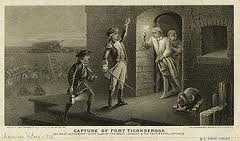
The colonel commandant and his militia began planning the seizure of Fort Ticonderoga from the British. On the eve of the planned assault, Colonel Benedict Arnold showed up to take over. Loyal to their existing officer, the Green Mountain Boys threatened to return home, which forced Arnold to share command with Allen. On the eve of May 9, 1775, Allen and Arnold planned the assault for the next morning.


Arriving at the lake opposite Fort Ticonderoga, the army had difficulty obtaining boats to cross over to the fort. With dawn fast approaching, Allen knew that successful assault required immediate action—yet only 83 of the 230 Green Mountain boys had as yet crossed. In his own narrative years later, Allen recounts his speech to the 83 members of his militia:

“Friends and fellow soldiers, you have, for a number of years, been a scourge and terror to arbitrary powers. Your valor has been famed abroad, and acknowledged, as appears by the advice and orders to me (from the General Assembly of Connecticut) to surprise and take the garrison now before us. I now propose to advance before you, and in person conduct you through the wicket gate; for we must this morning either quit our pretension to valor, or possess ourselves of this fortress in a few minutes; and, in as much as it is a desperate attempt (which none but the bravest of men dare undertake), I do not urge it on any contrary to his will. You that will undertake voluntarily, poise your firelocks.”

Leading the ranks in front and center, Allen took the fort that day, stating to the surrendering officer (Captain Delaplace) that he took the garrison “In the name of the Great Jehovah and the Continental Congress.”

Allen continued to lead the militia group, but four months later, they were engaged in fighting near Montreal when they were captured as prisoners. Thus began two and a half years of horror in prison as he and his men were transported first to England, then Halifax and finally to New York. During this time they were forced to survive in excrement-filled holds and forced to witness atrocities against captured patriots in New York. Concerning his first transport to England, Allen later wrote, “what is the most surprising is that not one of us died on passage.”

His imprisonment vacillated between inhumane conditions, then occasional reprieves by some officers who treated him in a more civil manor, since he was a colonel. At one point when imprisoned in New York, he was abruptly wined and dined by a British officer of rank and offered money and a tract of land if Allen would embark with General Burgoyne and “assist in the reduction of the country.”

Allen wrote, “I viewed the offer of land to be similar to that which the devil offered Jesus Christ, ‘To give Him all the kingdoms of the world if He would fall down and worship him.’”

On the third of May, 1777, Allen was taken out under guard and taken to a sloop in the New York harbor. Again, for two days, he was suddenly treated in a “polite manner” and given fine food and drink. A day later, this unexpected turn of events became clear: Allen was being exchanged for a British prisoner.

“I sailed to Elizabethtown-Point, and in a transport of joy, landed on liberty ground, and as I advanced into the country, received the acclamations of a grateful people.”

Taken to Valley Forge, Ethan Allen was “courteously received” by General Washington. Allen offered the general his further service on behalf of his country, “as soon as my health (which was very much impaired) would admit.”
http://www.ethanallenhomestead.org/

“I then bid farewell to my noble General and set out for Bennington (Vermont) the capital of the Green Mountain Boys, where I arrived the evening of the last day of May to their great surprise; for I was to them as one rose from the dead and now both their joy and mine was complete.”

Allen was given the rank of major general in the Vermont militia but his health was severely impaired by his years of imprisonment.  His first wife died in 1783, the year the Revolution ended. The following year he remarried and his young wife gave birth to three children.

In 1777, Vermonters had formally declared their independence from Britain and their fellow colonies and created the Republic of Vermont. Ethan Allen spent the rest of his life petitioning the Continental Congress to grant statehood to his beloved Vermont.

Even after the war concluded in 1783, New York, Massachusetts, and Connecticut all laid claim to the land in Vermont.

Allen died on February 12, 1789, at the age of 51, on his farm along the Winooski River in the still independent Republic of Vermont. The area was admitted to the Union two years later as the 14th state.  His youngest child was only two years old at the time of his death.