Announcements

10 Year Anniverary & New Releases Winners: Carrie Fancett Pagels' Butterfly Cottage - Melanie B, Dogwood Plantation - Patty H R, Janet Grunst's winner is Connie S., Denise Weimer's Winner is Kay M., Naomi Musch's winner is Chappy Debbie, Angela Couch - Kathleen Maher, Pegg Thomas Beverly D. M. & Gracie Y., Christy Distler - Kailey B., Shannon McNear - Marilyn R.
Showing posts with label campfollowing wives. Show all posts

Monday, December 19, 2016

Caty Greene: Darling of the Continental Army


Maj. Gen. & Mrs. Greene, date unknown
Last month I talked about Nathanael Greene, Revolutionary War general and former Quaker, and his crucial role in winning the war for independence for the colonies. Equally fascinating is his young wife, Catharine Littlefield Greene, or "Caty" for short.

Caty lost her mother at the tender age of 10, and in order to give her proper feminine influence, her father sent her to live with her aunt and uncle. She met Nathanael when she was 17, married him at 19 (he was not quite 32), then less than a year later had to surrender her hopes for a happy domestic life to his involvement in the cause of independence.

She made the most of it, however, and traveled whenever she could to be with him in the field--even during the terrible winter at Valley Forge. Famous for her charm and wit, she became a favorite with George and Martha Washington, and her presence helped fuel the effort to maintain a semblance of social normalcy for the Continental officers. It's said that she was so much a favorite with George Washington that he claimed her as a dance partner for hours at a time, on more than one occasion.

Caty's vivacious nature, while making her the darling of wartime society, left her wide open to rumors of infidelity. Caty made light of the accusations, brushing them off with vague answers that left room for the flirtations that happened sometimes under Nathanael's very nose--and it was common and somewhat socially acceptable during that era for women and men to "carry on" in public, up to a certain point.

The rumors were never really substantiated, however. To all appearances, Caty remained devoted to her husband and insisted even on journeying to him all the way from Philadelphia to South Carolina early in 1782, after Greene had largely exhausted the strength of the British forces and the surrender at Yorktown had taken place. Four of their six children were born during the war, although Nathanael was not free to rejoin his family until sometime in 1783.

Even then, her hopes for a peaceful family life were disappointed. Greene had essentially fed and clothed the Continental Army out of his own pockets during the Southern Campaign and at the close of the war found himself in dire financial straits. As partial compensation, Congress awarded him the estate of Mulberry Grove near Savannah, Georgia, and both Nathanael and Caty set to learning how to run a Southern plantation.

In June of 1786, tragedy struck. Nathanael Greene fell ill from sunstroke after being out too long surveying a neighbor's fields, and died a few days later. Both Caty and their mutual friend Anthony Wayne, who was present during Nathanael's illness and death, were devastated, but Caty did not give up. She determined to make plantation successful
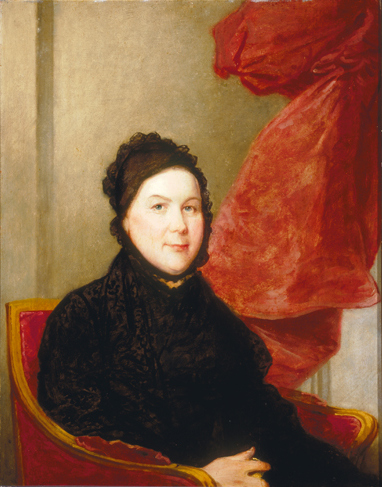
Catharine Greene Miller in 1809
She remained close friends with the Washingtons and others, and used her connections to appeal to Congress for support as a general's widow. In the meantime, her children's tutor, Phineas Miller, helped her manage the plantation. Caty also invited the neighbor children's tutor, a young man named Eli Whitney, to move to Mulberry Grove and pursue his inventions. Many insist that she was instrumental in his success with the cotton gin, which revolutionized cotton production.

In 1796, she married Phineas Miller, with the Washingtons in attendance. Mulberry Grove fell upon hard times and had to be sold, and Caty and Phineas moved to another holding originally given to Nathanael, an estate called Dungeness on Cumberland Island, Georgia. Phineas died in 1803; and in 1814, Caty followed.

The ironies of history amaze me. This couple from middle-class beginnings in Rhode Island had such an impact on our country's future and on the South in particular. If Nathanael had not died unexpectedly of sunstroke and left Caty to carve out her own future, would she have encouraged Eli Whitney in his progress on the cotton gin? If Caty had not first fueled and supported Nathanael's passion to win this country's independence, would he have had such heart for the long agony of the American Revolution in general, and the Southern Campaign in particular? We may never know, but the brief glimpses of their lives have provided an endless source of fascination for me.

Monday, July 14, 2014

Dispelling Colonial Myths: a reenactor myth started it all

Beautiful Drayton Hall ... occupied by the British
Living in the Charleston area for more than two decades can give one an interesting perspective on history. Not only have I gained a different slant on the Civil War than my Midwest school education gave me, but the richness of colonial history rooted here took me quite by surprise.

I’d been bitten by the reenacting bug a year before when attending a Civil War reenactment, but in May 2005 a new and intriguing historical event came on the scene, the 225th  anniversary commemoration of the Siege of Charleston. This grand reenactment spanned all three major Ashley River plantations: Middleton Place, Magnolia Gardens, and Drayton Hall. Each plantation had its own encampment, and each had its own admission price, and after deciding we didn’t have the time (or energy!) to hit all three of them, my family picked Drayton Hall, simply because it was the one of the three we hadn’t seen before.

Love the expressions! And the uniforms ... :-)
Thus my introduction to the British Legion, since none of the American (patriot) camps were at this location. During our exploration of the British camps, one friendly young reenactor cheerfully bestowed all sorts of useful and interesting information upon us.

A neat cluster of muskets
One nugget in particular caught my interest. The British soldiers, he said, often brought their wives along to help with the work of caring for the army—laundry and nursing and suchlike—and they were the ones the term “campfollower” originally applied to. Only later, especially during the Civil War, did it become synonymous with prostitutes who followed the army for their livelihood, although some of that happened during the Revolution as well.

The overlap of historical and modern
The young man proceeded to tell us that if a woman was unlucky enough to be widowed, the British army gave her a mere three days to attach herself to another man before abandoning her to whatever fate might dish out.

Three days.

My imagination fired at that, and the story premise behind Loyalty’s Cadence was born.

Later, I would join an 18th century research email list, frequented by historians and reenactors of the period, and I discovered this was not the case at all. The British army had very detailed regulations for the care of campfollowing wives, and the standard policy was, in the case of widowhood, to provide for her return to England, if she so wished. (I’m sure in the field, there was much room for difference of interpretation, but that’s another discussion.) I was indignant to find I’d been handed a common “reenactor myth,” told for the sake of sensationalizing history.

Standing guard at the house
As if history needs sensationalizing.

Thus also began my quest to find the truth in research, or at least as close to it as is possible through the reports of people who see events through the lenses of very different experiences and opinions.

And if I write with too much sympathy of the British and loyalist cause, I suppose it can be blamed on the fact that we chose Drayton Hall that muggy May day in Charleston. :-)
 
(Another highlight of the 225th Anniversary of the Siege of Charleston: a lecture, complete with visual aids, on colonial battlefield medicine. Useful stuff, for a writer, though his description of amputation left me very queasy. That, too, was inspiring in its own way!)

All photos are my own.