Announcements

10 Year Anniverary & New Releases Winners: Carrie Fancett Pagels' Butterfly Cottage - Melanie B, Dogwood Plantation - Patty H R, Janet Grunst's winner is Connie S., Denise Weimer's Winner is Kay M., Naomi Musch's winner is Chappy Debbie, Angela Couch - Kathleen Maher, Pegg Thomas Beverly D. M. & Gracie Y., Christy Distler - Kailey B., Shannon McNear - Marilyn R.
Showing posts with label Valley Forge. Show all posts

Monday, December 19, 2016

Caty Greene: Darling of the Continental Army


Maj. Gen. & Mrs. Greene, date unknown
Last month I talked about Nathanael Greene, Revolutionary War general and former Quaker, and his crucial role in winning the war for independence for the colonies. Equally fascinating is his young wife, Catharine Littlefield Greene, or "Caty" for short.

Caty lost her mother at the tender age of 10, and in order to give her proper feminine influence, her father sent her to live with her aunt and uncle. She met Nathanael when she was 17, married him at 19 (he was not quite 32), then less than a year later had to surrender her hopes for a happy domestic life to his involvement in the cause of independence.

She made the most of it, however, and traveled whenever she could to be with him in the field--even during the terrible winter at Valley Forge. Famous for her charm and wit, she became a favorite with George and Martha Washington, and her presence helped fuel the effort to maintain a semblance of social normalcy for the Continental officers. It's said that she was so much a favorite with George Washington that he claimed her as a dance partner for hours at a time, on more than one occasion.

Caty's vivacious nature, while making her the darling of wartime society, left her wide open to rumors of infidelity. Caty made light of the accusations, brushing them off with vague answers that left room for the flirtations that happened sometimes under Nathanael's very nose--and it was common and somewhat socially acceptable during that era for women and men to "carry on" in public, up to a certain point.

The rumors were never really substantiated, however. To all appearances, Caty remained devoted to her husband and insisted even on journeying to him all the way from Philadelphia to South Carolina early in 1782, after Greene had largely exhausted the strength of the British forces and the surrender at Yorktown had taken place. Four of their six children were born during the war, although Nathanael was not free to rejoin his family until sometime in 1783.

Even then, her hopes for a peaceful family life were disappointed. Greene had essentially fed and clothed the Continental Army out of his own pockets during the Southern Campaign and at the close of the war found himself in dire financial straits. As partial compensation, Congress awarded him the estate of Mulberry Grove near Savannah, Georgia, and both Nathanael and Caty set to learning how to run a Southern plantation.

In June of 1786, tragedy struck. Nathanael Greene fell ill from sunstroke after being out too long surveying a neighbor's fields, and died a few days later. Both Caty and their mutual friend Anthony Wayne, who was present during Nathanael's illness and death, were devastated, but Caty did not give up. She determined to make plantation successful
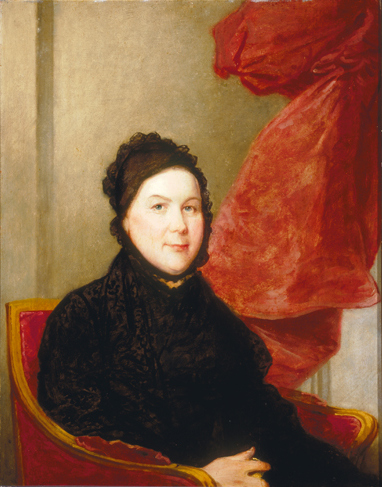
Catharine Greene Miller in 1809
She remained close friends with the Washingtons and others, and used her connections to appeal to Congress for support as a general's widow. In the meantime, her children's tutor, Phineas Miller, helped her manage the plantation. Caty also invited the neighbor children's tutor, a young man named Eli Whitney, to move to Mulberry Grove and pursue his inventions. Many insist that she was instrumental in his success with the cotton gin, which revolutionized cotton production.

In 1796, she married Phineas Miller, with the Washingtons in attendance. Mulberry Grove fell upon hard times and had to be sold, and Caty and Phineas moved to another holding originally given to Nathanael, an estate called Dungeness on Cumberland Island, Georgia. Phineas died in 1803; and in 1814, Caty followed.

The ironies of history amaze me. This couple from middle-class beginnings in Rhode Island had such an impact on our country's future and on the South in particular. If Nathanael had not died unexpectedly of sunstroke and left Caty to carve out her own future, would she have encouraged Eli Whitney in his progress on the cotton gin? If Caty had not first fueled and supported Nathanael's passion to win this country's independence, would he have had such heart for the long agony of the American Revolution in general, and the Southern Campaign in particular? We may never know, but the brief glimpses of their lives have provided an endless source of fascination for me.

Wednesday, January 8, 2014

Joseph Plumb Martin - Soldier of the Revolution

Re-Enactor Photo by Thomas Deitner


Joseph Plumb Martin was only fourteen years old when the first shots of the American Revolution were fired in 1775. But by the time the Continental Army was formed under the command of General George Washington in 1776, fifteen-year-old Martin was allowed by his grandparents (his guardians) to join the fight.

The Army was his home for the duration of the war.

Virtually none of us would even be aware of his existence except that, as an older veteran in his 70’s, Martin penned recollections of his experiences in the war. He felt compelled to describe his life as a soldier, explaining the incredible sacrifices he and his fellow soldiers had endured.

Martin wrote his war memoir at a time when many Americans were questioning whether or not pensions should be given to these aging veterans. Martin hoped to remind his country, for whom he had made great personal sacrifice, that the soldiers of the Continental Army were indeed worthy of support.

Here is an excerpt from his writings, published as A Narrative of a Revolutionary Soldier.

Campaign of 1777:

The army was now not only starved but naked; the greatest part were not only shirtless and barefoot, but destitute of all other clothing, especially blankets. I procured a small piece of raw cowhide and made myself a pair of moccasins, which kept my feet from the frozen ground…


The army continued at and near the Gulf for some days, after which we marched for the Valley Forge in order to take up our winter quarters. We were now in a truly forlorn condition—no clothing, no provisions and as disheartened as need be. We arrived, however, at our destination a few days before Christmas. Our prospect was indeed dreary. In our miserable condition, to go into the wild woods and build us habitations to stay (not to live) in, in such a weak, starved and naked condition, was appalling in the highest degree, especially to New Englanders, unaccustomed to such kinds of hardships at home. However, there was no remedy, no alternative but this or dispersion. But dispersion, I believe, was not thought of—at least I did not think of it. We had engaged in the defense of our injured country and were willing, nay, we were determined to persevere as long as such hardships were not altogether intolerable. I had experienced what I thought sufficient of the hardships of a military life the year before (although nothing in comparison to what I had suffered the present campaign) … But we were now absolutely in danger of perishing, and that too, in the midst of a plentiful country. We then had but little and often nothing to eat for days together; but now we had nothing and saw no likelihood of any betterment of our condition. Had there fallen deep snows (and it was the time of year to expect them) or even heavy and long rainstorms, the whole army must inevitably have perished. Or had the enemy, strong and well provided as he was then, thought fit to pursue us, our poor emaciated carcasses must have “strewed the plain.” But a kind and holy Providence took more notice and better care of us than did the country in whose service we were wearing away our lives piecemeal.

I found this original, unedited narrative compelling and gripping. It is truly my favorite first-person resource for the era.

I also found another edition with commentary, entitled Ordinary Courage, Edited by James Kirby Martin, to be a useful companion to the original.

There are Amazon links to both below.


Friday, September 30, 2011

Tools of the Trade: On Site Research - Visiting Valley Forge


By: Laura Frantz

This past July I had the privilege of going on tour with The Providence Forum and experiencing historic Philadelphia. Since Valley Forge isn't far, we spent a day there, too. Growing up, my vision of Valley Forge was limited to this image of George Washington praying in the snow. Legend says that a Quaker was walking in the woods and found Washington on his knees. Since Quakers hold to truthfulness as one of their tenets, I tend to believe this did happen. George Washington was a Christian, not a deist, and America's winning of the Revolutionary War was no small miracle.


Washington and his troops stayed at Valley Forge during a very brutal winter. I was here on a scorching summer's day so it was hard to imagine the cold and suffering that took place in 1777-78. This is the actual place he walked, talked, and made critical decisions that affected the course of the war. But he refused to move into this sturdy house until all his men finished building the huts that housed them first. They numbered in the thousands.

Washington's bedchamber at Valley Forge.

Martha spent the winter here also, encouraging her husband and the aides and officers surrounding him, several of whom had their wives in residence. How they all fit into this small house is a mystery but it's said they wiled the winter away together trying to make merry and even danced!

Headquarters where Washington and his aides worked daily excepting
the Sabbath.  This is the room at the back of the house on the first floor.

A desk, quill, ink and other necessities of that busy winter.

The kitchen is reached through a breezeway and isn't connected to
the main house. Notice the little oven within the hearth itself,
sometimes called a beehive, for baking bread.

The officers' quarters upstairs. Everything is displayed as if the
officers had just stepped out of the room. So lifelike!

Officer's quarters, same bedchamber, another view.
Love the Revolutionary War uniforms!

 Officers' quarters, second bedchamber at the top of the stairs.

The front room downstairs, yet another place for
conducting the business of war.

Valley Forge, though a very famous historic spot, offers a lingering lesson for today. I found it so moving to hear that this was the very place Washington thought about giving up the fight and surrendering to the British. Several close friends, including a beloved pastor, advised the general to abandon a hopeless effort to win American freedom. Though no war was waged between soldiers at Valley Forge, a fierce inward struggle transpired here. It became a battle of doubt, discouragement, and near defeat. Washington trimuphed in the end but we'll never know what he suffered during his time here. I think about it often now when I'm tempted to give up or give in to something that's troubling me.


Can you name a historic spot that is moving to you or holds a lasting lesson for us today?