Announcements

10 Year Anniverary & New Releases Winners: Carrie Fancett Pagels' Butterfly Cottage - Melanie B, Dogwood Plantation - Patty H R, Janet Grunst's winner is Connie S., Denise Weimer's Winner is Kay M., Naomi Musch's winner is Chappy Debbie, Angela Couch - Kathleen Maher, Pegg Thomas Beverly D. M. & Gracie Y., Christy Distler - Kailey B., Shannon McNear - Marilyn R.
Showing posts with label colonial Boston. Show all posts

Monday, October 19, 2020

Historic Boston, part 3: the Old North Church

(This post will be a little photo heavy again. Please click individual images to zoom in and get more detail!)

This inscription reads, "The signal lanterns of Paul Revere displayed in the steeple of this church April 13 1775 warned the country of the march of the British troops to Lexington and Concord."

Last July, when in Boston for a family wedding, my girls and I just happened upon the Old North Church and decided to stop in for a tour. We were so glad that we did--and so, apparently, was the staff! The man giving the talk at the front of the church (at a plexiglas-shielded podium just below the pulpit) heartily thanked our small group and said they were newly reopened after 4 months of closing due to COVID-19. [I see on their website that they're closed once again.]

He explained how Paul Revere and others knew that the British planned to attack but didn't know whether they'd march the long way away around by land, or take the quicker but more dangerous crossing across the harbor, but Revere would be waiting for the signal--"one if by land, two if by sea"--before saddling his horse to ride out and warn the countryside.


The church buildings, the smaller housing the gift shop, and two of my daughters reading the signage.


A shot of the front right side of the church, with the one remaining original window (lower right).
The pulpit with the sounding board above--the answer to acoustic issues before the age of microphones!


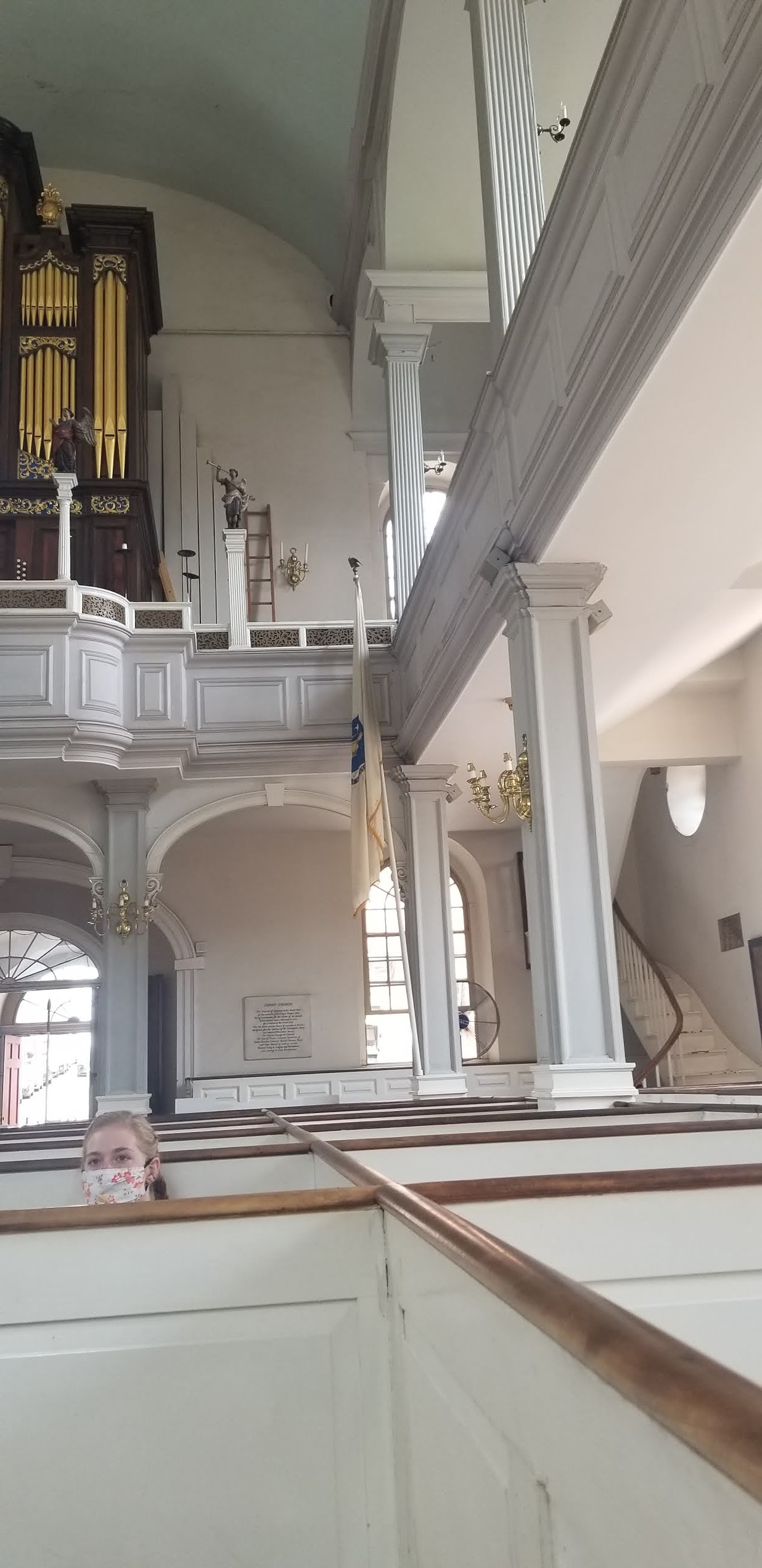
Only those wealthy enough to afford patronage for pew boxes were seated on the main floor, while the second-story galleries provided seating for enslaved and lower-class free folk.
Not sure if this rendering of the Apostles' Creed is original to the church, but it provided a sweet touchpoint for me, after attending a slightly liturgical church myself these past few years.
A quick shot (or two) of the pew box with sample personalized furnishings--showing how people would outfit them according to their own needs and tastes.
Love the colors and fabrics!


A shot of the rear corner, where the sexton carrying the lanterns for the signal climbed the stairs, then accessed the steeple stairwell from right behind those organ pipes. Can you imagine that climb? (And another of my cute daughters, tucked into her own pew box behind us!)

A long view of the aisle and church front, from the back. (With, yes, one of my daughters!)

So beautiful. I am a sucker for historic churches! Back when my family and I all lived in Charleston, South Carolina, I did several posts on because, well, they are just too beautiful and special to miss--and this one was no exception! I found several similarities to churches I'd visited elsewhere, but also many unique features.

And an unexpected connection to North Dakota! Many of the pew boxes bore engraved plates with the names of patrons who'd used those spaces, and here we read that Theodore Roosevelt, who spent much time in North Dakota in his younger days, and was a strong supporter of the National Park system, had visited and attended services at the Old North Church.
Closeup of the stairs ... and yes, there's a matching staircase on the other side.
The original wood collection box, under plexiglas of course. (I'm such a geek about these sorts of details!)

It was a sweet, if too-short, visit. I wish we lived close enough to go back again soon!

For more about the architecture and history: Old North Church

(They also have THE most fabulous gift shop everrrr! Do visit if you ever have a chance.)

Monday, September 21, 2020

Historic Boston: the highlights, part 2

 
Sometimes the best history is found in ... a cemetery.
 
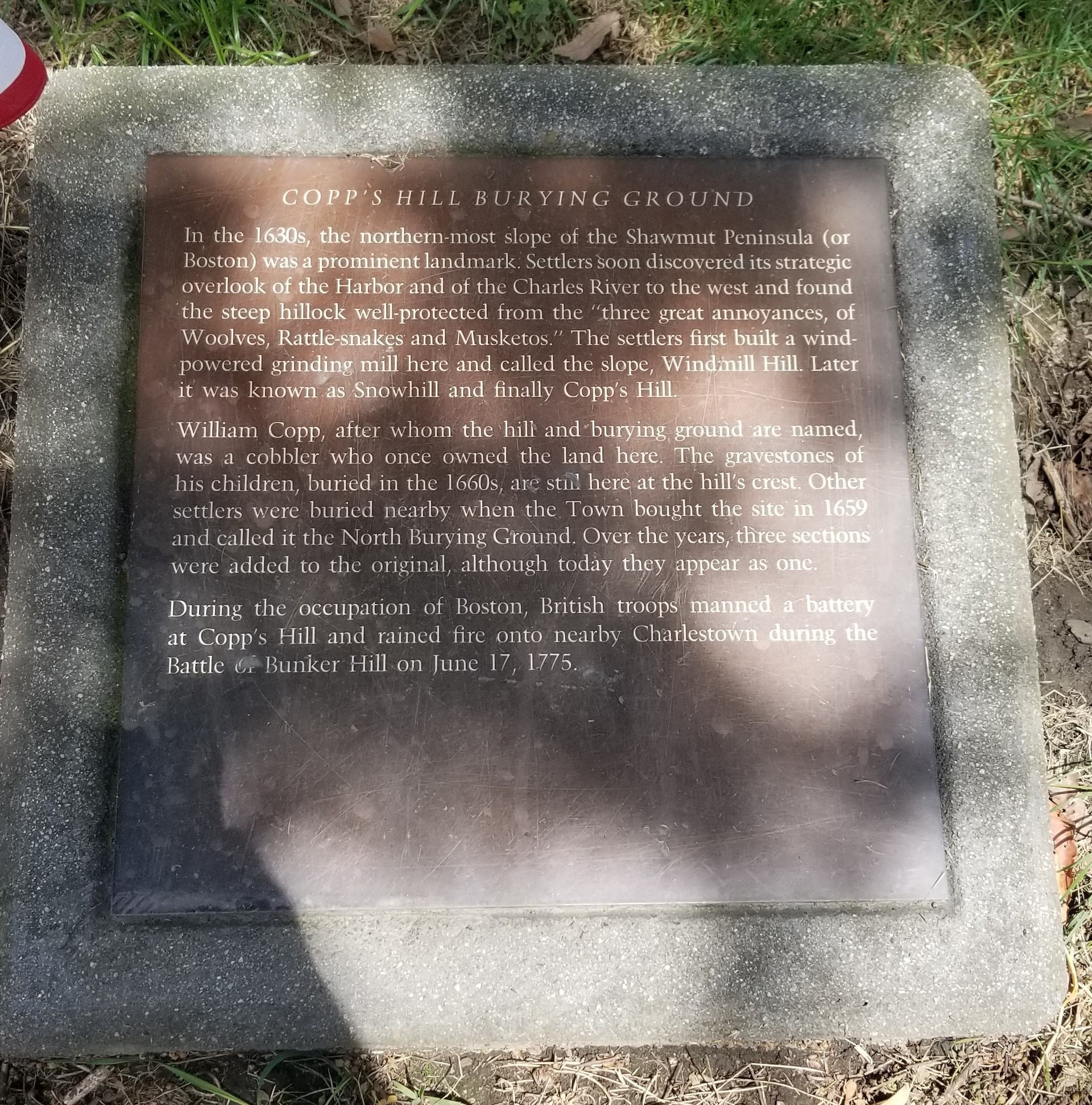
One of our too-short stops in the North End of Boston (which I completely fell in love with!) was the Copps Hill Burying Ground. This cemetery was, as explained by one of the informational placards, transformed during the Victorian era from a simple "burying ground" to a park.


 (Forgive the odd formatting on this post--Blogger has changed things all up and it's much harder to get things to look the way one wishes them to!)


One of my favorite discoveries was the family tomb of Cotton Mather, his son Increase, and grandson Samuel. I remember reading about Cotton Mather in church history, so in nosing around the CQ archives for connections to him, I really enjoyed MaryLu Tyndall's article, Cotton Mather: Preacher to the Pirates!
 
(Note the furry resident taking refuge in the construction around the monument ...)


And my youngest daughter, trying to see how close she can get to the wild bunny ...
 
Amongst other things we saw on this particular morning was the Revere house. We lacked the time to go in and tour, but I snapped an awkward selfie, and turned to capture the way the colonial building abuts a more modern construction before we had to hurry on.


And then there was the beautiful Old North Church! More on that next time, because it deserves its own post ...


Monday, August 17, 2020

Historic Boston (just the highlights! pt.1)

Attending family events, and maybe even doing book research, in the time of corona, is a rare and beautiful thing. Not that I'm saying I've done any of that recently. But I just happen to have found these photos on my phone and would love to share some visual bits of history with y'all ...


We didn't have much time, and what we did get to visit seemed rather haphazard. The first day was a drive-around tour that included Bunker Hill, then the USS Constitution (Old Ironsides) and a drive over to the North End of Boston, up State Street from the wharf to the site of the Boston Massacre. The second day, we walked around the North End and wound up taking the tour of the Old North Church. Remember my previous posts on colonial churches?? More on that one later!

But for now, here are a few highlights of Bunker Hill, one of the first actions of the American Revolution (possibly THE first action) ...

(This post is photo-heavy but I want to make sure some of these are big enough to read!)


This is technically Charlestowne, but the Boston area is BEAUTIFUL, y'all!

My brother, the Marine Corps colonel, shares my love of history, and gave us a running narrative of the Battle of Bunker Hill ... and it definitely took place on a real hill!


We'd come to Boston for a family wedding, but how can a history nerd refuse the chance to splash her toes in the waters of the past, when the opportunity presented itself? With all my study of the Southern Campaign of the American Revolution, standing here on Bunker Hill felt like the completion of something I'd begun years ago--you know, the FIRST half of RevWar history that everyone usually focuses on! :-

More to come ...

Friday, April 15, 2016

Paul Revere and His Riders

by Tamera Lynn Kraft

Thanks to the poem by Henry Wadsworth Longfellow called The Midnight Ride of Paul Revere, every American knows that Paul Revere made a midnight ride warning the colonists that the British are coming. Here is one stanza of the poem.

Listen my children and you shall hear
Of the midnight ride of Paul Revere,
On the eighteenth of April, in Seventy-five;
Hardly a man is now alive
Who remembers that famous day and year.


One thing the poem leaves out is there were many riders who rode to warn patriots of British invasion. Here's a brief sketch of all five riders who were well known.

Sybil Ludington: Sybil was the only woman rider. Her ride took place later than the other riders, April 26, 1777, but her service to the American cause was invaluable. She was the daughter of Colonel Henry Ludington. She rode 40 miles, double the miles Revere rode, to warn the colonists at Danbury, Connecticut of the approach of the British. She was later commended by George Washington for her heroism, and a statue of her was erected along her route in Carmel, New York.

William Dawes: During the war, in 1776, William Dawes was commissioned as a second major of the Boston militia regiment. A year earlier, on the night of April 18, 1775, Doctor Joseph Warren sent William Dawes, along with Revere, to ride from Boston, Massachusetts north to Lexington to warn Samuel Adams and John Hancock of their impending arrest, and to alert the colonial minutemen that the British were coming. Dawes arrived in Lexington half an hour after Revere because he took the longer route by land through the Boston Neck and his horse wasn't as fast. After warning Adams and Hancock, Dawes and Revere set out to warn Concord in case that was the British target.

British officers waited on the road between Lexington and Concord and ordered Dawes, Revere, and Prescott, another rider, to halt. The three men rode off in different directions hoping at one of them would escape. Dawes later told his children that after he rode into the yard of a house shouting that he had lured two officers there. Fearing an ambush, the officers stopped chasing him. But Dawes's horse bucked him off and ran away. He had to walk back to Lexington. Dawes and the other riders' warnings were successful. The town militas were ready for the British and won their first colonial victory. The British never found the weapons they planned to destroy and had to retreat to Boston.

In 1896, Helen F. Moore wrote this verse about the ride of Dawes.

Tis all very well for the children to hear
Of the midnight ride of Paul Revere;
But why should my name be quite forgot,
Who rode as boldly and well, God wot?
Why should I ask? The reason is clear-
My name was Dawes and his Revere.


Samuel Prescott: Paul Revere arranged for Samuel Prescott to meet him and Dawes on the road from Lexington to Concord the night of April 18, 1775. Prescott was a native of Concord, Massachusetts and knew the territory. He was to be a guide for the other two men.
When Prescott met Revere and Dawes on the road to Concord, British officers forced them to split up. Prescott would be the only man to eventually reach Concord safely and warn the Patriots there. Prescott then continued west to warn Acton, Massachusetts while his brother Abel Prescott rode south to warn Sudbury and Framingham. By this time, many riders were also dispatched from other towns to spread the warning. Bells were rung, and cannons were fired to warn of the danger at hand.

Prescott witnessed the Battle of Concord, then rode back to Lexington where he stayed to volunteer as a surgeon for two weeks. Later he became a surgeon for the Continental Army.

Israel Bissell: Israel Bissell made the longest ride in mid April 1775, starting around the 13th of that month. According to legend, Bissell was a professional post rider for the American colonists who rode 345 miles in four days and six hours along the Old Post Road covering a total of 345 miles. He shouted along the way "To arms, to arms, the war has begun." Bissell began his journey in Watertown, Massachusetts and drove his first horse so hard that it died just outside of Worcester, Massachusetts. He continued down to Philadelphia warning the militias along the way. Bissell carried a message from General Joseph Palmer where he was supposed to pass it to another courier. The newspapers of the day printed the warning and Bissell's name as the only rider. Some believe he is a composite of all the riders who carried the warning. Even if Bissell only rode from Watertown to Hartford, he rode the furthest of the five riders, and should be remembered for this service to the American colonists. Later Bissell enlisted in the Connecticut regiment and would eventually become a sergeant under Colonel Erastus Wolcott, signer of the Declaration of Independence.

The American poet and historian, Clay Perry, wrote an ode to Bissell with these opening lines:

Listen, my children, to my epistle
Of the long, long ride of Israel Bissell,
Who outrode Paul by miles and time
But didn't rate a poet's rhyme.


Paul Revere: Paul Revere, the most famous of riders, was trained to be a silversmith. When the Stamp Act of 1765 caused financial difficulties for his business, he joined the Sons of Liberty, the group of men responsible for organizing early revolution efforts. This is how he become aquanted with Joseph Warren, the leader who sent the riders out with their warning. Between 1773 and 1775, Revere made 18 rides as a courier for the Boston Committee of Public Safety reporting unrest. One April 7, 1775, Joseph Warren sent Revere to Concord to warn the Massachusetts Provincial Congress about British troop movements. Concord citizens moved the munitions and hid them.

Before the famous ride, Revere had instructed Robert Newman, the sexton of the North Church, to send a signal by lantern to alert colonists in Charlestown about to the movements of the troops. The code was "one if by land, two if by sea", one lantern would signal the army chose the land route while two lanterns would signal the route "by water" across the Charles River. There were two lanterns hung on April 18.

On the night of April 18, 1775, Warren sent Revere to send the signal to Charlestown that the British troops were on the move. Revere rode through northern Boston warning the American patriots about the enemy's movement. He never shouted the phrase "the British are coming." He rode swiftly and in secrecy northward. His journey ended in Lexington where he met other Sons of Liberty John Hancock and Samuel Adams. After meeting up with William Dawes and Samuel Prescott, Revere was captured and questioned by the British, so he never completed his ride to Concord. After he was released the same night, he helped Hancock escape Lexington.

During the war, Revere served in the Continental Army and afterwards returned to his profession as a silversmith.


Friday, May 11, 2012

Cotton Mather - Preacher to the Pirates!

On Friday, 20 June 1704, Cotton Mather and another minister, as well as “Forty Musketeers, Constables of the Town, the Provost Marshall and his Oficers,” accompanied the condemned pirates to the place of execution. In An Account of the Behaviour and Last Dying Speeches of the Six Pirates, he wrote:
Being allowed to walk on Foot through the Town, to Scarlets wharf, where the Silver Oar being carried before them; they went by Water to the Place of Execution being Crowded and thronged on all sides with Multitudes of Spectators.

Cotton Mather made it his life's goal to preach to condemned pirates with the intent of saving their souls for all eternity.  He often visited them in prison, reading Scripture to them and exhorting them to come to a true repentance for their sins before their execution. A diary entry in April 1699 read:
After the other public Services of the Day were over, I visited the Prison. A great Number of Pyrates being there committed, besides other Malefactors, I went and pray’d with them, and preach’d to them. The Text, in which the Lord helped mee to Discourse, was Jer. 2. 26. The Thief is ashamed, when hee is found. I hope, I shall have some good Fruit of these Endeavours.
http://alturl.com/yd6tr
But who was this Cotton Mather? Born in 1663, the eldest son of a prominent preacher in Boston, he grew up believing in hard work and living a Godly life. He learned to speak and read Latin, Greek, and Hebrew. Science intrigued him to such a degree that in 1713 he became the first person born in America to become a member of The Royal Society in England.   At age eleven, he was the youngest person admitted to Harvard College where he studied medicine and theology.

Two years after he graduated in 1678, Cotton Mather delivered his first sermon in Dorchester at Grandfather Richard Mather’s church.   Eight years later, he visited his first condemned prisoner.

His doctrine, or fundamental belief, was that “If we Mark the Ways of Wicked men, which is indeed, an old Way, we shall find in it some things that are truly Remarkable.”  The truths he found "remarkable" in each of the condemned men he visited were:

  • Sin has been around for a long time 
  • To follow the path of evil is not an easy way
  • When one allies himself with evil, he hastens his downfall
  • Sinning is a deceitful vocation
  • Commiting a sin only leads one to greater sins.
  • Once facing justice, sinners claim to repent but they're not sincere in doing so
  • Too much wickedness ensures an early demise
  • God knows all sins the wicked commit
  • Sooner or later all sinners must face their just punishments

Over his years, Cotton ministered to hundreds of condemned pirates. Most repented. Some never did. One of the most famous of those men who refused to see the light was a man by the name of William Fly, a 27 year old sailor who staged a mutiny on board the slaver, Elizabeth in 1726. After killing the captain and first mate, they took over the ship and became pirates, feasting on any ship that happened their way. After Fly's capture and speedy trail, he was quickly condemned to death by hanging.

Mather then described two meetings he had with the convicted pirates. Their first conference took place six days before their executions. Although doomed men, Mather assured them they could still be saved – “Tho’ you have been so wicked overmuch, that the Sword of Justice can do no other, than Cause you to Dy before your Time, yet there is Mercy with God for you, if you Return to Him. . .the great God is Angry with you…. You are within a very few Days, to be thrown into those Hands, which if you dy in Ill Terms with Heaven, you will find it a fearful thing to fall into. Now, tis only in the Way of repentance…that you can be saved from the inconceivable Miseries….

After several meetings , and try as Cotton Mather did, he failed to turn Fly toward God. 

The final segment of The Vial Poured out upon the Sea (an account of the proceedings)  involved the execution. Mather bid Fly “to Speak, what he should judge proper to be spoken on that sad occasion….” Instead of confessing or warning others not to tread the path he had, Fly said, “he would advise the Masters of Vessels to carry it well to their Men, lest they should be put upon doing as he had done.” Remaining defiant to the end, Fly died on 11 July 1726, at the age of twenty-seven, and his “Carcase hanged in Chains, on an Island, at the Entrance into Boston-Harbour.” 

Cotton Mather was sixty-three when he counseled William Fly. The Vial Poured out upon the Sea was his last narrative that focused on condemned criminals. He took seriously his job of ministering to sinners before they departed this life. 

Cotton Mather was the most prolific writer of early American literature, yet few of his 469 published writings have appeared in print since his death in 1728. He craved knowledge, and when he died, he owned one of the largest libraries in America.   


Wednesday, February 1, 2012

Guest Post by Pegg Thomas - The Farmer’s Life in Colonial Boston


The Farmer’s Life in Colonial Boston, by Pegg Thomas


Hello! It’s early you are, but no mind. Come to the house and refresh yourself. I’ll be lucky to get the milk bucket there before it freezes. Never seen such a winter as this back home. You’ve probably noticed by my talking, but me husband and I came over from Ireland. His brother came five years back and helped bring us over last summer.
Oh, and didn’t I think it grand in May! Sure, with the warm sun on my face I freckled up something fierce. But then you didn’t come to hear about that now. And where are my manners? Maggie Thornton’s the name. Me dear friend, Carrie, told me you want to learn about the life of a farmer.  Sure and I only know what I’ve learned myself so far, but happy I am to share it.

My Da’s farm in Ireland was vastly different from here. The soil outside Boston is so rocky and hard. I believe the ground grows rocks! ‘Tis only too true. Himself and I spent the first several weeks picking more stones than weeds from our poor crop. Still, they do make for a sturdy pasture fence.
His brother came and helped plant, such different crops from home. The ground is too rocky for potatoes which I had just taken a fancy to. It takes to rye, corn, and the beans and peas, of course. I thought we planted too much, but if we hadn’t we’d be in a sorry state this long winter.
Do we have any extra to sell? Bless me, no. The ground yields just enough for us and the livestock to get through the winter. Himself took a job at the docks this winter to help out. Nothing much, but better than not. He’s a good hand with wood and they aren’t short of repairs that need doing. Many have turned to fishing instead of farming but I think my Robert will stay with the land.
Give me a moment while I get the pease porrage cooking. I don’t mind telling you I’m more than a wee bit tired of it. We go through a pot full every day. It’s filling though and good for the children.
The livestock, yes, we have our milk cow of course, you saw her in the barn. Himself hitched the team to go to town. We put up a good store of hay last summer to keep them through the snows. The loft is still half full.

We keep a couple dozen hens, or try to, since the fox wants them that bad. We are keeping our ears open for a dog to help. The hens will want to start setting in a few more weeks. We’ve only a couple of young cockerels left for meat. The new chicks will be a blessing. And eggs, I do miss the fresh eggs in winter. Oh, we get a few, but only enough for the baking.
Our neighbor has pigs and we’ll buy a pair of piglets when they farrow come spring. No sense wintering over a sow until the children get bigger and we need more meat than Robert can bring in hunting. The boys will start helping with the corn this summer, they are seven and eight already. Here it is 1719, where do the years go?
How did we come by this farm? Well and that’s a long story. Himself’s brother knew the farmer here more than well. Best of friends they were. But he up and moved his family to Rutland, that new community that opened up in the Indian Territory. I’d be scared to death, I would. We were only too happy to buy this place, rocky as it is, and call it home.
Must you leave so soon? Well, and it’s a fair walk back. Blessings on you and make free to stop again.