Announcements

10 Year Anniverary & New Releases Winners: Carrie Fancett Pagels' Butterfly Cottage - Melanie B, Dogwood Plantation - Patty H R, Janet Grunst's winner is Connie S., Denise Weimer's Winner is Kay M., Naomi Musch's winner is Chappy Debbie, Angela Couch - Kathleen Maher, Pegg Thomas Beverly D. M. & Gracie Y., Christy Distler - Kailey B., Shannon McNear - Marilyn R.
Showing posts with label Pontiac's Rebellion. Show all posts

Friday, February 28, 2020

Colonial Germ Warfare - Who Struck First?


Many of us have heard the stories of blankets infected by smallpox victims that were given to the Indians as a first venture into using germ warfare during battle. In research for the novel I'm currently writing, I found a reference to just such a thing happening. It led me on a rabbit trail of investigation.

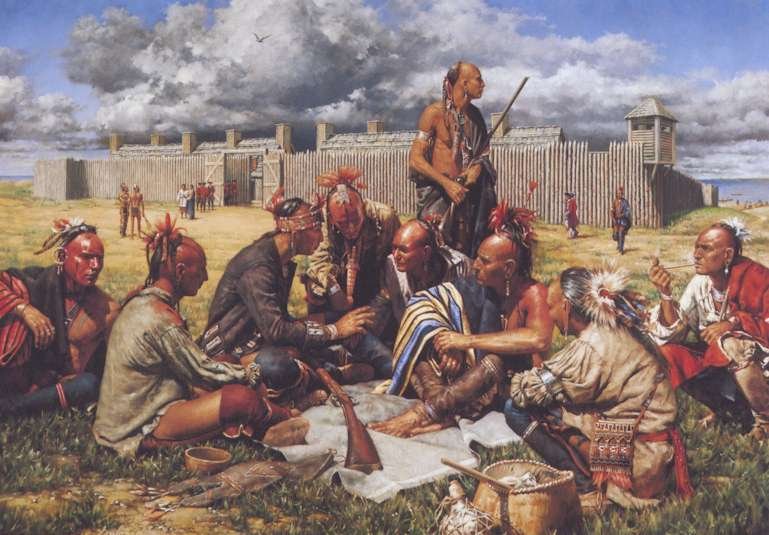
During the siege of Fort Pitt - part of Pontiac's Rebellion in 1763 - a man named William Trent kept a detailed journal. Trent was in command of the militia forces at the fort. Much of what we know about that fort and other forts that were attacked during the rebellion we owe to his journal.

There was a smallpox outbreak inside the fort when it was crowded past twice its intended occupation due to the number of British settlers who took refuge there. At one point, well into the siege, Trent made the decision to gift two Indian chiefs with blankets from the smallpox victims. He then wrote in his journal, "I hope it will have the desired effect."

Lest we come down too hard on Trent and his fellow officers, it's right to point out that the fort was surrounded by a much larger fighting force, was crammed to the rafters with people, was low on food and gun powder, and had no immediate hope for any relief. In short, they needed to lessen the numbers of their opponents. Militarily speaking, this was a prudent move on their part.

But the British were not the first to incorporate germ warfare tactics. In 1761, it was the Indians who tried to poison the well at Fort Ligonier to kill off the soldiers stationed there. It was discovered before any soldiers were poisoned.

As far as the smallpox blankets and their effectiveness, both of the Indian Chiefs are recorded as having returned to the fort weeks after receiving the blankets and with no visible signs of illness. Smallpox did run rampant that summer, but any linkage to the blankets having participated in the spreading of the disease has been deemed highly unlikely.


Pegg Thomas - Writing History with a Touch of Humor


Friday, May 3, 2019

Pontiac and the Conspiracy that Shook an Empire

The French and Indian War, known also in Europe as the Seven-Years-war, was actually the fourth in a series of long and bloody clashes beginning in 1688 between European powers and their native American allies for control of a continent. The period from 1758-1763 we now call the French and Indian War followed King William’s War, Queen Anne’s War, and King George’s War. Collectively, they were known as the French and Indian wars.


In 1756 the most notable of these French and Indian Wars erupted. After six years of vicious fighting, the French abruptly abandoned many of their posts in the interior of the continent along the Ohio Valley and western Great Lakes. The swell of victory lay within England's grasp—except they did not realize that defeating the French did not mean the natives of that country would give up. Many tribes were not willing to hand over yet more of their ancestral lands to the Europeans for settlement and colonization.

Michilimackinac

Then emerged an Odawa leader who had fought alongside the French. His name was Pontiac, called Obwandiyag by the Odawa. He was born on a night of snow and rain, wind and thunder. It is said the elders of his tribe remarked that a great leader was being born. Little is known of his early life, but Pontiac grew to become an important war chief among the Odawa. He was furious when his French allies signed a treaty in 1763 handing over all their lands to the British. Pontiac believed that now the English would flood the country, building towns and pushing the Indians further off their ancestral lands. Pontiac believed the only way to stop this was for all the Indian nations to put aside their past disputes and join together to stop the English. He also hoped that the French would once again join in and help, for they had never shown the intense interest in colonization that the British did.


Indeed, he must have been a great leader and diplomat, for he brought together tribes that had been his peoples’ enemies for countless decades—the Huron, Shawnee, Munsee, Wyandotte, Seneca-Cayuga, Ojibwe, and Lenape—and convinced them that they must stand together against the English. The league of nations he gathered together became known as Pontiac’s Confederacy. In May of 1763, Pontiac’s Rebellion erupted with the siege of Fort Detroit and developed further as he began plucking off the British forts one by one, shaking the foundations of Britain's strength.

Pontiac's Rebellion (also called Pontiac's Conspiracy or Pontiac's War), however, was doomed to failure. In the autumn of 1764, the British military took the offensive, invading the Ohio Valley. Pontiac began to lose some of his followers. The British eventually resorted to negotiating with Pontiac to end hostilities, but the result was the exact opposite of what Pontiac hoped for, because it brought about a greater British military presence in the Ohio Valley and Great Lakes region. Pontiac was eventually assassinated by a Peoria warrior a few years later in the French town of Cahokia. Rumors have long circulated about his death.

I've long been interested in the history surrounding Pontiac's War. This coming November, 2019, will see the release of a new, 4-author, historical romance novella collection in which my story A TENDER SIEGE is set during Pontiac's War. The story follows one particular battle which I'll write about next time. Stay tuned here, and sign up for my newsletter for updates on that release.

You'll also want to stay in touch for a reminder about a FREE book download coming May 23-27 of my novel The Softest Breath, Echoes of the Heart, Book Two. (Book One is only $3.99) It's not a colonial era novel, but I hope you enjoy it. Mark your calendar!


Blessings for your May basket~ 


Friday, May 26, 2017

Ojibwe of the Straits of Mackinac


Image result for ojibwe photosWho are these natives of the Great Lakes Region? They call themselves Anishinabe, which means "first people." Many know them today as Chippewa. The French, the first Europeans to settle among them, called them Ojibwe, also spelled Ojibwa or Ojibway.

In my current work-in-progress, my heroine is friends with an Ojibwe woman and her brother. Lucky for me, there are websites with Ojibwe names which include audio of their pronunciation. There are also many websites with the history - sometimes conflicting - of the Ojibwe people and their culture.

The Ojibwe were part of the organized movement against the British called Pontiac's Rebellion. My story is set at Fort Michilimackinac at the Straits of Mackinac where Lakes Michigan and Huron join at the top of Michigan's lower peninsula. The well-documented attack on the British-held fort by the Ojibwe was one of the victories for Pontiac's Rebellion. My characters will have to deal with the fallout of that attack.

My story will be part of The Backcountry Brides Collection releasing in May 2018. This will be a very special collection of authors who are all COLONIAL QUILLS contributors! Stay tuned to the blog in the months to come as our authors share their research with all of you readers ... who will then be able to read the stories in one handy collection. Huzzah!


PeggThomas.com

Embattled Hearts, Pegg's debut novella, is part of The Pony Express Romance Collection. Her second novella, In Sheep's Clothing, is part of The Bouquet of Brides Collection releasing in January 2018. Her third novella will be part of The Backcountry Brides Collection releasing in May, 2018.


Friday, October 23, 2015

Michigan's First Jewish Settler

Sometimes it's easy to fall into the rut of thinking all colonial people were British, Protestant, and poor. We remember the Pilgrims barely surviving their first winter, or the Puritans coming in droves to back-breaking labor in an untamed land. But, in fact, people came to our new shores for many different reasons.

Ezekiel Solomon was born in Germany during the Enlightenment Period. He arrived in Montreal, Canada, in the late 1750s. Quite likely he came from a prosperous family, since he had the money to relocate to Canada and the knowledge to run a successful business. He partnered with several other Jewish men and set out for Fort Michilimackinac, where he established his mercantile in 1761.

It was a rough time to live on the northern frontier. This was the end of the French and Indian War, when the British gained control of Fort Michilimackinac and other previously French strongholds in the Great Lakes area. The native tribes, used receiving many gifts from the French, were not happy with the British in power. Pontiac's Rebellion, a coordinated war by Ottawa Chief Pontiac and warriors from many other tribes, came north to Fort Michilimackinac in 1763. During the attack, Ezekiel Solomon and a few others were taken hostage and eventually ransomed in Montreal. Exactly why Solomon was spared when so many others died is unknown.

Returning to Fort Michilimackinac, Solomon restarted his business, making many trips back and forth to Montreal. At some point, he married Louise Dubois, also known as Okimabinesikwe, a practicing Roman Catholic. Their marriage was both inter-racial and inter-faith.

Solomon moved his business several times after the Revolutionary War to avoid living on American soil. He moved first to Mackinac Island, then St. Joseph's Island, and sometime later to Dummond Island.

Ezekiel Solomon was a partner of the Mackinaw Company, organized in 1779 by traders and companies. It is believed to be the first example of a department store operated in the United States.

Trooper and Pegg cropped