Announcements

10 Year Anniverary & New Releases Winners: Carrie Fancett Pagels' Butterfly Cottage - Melanie B, Dogwood Plantation - Patty H R, Janet Grunst's winner is Connie S., Denise Weimer's Winner is Kay M., Naomi Musch's winner is Chappy Debbie, Angela Couch - Kathleen Maher, Pegg Thomas Beverly D. M. & Gracie Y., Christy Distler - Kailey B., Shannon McNear - Marilyn R.
Showing posts with label William Penn. Show all posts

Friday, July 26, 2019

Lenni Lenape and William Penn

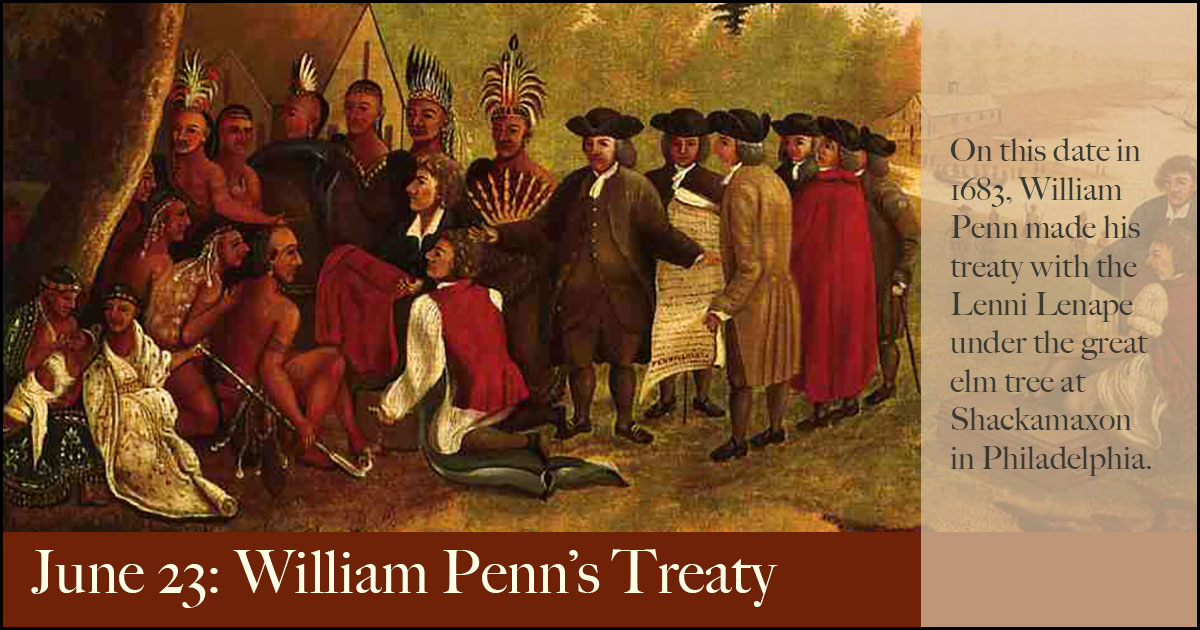
Image result for lenni lenape images with William Penn
William Penn, the Quaker who settled what is now Pennsylvania, was one of the few Europeans with a desire to deal fairly with the Native American tribes. At least initially. It was 336 years ago last month - according to tradition - that he signed a treaty with the Lenni Lenape tribe.

The treaty was said to have been signed under an elm tree at Shackamaxon, a Lenni Lenape town located near present-day Kensington, PA. It is believed that Shackamaxon was both a major settlement and a ceremonial area.

Because Quakers were prohibited from making oaths by their religious beliefs, this was the only treaty not ratified in that way. The French philosopher Voltaire claimed it was also the only treaty to never be infringed upon. History can debate his accuracy on that claim, as there is no written record of what was agreed upon.

William's Penn's grandson donated a wampum belt depicting two men joining hands that reportedly was given to William Penn at the treaty. It can be seen at the Philadelphia History Museum.

In this series:
The Lenni Lenape People
Lenni Lenape and Their Wars

Pegg Thomas writes "History with a Touch of Humor."


Wednesday, January 31, 2018

Pennsylvania: William Penn's Holy Experiment


The Peaceable Kingdom (Edward Hicks, c. 1834) exemplifies Quaker ideals.
William Penn, Pennsylvania’s founder, was an English Quaker who received the charter to Pennsylvania as the result of a debt owed to his father, Admiral Sir William Penn. The younger Penn, who grew up in English high society, began attending Friends meetings while living on a family estate in Cork, Ireland, and publicly joined the Society of Friends at the age of twenty-two. This soon got him arrested multiple times, as King Charles had placed stringent restrictions against religious groups other than the Anglican church. The Crown especially hated the Quakers, who believed all people (whether royalty or commoner) were created equal.

Despite persecutions, imprisonments, and being disowned by his family, William Penn’s Quaker faith burgeoned, getting him exiled from English society. He eventually ended up in Newgate Prison, and his dying father, who had gained respect for his son’s religious convictions, made peace with him and paid the fine to have him released. Sir Admiral Penn, knowing his son would face even worse persecution after his death, set the conditions for the founding of Pennsylvania. After the admiral’s death, young William Penn proposed to the Crown a partial solution to England’s religious strife: a mass emigration of English Quakers to America. To Penn’s surprise, the king granted him a large charter, giving him a large tract of land west of New Jersey and north of Maryland.

William Penn, a strong believer in religious tolerance and a man all too familiar with religious persecution, set forth to make his land (first called New Wales, then Sylvania, and finally Pennsylvania) a “Holy Experiment”—a haven for persecuted religious minorities. Within fifty years, the commonwealth had a quickly growing city (Philadelphia) and was home to people of several religious backgrounds.

The Society of Friends
Quakers began worshiping (silently, of course) at Upland in 1675. After Penn received his charter, Quakers emigrated in large numbers from England, Ireland, and Wales. They settled primarily in Philadelphia and the surrounding counties, and controlled Pennsylvania’s government until 1756, when their pacifism became unpopular with nonpacifistic Pennsylvanians during the French and Indian War. While Quaker dominance gradually diminished as people of other religious backgrounds made Pennsylvania their home, many Friends Meetings still exist today, often worshiping in the same meetinghouses used three hundred years ago.

The Pennsylvania Germans
Most Pennsylvania Germans belonged to the Lutheran and Reformed churches, but Pennsylvania also drew several smaller groups, primarily the Mennonites, Amish, Dunkers (German Baptist Brethren), Schwenkfelders, and Moravians. A small group of Mennonites and Quakers arrived in Pennsylvania in 1683 and settled Germantown (now part of Philadelphia), and by the 1730s, more Mennonites and the first Amish immigrants had arrived in Pennsylvania. The Schwenkfelders started arriving in 1731, and the Moravians in 1741. These smaller groups, all believers in nonresistance and baptism upon confession of faith in Christ, settled north and west of Philadelphia to farm the land. The Moravians soon became known for their mission work among the Native American tribes.

The Church of England
William Penn’s religious tolerance was so great that he allowed those who belonged to the Church of England, the same group that had persecuted him in England, to come to Pennsylvania. The Anglicans held services in Philadelphia as early as 1695, eventually building Christ Church, still one of Philadelphia’s most notable churches. With the addition of its spire in 1754, Christ Church became the tallest building in North America.

The Catholic Church
The first Catholic congregation was organized in 1720 in Philadelphia, and they built their first chapel in 1733. Pennsylvania had the second largest Catholic population during Colonial times, but their numbers were hardly large. Even in 1757, of Pennsylvania’s 200,000 residents, fewer than 1,400 were recorded as Catholic. This number is substantially higher today, with 28% of Pennsylvanians now characterizing themselves as Catholic.

The Presbyterian Church
The Scotch brought Presbyterianism to Pennsylvania, with the first congregation organized in 1698 in Philadelphia. Scotch-Irish immigration from 1710 till 1775 ushered in around 200,000 people to the Colonies, with most coming to Pennsylvania before spreading west and south. Presbyterians now make up approximately 4% of Pennsylvania’s population.

The Methodist Church
Methodists arrived in Philadelphia later in the colonial period. Their first church, St. George's Church, was built in 1769 and is the oldest Methodist building in America. Methodists now make up around 5% of Pennsylvania’s population.

The Jewish Community
Colonial Pennsylvania had a significant Jewish population. The first Jewish Philadelphian recorded was Jonas Aaron, in 1703, but sources show that Jews were in the area before then. Mikveh Israel, founded by Spanish and Portuguese Jews, was established in the city in 1740.

Nowadays, American states include a myriad of different religions. During Colonial times, however, Pennsylvania stood out. While other colonies restricted members of certain religious groups, William Penn opened Pennsylvania to all who worshiped God. Through this, he helped change the trajectory of an entire country.

Wednesday, March 18, 2015

By Turf & Twig ~ A Transfer of Land in Colonial America

“This turf and twig I give to thee, and I hope a loving brother thou wilt be.”
From the Turf and Twig, Livery of Seisin Ceremony.
 
Spencer-Pierce Farm which was conveyed by Turf and Twig.

I first heard of the turf and twig ceremony when researching my ancestor, Daniel Pierce, and learned that a property was conveyed to him from John Spencer in 1651 by means of "turfe and twigge." The following deposition was recorded in the Registry of Deeds, Salem, Massachusetts.
"This deponent saith that about the yeares 1651 or fifty-two I was at the farm y’ Mr. John Spencer sold to Mr. Daniell Peirce in Newbury, and Mr. Spencer and Mr. Peirce with myselfe and another, I suppose it was Mr. William Thomas, and, as we were going through the land of ye said farme, Mr. Pierce said to Mr. Spencer you promised to give me possession by turfe and twigge. Mr. Spencer said soe I will, if you please to cutt a turff and twigge, and Mr. Pierce did cut off a twigge off a tree, and cutt up a turfe, and Mr. Spencer tooke the twigge and stuck it into the turff, and bid us beare witness that he gave Mr. Pierce possession thereby of the house and land and ffarme that he had bought of him, and gave the turff and twigge to Mr. Pierce and further saith not.
Taken upon oath 10 Jan. 1679.
Before me
JOHN WoooBRHXiE, Commissioner."

William Penn Statue, New Castle Common, Delaware
Turf and Twig, otherwise known as Livery of Seisin, is a ceremony performed since medieval times in England that effected the transfer of land from one party to another. Livery means delivery, and seizin means possession. The common law once provided that a valid conveyance of a fee interest in land required the physical transfer by the transferor to the transferee, in the presence of witnesses, of a piece of the ground (often, in the literal sense of a hand-to-hand passing of an amount of soil), a twig, key, or other symbol. This practice was brought to the American Colonies and continued until the late 17th century. In fact, in 1682 William Penn performed the Livery of Seisin ceremony with twig and turf, along with a porringer of riverwater, when he obtained property in New Castle, Delaware.


Sealing of the Freeman's Purchase With the Presentation of Turf and Twig
An example of the many Livery of Siesen ceremony's that took place between the colonists and the Indians is the Freeman's Purchase in 1659, made by the General Court of Plymouth from Wamsutta, son of Massa­soit. The land included in the pur­chase extended to the northern bound­ary of Freetown (Massachusetts) and easterly from the Taunton River four miles. It was all purchased for some household implements and some pieces of cloth. The contract was denoted by the English custom of presenting the "turf and twig." The "turf" represented all the water included in the purchase, and the "twig" denoted all the land and all that was on it.

1797 Early American Deed

When conveyance was made by turf and twig the transfer was supplemented by a deed in the usual form, duly signed and recorded. Witnesses signed an affidavit attesting that they witnessed the deed of transferring the clump of dirt. And this, my friends, is the origin of the word deed! In colonial deeds and wills the term “seized” is frequently used to describe the land they are selling as something which they are“lawfully seized and possessed of,” or that someone “died seized” of a piece of property. Although some of the terminology from the Livery of Seisin exists today, the ancient ceremony became obsolete as literacy increased and only a written deed was deemed necessary. See the video below to observe how the turf and twig ceremony was performed.


Wednesday, February 12, 2014

The Amish in Colonial America

I was raised as a Mennonite by parents who grew up Amish, and I have a multitude of Amish relatives. With the continuing interest in this conservative denomination and the popularity of Amish romances, I thought it might be interesting to take a look at the origins of the Amish church in America, especially their main settlement in the mid 1700s, the Northkill Amish Church, named for the creek that wound through it.

Northkill Marker
For the past few years I’ve spent considerable time researching the lives of my Hochstetler ancestors for the novel a cousin, author Bob Hostetler, and I have coauthored, releasing March 1. Titled Northkill, the story focuses on the family of Jacob Hochstetler, whose farm came under attack during the French and Indian War. The story of the Hochstetler massacre is well known in the Amish and Mennonite communities, and a plaque marks the site of the farm where it happened, near present-day Shartlesville, Pennsylvania. We were determined to make our fictional depiction of this story as accurate as possible 257 years later, which meant not only doing intensive research, but also mentally, emotionally, and spiritually living in their time. Writing Northkill has been a fascinating and emotional journey, all the more so because as direct descendents of the story’s main characters we owe our very existence to them.

The Amish came to America because of severe persecution in Europe during the 16th and 17th centuries due to their insistence on believers’ baptism and opposition to military service. They were drawn to Pennsylvania by William Penn’s assurances of religious freedom and economic opportunity denied them in Europe. The Northkill Creek area in Berks County was opened for settlement in 1736, and that year a couple of Amish families settled there, with others following the next year. My great-great-great-great-great grandfather and grandmother, with two small children, were part of a group that landed at Philadelphia on November 9, 1738, aboard the ship Charming Nancy.

They soon joined other members of their church in the Northkill settlement 75 miles northwest of Philadelphia. Additional groups immigrated to the area in 1742, and again in 1749, when Bishop Jacob Hertzler arrived to provide leadership for the growing congregation. The earliest known organized Amish church in America, it included nearly 200 families at its height. It remained the largest Amish settlement in America into the 1780s, when it slowly declined as families moved westward in search of better farmland.

The Northkill settlement lay at the foot of the Blue Mountain, the legal boundary of English settlements according to treaties with the Native Americans. However, white settlers persisted in crossing the mountains into territory claimed by the French and their native allies. Hostilities finally broke out in 1754, with the French enlisting the Indians to attack the border settlements. During the French and Indian War over 200 settlers were killed in Berks County alone. The Indian attack against my ancestors’ farm early on the morning of September 20, 1757, was one of those horrific incidents.

On Monday, September 19, the Hochstetler family hosted an apfelschnitzen (apple cutting) frolic for the young people of the church. The youth traditionally stayed late into the evening to enjoy games and courting, but their guests finally left and the family went to bed. In the dark hours of Tuesday morning, the oldest son still living at home, Jacob Jr., roused when the family’s dog set up a clamor. When he opened the door, 17-year-old Jacob was shot in the leg by a member of a war party composed of Delaware and Shawnee warriors who surrounded the house.

The family managed to barricade themselves inside. Because the Amish hold fast to the commandment not to kill, Jacob made what must have been a truly wrenching decision that they wouldn’t shoot at their attackers despite the hunting rifles at hand and his sons’ desperate pleas. When the Indians set fire to the house, Jacob, his wife, three sons, and a young daughter were forced to take refuge in the cellar. During the terrifying hours that followed, they repeatedly beat out flaming embers while the house burned above their heads.

Artist's Depiction of Attack on Hochstetler Farm
At last dawn brightened the sky. Seeing through a narrow window in the foundation that the Indians had withdrawn and believing themselves safe, the family hurriedly forced their way out, barely escaping the flames. But one of the warriors, a young man called Tom Lyons, had lingered in the orchard to pick ripe peaches. When he saw them emerge from the blazing structure, he called the rest of the war party back, and they fell upon their defenseless victims.

The mother, the wounded son, and the young daughter were killed and scalped. Jacob and two sons, Joseph, 15 years old, and Christian, 11, were carried away into captivity. Their journey, described in a remarkable deposition preserved in the papers of British Colonel Henry Bouquet after Jacob’s dramatic escape, will be the subject of book 2 of the series, The Return. It will cover the captives’ lives among the Indian clans the French gave them to, Jacob’s harrowing escape and his efforts to find his boys, Joseph and Christian’s forced return home after the war, and their difficulty in assimilating into a culture they had largely forgotten, while reestablishing a relationship with the father whose decision had torn apart their lives.

The story of my ancestors is a deeply moving account of obedience, hope, and endurance, and of God’s unfailing faithfulness to His people even in the worst of trials. In the centuries since the attack, our family has been extraordinarily blessed. Jacob’s descendants have spread throughout the world and their accomplishments span a wide range of endeavors. My ancestors’ example daily inspires me to faithful discipleship, and my hope and prayer is that it will equally inspire readers in their walk with the Lord.

For more information, visit my Northkill blog.