Announcements

10 Year Anniverary & New Releases Winners: Carrie Fancett Pagels' Butterfly Cottage - Melanie B, Dogwood Plantation - Patty H R, Janet Grunst's winner is Connie S., Denise Weimer's Winner is Kay M., Naomi Musch's winner is Chappy Debbie, Angela Couch - Kathleen Maher, Pegg Thomas Beverly D. M. & Gracie Y., Christy Distler - Kailey B., Shannon McNear - Marilyn R.
Showing posts with label Lenape Indians. Show all posts

Friday, July 26, 2019

Lenni Lenape and William Penn

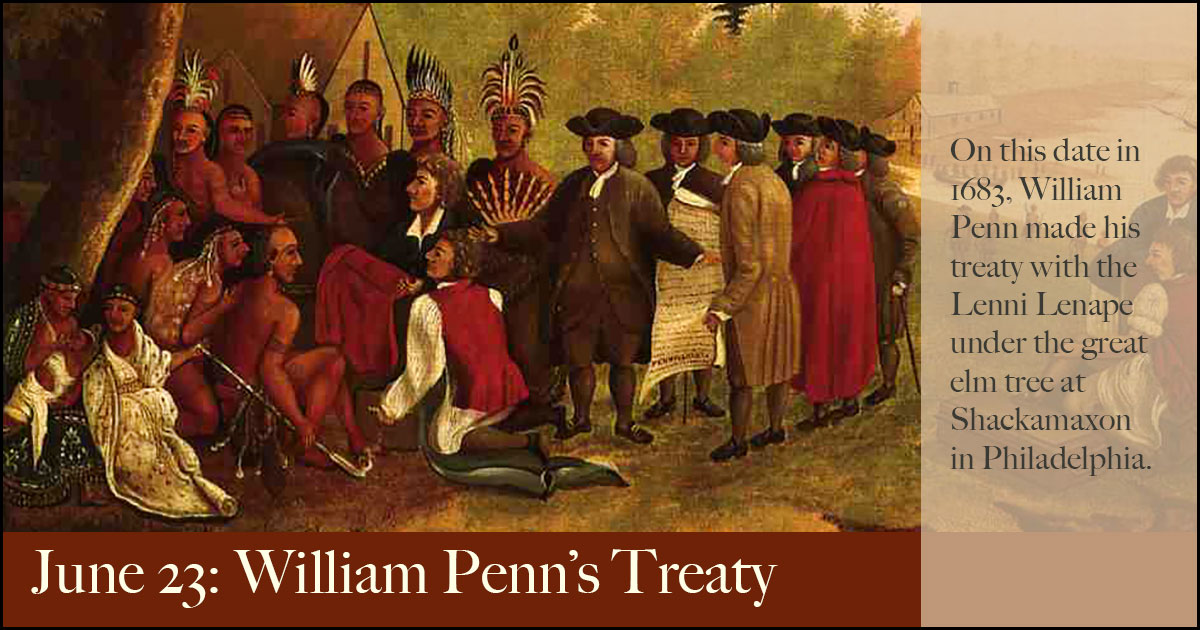
Image result for lenni lenape images with William Penn
William Penn, the Quaker who settled what is now Pennsylvania, was one of the few Europeans with a desire to deal fairly with the Native American tribes. At least initially. It was 336 years ago last month - according to tradition - that he signed a treaty with the Lenni Lenape tribe.

The treaty was said to have been signed under an elm tree at Shackamaxon, a Lenni Lenape town located near present-day Kensington, PA. It is believed that Shackamaxon was both a major settlement and a ceremonial area.

Because Quakers were prohibited from making oaths by their religious beliefs, this was the only treaty not ratified in that way. The French philosopher Voltaire claimed it was also the only treaty to never be infringed upon. History can debate his accuracy on that claim, as there is no written record of what was agreed upon.

William's Penn's grandson donated a wampum belt depicting two men joining hands that reportedly was given to William Penn at the treaty. It can be seen at the Philadelphia History Museum.

In this series:
The Lenni Lenape People
Lenni Lenape and Their Wars

Pegg Thomas writes "History with a Touch of Humor."


Friday, May 24, 2019

Lenni Lenape and Their Wars


Like so many Native American tribes, the Lenni Lenape were severely and negatively impacted by the arrival of the Europeans, but in the beginning, not in the way many people expect.
Related imageLiving along the waterways of the east coast, the Lenni Lenape's villages were in a prime location for trading with the Dutch settlers who arrived in the early 1600s. Trade with the Dutch was highly valued by other tribes like the Susquehannock to the west and the Mohawk and Mahican to the north, tribes who had been at war with the Lenni Lenape for generations. Tribes who wanted free access to the new Europeans trade.
From 1630 to 1635, the Susquehannock forced the Lenni Lenape to the east of the Delaware River into southern New Jersey and Delaware, which gave the Susquehannock full control of the trade route with the Dutch settlers. During that same period, there was a smallpox outbreak, a disease the Europeans introduced to the new shores. Between these two events, the 5-year war and smallpox, half the population of the Lenni Lenape were wiped out. They became a conquered people, subjected to the Susquehannocks and forced to fight in their wars.
In the 1660s, the Iroquois attacked the Susquehannock and their Lenni Lenape subordinates as yet another smallpox outbreak ravaged the east coast. By 1675, the Iroquois had beaten the Susquehannock and taken control of the Lenni Lenape.
By the time William Penn arrived in 1682, he "inherited the remnants of the wasted Lenni Lenape tribe."

But hang on … they make a comeback! More posts on this people group in the coming months.

In this series:

The Lenni Lenape People

Pegg Thomas writes "History with a Touch of Humor."

Friday, April 26, 2019

The Lenni Lenape People

Related image

My current work in progress, a historical romance set during the Revolutionary War, has a Lenni Lenape hero. That's pretty cool! Except I knew nothing - literally - about the Lenni Lenape people. So this past month I've been devouring everything I can find on this Native America tribe that had almost disappeared.

Better known today as the Delaware Indians, the Lenni Lenape is considered one of the oldest tribes on the east coast. Even other Algonquian tribes referred to them as the Grandfather Tribe, Grandmother Tribe, or the Ancient Ones. 

The tribe was so large and so widespread before the arrival of the Europeans - its territory included parts of present-day New York, Pennsylvania, New Jersey, and Delaware - that it spoke three major dialects.

They were the tribe who signed treaties with William Penn and the Quakers in Pennsylvania. They were the tribe who fought alongside the Patriots and helped defeat the British. They were also the tribe best known for capturing white children and taking them captive. Indeed, there is much to learn about this ancient tribe. I'll be writing a series of posts on them in the coming months.


Pegg Thomas writes "History with a Touch of Humor."
Wednesday, November 30, 2016

Pennsylvania, 1756: Quaker Strivings for Peace amidst the French and Indian War

Israel Pemberton Jr, caricatured as "King Wampum," in a political cartoon
 mocking the Quaker government of Pennsylvania. By H. Dawkins, 1764.
Bc 612 D32a, Historical Society of Pennsylvania.
The novel I’m currently finishing takes place in 1756, and delves into Pennsylvania’s greatly deteriorating relationship with the province’s Indian tribes, as well as the effort that Philadelphia Quakers put forth to bring about peace.

The French and Indian War (1754–1763), known as the Seven Years’ War in Europe, isn’t nearly as renowned as the Revolutionary War, but it was a pivotal point in American history. The French controlled Canada and had their sights set on what is now the U.S. Midwest. They hoped to thwart English expansion to the west, especially in Pennsylvania, and tried to prevent the English from buying land that belonged to the province’s tribes—primarily the Lenape (called the Delaware by European settlers), the Susquehannock, and the Shawanese.

The Lenape were already devastated by the loss of their lands in eastern Pennsylvania, particularly the infamous Walking Purchase in 1737. The tribe’s continued gross mistreatment by Pennsylvania’s government and settlers then impelled them to ally with the French and turn the frontier to the north and west of Philadelphia into “a theatre of bloodshed.”

While the non-Quaker population called for the raising of a militia for self-defense, the pacifistic Friends (Quakers) in the Pennsylvania Assembly refused. This political struggle finally ended in May 1756 when six prominent Friends resigned from the Assembly, allowing Pennsylvania to fully embrace military defenses.

To address the violence on the frontier in their own way, Friends in Philadelphia formed the Friendly Association for Regaining and Preserving Peace with the Indians by Pacific Measures, under the leadership of Israel Pemberton Jr., a former assemblyman. This group worked tirelessly to forge peace with the Lenape through treating them with respect and love, working to compensate them for their losses, and acting as a liaison between the tribe and the government. The Friendly Association continued to meet with the Lenape and the Six Nations (who controlled the Lenape) throughout the French and Indian War period, providing needed provisions and assisting with multiple peace treaties, some of which were more successful than others.

In 1758, Pennsylvania passed an act that created provincial stores to provide supplies to the Indians at reasonable prices. In addition, profit from the stores’ sales would go toward the cost of schoolmasters for the Indians and other tribal expenses. The Friendly Association offered its support, hoping that the stores would benefit the tribes, but various problems developed over the next few years. After the outbreak of Pontiac’s War (1763), the stores closed.

Quaker support of the Friendly Association dwindled in the early 1760s, and, after Pontiac’s War, so did Quaker influence in Indian affairs. The British Ministry now forbid those who had no official capacity to engage with the Indians, and while Israel Pemberton and other Friendly Association leaders were still quite concerned for the Lenape’s welfare, many Friends became discouraged by the group’s inadequate results and stopped contributing funds. Eventually the group was no longer able to carry out its mission and stopped meeting.

Over the years since, the Friendly Association has garnered both praise and criticism from historians, depending on their viewpoint. Many have concluded that whatever the outcome, the group no doubt had the tribes’ interests in mind and truly hoped to bring about peace during a very turbulent time. Amid a horrible war, they gave many Indians some renewed confidence in the English (who quite honestly didn’t deserve it), and their influence with the Lenape people helped pave the way for peace treaties with other tribes. 

Still, the Friendly Association couldn’t fix what the Pennsylvania government had destroyed and had no intention of mending. In spite of the group’s inability to accomplish all it hoped to, there is no doubt that the Friendly Association had its successes as well. The group did what it could to alleviate suffering, and one can only wonder how many other lives would have been claimed during the war—both Indian and white—had it not been for their dedication.