Announcements

10 Year Anniverary & New Releases Winners: Carrie Fancett Pagels' Butterfly Cottage - Melanie B, Dogwood Plantation - Patty H R, Janet Grunst's winner is Connie S., Denise Weimer's Winner is Kay M., Naomi Musch's winner is Chappy Debbie, Angela Couch - Kathleen Maher, Pegg Thomas Beverly D. M. & Gracie Y., Christy Distler - Kailey B., Shannon McNear - Marilyn R.
Showing posts with label Virginia. Show all posts

Wednesday, April 22, 2020

Colonial Williamsburg During Pandemic: The Greens Are Empty

A sight you may never see again --
Colonial Williamsburg greens by the Courthouse, empty during the pandemic

Colonial Williamsburg During Pandemic
Part 1
The Greens Are Empty!

Living here in the Historic Triangle of Virginia I and my family have been blessed to be able to visit Colonial Williamsburg regularly.  We have splendid re-enactors and incredibly talented craftsman. During this shut-down in Virginia, ordered by our governor, we are limited to what we can do and how we can do it. But we are still able to take walks and my son and I walked through Colonial Williamsburg. There were very few people there and those who were observed the new "social distancing" rule of six feet between yourself and the next person.
The Colonial Williamsburg Courthouse -- Empty during Pandemic
What a strange thing to walk up to the courthouse and have absolutely no visitors lingering on the steps of this popular site! This also gave me a chance to get some good pictures. In a normal April, this is a fantastic time to visit because the weather is usually good and the flowers are blooming. More about that in an upcoming post.

Colonial Williamsburg Mary Dickinson building -- Also empty during the Pandemic
Normally, the wonderful re-enactors are bustling about Williamsburg in their colonial-era costumes. We didn't spy any of those folks on our visit but we did run into one of the craftsmen carpenters who chatted with us, something I've never had happen in the twenty years I've been visiting. He pointed out to my son some of the craftsmanship on one of the building's exterior and said that the seven carpenters at CW are in charge of (the woodwork on) hundreds of buildings. That was interesting!

Peyton Randolph home at Colonial Williamsburg during the Pandemic
We took a nice walk and hope to go again sometime soon. The Peyton Randolph home usually has a line of guests waiting outside (on the side not in the front as in this picture) but of course no one there during our April visit.
Empty Street at Colonial Williamsburg during Pandemic

Above is a scene you'll not normally encounter in Springtime at Colonial Williamsburg. It was quite an eery thing to behold. Usually when I'm at CW, I have trouble getting pictures for the blog that don't have modern-attired visitors in them. Granted these are paved streets in the center for our modern times with some cobblestones on the side.

If you recognize the building above, from Colonial Williamsburg, you might remember we "hosted" a Colonial Quills blog Tea Party there (virtually!) a while back. Never fear, Colonial Williamsburg will endure beyond this pandemic. In the meanwhile, be sure to support Colonial Williamsburg with your donations.

Question: What historic locations are you still able to visit near where you live, during this Pandemic?

Wednesday, March 8, 2017

Sins of the Fathers -- Slavery's Roots in Virginia by Carrie Fancett Pagels


I began the following post several years ago, but didn't post it. I recently completed a novella, "Love's Escape" which will be published in November, 2017, by Barbour in The Captive Brides collection. This novella includes two escaped slaves who are one-eighth African descent, being brought out of bondage via my hero, the son of a funeral home owner and his friend.

Recently, Pegg Thomas post about Abolitionism in colonial times. I pulled the following post out of draft mode to share! And I've modified it and added to my original post.

As I've mentioned in a previous post several year ago, with Julian Charity, Historian at Shirley Plantation, the indentured servants were the first main workforce in Virginia and it was only later that slavery began its pernicious roots. I live right here in the heart of of where the enslavement of Africans began. Lest you think only the British were transporting slaves, one of the first cargoes to Virginia was from a captured Spanish shipload and diverted to Virginia.

Also, as documented at Colonial Michilimackinac in the St. Anne parish, the French enslaved both Indians and Africans, and many of these children were baptized, leaving a record of such barbarisms as recordings that child of slave girl and her owner was baptized on such and such a date. I'll admit I'm ignorant of what the French did with offspring of such unions, but I'm assuming they continued to be enslaved in the far north. However, I do know what happened in Virginia after 1662. The white landowners enacted laws that stated that the children born to those enslaved remained enslaved and the property of the owner.

Therein, during colonial times, began the not only the horrible practice of enslaving future generations but from then forward any children born between master and slave were continued to be enslaved (unless freed, of course--but there were various restrictions there, too.) So that by the time of the 1860s, abolitionists utilized the modern-day technology of photographs to share picture of enslaved white children, in the south, offspring of multi-generational owner-slave "unions" -- and while it shouldn't have taken that to have awakened consciousness of the evil of slavery, at least sympathies were finally stirred to the point of taking action.

But I digress. Early on, in the mid 1600s, records indicate there were only several hundred blacks present among over ten thousand colonials. Just a fraction. Can you imagine, if you were, say, one of these very small minority blacks, a freeman, and now you see shiploads of slaves being brought into Jamestown and Yorktown? I know what I'd be thinking--how long till they try to enslave me?

Near where I live, across the York River, is an area referred to as Guinea. Locally, they've said this was because the watermen who settled there were often paid in Guineas. But the reason for the name of the British guinea coin is from Africa, specifically Guinea. The first guinea coins weren't minted until 1663.

In the 1660's, the Royal Africa company began business and soon thereafter brought thousands of slaves to Virginia.

Rosewell and a dependency

The owners of the once-magnificent Rosewell Plantation (see above), in Gloucester, were some of the main importers of human lives. The ruins of a majestic brick three-story home (with twenty-one fireplaces!) still stand in Gloucester. It is an interesting place to visit.

In my July 2016 release, Saving the Marquise's Granddaughter (White Rose/Pelican), my characters go into indentured servitude. But it is a much kinder and gentler situation than most folks endured. Simply perusing the newspapers from that time frame (mid-1700s) reveals all kinds of misuse of indentured servants.

And lest you think I am pointing the finger, I have deep Virginia roots myself, back to the 1600s in the very area where I live, but wasn't raised.

In the November release, we have brides from all kinds of backgrounds but who are "captive" by something.

Question: Do you have an ancestor who was enslaved or indentured? Do you possibly not know but suspect it?


Wednesday, February 24, 2016

Three Places to Win Copies of Carrie's Release "The Steeplechase"


My new novella, set in 1810 Tidewater Virginia, is now available in paperback! This is the cover, above!

Several ways to win a copy!

1) Go by the Facebook party on Thursday, February 25th for Love's Sporting Chance collection, including The Steeplechase! (click here or on image above) I'll be giving away a paperback copy and several ebook copies at the party and

2) one on my author page. (Click image above or click here.)

3) Come back here to Colonial Quills next Friday, March, for our Tea Party celebrating our authors' new releases, including The Steeplechase! We'll also be hosting a Facebook party for part of the day, where visitors can interact with the authors! (Click here for the Facebook party.)

Friday, February 12, 2016

High Tea in Winchester Virginia -- Guest Post by Kay Moorhouse


High Tea in Winchester Virginia 
Guest Post
By Kay Moorhouse

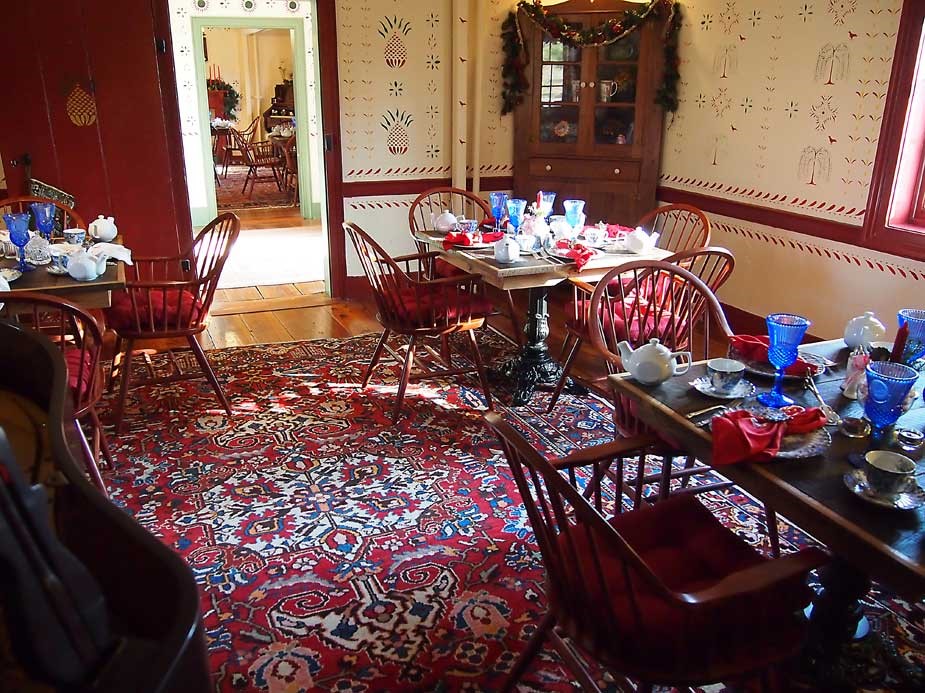
The Coach and Horses Tea Room serves a lovely high tea in a 1790’s house in Winchester, Virginia. Since, I was there during the holiday season, the rooms in the establishment were embellished with greenery, ribbons, and other Christmas decorations, including a charming, Dickens village atop the baby grand piano. A low hum of chatter filled the rooms as groups of women enjoyed the food and companionship. A quiet background of Christmas music floated through the air adding an additional, festive note to the high tea.


High tea might mean a different tradition to different people. There is much speculation and legend concerning the history of tea times in Great Britain. There is also some confusion about the term “high tea,” which originated with the working class and was a name for the evening meal, sometimes called “meat tea.” Today, the high tea experience in American tea rooms is comparable to the English full afternoon tea. It generally includes varieties of hot tea, scones, sweets and savories.


At The Coach and Horses Tea Room, where I went with my daughter and granddaughter for their high tea, we each had our own teapot—outfitted in a teapot cozy. Our first decision was to each chose a tea from a long list of tea selections. I chose Berkshire Apple Fig; my daughter chose French Vanilla Bean; and my granddaughter chose a seasonal Pumpkin Caramel Spice. It was fun to try the different flavors. My daughter and I traded teapots, as I preferred the one she ordered and she preferred mine. My 12-year-old granddaughter was very pleased with her choice, to which she added milk and sugar.

The first course was a choice of either Artisan Greens served with various fruits and berries along with a pomegranate dressing or a bowl of Asparagus Leek Soup. Both were excellent and generous servings. The salad ingredients were exceptionally fresh. The creamy soup included chunks of potato.

The second course was Cranberry Eggnog Scones served with clotted cream and preserves. The scones were exceptional--flakey and tender. These were the best I’ve ever tasted. I didn’t try the preserves, but the clotted cream was a decadent addition to these special scones. When the owner was at our table, I asked him about the scones and he explained their painstaking preparation, which includes grating the frozen butter, keeping the dough very cold, and using White Lily flour.


Finally, the 3-tiered serving tray, was brought to our table. It was laden with a myriad of eye-catching delicacies. According to the menu, the selection always includes dainty tea sandwiches with homemade fillings, mini savories, fresh fruit, sweet delicacies and desserts. The offerings on the bottom tier of our tray were mostly savories, as were the hot miniatures on an additional plate. We decided to start with those and work our way up. There were three of every tiny treat—one for each of us. We all enjoyed the delicious, beef pastry. There was a hot, chicken pastry and another that included asparagus. All were very tasty. Little sandwiches, served cold, included a pimento cheese on a dark, soft roll; and a wonderful cucumber pesto, open-faced sandwich on dark bread.

The sweets on the tray were appropriately decadent. Miniature mincemeat pies were served hot from the oven in tiny soufflé cups. The custard, fruit tarts are delicious with a thick layer of custard topped with a variety of large, fresh berries. Fresh pineapple and kiwi were added to the mix. Altogether, I am guessing there were 20-24 different dainties on the 3-tiered tray and the additional plate.

High tea is always a fun experience. High tea at The Coach and Horses Tea Room is an experience I will long remember.


 Our Guest contributor, Kay Mooorhouse, is an avid reader of Christian fiction. She is a reader and reviewer for many Christian authors.  Thanks, Kay, for sharing with us!!!

Friday, February 20, 2015

Persecution in the Colonies


While many Christians escaped persecution by coming to America, some Christian groups faced persecution in the colonies as well. Here are some instances of that persecution.

In Jamestown, America's first permanent English settlement, people were required to attend the Anglican Church (the church of England) regularly. Later in Virginia, taxes were paid to the church and Sunday laws required attendance at least once a month.

Many denominations got around that law by meeting three times a month at their own church and going to the Anglican Church once a month, but some felt they were denying Christ by compromising their beliefs to go to a church they didn't agree with. The punishment was normally a hefty fine.

In 1643, Virginia enacted a law which stated that only those were permitted to preach and teach, publicly or privately, whose beliefs conformed to those of the Church of England. This meant that any church meetings held by Quakers, Baptists, or other denominations were considered illegal.

It was worse for those who were considered to have blasphemed the name of God. The punishment for that crime was imprisonment or death.

The Puritans who established settlements in Massachusetts also persecuted those who disagreed with them. Roger Williams and Anne Hutchinson were among those who were banished and formed settlements in other colonies.

Eventually Baptists, Episcopalians, Presbyterians, and Congregationalist Puritans formed colony and community churches throughout New England. Anyone who disagreed with the doctrine of the colony's church was banished, severely punished, or sometimes executed.

Quakers received the most severe persecution in the colonies. My ancestors, the Willis' and the Brinton's were among the Quakers who came to America to escape persecution only to have their lands ceased and be imprisoned in the colonies.

As more settlers of different denominations and religions came to America, tolerance of the different beliefs became more prevalent. By the Revolutionary War, many of our founding fathers believed in the principle of religious tolerance. Men like George Washington and Thomas Jefferson enacted laws and the first amendment of the Constitution to prevent an establishment of any religion so that all denominations and religions had freedom to practice their beliefs in the public area. Unfortunately, a false interpretation of that amendment is now being used to stop Christians from practicing their beliefs in public, and a new religious intolerance is sweeping America.

Monday, December 15, 2014

Sherwood Forest Plantation - By Carrie Fancett Pagels


Last year I had the privilege of going on the Charles City "pilgrimage" of homes along the James River. One of the magnificent estates was Sherwood Forest.  As indicated on their website, Sherwood Forest is the longest presidential home in the nation.

Left side of the house - Sherwood Forest

This home is about as long as a football field! And my, oh my, are there stories waiting to be told there!  Above is a picture of the left side of the home and below is the right side.


On the day I visited, we were blessed to be greeted at the house by President John Tyler's grandson, Harrison Ruffin Tyler, who owns the property.
Harrison Ruffin Tyler, 2013
He was very gracious in answering questions and explaining about the property.  I think the most fascinating thing to me was President John Tyler's wife, Julia, who was thirty years his junior.  I really felt their love story would be a fascinating one to write up as a historical romance!

And YES President Tyler was this gentleman's grandfather, despite John Tyler having been born in 1790. Here's an article that explains (click here.) Basically, President Tyler was in his 60's when his son, Lyon Gardiner Tyler (former president of the College of William and Mary) was born and   Professor Tyler was in his 70's when Harrison was born. (And I thought we had some long gaps in our family tree! My grandfather was born in 1886 and his youngest great-grandchild in 2002.)

The estate is a private home and is only open on special occasions. There was another recent viewing in December, 2013. The proceeds from the Pilgrimage (which included Sherwood Forest and several other plantations) I attended in 2013 went to a program through the local Westover Episcopal Church.


Dog statuary marks the front porch! I think this may be a "nod" to the Princess Anne Hunt Club which hunts on the property.
Dog statuary on the porch of Sherwood Forest


I loved this old bell in the back of the house!

The house is a series of chambers that connect one to another, forming a very long home indeed! At the end on the river side is a huge ballroom that was added so visitors could dance during celebrations. It is most impressive, especially considering how long ago it was built! The James River  runs adjacent to the land, but the house does not have a view. For that, you must walk down to the water. Below is the circular drive to the home.

This is Part 1 on Sherwood Plantation. Watch for a Part 2.

Question: Have you ever visited this private estate?  What impressed you most?

Friday, October 24, 2014

Reenactments as Learning Tools for Homeschoolers by Carrie Fancett Pagels


Last year I had the privilege of attending a reenactment of the Battle of the Hook which took place in Gloucester, Virginia. Cynthia Howerter has also blogged about this experience on Colonial Quills. Today I am writing about the value in bringing your homeschoolers to such events.

The picture above is the scene we were met with when we entered Warner Hall. Can you imagine, living back in the time of the American Revolution, what it would be like to wake up and find an army encamped in your fields? By bringing children to some of these events, they can see in real life what their history books are talking about (without the gore of course!)
Youth in regimental uniform
You can bet that the young fellow pictured above has learned a great deal about colonial times by participating in reenactments with his parents. We've just begun homeschooling this year, but we've been bringing our son to many of these events over the years. And he earned perfect SOL History scores in public school. God has been good in giving us opportunities, where we live, to experience "living history" in Virginia's Historic Triangle.

The adults we met were very helpful in answering questions about their regiments, which had come from all over the United States. This is an opportunity for your young scholar to hear from people who have knowledge about specific parts of the eastern seaboard. Before going to an event, ask your homeschooling child to come up with some questions they'd like answered. Have them bring a small notepad and a backpack.

Also, for moms and dads, bring your pocketbook for all the amazing shops for reenactors clothing! I was able to purchase a colonial outfit for myself at a fraction of the cost I would have paid for such an ensemble locally. Word of caution--when purchasing hand sewn items for children, double check that the stitching is tight and is double stitched. I found a gorgeous shirt for my son that tore after only one wearing. I should have known to have checked because I learned to sew as a child.


With Virginia reenact ors dressed in frontiersmen's garb, this is an opportunity for parents to ask their children why these soldiers are dressed differently. And to discuss the differences between local militia units and being part of the Continental Army. Also great chance to ask about what the militia men and their families faced by having left their homes, and potentially crops, behind.
Frontiersmen Reenactors

We also got to view an arrival by water, which was really wonderful! If you look at the water, you'll see reenact ors arriving at the battle scene by boat! I've never seen anything like that before.


Set at gorgeous Warner Hall, a bed and breakfast, The Battle of the Hook Reenactment was open to the public. But you can also come stay on these historic grounds at other times as a paying guest at the inn. Last year they also had a Christmas event with cookies and hot cocoa for the children.  Warner Hall was so expansive I had to take two pictures to fit it all in. Notice how the building extends to the right. And below I've added the picture of the left flank.
This is the main house at Warner Hall
Left flanking house from Warner Hall


Looks like a great place for Mom and Dad to come back to by themselves, don't you agree?

Here's the link to The Inn at Warner Hall (click here.)


Read more about Warner Hall here on Janet Grunst's post last year on CQ (Click here.)

Jennifer Hudson Taylor also blogged about the value of reenactments. (Click here.)


Q: Do you have a special reenactment event that you like to attend?


Bio: Carrie Fancett Pagels is the Amazon bestselling author of "The Fruitcake Challenge" and "Return to Shirley Plantation: A Civil War Romance" and loves almost all things colonial!

Friday, March 14, 2014

THE BATTLE OF GREEN SPRING by Janet Grunst

In an earlier post of the Battle of Great Bridge (December 9, 1775), I wrote about the first major land battle of the Revolutionary War in Virginia. http://colonialquills.blogspot.com/2014/01/the-battle-of-great-bridge-virginia.html

General Lord Cornwallis
By 1780, after successes further south, a confident British General Lord Cornwallis determined that a stranglehold on Virginia was strategic in blocking supply movements and communication between General Nathanael Green, and his southern contingent of the Continental Army, and General George Washington's army on the Hudson River. Additionally, he believed that control of the Chesapeake Bay and the various rivers that flowed into it would allow for a British army invasion by water. 

As part of their southern strategy, the British forces, without much opposition occupied Portsmouth and Norfolk Virginia, giving them control of critical ports at the juncture of the Chesapeake Bay and the James River.

In the winter of 1781, Benedict Arnold, the American traitor and now a British general, arrived in Hampton Roads and sailed up the James to Westover. From there he marched on Richmond where he burned much of the city before returning to Portsmouth. 

General Lafayette 
In retaliation, General Washington sent a combined force of Continentals and Virginia militia under the command of General Lafayette in an attempt to capture his former general.

By the summer of 1781, in an effort to squash the patriot resistance on the peninsula, General Lord Cornwallis departed Richmond with about 6,000 British regulars and traveled east toward the city of Williamsburg, which he occupied for ten days. While there, he received orders from General Henry Clinton to go to Portsmouth and return to New York City. 

So on July 4th he departed and headed south toward Jamestown with a troop detachment. His intention was to cross the James River via ferry and travel southeast 48 miles to Portsmouth.  As they began the movement, Corwallis and his men were being shadowed by General Lafayette and his men.

For about a month, General Lafayette, with only soldiers and militiamen, played a waiting game of evasions and skirmishes with Cornwallis until General Anthony Wayne and 1,000 reinforcements could bolster his Continental Army.

General Cornwallis, eager to defeat more colonials before departing for Portsmouth, devised a plan to trap General Lafayette’s forces at the James River ferry crossing near Green Springs Plantation. Cornwallis sent a few deserters to infiltrate Lafayette’s army, with information that most of the British army had already crossed the river.

General Anthony Wayne 
Lafayette, sensing an opportunity to weaken his adversary, then sent 500 troops under General Anthony Wayne to strike what he assumed was the rear-guard of the British Army. In addition, he then sent 300 Pennsylvania reserves to aid in Wayne’s attack. But it was a trap. When the Colonials reached some abandoned British artillery, it signaled Cornwallis’s army, which was still on the northern bank of the river, to attack the surprised American forces. The British artillery charged and fired upon Wayne’s outnumbered men. Bravely, Wayne reassembled his forces and led a bayoneted charge against the vastly larger British army. Lafayette, realizing Wayne’s dilemma, brought in enough reserves to provide cover to allow his colonials to retreat. 

Lafayette and the Colonial Army returned to Green Spring Plantation and the British Army eventually crossed the James River. Not long after that, General Clinton ordered Cornwallis to remain in Virginia and form a naval stronghold on the Peninsula which ultimately resulted in the Siege of Yorktown in October of 1781, an American victory critical in ending the war and leading to American independence.

Monday, January 27, 2014

A Visit to the Moore House - Yorktown, Virginia, by Carrie Fancett Pagels


Moore House Parlor - Arranged as For Surrender of Yorktown Negotiations

The Moore House is a site held by the National Parks and sits on a gorgeous bluff above the York River in Yorktown, Virginia.  Here, after the Yorktown Battle, the final major battle in the American Revolution, officers met to negotiate the terms of the surrender.

To visit this historic home, restored some decades ago, you must first go to the National Parks Building in Yorktown. The Yorktown Battlefield also sits on a bluff, with a grand view, a few miles further up river. Below is the majestic view from the Moore House, which you must drive to after registering at the National Parks site and obtaining a sticker.
View of the Yorktown River from the Moore House

Almost any time of year is good for a visit to coastal Virginia. We are most prone to having some type of snowfall in late January and early February, if we get any. This year we've had a few inches and we are anticipating another storm shortly, but such is unusual here in this mild climate.

In mid October, 1781, when the officers met to negotiate the terms of surrender, the weather may have been mild, especially for those accustomed to northern cold.


If you've ever wondered what historic fiction writers do when they have company in town, well here is an example--they take their family members to visit research sites! My brother obliged by posing for this picture!  I've seen pictures of the house, before it was restored, and it looked so sad.  But the National Parks did a lovely job fixing it, both inside and out.
Front of Moore House, Gary Lee Fancett


The interior is available for perusal and period pieces have been added. A National Parks employee will be on site to greet you and answer your questions.


The dining room is set up as if company was expected any moment. It is tempting to cross through the cordoned ropes and sit down for tea!  Would you care to join me?

Moore House Dining Room

Friday, January 3, 2014

Sausage Making in Colonial Virginia by Carrie Fancett Pagels

Sausage Making at Yorktown Victory Center in Virginia

Sausage making in colonial Virginia was quite a chore.  These two men are making sausages at Yorktown Victory Center in Virginia.  First the pork had to be chopped.  The man on the left used a cleaver to chop the meat into tiny pieces. This was very labor intensive, as you can imagine.

The pork was seasoned for the sausage with thyme and other seasonings, perhaps fennel and parsley and other herbs. The pork was first chopped into tiny sections and then transferred to a trencher or a bowl and then stuffed inside the casing.


The pork mixture was pushed through a funnel, to which the casement was "attached" by the sausage stuffer holding the casing to the opening in the funnel.

The Yorktown Victory Center does wonderful demonstrations this time of year about how farmers prepared food for winter.  Hogs were normally killed in late November and then the meat put up.


The sausage casing gets slippery and is difficult to keep attached.  In the picture below, the sausage maker is using two fingers to hold the casing to the funnel.

The meat had to be pushed through the funnel with a wood spoon, in this case, and into the casing.  This required some attention on the part of the sausage maker.

This looks quite different from the way my mother made sausage.  She had a meat grinder and ran the meat and seasonings through the metal grinder which had a crank handle. It had a section where the casings attached and if I recall correctly, there was a metal clip device that kept the casing on while Mom made the sausage.


Question:  Have you ever seen sausage made?  What did you think?  Do you make sausage or have you ever?

Monday, September 16, 2013

Warner Hall


Warner Hall

Augustine Warner
Did you know that George Washington, Queen Elizabeth II, Robert E. Lee, and Meriwether Lewis all share common ancestors and a location in America? Augustine and Mary Warner began that family, and Warner Hall, in Gloucester County, VA is the place that can make this unique claim.

In 1642 Augustine Warner received a “land grant” for a six hundred-acre plantation from Britain’s King Charles I in exchange for bringing settlers to the struggling Jamestowne Settlement. Warner Hall, situated on the Severn River, was built in 1674.
Meriwether Lewis

The other family associated with Warner Hall is the Lewis family. The Lewis family entered into the plantation’s history when Elizabeth, the third daughter of Augustine Warner II, married John Lewis and inherited Warner Hall. The Warners and the Lewises, two prominent Virginia families, continued on the property well into the 19th century.

George Washington
Augustine Warner was the great-grandfather of President George Washington and the eighth great-grandfather of Queen Elizabeth II through her mother's Bowes-Lyons family.
 
Aerial View of Warner Hall
Warner Hall was rebuilt several times when the home was damaged or destroyed by fire. The current home, a Colonial Revival manor house, was built on the earlier foundation in the early 1900s. It and its dependency structures have been meticulously restored.

The walled Warner Hall Graveyard, site of the tombs of Augustine Warner and other members of the Warner and Lewis families is discretely located behind the manor house. It is owned and maintained by the Association for Preservation of Virginia Antiquities.
Warner Hall Graveyard

The Inn at Warner Hall

Theresa and Troy Stavens, purchased and restored Warner Hall in the 90’s utilizing their financial management and marketing skills and passion for hospitality and historic preservation, to create the Inn at Warner Hall. I first learned about Warner Hall from good friends who regularly dine and stay at this charming 38 acre country inn with eleven
The Inn at Warner Hall
guestrooms.

Center Hall Stairway
I was curious to find out more about the inn I’d heard so much about, so on Labor Day my husband and I visited Warner Hall. It was a delight to wander around this beautiful property and restored 19th century mansion, so filled with history, which continues to be enjoyed and appreciated by many.


Solarium
For more information about The Inn at Warner Hall: http://warnerhall.com/