Announcements

10 Year Anniverary & New Releases Winners: Carrie Fancett Pagels' Butterfly Cottage - Melanie B, Dogwood Plantation - Patty H R, Janet Grunst's winner is Connie S., Denise Weimer's Winner is Kay M., Naomi Musch's winner is Chappy Debbie, Angela Couch - Kathleen Maher, Pegg Thomas Beverly D. M. & Gracie Y., Christy Distler - Kailey B., Shannon McNear - Marilyn R.
Showing posts with label Anne Hutchinson. Show all posts

Friday, February 20, 2015

Persecution in the Colonies


While many Christians escaped persecution by coming to America, some Christian groups faced persecution in the colonies as well. Here are some instances of that persecution.

In Jamestown, America's first permanent English settlement, people were required to attend the Anglican Church (the church of England) regularly. Later in Virginia, taxes were paid to the church and Sunday laws required attendance at least once a month.

Many denominations got around that law by meeting three times a month at their own church and going to the Anglican Church once a month, but some felt they were denying Christ by compromising their beliefs to go to a church they didn't agree with. The punishment was normally a hefty fine.

In 1643, Virginia enacted a law which stated that only those were permitted to preach and teach, publicly or privately, whose beliefs conformed to those of the Church of England. This meant that any church meetings held by Quakers, Baptists, or other denominations were considered illegal.

It was worse for those who were considered to have blasphemed the name of God. The punishment for that crime was imprisonment or death.

The Puritans who established settlements in Massachusetts also persecuted those who disagreed with them. Roger Williams and Anne Hutchinson were among those who were banished and formed settlements in other colonies.

Eventually Baptists, Episcopalians, Presbyterians, and Congregationalist Puritans formed colony and community churches throughout New England. Anyone who disagreed with the doctrine of the colony's church was banished, severely punished, or sometimes executed.

Quakers received the most severe persecution in the colonies. My ancestors, the Willis' and the Brinton's were among the Quakers who came to America to escape persecution only to have their lands ceased and be imprisoned in the colonies.

As more settlers of different denominations and religions came to America, tolerance of the different beliefs became more prevalent. By the Revolutionary War, many of our founding fathers believed in the principle of religious tolerance. Men like George Washington and Thomas Jefferson enacted laws and the first amendment of the Constitution to prevent an establishment of any religion so that all denominations and religions had freedom to practice their beliefs in the public area. Unfortunately, a false interpretation of that amendment is now being used to stop Christians from practicing their beliefs in public, and a new religious intolerance is sweeping America.

Wednesday, June 19, 2013

Nathaniel Griffith's Perspective of the "City upon a Hill"

Trouble brewed in the Massachusetts Bay Colony in 1649. But before I give you the next of my memoirs, please take this seat beside me overlooking my wife's garden. I, Nathaniel Griffith, would not have the pleasure of this great garden view (which overlooks the Narragansett Bay) had it not been for the grace of God.

Let me first be charitable to my father and those Puritans who first came to this land. Their intentions were good, desiring to establish a model community in and around the Boston area. Zealous for pure living among all church members (especially of the clergy) and for the church of England to be completely pure of Catholic influence, John Winthrop led a group of men to America. His was a tumultuous life--though I suppose any leader experiences such--but he served his people well and with the best of intentions.

I was a young man when John Winthrop died in 1649. My father insisted I should learn these words from this great man:

"...we shall be as a City upon a Hill. The eyes of all people are upon us."

And indeed, the world did watch to see if these Puritans would succeed. Those who crossed the Atlantic with John Winthrop believed they entered into a covenant with God.

Yea, I am shaking my head. Woe unto us who dare to think we have power to influence God by our right living, for righteous we are not. Nay, they learned through strife that one cannot be the conscience of another and not easily fall into sin oneself. Perhaps not the sin of the man they judge, but a sin even greater in believing they could act in God's stead.

After much labor one day, I rested against the stone fence my father insisted I build. You see, we had two horses which loved to wander. We kept them near on a picket line. What is that you asked? 'Tis a rope we strung about chest level between trees. We tied our horses to this line. We also used a high line, which is simply a picket line hung above the horses' heads. The high lines allowed the horses to graze and not get tangled in their lead. But I digress.

Behind my fence, three men walked. They spoke of those burned at the stake in England for beliefs contrary to the clergy, and then they spoke of those dissenters infecting the churches here in New England. Roger Williams was banished in 1635, Anne Hutchinson was banished, taking with her a number of other colonists to settle Portsmouth, Rhode Island. John Wheelwright was also banished then founded the town of Exeter, New Hampshire. And the list continues. Trouble brewed in England as well and the English Civil Wars began, leading to the beheading of King Charles I.

As I listened, I quaked with fear for Sarah Brown, the woman I loved. Her father had stood with Roger Williams against some of the teachings of the Puritans. Her father also stood in support of Anne Hutchinson and considered leaving with her when she was banished. Instead he stayed, his quiet manner seeming to appease those who opposed the teachings of salvation by grace alone and clung to the necessity of infant baptism. But he soon died and left Sarah. My father then took her in as a maid for my sister. A charitable act driven by a sense of guilt, for he was not without fault for the death of Goodman Brown.

These men that passed my fence determined to purify the Massachusetts Bay Colony of any and all who did not hold to their tenements. As the year progressed, they would seek out any who held a meeting outside of the church and arrest them. Indeed, in the years following some believe those who were tried for witchcraft were not witches, but those who claimed the Holy Spirit communicated with their spirit. And perhaps the most shaking of revelation to these staunch Puritans was the dissension of Henry Dunster in 1653. And one mustn't forget the hanging of Mary Dyer, a Quaker, in 1660, Boston.

I knew I needed to do something to keep Sarah from having the same fate of Anne Hutchinson and others who spoke freely of beliefs contrary to that of the religious leaders of the time. I thought perhaps if I could marry her, I could protect her, but my father would never let me marry beneath my station. Nor did I believe Sarah would have me, a wretched sinner.

Alas, the sun is setting. Perhaps Sarah will share with you next month. And thank you for listening to me ramble on about those days. I fear I lacked great courage and faith, but God would work despite me.
______________________________________________

Here is the timeline of the events Nathaniel mentions:

1630 John Winthrop writes the sermon "A Model of Christian Charity," which includes the section known as "The City upon a Hill." Winthrop then sails to New England

1631 Roger Williams arrives in Massachusetts

1635 William and Anne Hutchinson follow John Cotton to the New World

1635 Roger Williams is banished

1636 Harvard College is established

1637 Rev. John Wheelwright preaches a controversial sermon

1637 Anne Hutchinson and her followers are tried and banished

1638 John Wheelwright is banished

1642 English Civil Wars begin

1649 King Charles I is executed

1649 John Winthrop dies

1651 John Clarke, Obadiah Holmes, and John Crandall arrested for conducting an illegal worship service

1653/54 Henry Dunster, first president of Harvard College, abandons the Puritan view of infant baptism

1654/55 Henry Dunster exiles himself

1659 William Robinson and Maramaduke Stevenson were hung in Boston for returning to the Massachusetts Bay Colony after banishment (they were Quakers)

1660 Mary Dyer is hung in Boston

1660 Parliament asks Charles II to assume the throne thus restoring the monarchy in England.

1661 Executions of Quakers halted by Charles II

This is a very small list of acts the men, whom Nathaniel overheard, had seen and would see in the years to come. It is a quick overview of the struggle those early colonists went through, growing pains of the freedom we now enjoy. Many look at this list and become angry with Christians, but I don't think that is an accurate reaction. Without the Bible to guide our forefathers in an understanding of what true freedom of conscience is, we would never have seen the constitution we have today. I believe the colonists needed to go through these struggles before they could gain an understanding of what America was to become. Without experiencing the trials some of these men endured, they would not have known the importance of their own discovery of true freedom. These men did not look at their current situation, but at the future in which their children would live. They fought for a better place and a better life for those who would live after them.

In my opinion, I think we need to tread carefully before we pass judgment on those in this era. These people were mere men seeking to accomplish something greater than themselves, not realizing they couldn't do it without God's grace.


Wednesday, May 15, 2013

Nathaniel's Folly at Mount Woolaston

God bless you, my friends for joining me this morn. For those new, I am Nathaniel Griffith of Newport in the colony of Rhode Island, 1670. I see you noticed my lame leg. Aye, the Lord gave it to me to remind me of my folly. I was not always the God-fearing man I am now.

Come now, though. Sit by the fire. 'Tis cool this May rain. Not uncommon for Newport this time of year, but I'll be glad to see the summer warmth. Through the winter my hip aches with sharp pains radiating down me legs like burning knives. But at least I have my legs and my life.

Nigh thirty years ago I had an affinity for all things contrary to my father's Puritan ways. Me tad thought I might reform if I went to Harvard. I believe he hoped I'd be a clergyman when 'twas clear I had no taste for the sea or the shipping company. But the strict rules and teachings of Harvard only strengthened my resolve to rebel.

On break one winter I set out from the college to return home a different way, to my shame. I set out to find a wench at  Mount Woolaston (renamed Merry Mount by Thomas Morton for a time and later the town was called Braintree). Martin Saunders kept a house of entertainment there where a young man such as myself could enjoy a drink of wine. Aye, Mount Wollaston, er, Braintree could soothe my conscience as well for there resided the notable Anne Hutchinson. I also met the respectable William Coddington with whom I would join here in Newport in later years.

Who is Anne Hutchinson, you ask? She was a woman who dared to stand against the Puritans for their works-driven faith. Aye, but she also did not correct me in my wayward ways. Perhaps if she had . . . but I stray from my story.

'Twas late when I finally said goodbye to my wench. Martin Saunders had kept my glass full through the night so as to keep me from being cold on my ride. Folly, that be. I mounted my horse and swayed a top it. It staggered under my weight but steadied itself and turned home. An ice storm had come through and the roads were slippery. The horse slid. I felt the fall would never end as he scrambled to get his footing, tossing me about the saddle. Then as though the hand of God swatted it, the horse fell to its side, catching my leg beneath it and wrenching my hip. In my drunken stupor I hardly felt the pain, but I must have cried out for Reverend John Wheelwright found me and helped me to his home.

Not for several weeks did I return to my father's house, and that in shame. My father could not stand the sight of me. I had ruined my chances of ever being a clergyman and marred his stature in our town. I was ruined. Like Jacob in the Bible, I would spend the rest of my life walking with a halt. By God's mercy, He stopped my folly and soon after my sweet wife, though at the time she was my sister's handmaid, showed me a better way.

That story shall wait for another day. My goodwife, Sarah, has been encouraging me to write my story down. I should say our story, for her role is equal to, and perhaps greater than, mine. Suffice it to say for now the slipping of that horse changed the course of my life, and I am a better man today for it.


Lynn Squire here. Mount Wollaston did exist at what is now Qunicy, MA. Though the name changed several times through the years, the first half of the 1600's the area had a reputation for 'unholy' living. Martin Saunders did receive permission from the Puritans to have a house of entertainment in 1639 where he could sell wine (1640). As to a wench? Well, the reputation of the area was one of loose morals.

Braintree, MA and the surrounding area was home to many well-known characters, not only of the 17th century, but of later individuals, like John Adams and John Hancock.

As to the horse falling and injuring Nathaniel...can I have Nathaniel tell a story without me having a similar one? I also had a horse slip, fall on its side, and trap my leg beneath it. My ankle was seriously injured. After a great deal of physical therapy in an attempt to restore its strength, my doctor concluded I would spend the rest of my life wearing a brace. I spent perhaps a month in that brace. The Lord had a work for me to do, and I would be hindered if I were to wear the brace. One morning I decided to toss the brace aside and go about my business as the Lord deemed necessary. I praise the Lord that today I walk well without a brace or crutch of any sort. No one would know of the injury (except perhaps via x-ray or to look closely at the shape of the ankle and the scars). And I must add that when the horse fell on me I was of sound mind--not drunk or otherwise. To God be all glory.

Sunday, May 13, 2012

Ann Hutchinson, A Woman of Interest

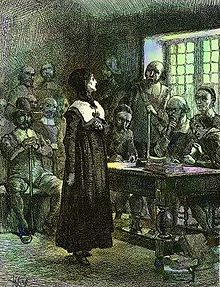
Anne Hutchinson on Trial by Edwin Austin Abbey
"I acknowledge using the words of the apostle to the Corinthians unto him, that they that were ministers of the letter and not the spirit did preach a covenant of works..."
Anne Hutchinson, her trial 1637
"Who also hath made us able ministers of the new testament; not of the letter, but of the spirit: for the letter killeth, but the spirit giveth life." II Corinthians 3:6

Anne Hutchinson stood on trial in the Massachusetts Bay Colony because of her convictions that we live by grace, not by works.

The salvation God offers us is free to those who call upon the name of Jesus, the Son of God.
"That if thou shalt confess with thy mouth the Lord Jesus, and shalt believe in thine heart that God hath raised him from the dead, thou shalt be saved.
"For with the heart man believeth unto righteousness; and with the mouth confession is made unto salvation....
"For whosoever shall call upon the name of the Lord shall be saved." Romans 10:9-10,13
Salvation doesn't come through any other person.
"Neither is there salvation in any other: for there is none other name under heaven given among men, whereby we must be saved." Acts 4:12
 Salvation doesn't come through any act of righteousness or any ritual (works).
"For by grace are ye saved through faith; and that not of yourselves: it is the gift of God: Not of works lest any man should boast." Ephesians 2:8-9
 Salvation comes simply from faith in the death, burial, and resurrection of Jesus Christ for the payment for our sins. A person comes to understand that he will die in his sins. He desires not to; believes that Jesus died in his place, was buried, and rose again; and calls on Jesus to save him. Once saved, a person will desire to love Jesus because of what Jesus has done for him. This change occurs because of the Holy Spirit working within the saved person. Jesus said:
"If ye love me, keep my commandments." John 14:15
 Have you called upon Jesus to save you from your sins and the wages of your sins? If not, please pray even now and ask Him to forgive you. Let Him know you want Him to save you. If you want to talk with someone about it, please feel free to email me at: lynnsquire@gmail.com