Announcements

10 Year Anniverary & New Releases Winners: Carrie Fancett Pagels' Butterfly Cottage - Melanie B, Dogwood Plantation - Patty H R, Janet Grunst's winner is Connie S., Denise Weimer's Winner is Kay M., Naomi Musch's winner is Chappy Debbie, Angela Couch - Kathleen Maher, Pegg Thomas Beverly D. M. & Gracie Y., Christy Distler - Kailey B., Shannon McNear - Marilyn R.
Showing posts with label 18th Century Churches. Show all posts

Monday, October 19, 2020

Historic Boston, part 3: the Old North Church

(This post will be a little photo heavy again. Please click individual images to zoom in and get more detail!)

This inscription reads, "The signal lanterns of Paul Revere displayed in the steeple of this church April 13 1775 warned the country of the march of the British troops to Lexington and Concord."

Last July, when in Boston for a family wedding, my girls and I just happened upon the Old North Church and decided to stop in for a tour. We were so glad that we did--and so, apparently, was the staff! The man giving the talk at the front of the church (at a plexiglas-shielded podium just below the pulpit) heartily thanked our small group and said they were newly reopened after 4 months of closing due to COVID-19. [I see on their website that they're closed once again.]

He explained how Paul Revere and others knew that the British planned to attack but didn't know whether they'd march the long way away around by land, or take the quicker but more dangerous crossing across the harbor, but Revere would be waiting for the signal--"one if by land, two if by sea"--before saddling his horse to ride out and warn the countryside.


The church buildings, the smaller housing the gift shop, and two of my daughters reading the signage.


A shot of the front right side of the church, with the one remaining original window (lower right).
The pulpit with the sounding board above--the answer to acoustic issues before the age of microphones!


Only those wealthy enough to afford patronage for pew boxes were seated on the main floor, while the second-story galleries provided seating for enslaved and lower-class free folk.
Not sure if this rendering of the Apostles' Creed is original to the church, but it provided a sweet touchpoint for me, after attending a slightly liturgical church myself these past few years.
A quick shot (or two) of the pew box with sample personalized furnishings--showing how people would outfit them according to their own needs and tastes.
Love the colors and fabrics!


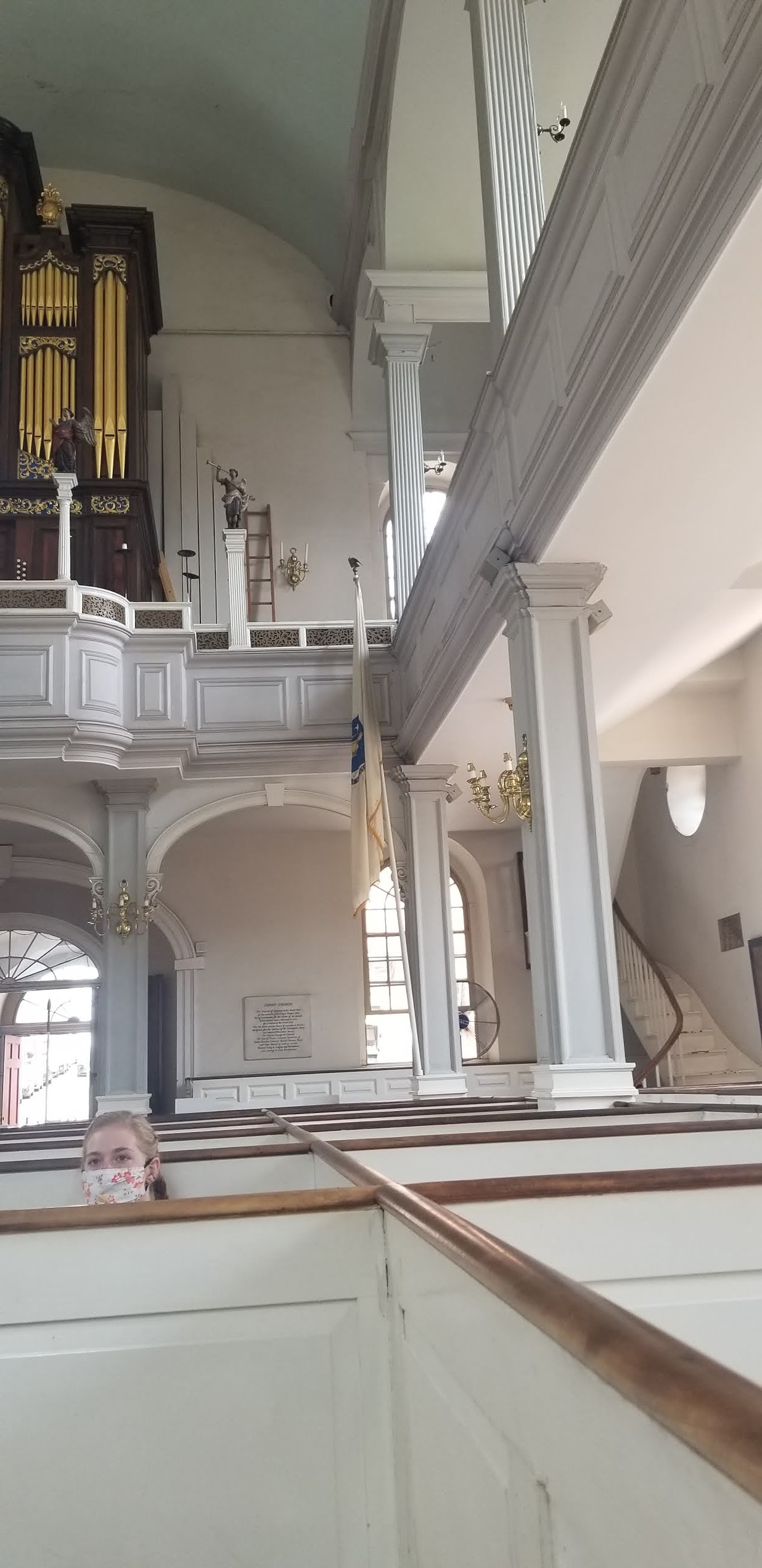
A shot of the rear corner, where the sexton carrying the lanterns for the signal climbed the stairs, then accessed the steeple stairwell from right behind those organ pipes. Can you imagine that climb? (And another of my cute daughters, tucked into her own pew box behind us!)

A long view of the aisle and church front, from the back. (With, yes, one of my daughters!)

So beautiful. I am a sucker for historic churches! Back when my family and I all lived in Charleston, South Carolina, I did several posts on because, well, they are just too beautiful and special to miss--and this one was no exception! I found several similarities to churches I'd visited elsewhere, but also many unique features.

And an unexpected connection to North Dakota! Many of the pew boxes bore engraved plates with the names of patrons who'd used those spaces, and here we read that Theodore Roosevelt, who spent much time in North Dakota in his younger days, and was a strong supporter of the National Park system, had visited and attended services at the Old North Church.
Closeup of the stairs ... and yes, there's a matching staircase on the other side.
The original wood collection box, under plexiglas of course. (I'm such a geek about these sorts of details!)

It was a sweet, if too-short, visit. I wish we lived close enough to go back again soon!

For more about the architecture and history: Old North Church

(They also have THE most fabulous gift shop everrrr! Do visit if you ever have a chance.)

Monday, November 18, 2019

New Light Baptists (and other denominations of the colonial era)

Some time ago, while reading The Carolina Backcountry on the Eve of the Revolution, featuring the journal and sermons of traveling Anglican minister Charles Woodmason, I came across the term "New Light Baptist" and was curious to know more. Woodmason speaks of them in scathing terms, as he does of every other denomination and most people groups in general, but being raised in a Baptist church myself, I was curious to know.


Wikipedia (which tends to be better sourced these days than it once was) offers a good discussion on the subject, but I also found this snapshot of the religious landscape of the colonial era:

Early New Englanders generally practiced congregationalism, though by the 18th century they seldom thought of themselves as the spearhead of the Reformation. A wave of revivals known as the Great Awakening swept New England beginning in the 1720s, dividing churchgoers into New Light (evangelical Calvinists) and Old Light (more moderate) wings. An increasing minority were calling themselves Baptists.

Nearly all Europeans in these colonies were Protestants, but individual denominations were very different. There were Presbyterians, Lutherans, Baptists, Anglicans, Dutch Reformed, Mennonites and Quakers. While the Church of England was the established church (the official, government-supported church) in the Chesapeake colonies, German and Scottish non-Anglicans were migrating south from the middle colonies, and Baptists were making their first southern converts. Although most Chesapeake slaves were American-born by the late 18th century, they practiced what they remembered of African religions, while some became Christians in 18th-century revivals. [from New Light Schism]

The terms "Old Light" and "New Light" have been applied over the years to several denominational splits, but during the Great Awakening, the debate raged between those who argued that Christianity was more about right doctrine and theology and those who emphasized personal transformation as a result of one's theology. Old Lights were criticized for only caring about one's beliefs, while disregarding behavior such as drunkenness and greed; and New Lights were criticized for their focus on experience and emotion. What began as a split between Presbyterians and Congregationalists birthed the movement called New Light Baptists, when a group of folks influenced by George Whitefield's preaching decided they could find no evidence in Scripture of infant baptism.

John Smyth
But this was not the first time people dissented with such widely accepted theology. There is debate over whether the Baptist church finds its roots in the Anabaptist movement (many say not), or can trace its roots all the way back to the time of Christ, but many say that the movement which led to the modern Baptist church had its beginnings in 1609 Amsterdam, with a man named John Smyth, an English Separatist. These roots, then, cling to the history of the Puritans and Pilgrims, and led to a division between "General" and "Particular" Baptists, who argued whether Christ's atonement applied to all people, or just to God's elect. (Similar debates went on in the Presbyterian Church, famed for following the teachings of John Calvin.) Smyth was eventually imprisoned for his dissent with the Anglican church.

Another Baptist of note was Roger Williams, who founded the very first Baptist congregation in the American colonies (1638, Rhode Island). Not until the First Great Awakening, however, did the term "New Light" become associated with Baptists, when many of them broke away from their Calvinist leanings and it was not held as a complimentary term by those of more established denominations.

Woodhouse rails against New Lights as unlearned, unstable, overly emotional, given to fleshly impulse and vice. He bemoans their lack of Scriptural grounding, their quibbling over liturgical service elements while indulging in public indecency, and their exercise of spiritual gifts as a cloak for sinful indulgence. Doesn't sound so different from criticism between churches today, does it? His accounts tell of shenanigans ranging from a sensuality to rival any modern tabloid, to the cultish and downright criminal. Just the reading of it is enough to make one question one's entire upbringing.

It just goes to show that even the most august structures can have less than auspicious beginnings ... and human nature has certainly never changed, when left to itself.

Despite all that, the Baptist church as a whole found a home in the Carolinas, put down roots, spread across the colonies and into the frontier, becoming a solid, established expression of early American faith alongside more settled and staid denominations.

~*~*~*~

Additional sources:
New Lights (from NCpedia)
Old and New Light (from Wikipedia)
Baptists (from Wikipedia)


Monday, October 12, 2015

Colonial churches of coastal South Carolina

St. James Santee Church
In 1706, the South Carolina Commons House of Assembly voted to establish the Church of England as their official church and divided the colony into ten parishes. Each parish had one central church with smaller affiliated churches, designated as chapels of ease. These outlying meeting places provided local church attendance to the more remote areas of the parish.

I've written previously about Strawberry Chapel, a chapel of ease for St. John's Parish in Berkeley County, and St. George Anglican Church at Colonial Dorchester, but I've had the pleasure of visiting others during my years of living and touring around the South Carolina lowcountry.

There's a very small person in that pulpit--and beside!
Our visit to St. James Santee Church was almost accidental, a side trip on the day we'd driven up to McClellanville to see Hampton Plantation. The elegant brick chapel is located way down a sandy road which traces the route of the old King's Highway between Charleston and Georgetown.

 The building is noteworthy as an example of Georgian architecture, completed in 1768, and a list of all its features is found at South Carolina's National Register site: http://www.nationalregister.sc.gov/charleston/S10817710012/index.htm. Our family found it interesting for the original enclosed box pews and the raised pulpit. Its history is noteworthy as a place where English settlers worshiped together with French Huguenots:  http://homepages.rootsweb.ancestry.com/~scroots/sc13846.htm and http://www.stjamesec.org/brickchurch.html.

Pompion Hill Chapel, from the Cooper River
Very similar in archectural style is Pompion Hill Chapel, a chapel of ease for St. Thomas's parish, built 1763-65 on the banks of the Cooper River in rural Berkeley County. (On the east branch of the Cooper, incidentally--across the river and some from Strawberry, which is on the west branch.) Reportedly Pompion is the French word for "pumpkin," and so the name permuted to "punkin" and in one contemporary spelling is cited as "Ponkin Hill."
Pompion Hill Chapel

Inside Pompion Hill Chapel
We visited here during a family boat trip up the east branch of the Cooper River. When we stopped at the churchyard for exploration, the church was locked, but we took a peek through the windows. A raised pulpit is located far right of the window where this shot was taken, but it appears that most of the original box pews are gone.

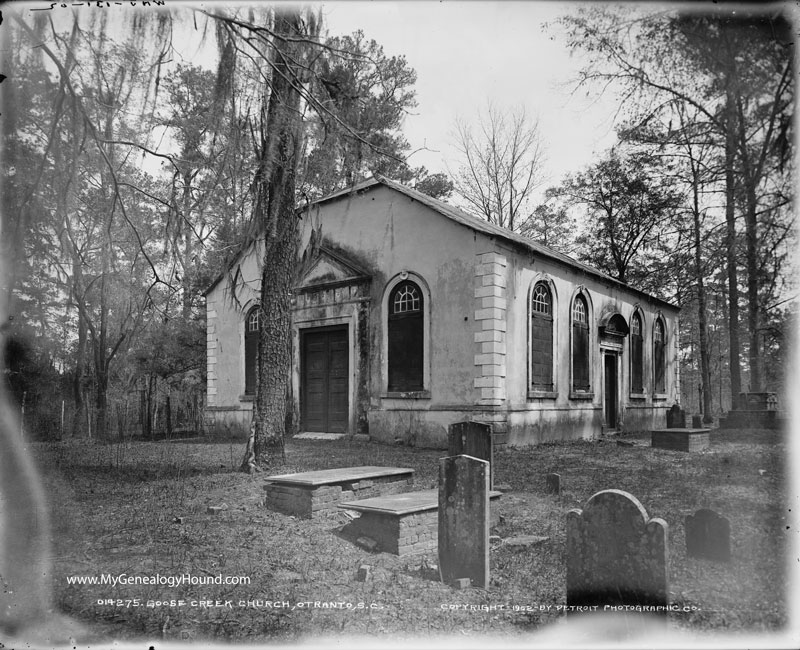
Historic photo of St. James Goose Creek
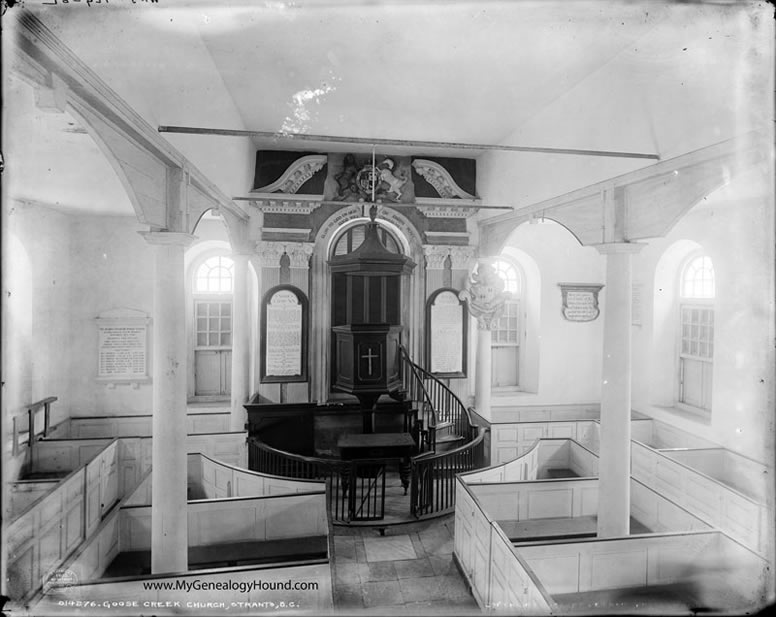
The historic church closest to where we lived was one I sadly never took the opportunity to go see: St. James Goose Creek, chapel of ease for St. James's Parish. This one, built 1713-19, has quite a history. Legend has it the church was spared during the British occupation of Charleston, during the American Revolution, because of the royal seal displayed behind the pulpit.
Inside St. James Goose Creek

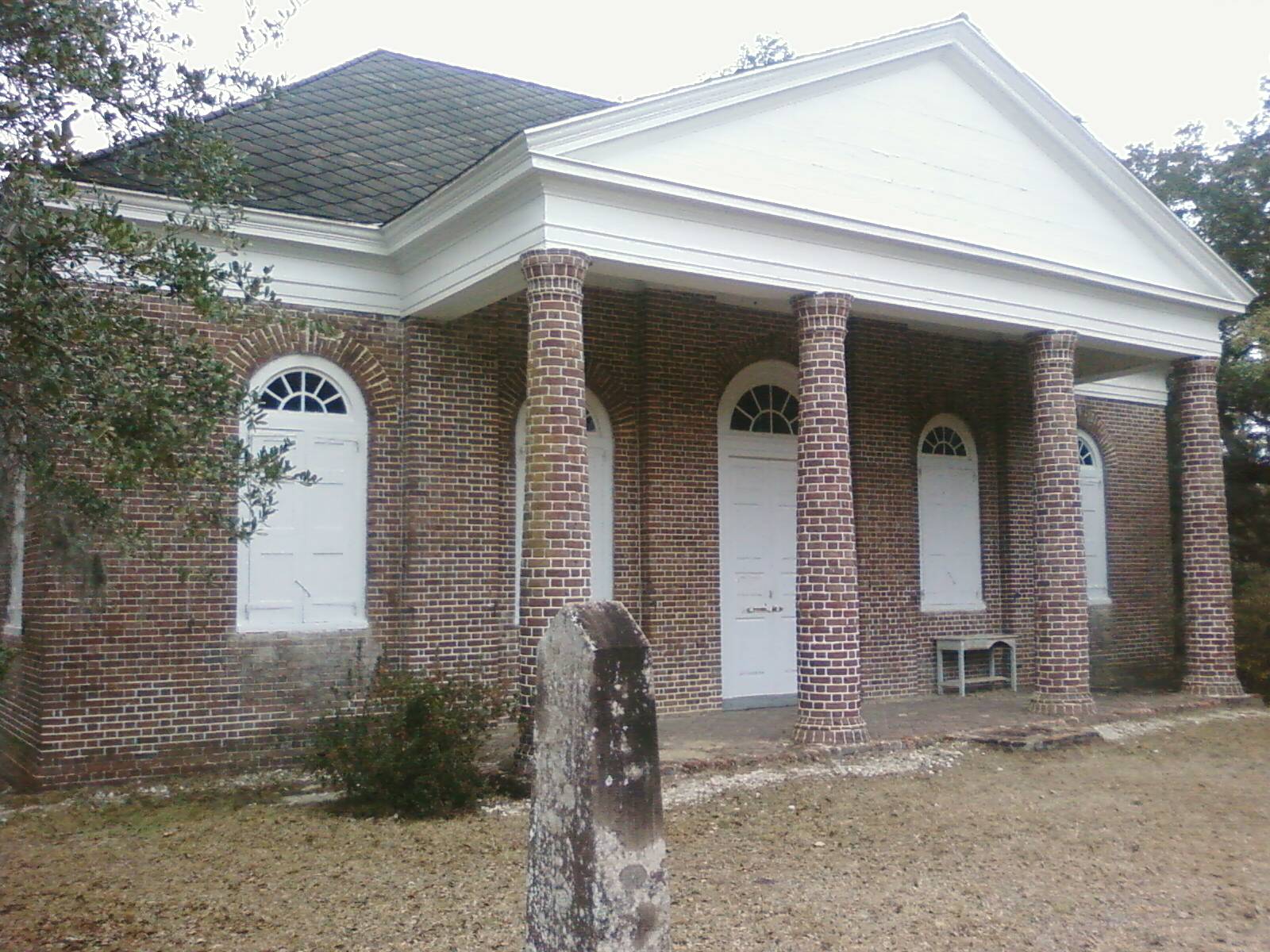
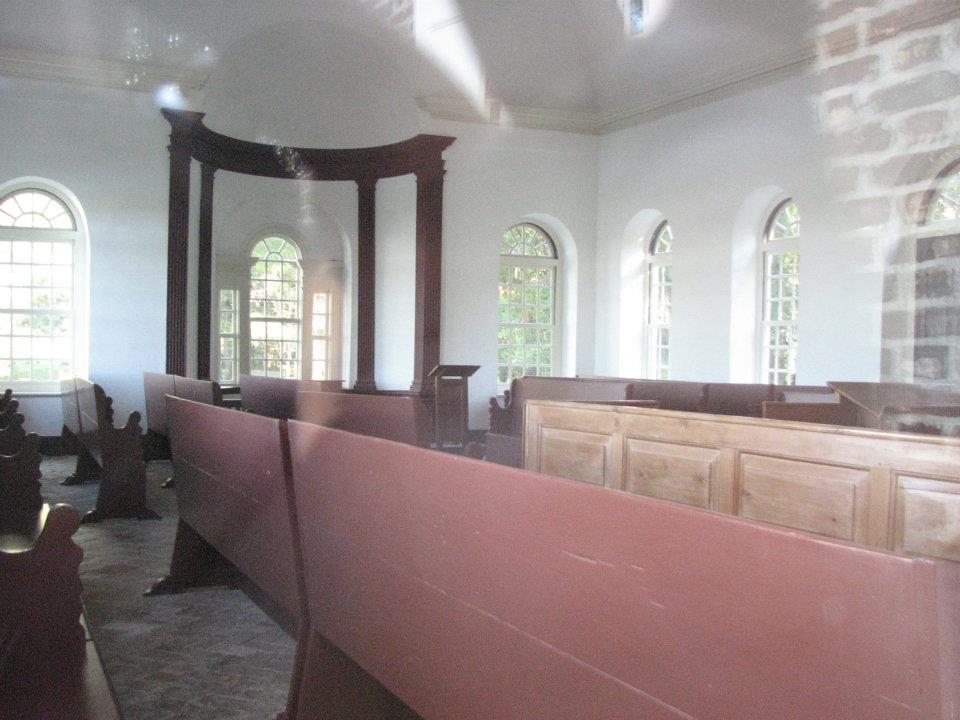
Just from its photos, the church building reminds me of Strawberry Chapel with its white stucco exterior. I find it interesting that all four historic church buildings (including Strawberry) share the Georgian building style and jerkinhead roof type. Some sustained more damage than others over the years (the Goose Creek church suffered a partial collapse in the 1886 Charleston earthquake) but all have been restored and/or kept up as examples of colonial-era architecture.

(Photos of St. James Santee and Pompion Hill Chapel are my own.)

Friday, March 13, 2015

CHRIST CHURCH IN LANCASTER COUNTY, VA ~ ~ A BEAUTIFUL 18TH CENTURY CHURCH WITH A HINT OF MYSTERY


Christ Church, Weems, VA
On a recent sunny winter day I went to Weems in Lancaster County, in the coastal area of Virginia, to visit Christ Church, one of several 18th century churches in the Tidewater region. While there, I had a remarkable encounter with a local resident and saw some fascinating details about the structure. The gentleman who shared this with me has studied all aspects of the church for over twenty years. He cited reasons why he believes that one day the design will be credited to Sir Christopher Wren.
But more on that later. . .

The first Christ Church in Weems, Virginia, founded in 1670, was a wooden structure built as directed by John Carter. The current the church, completed in 1735, is a one story cruciform or cross-shaped plan (equal sides). Its Georgian style with symmetrical layout and pediment facade is completely brick in Flemish bond style with a steep hipped roof.

Robert Carter Tomb
Robert “King” Carter commissioned the building of the current church. At the time, he was the richest and most powerful landowner and planter in Virginia and lived nearby at Corotoman, his plantation on the Rappahannock River. At his death, his sons completed the building project. There is a cedar lined walk that leads from the church to the former plantation site. Many Carter graves are located within the church walls.
cedar lined walkway

Christ Church Parish is one of the best preserved Anglican parish churches in Virginia. The craftsmanship and architecture of this brick church is stunning.

Two tablets that contain the Decalogue, or Ten Commandments, frame the altarpiece. Canon Law LXXXII of 1604, the Church of England required that “the Ten Commandments be set up on the East end of every Church and Chapel, where the people may best be able to see and read.” Even the church at the Jamestown site contains the Decalogue.  

ox-eye window
Each of the churches three doorways has an ox-eye, or elliptical, window centered above them. Twelve large compass-head windows add considerable light to this beautiful church.


There is a museum staffed by volunteers that offers a history of the church and the Carter family to visitors.

It was almost five o’clock when I arrived at the church. Because there was work being done on the roof, considerable scaffolding surrounded it. Mr. Stewart was the lone gentleman standing outside. He asked if I was interested in learning more about the church. At his suggestion, I looked through the keyhole and could see the cross illuminated by the declining sun from the ox-eye window above the door. It was amazing. Mr. Stewart, a Horologist, one who studies the science of measuring time, spent the next hour explaining the connection between Wren and the Carters, and that the building was designed to act as a sun dial as well as a Christian church. Specific dimensions, the latitude of the church, as well as its siting on the property, were incorporated to achieve this purpose.

“Sunlight and shadows are used to indicate the time and the changing dates of the year, the progression of the seasons, the dates of the equinoxes and solstices, the 'cross-quarter' days (half way between the equinoxes and solstices), while the beam of the sun, shining through carefully aligned oval windows, enables a pool of sunlight to fall exactly on the tomb of one David Miles four times a year, and twice each year the sunbeam advances and retreats across the altar table and cross.” *

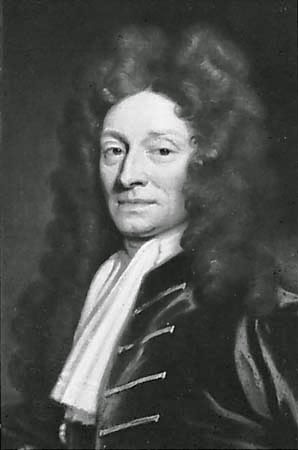
Sir Christopher Wren
National Portrait Gallery
            The architect for Christ Church is said to be anonymous. Sir Christopher Wren was an astronomer and geometrician as well as an architect. He was the architect of the Wren building at The College of William & Mary in Williamsburg, VA, St. Paul’s Cathedral, London, The Royal Observatory, and numerous other churches and buildings. Wren died in 1723.

I don’t know if Wren, or a student of Wren’s work, had anything to do with the design of Christ Church, Weems. But I do find it interesting that on Every Easter Sunday, light from the sun if it is shining, shine through an ox-eye window on to the alter. 

Below is a time compresses video showing the sun shining on the alter on Easter of 2012.


* Horological Journal May 1994 Vol136 No11 Pages 365-400