Announcements

10 Year Anniverary & New Releases Winners: Carrie Fancett Pagels' Butterfly Cottage - Melanie B, Dogwood Plantation - Patty H R, Janet Grunst's winner is Connie S., Denise Weimer's Winner is Kay M., Naomi Musch's winner is Chappy Debbie, Angela Couch - Kathleen Maher, Pegg Thomas Beverly D. M. & Gracie Y., Christy Distler - Kailey B., Shannon McNear - Marilyn R.
Showing posts with label Anglican church. Show all posts

Monday, October 12, 2015

Colonial churches of coastal South Carolina

St. James Santee Church
In 1706, the South Carolina Commons House of Assembly voted to establish the Church of England as their official church and divided the colony into ten parishes. Each parish had one central church with smaller affiliated churches, designated as chapels of ease. These outlying meeting places provided local church attendance to the more remote areas of the parish.

I've written previously about Strawberry Chapel, a chapel of ease for St. John's Parish in Berkeley County, and St. George Anglican Church at Colonial Dorchester, but I've had the pleasure of visiting others during my years of living and touring around the South Carolina lowcountry.

There's a very small person in that pulpit--and beside!
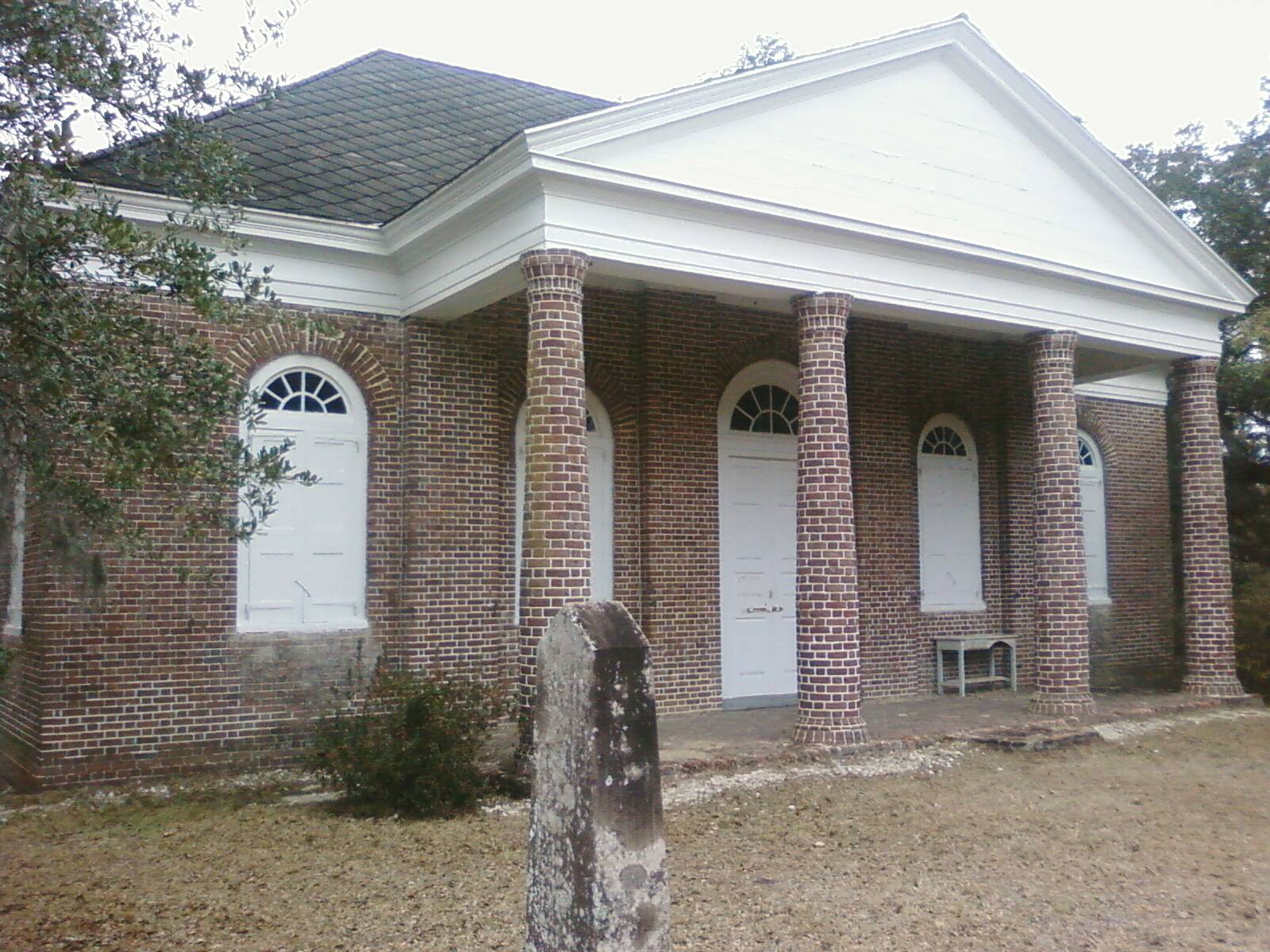
Our visit to St. James Santee Church was almost accidental, a side trip on the day we'd driven up to McClellanville to see Hampton Plantation. The elegant brick chapel is located way down a sandy road which traces the route of the old King's Highway between Charleston and Georgetown.

 The building is noteworthy as an example of Georgian architecture, completed in 1768, and a list of all its features is found at South Carolina's National Register site: http://www.nationalregister.sc.gov/charleston/S10817710012/index.htm. Our family found it interesting for the original enclosed box pews and the raised pulpit. Its history is noteworthy as a place where English settlers worshiped together with French Huguenots:  http://homepages.rootsweb.ancestry.com/~scroots/sc13846.htm and http://www.stjamesec.org/brickchurch.html.

Pompion Hill Chapel, from the Cooper River
Very similar in archectural style is Pompion Hill Chapel, a chapel of ease for St. Thomas's parish, built 1763-65 on the banks of the Cooper River in rural Berkeley County. (On the east branch of the Cooper, incidentally--across the river and some from Strawberry, which is on the west branch.) Reportedly Pompion is the French word for "pumpkin," and so the name permuted to "punkin" and in one contemporary spelling is cited as "Ponkin Hill."
Pompion Hill Chapel

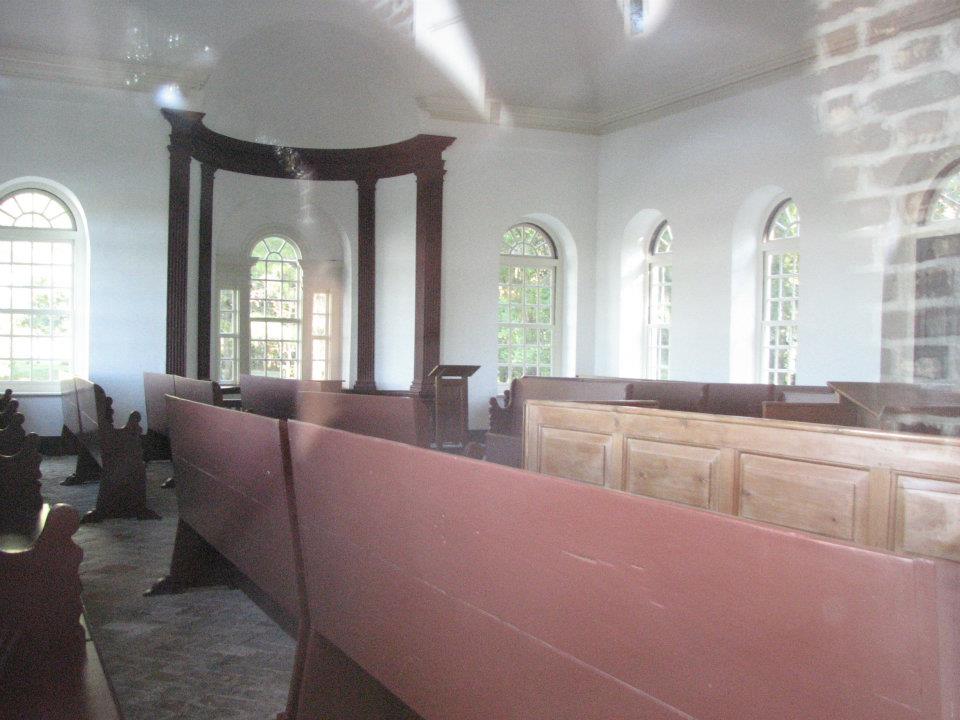
Inside Pompion Hill Chapel
We visited here during a family boat trip up the east branch of the Cooper River. When we stopped at the churchyard for exploration, the church was locked, but we took a peek through the windows. A raised pulpit is located far right of the window where this shot was taken, but it appears that most of the original box pews are gone.

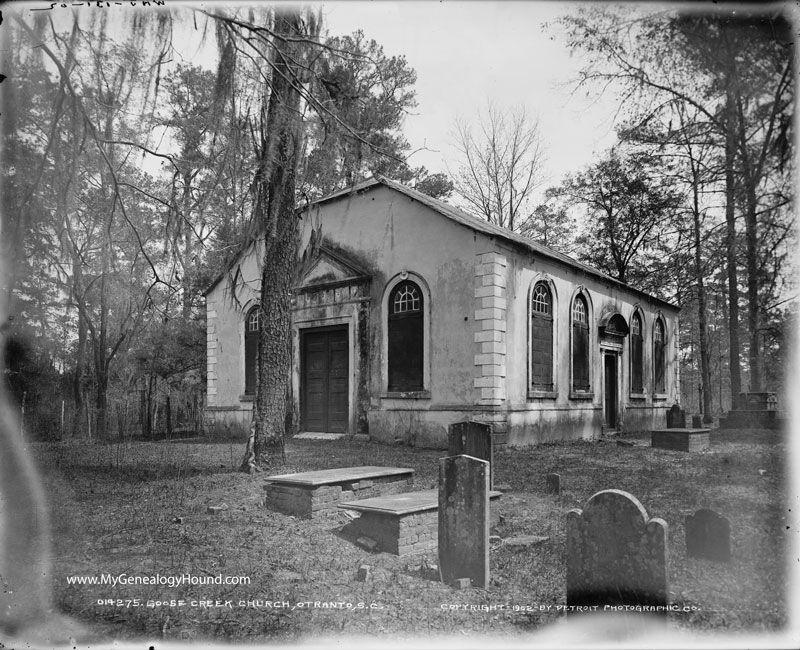
Historic photo of St. James Goose Creek
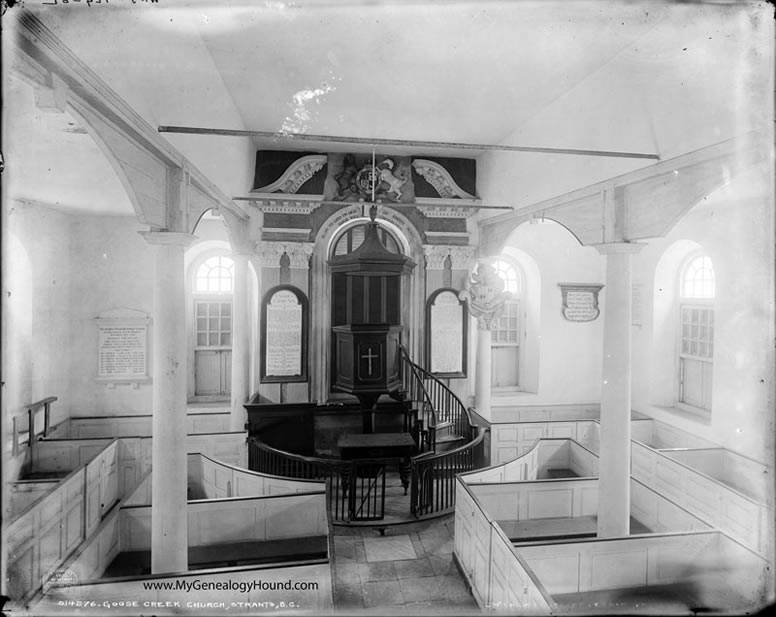
The historic church closest to where we lived was one I sadly never took the opportunity to go see: St. James Goose Creek, chapel of ease for St. James's Parish. This one, built 1713-19, has quite a history. Legend has it the church was spared during the British occupation of Charleston, during the American Revolution, because of the royal seal displayed behind the pulpit.
Inside St. James Goose Creek

Just from its photos, the church building reminds me of Strawberry Chapel with its white stucco exterior. I find it interesting that all four historic church buildings (including Strawberry) share the Georgian building style and jerkinhead roof type. Some sustained more damage than others over the years (the Goose Creek church suffered a partial collapse in the 1886 Charleston earthquake) but all have been restored and/or kept up as examples of colonial-era architecture.

(Photos of St. James Santee and Pompion Hill Chapel are my own.)

Thursday, May 17, 2012

The Revolutionary War And The Anglican Church


While it is well known that the Revolutionary War caused division in communities and families throughout the colonies, it also brought about the disestablishment of a Christian denomination. The history of the Church of England, or the Anglican Church in America, dates back to 1607 when the first permanent English settlement at Jamestown, Virginia was formed.
Bruton Parish, Williamsburg, Virginia circa 1660
Current structure built in 1715 remains an active parish

In 1693 James Blair, an Anglican missionary to colonial Virginia, secured the charter for an institution of higher learning for the colonies. The College of William and Mary, located in Williamsburg, Virginia is the second oldest college in the United States, preceded only by Harvard.

In 1775, when the Revolution began, there were about 300 congregations of The Church of England throughout the thirteen colonies. The Church of England was the established church in six of the thirteen colonies. They were: Virginia, Maryland, North Carolina, South Carolina, Georgia and New York.

The “established church” is a church recognized by law as the official church of a state or nation and supported by civil authority. Within those six colonies there were other religious orientations. For instance, Maryland had a religious orientation to Roman Catholicism. The religious orientation in New York was Dutch Reformed. It just means that the Church of England, or the Anglican Church, was the established church.

You can imagine when the colonies found themselves divided between the patriots pursuing separation and the loyalists, or Tories, maintaining ties to the crown, that the established church would be impacted, as well. The Church of England in the colonies experienced hostility and its membership declined during the Revolution, since all clergy swore an oath of allegiance to the crown when they were ordained. As a result, many of the clergy fled to Canada and England while others who sided with the patriots seeking independence remained. 

Bishop William White
credit Library of Congress, Washington DC

In order to continue the spiritual legacy of the Church of England, but to be separate from it, a proposition was made by William White, the Chaplain of the Continental Congress that the congregations become an American church. A Convention of clergy and laity was held in the early 1780s resulted in taking the church properties from the Church of England and establishing a new church in American. During that decade interstate conventions for the new church were held, and a constitution and prayer book were drafted. Dr. Samuel Seabury of Connecticut was consecrated Bishop in 1784 by the bishops of Scotland, and William White of Pennsylvania and Samuel Provoost of New York were consecrated bishops in England in 1787. The Episcopal Church, autonomous but part of the Anglican Communion, was formally organized in Philadelphia in 1789 as the successor to the Church of England. William White became the first Presiding Bishop of the United States.


Conflict in this denomination in America has not been limited to the eighteenth century. The Episcopal Church has once again become embroiled in division in the twenty-first century. After about three decades of debate over orthodoxy, practice, and the authority of Scripture, many congregations in the United States have experienced partition. Beyond the anguish and legal battles over property, it has resulted in the formation of over 1000 new Anglican congregations coming out of existing Episcopal Churches. It will be interesting to see what the future holds, but it is often through times of great trial that the body of Christ is purified and strengthened. Hopefully, that will be the result of the present upheaval.