Announcements

10 Year Anniverary & New Releases Winners: Carrie Fancett Pagels' Butterfly Cottage - Melanie B, Dogwood Plantation - Patty H R, Janet Grunst's winner is Connie S., Denise Weimer's Winner is Kay M., Naomi Musch's winner is Chappy Debbie, Angela Couch - Kathleen Maher, Pegg Thomas Beverly D. M. & Gracie Y., Christy Distler - Kailey B., Shannon McNear - Marilyn R.
Showing posts with label Boston. Show all posts

Monday, October 19, 2020

Historic Boston, part 3: the Old North Church

(This post will be a little photo heavy again. Please click individual images to zoom in and get more detail!)

This inscription reads, "The signal lanterns of Paul Revere displayed in the steeple of this church April 13 1775 warned the country of the march of the British troops to Lexington and Concord."

Last July, when in Boston for a family wedding, my girls and I just happened upon the Old North Church and decided to stop in for a tour. We were so glad that we did--and so, apparently, was the staff! The man giving the talk at the front of the church (at a plexiglas-shielded podium just below the pulpit) heartily thanked our small group and said they were newly reopened after 4 months of closing due to COVID-19. [I see on their website that they're closed once again.]

He explained how Paul Revere and others knew that the British planned to attack but didn't know whether they'd march the long way away around by land, or take the quicker but more dangerous crossing across the harbor, but Revere would be waiting for the signal--"one if by land, two if by sea"--before saddling his horse to ride out and warn the countryside.


The church buildings, the smaller housing the gift shop, and two of my daughters reading the signage.


A shot of the front right side of the church, with the one remaining original window (lower right).
The pulpit with the sounding board above--the answer to acoustic issues before the age of microphones!


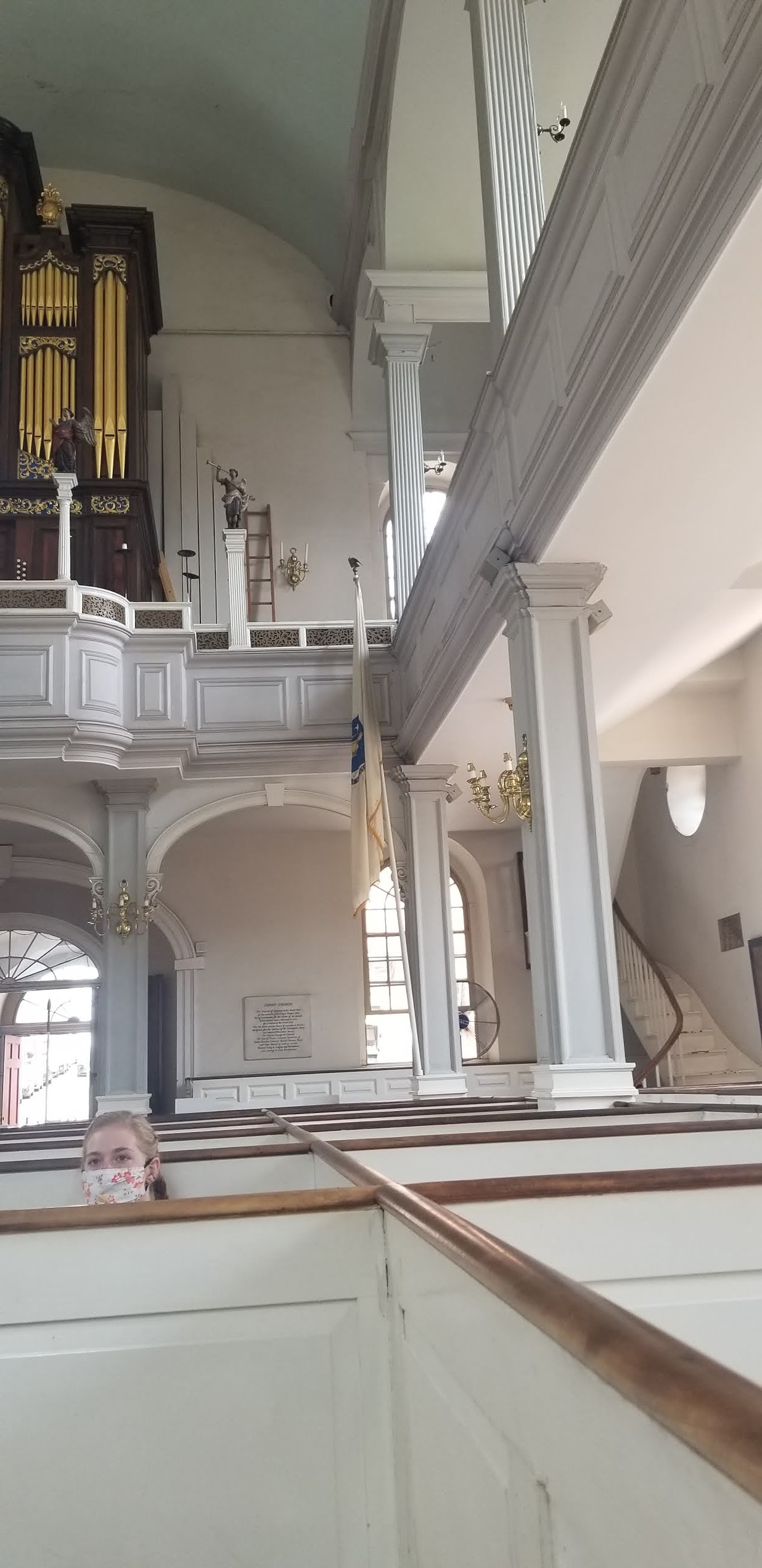
Only those wealthy enough to afford patronage for pew boxes were seated on the main floor, while the second-story galleries provided seating for enslaved and lower-class free folk.
Not sure if this rendering of the Apostles' Creed is original to the church, but it provided a sweet touchpoint for me, after attending a slightly liturgical church myself these past few years.
A quick shot (or two) of the pew box with sample personalized furnishings--showing how people would outfit them according to their own needs and tastes.
Love the colors and fabrics!


A shot of the rear corner, where the sexton carrying the lanterns for the signal climbed the stairs, then accessed the steeple stairwell from right behind those organ pipes. Can you imagine that climb? (And another of my cute daughters, tucked into her own pew box behind us!)

A long view of the aisle and church front, from the back. (With, yes, one of my daughters!)

So beautiful. I am a sucker for historic churches! Back when my family and I all lived in Charleston, South Carolina, I did several posts on because, well, they are just too beautiful and special to miss--and this one was no exception! I found several similarities to churches I'd visited elsewhere, but also many unique features.

And an unexpected connection to North Dakota! Many of the pew boxes bore engraved plates with the names of patrons who'd used those spaces, and here we read that Theodore Roosevelt, who spent much time in North Dakota in his younger days, and was a strong supporter of the National Park system, had visited and attended services at the Old North Church.
Closeup of the stairs ... and yes, there's a matching staircase on the other side.
The original wood collection box, under plexiglas of course. (I'm such a geek about these sorts of details!)

It was a sweet, if too-short, visit. I wish we lived close enough to go back again soon!

For more about the architecture and history: Old North Church

(They also have THE most fabulous gift shop everrrr! Do visit if you ever have a chance.)

Monday, February 24, 2020

Important Early American Artists #4: John Singleton Copley

By J. M. Hochstetler

John Singleton Copley, Self Portrait (1780-84)
When I was in school I loved art class, and although it’s been a number of years since I’ve done any drawing or painting, my interest in the visual arts has continued throughout my life. Which is why I’ve been focusing on important early American artists in my last 3 three posts. Today I’m going to wrap up the series by taking a look at John Singleton Copley, who became famous in both America and England for his portraits and paintings of historical subjects and is generally acclaimed as the finest artist in colonial America.

Copley was born July 3, 1738, most likely in Boston, Massachusetts, to Richard and Mary Copley. Richard was from Limerick, while Mary was a Singleton from County Clare whose family was of Lancashire origin. They immigrated to Boston in 1736 and owned a tobacco shop on Long Wharf. Richard apparently arrived in America in ill health, however, and around the time of John's birth went to the West Indies, where he died in either 1737 or 1748, depending on the source you consult. In any case, he died previous to Mary’s wedding Peter Pelham on May 22, 1748.

Paul Revere (1768-70)
Little is known of Copley’s childhood. Pelham painted portraits and was an excellent engraver, however, which undoubtedly set Copley on the path to a career as a painter. Young Copley was around fourteen when his stepfather died, and about that same age Copley painted his half-brother Charles Pelham, his earliest extant portrait. More promising works followed during the next few years, and by the time he was 20 he was steadily employed in painting portraits. Copley’s works reveal a detailed knowledge of New England people and culture. Influenced by the Rococo style of Joseph Blackburn, Copley portrayed his subjects with objects relevant to their personal lives, like this one of Paul Revere, which gave his portraits an intimate sense of the person’s character and interests that was rare 18th-century American painting.

A Boy with a Flying Squirrel (1765)
Commissions from the foremost members of New England society made Copley a prosperous man. His income, extraordinary for New England in the 1760s, elevated him to the Boston aristocracy. But he was eager for wider recognition. In 1766 Benjamin West, a fellow countryman who had moved to London to pursue his own art career, entered Copley’s painting A Boy with a Flying Squirrel (1765), at left, in the annual Exhibition of the Society of Artists of Great Britain. The subject is Copley’s half-brother, Henry Pelham, seated at a table playing with a pet squirrel, and it gained Copley’s election as a Fellow of the Society. West urged him to come to England to study for several years, but although Copley continued to send pictures to the Exhibition, he hesitated to risk the prosperity he enjoyed in Boston for an uncertain future in England.

Copley Family (1776-77)
On November 16, 1769 Copley married a woman of impeccable social status. Susanna Farnham Clarke was the daughter of Richard and Elizabeth (Winslow) Clarke. Her father had become very wealthy as an agent of the East India Company in Boston, and her mother’s ancestors had arrived in America on the Mayflower. By all accounts the Copleys’ marriage was not only socially notable, but also a happy one. Susanna was a beautiful, poised woman, whose portrait Copley painted several times. He and Susanna welcomed six children into their family in a house he built on the west side of Beacon Hill, where they lived as members of the top tier of Boston society.

The only substantial time Copley left Boston during this period was in 1771 and 1772, when he spent seven-months painting in New York City and Philadelphia as the political situation in Boston was deteriorating. The tea destroyed in the Boston Tea Party had been consigned to his father-in-law, and his extended family were all Loyalists, which made it increasingly dangerous for him to stay in the area. He finally heeded the urging of West and others and sailed for England in June 1774 as many other American artists had done before him, leaving his mother, wife, and children behind until he could secure lodgings. In England he received a warm reception from West and England’s art community. In 1775 while he traveled through France and Italy to study the great works of art, his wife and children arrived in London, where they stayed with her brother-in-law, Henry Bromfield. Susanna’s father and brothers soon joined them in London. After Copley’s return he and his family settled in 25 George St., Hanover Square, where Copley, Susanna, and their son, John Singleton Copley, Jr., the future Lord Lyndhurst, lived until their deaths.

Watson and the Shark (1778)
Encouraged by the success of West and others, Copley ventured outside of portraiture and began to paint more historical pieces. His first important work in the genre was Watson and the Shark (1778), at left, which portrays an incident involving his friend and fellow artist Brook Watson, who at the age of 14 lost a leg in a shark attack while swimming in Havana harbor. The painting foreshadows one of the great themes of 19th-century Romantic art: man’s struggle against nature. Copley’s historical paintings were so successful because he went to great lengths to create excellent likenesses of the people in them and to include correct details of the historical period. He traveled throughout England to make studies of old portraits of the subjects he intended to paint as well as the actual historical locations. At the same time he continued to paint portraits of English royalty and famous British and American individuals.

Copley was elected as an associate member of the Royal Academy in 1776 and made a full member in 1783. Likely more politically liberal than his relatives, he maintained contact with many New Englanders, painting portraits of John Adams, John Quincy Adams, and other Bostonians when they visited England, and in 1791 he was elected a Foreign Honorary Member of the American Academy of Arts and Sciences. His daughter Elizabeth married wealthy Gardiner Greene of Boston, whose descendants preserved much of the Copley family’s correspondence for posterity.

John Adams (1783)
Ultimately, although Copley’s intensive work habits certainly contributed to his success, the long hours at the easel and lack of regular exercise also took a toll on his health and disposition. A granddaughter recalled that he usually painted continuously from early morning until evening, when his wife or one of their daughters would read to him. In his latter years he struggled with depression made worse by the expense of maintaining his household and educating his son, John Singleton Copley, Jr., who in adulthood became a brilliant lawyer. As Copley’s own career waned, paintings that took years of labor remained unsold, forcing him to borrow heavily to cover household expenses. His physical and mental health declined as well, and he died of a stroke on September 9, 1815, deeply in debt. His daughter Mary wrote that “He was perfectly resigned and willing to die, and expressed his firm trust in God, through the merits of our Redeemer.” He was buried in Croydon Minster in Croydon, Surrey.

Copley became the greatest and most influential painter in colonial America, with a legacy that extended well into the nineteenth century. In Britain his greatest achievement was in developing contemporary history painting as a combination of history, idealism, and theater. Boston’s Copley Square, Copley Square Hotel, and Copley Plaza are named after him, as are Copley Township in Summit County, Ohio, and the Copley crater on the planet Mercury. In 1965 the U.S. Postal Service issued a 5-cent stamp commemorating the 150th anniversary of his death that features his daughter, Elizabeth Clark Copley, from his Portrait of the Copley Family (1776) above.

In this series I’ve covered John Trumbull, Benjamin West, Gilbert Stuart, and now John Singleton Copley. Please check out the links to those articles in their names above and answer the following questions.

1. What do you find the most interesting about one of these artists?

2. Which painting by any one of the artists are you most drawn to?
Please share, and I’ll share mine too!
~~~
J. M. Hochstetler is the daughter of Mennonite farmers and a lifelong student of history. She is a professional editor, a publisher, and the author of award-winning historical fiction whose books have been endorsed by bestselling authors such as Lori Benton, Laura Frantz, and Jocelyn Green. Her American Patriot Series is the only comprehensive historical fiction series on the American Revolution. Book 6, Refiner’s Fire, released in 2019, and one more volume, Forge of Freedom, will complete the series. She is also the author of One Holy Night, the Christian Small Publishers 2009 Book of the Year, and co-authored the award-winning Northkill Amish Series with Bob Hostetler.


Wednesday, April 20, 2016

Remembering Patriot's Day

By Elaine Marie Cooper


Since I grew up near Boston, Massachusetts, I can never think about the week of April 19th without pausing to reflect on its meaning for our country. It was the day in 1775 when the first battles took place at the onset of the American Revolution.

As children, we all loved Patriot's Day. Parades were held in the city and the suburbs commemorating the event. A rider dressed like Paul Revere would carry the news that "The Regulars are coming!" Of course, we weren't too concerned in the 20th century about British soldiers coming down Mass Ave. If they did, we'd have likely cheered them on instead of fleeing. :)

But it was both a celebration and a memorial to the brave men—simple farmers—who made a stand against the greatest army in the world of that time. The outcome shocked the world and birthed the great country of the United States of America.

When I was young, it didn't occur to me that the very road down which the bands played and the floats sailed upon, was the very route that the British Army actually trod. It was a journey that began an eight year war.

                                                        *     *     *     *     *

Beginning in Boston the night of April 18, 1775, over 1,000 British soldiers marched their way to Concord where supplies of Colonial gunpowder were hidden. On the way, they were confronted by the brave men of Lexington. The first shots were fired and the first fatalities occurred.

Buckman Tavern, Gathering Place of the Lexington Militia
The soldiers continued their march to Concord and were surprised by the increasing numbers of Colonial militia who were bent on stopping the King's Army. Two British soldiers were killed and then buried near Concord Bridge.
The aggressive Minute Men intimidated the British forces the entire way back to Boston. Fighting Indian-style, the American militia hid behind stone walls and trees and killed numerous enemy soldiers along the way. The King's Army became more enraged by the moment. By the time they reached Menotomy Village (now Arlington, MA), reinforcements for the Brits had arrived. The worst Battle of the day occurred at the home of farmer Jason Russell.
Jason Russell House, Arlington, MA


More deaths occurred at this site than any other battlefield that day, April 19, 1775.

                                                           *     *     *     *     *

When I was a child celebrating Patriot's Day every year, I never knew that the house on the corner just one block away from my home, held the story of the worst battle that occurred that first day of the Revolution.

I often thought about that house after I grew up and decided to discover the secrets that lay within its walls. The story that I uncovered was an amazing and heartbreaking tale of love, loyalty and demise. It was an incident hidden from the history books, just waiting to be revealed. I decided to be the storyteller of the Russell family and the community that took a stand for freedom from tyranny.

And thus was birthed Fields of the Fatherless, Winner of the the 2014 Selah Award for YA Fiction; Winner of the 2014 Next Generation Book Award, Religious Fiction; and Winner of the 2014 Moonbeam Children's Book Award, Best YA Religious Fiction.

To celebrate Patriot's Day, I am giving away two gifts—a signed copy of Fields of the Fatherless and a box of eight cards of the Doolittle prints that depict the battles of April 19, 1775—to a reader who leaves a comment on this blog. I will do a drawing for those who leave their email address and announce the winner on Friday, April 22.


Wednesday, March 11, 2015

Old Ironsides


by Elaine Marie Cooper


I first met her when I was a young teenager and I’ve never forgotten her beauty. Her nickname is “Old Ironsides” and she is the world’s oldest commissioned naval vessel still afloat.

For years now she has been berthed at the Charlestown Naval Yard in Boston but her anchoring has not kept her from occasional voyages to celebrate her greatness. She sailed under her own power in 1997 to celebrate her 200th birthday.


Her official name is the USS Constitution and she was one of six vessels authorized for construction by the newly formed United States Navy, enacted by the Naval Act in 1794. She was given her name by none other than President George Washington in honor of this nation’s Constitution. Her launching in 1797 was attended by then-President John Adams. She and the other frigates were built larger than traditional ships of that day: They needed to be strong enough for war.

The Constitution did not have to wait long to fulfill her purpose. She was assigned to protect American merchant vessels from pirates along the Barbary Coast of North Africa in the early 1800’s.

She is most well known for her involvement in the War of 1812 as we, once again, fought against Great Britain, following our victory in the American Revolution. She defeated five British warships, including HMS Guerriere. That was the victory that earned her the name, “Old Ironsides.”


During the Civil War, she was used for training purposes by the United States Naval Academy. Old Ironsides was retired from active service in 1881.

For years, the love of the American people has kept her from the scrap heap that is the burial ground for most naval vessels that have served their country. Affection has kept her afloat and today, she is a museum ship visited by thousands every year. In August of 2012, she did a victory sail to commemorate the 200th anniversary of her victory over the Guerriere.


Her mission today—for she is still a fully commissioned US Navy ship—is to promote understanding of the Navy’s role in both war and peace. The USS Constitution is staffed by a crew of sixty active-duty officers and sailors. Their assignment is to participate in special events and educational programs.

From the moment I stepped aboard Old Ironsides so many years ago, I fell in love with her. She stirred both an affection for history and a pride in our country that has never left my heart. She will always remind me that, although the Constitution may go through many a battle, she can stay afloat in the storms, with God’s help.


                                                             *     *     *
Oliver Wendell Holmes


This poem, written by Oliver Wendell Holmes, first appeared in the Boston Daily Advertiser on September 16, 1830. It was in response to a proposal to break up the old ship as unfit for service.

OLD IRONSIDES

Ay, tear her tattered ensign down!
Long has it waved on high,
And many an eye has danced to see
That banner in the sky;
Beneath it rung the battle shout,
And burst the cannon's roar;--
The meteor of the ocean air
Shall sweep the clouds no more.

Her deck, once red with heroes' blood,
Where knelt the vanquished foe,
When winds were hurrying o'er the flood,
And waves were white below,
No more shall feel the victor's tread,
Or know the conquered knee;--
The harpies of the shore shall pluck
The eagle of the sea!

Oh, better that her shattered bulk
Should sink beneath the wave;
Her thunders shook the mighty deep,
And there should be her grave;
Nail to the mast her holy flag,
Set every threadbare sail,
And give her to the god of storms,
The lightning and the gale!


Elaine Marie Cooper grew up in the Boston area, visiting the historical sites of our nation's founding. She has written Fields of the Fatherless, a young adult novel based on a true story from the American Revolution. You can visit her website/ blog here.