Announcements

10 Year Anniverary & New Releases Winners: Carrie Fancett Pagels' Butterfly Cottage - Melanie B, Dogwood Plantation - Patty H R, Janet Grunst's winner is Connie S., Denise Weimer's Winner is Kay M., Naomi Musch's winner is Chappy Debbie, Angela Couch - Kathleen Maher, Pegg Thomas Beverly D. M. & Gracie Y., Christy Distler - Kailey B., Shannon McNear - Marilyn R.
Showing posts with label Paul Revere. Show all posts

Monday, October 19, 2020

Historic Boston, part 3: the Old North Church

(This post will be a little photo heavy again. Please click individual images to zoom in and get more detail!)

This inscription reads, "The signal lanterns of Paul Revere displayed in the steeple of this church April 13 1775 warned the country of the march of the British troops to Lexington and Concord."

Last July, when in Boston for a family wedding, my girls and I just happened upon the Old North Church and decided to stop in for a tour. We were so glad that we did--and so, apparently, was the staff! The man giving the talk at the front of the church (at a plexiglas-shielded podium just below the pulpit) heartily thanked our small group and said they were newly reopened after 4 months of closing due to COVID-19. [I see on their website that they're closed once again.]

He explained how Paul Revere and others knew that the British planned to attack but didn't know whether they'd march the long way away around by land, or take the quicker but more dangerous crossing across the harbor, but Revere would be waiting for the signal--"one if by land, two if by sea"--before saddling his horse to ride out and warn the countryside.


The church buildings, the smaller housing the gift shop, and two of my daughters reading the signage.


A shot of the front right side of the church, with the one remaining original window (lower right).
The pulpit with the sounding board above--the answer to acoustic issues before the age of microphones!


Only those wealthy enough to afford patronage for pew boxes were seated on the main floor, while the second-story galleries provided seating for enslaved and lower-class free folk.
Not sure if this rendering of the Apostles' Creed is original to the church, but it provided a sweet touchpoint for me, after attending a slightly liturgical church myself these past few years.
A quick shot (or two) of the pew box with sample personalized furnishings--showing how people would outfit them according to their own needs and tastes.
Love the colors and fabrics!


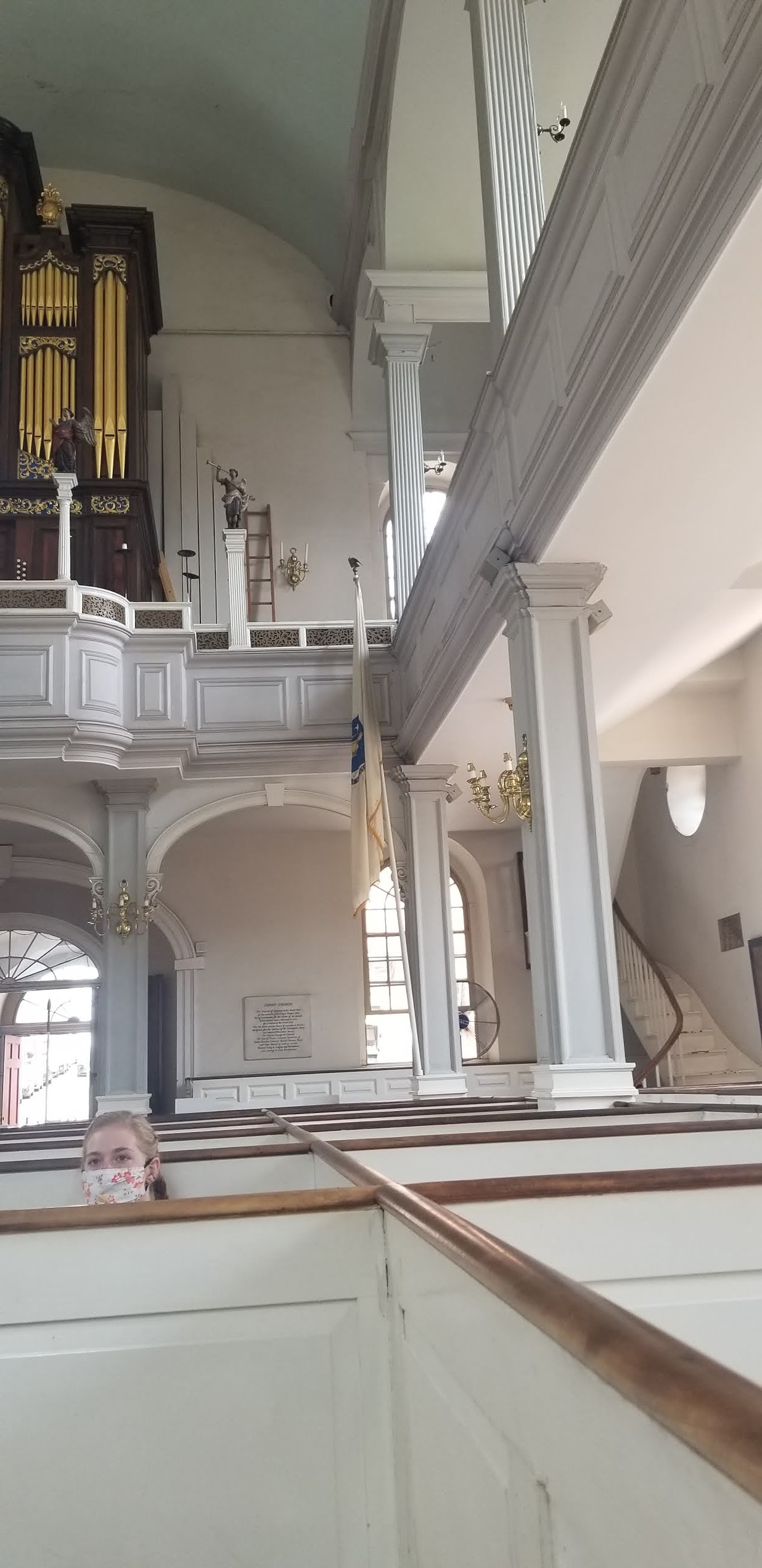
A shot of the rear corner, where the sexton carrying the lanterns for the signal climbed the stairs, then accessed the steeple stairwell from right behind those organ pipes. Can you imagine that climb? (And another of my cute daughters, tucked into her own pew box behind us!)

A long view of the aisle and church front, from the back. (With, yes, one of my daughters!)

So beautiful. I am a sucker for historic churches! Back when my family and I all lived in Charleston, South Carolina, I did several posts on because, well, they are just too beautiful and special to miss--and this one was no exception! I found several similarities to churches I'd visited elsewhere, but also many unique features.

And an unexpected connection to North Dakota! Many of the pew boxes bore engraved plates with the names of patrons who'd used those spaces, and here we read that Theodore Roosevelt, who spent much time in North Dakota in his younger days, and was a strong supporter of the National Park system, had visited and attended services at the Old North Church.
Closeup of the stairs ... and yes, there's a matching staircase on the other side.
The original wood collection box, under plexiglas of course. (I'm such a geek about these sorts of details!)

It was a sweet, if too-short, visit. I wish we lived close enough to go back again soon!

For more about the architecture and history: Old North Church

(They also have THE most fabulous gift shop everrrr! Do visit if you ever have a chance.)

Monday, September 21, 2020

Historic Boston: the highlights, part 2

 
Sometimes the best history is found in ... a cemetery.
 
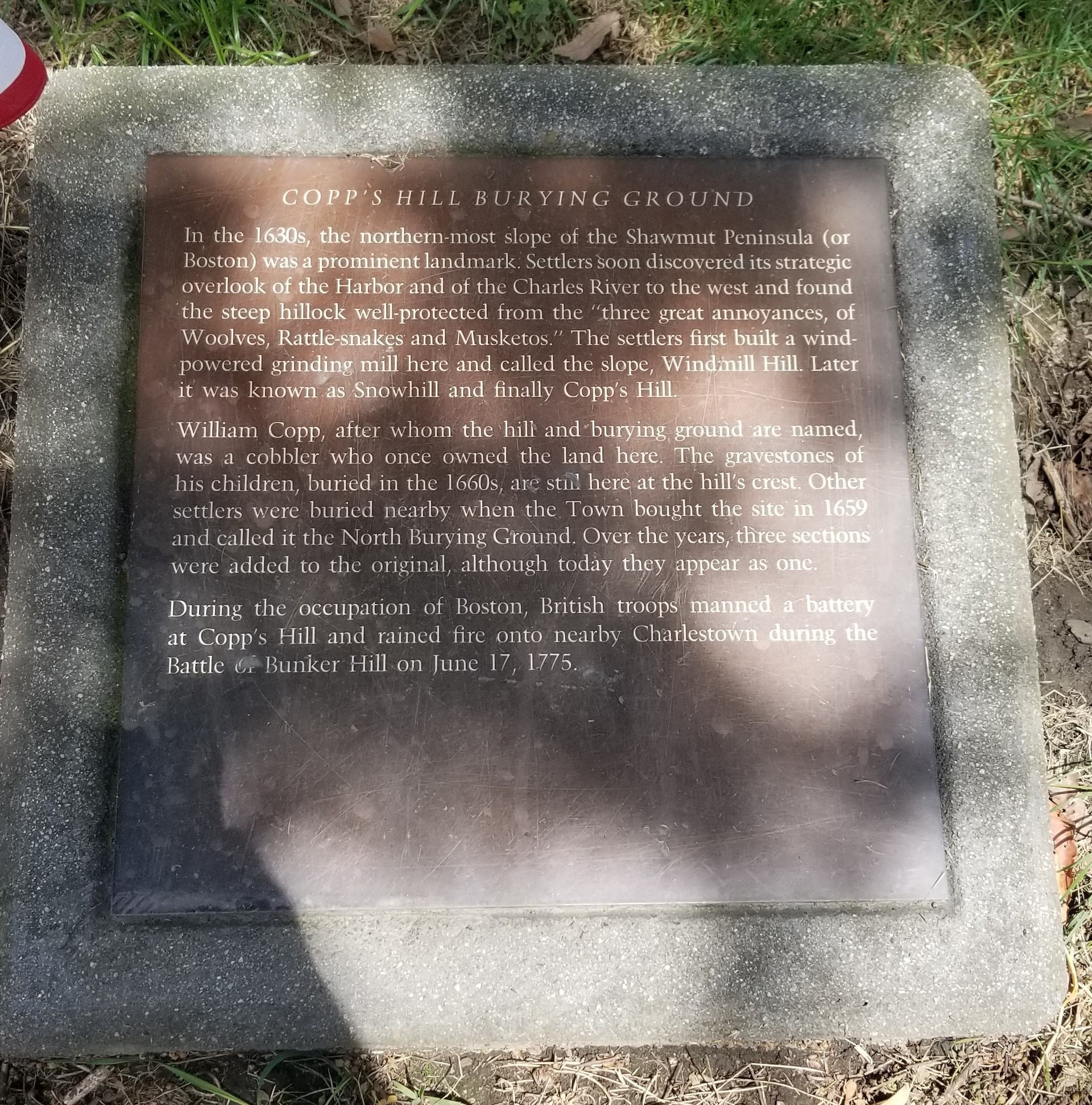
One of our too-short stops in the North End of Boston (which I completely fell in love with!) was the Copps Hill Burying Ground. This cemetery was, as explained by one of the informational placards, transformed during the Victorian era from a simple "burying ground" to a park.


 (Forgive the odd formatting on this post--Blogger has changed things all up and it's much harder to get things to look the way one wishes them to!)


One of my favorite discoveries was the family tomb of Cotton Mather, his son Increase, and grandson Samuel. I remember reading about Cotton Mather in church history, so in nosing around the CQ archives for connections to him, I really enjoyed MaryLu Tyndall's article, Cotton Mather: Preacher to the Pirates!
 
(Note the furry resident taking refuge in the construction around the monument ...)


And my youngest daughter, trying to see how close she can get to the wild bunny ...
 
Amongst other things we saw on this particular morning was the Revere house. We lacked the time to go in and tour, but I snapped an awkward selfie, and turned to capture the way the colonial building abuts a more modern construction before we had to hurry on.


And then there was the beautiful Old North Church! More on that next time, because it deserves its own post ...


Monday, February 24, 2020

Important Early American Artists #4: John Singleton Copley

By J. M. Hochstetler

John Singleton Copley, Self Portrait (1780-84)
When I was in school I loved art class, and although it’s been a number of years since I’ve done any drawing or painting, my interest in the visual arts has continued throughout my life. Which is why I’ve been focusing on important early American artists in my last 3 three posts. Today I’m going to wrap up the series by taking a look at John Singleton Copley, who became famous in both America and England for his portraits and paintings of historical subjects and is generally acclaimed as the finest artist in colonial America.

Copley was born July 3, 1738, most likely in Boston, Massachusetts, to Richard and Mary Copley. Richard was from Limerick, while Mary was a Singleton from County Clare whose family was of Lancashire origin. They immigrated to Boston in 1736 and owned a tobacco shop on Long Wharf. Richard apparently arrived in America in ill health, however, and around the time of John's birth went to the West Indies, where he died in either 1737 or 1748, depending on the source you consult. In any case, he died previous to Mary’s wedding Peter Pelham on May 22, 1748.

Paul Revere (1768-70)
Little is known of Copley’s childhood. Pelham painted portraits and was an excellent engraver, however, which undoubtedly set Copley on the path to a career as a painter. Young Copley was around fourteen when his stepfather died, and about that same age Copley painted his half-brother Charles Pelham, his earliest extant portrait. More promising works followed during the next few years, and by the time he was 20 he was steadily employed in painting portraits. Copley’s works reveal a detailed knowledge of New England people and culture. Influenced by the Rococo style of Joseph Blackburn, Copley portrayed his subjects with objects relevant to their personal lives, like this one of Paul Revere, which gave his portraits an intimate sense of the person’s character and interests that was rare 18th-century American painting.

A Boy with a Flying Squirrel (1765)
Commissions from the foremost members of New England society made Copley a prosperous man. His income, extraordinary for New England in the 1760s, elevated him to the Boston aristocracy. But he was eager for wider recognition. In 1766 Benjamin West, a fellow countryman who had moved to London to pursue his own art career, entered Copley’s painting A Boy with a Flying Squirrel (1765), at left, in the annual Exhibition of the Society of Artists of Great Britain. The subject is Copley’s half-brother, Henry Pelham, seated at a table playing with a pet squirrel, and it gained Copley’s election as a Fellow of the Society. West urged him to come to England to study for several years, but although Copley continued to send pictures to the Exhibition, he hesitated to risk the prosperity he enjoyed in Boston for an uncertain future in England.

Copley Family (1776-77)
On November 16, 1769 Copley married a woman of impeccable social status. Susanna Farnham Clarke was the daughter of Richard and Elizabeth (Winslow) Clarke. Her father had become very wealthy as an agent of the East India Company in Boston, and her mother’s ancestors had arrived in America on the Mayflower. By all accounts the Copleys’ marriage was not only socially notable, but also a happy one. Susanna was a beautiful, poised woman, whose portrait Copley painted several times. He and Susanna welcomed six children into their family in a house he built on the west side of Beacon Hill, where they lived as members of the top tier of Boston society.

The only substantial time Copley left Boston during this period was in 1771 and 1772, when he spent seven-months painting in New York City and Philadelphia as the political situation in Boston was deteriorating. The tea destroyed in the Boston Tea Party had been consigned to his father-in-law, and his extended family were all Loyalists, which made it increasingly dangerous for him to stay in the area. He finally heeded the urging of West and others and sailed for England in June 1774 as many other American artists had done before him, leaving his mother, wife, and children behind until he could secure lodgings. In England he received a warm reception from West and England’s art community. In 1775 while he traveled through France and Italy to study the great works of art, his wife and children arrived in London, where they stayed with her brother-in-law, Henry Bromfield. Susanna’s father and brothers soon joined them in London. After Copley’s return he and his family settled in 25 George St., Hanover Square, where Copley, Susanna, and their son, John Singleton Copley, Jr., the future Lord Lyndhurst, lived until their deaths.

Watson and the Shark (1778)
Encouraged by the success of West and others, Copley ventured outside of portraiture and began to paint more historical pieces. His first important work in the genre was Watson and the Shark (1778), at left, which portrays an incident involving his friend and fellow artist Brook Watson, who at the age of 14 lost a leg in a shark attack while swimming in Havana harbor. The painting foreshadows one of the great themes of 19th-century Romantic art: man’s struggle against nature. Copley’s historical paintings were so successful because he went to great lengths to create excellent likenesses of the people in them and to include correct details of the historical period. He traveled throughout England to make studies of old portraits of the subjects he intended to paint as well as the actual historical locations. At the same time he continued to paint portraits of English royalty and famous British and American individuals.

Copley was elected as an associate member of the Royal Academy in 1776 and made a full member in 1783. Likely more politically liberal than his relatives, he maintained contact with many New Englanders, painting portraits of John Adams, John Quincy Adams, and other Bostonians when they visited England, and in 1791 he was elected a Foreign Honorary Member of the American Academy of Arts and Sciences. His daughter Elizabeth married wealthy Gardiner Greene of Boston, whose descendants preserved much of the Copley family’s correspondence for posterity.

John Adams (1783)
Ultimately, although Copley’s intensive work habits certainly contributed to his success, the long hours at the easel and lack of regular exercise also took a toll on his health and disposition. A granddaughter recalled that he usually painted continuously from early morning until evening, when his wife or one of their daughters would read to him. In his latter years he struggled with depression made worse by the expense of maintaining his household and educating his son, John Singleton Copley, Jr., who in adulthood became a brilliant lawyer. As Copley’s own career waned, paintings that took years of labor remained unsold, forcing him to borrow heavily to cover household expenses. His physical and mental health declined as well, and he died of a stroke on September 9, 1815, deeply in debt. His daughter Mary wrote that “He was perfectly resigned and willing to die, and expressed his firm trust in God, through the merits of our Redeemer.” He was buried in Croydon Minster in Croydon, Surrey.

Copley became the greatest and most influential painter in colonial America, with a legacy that extended well into the nineteenth century. In Britain his greatest achievement was in developing contemporary history painting as a combination of history, idealism, and theater. Boston’s Copley Square, Copley Square Hotel, and Copley Plaza are named after him, as are Copley Township in Summit County, Ohio, and the Copley crater on the planet Mercury. In 1965 the U.S. Postal Service issued a 5-cent stamp commemorating the 150th anniversary of his death that features his daughter, Elizabeth Clark Copley, from his Portrait of the Copley Family (1776) above.

In this series I’ve covered John Trumbull, Benjamin West, Gilbert Stuart, and now John Singleton Copley. Please check out the links to those articles in their names above and answer the following questions.

1. What do you find the most interesting about one of these artists?

2. Which painting by any one of the artists are you most drawn to?
Please share, and I’ll share mine too!
~~~
J. M. Hochstetler is the daughter of Mennonite farmers and a lifelong student of history. She is a professional editor, a publisher, and the author of award-winning historical fiction whose books have been endorsed by bestselling authors such as Lori Benton, Laura Frantz, and Jocelyn Green. Her American Patriot Series is the only comprehensive historical fiction series on the American Revolution. Book 6, Refiner’s Fire, released in 2019, and one more volume, Forge of Freedom, will complete the series. She is also the author of One Holy Night, the Christian Small Publishers 2009 Book of the Year, and co-authored the award-winning Northkill Amish Series with Bob Hostetler.


Monday, September 23, 2019

Eighteenth-Century Hygiene: Dental Care

Today I’m wrapping up my series on 18th century hygiene with a look at dental care. When you’re researching a particular period, as we historical fiction writers do, you run across a lot of fascinating information about how people lived and took care of themselves back in the day. Though I doubt any specifics related to this subject will ever show up in my books, it does make a good, and in some instances hair-raising, topic for a blog post. So let’s delve into what was going on with teeth back in the 1700s.

No matter what class you belonged to, in past centuries everyone suffered from tooth decay and gum disease. Malaria, smallpox, scurvy, syphilis, and other diseases that can contribute to tooth decay were prevalent. Another contributor was the common diet, which consisted mainly of heavy meat dishes, salt-cured meats, sugary desserts, sweetened tea and coffee, and sweet wines and other alcoholic beverages, with little in the way of fresh fruits and vegetables. A well-known proverb of the time also maintained that a woman would lose a tooth with each pregnancy.

Egyptian Toothbrush
Naturally people wanted to look good and avoid pain, so daily tooth care was as imperative as it is today. The earliest type of toothbrush was made by the Egyptians and Babylonians, who chewed or mashed the ends of twigs until they were frayed, then used them to scrub debris from their teeth. Over the centuries, strips of linen, sponges, feathers, animal bones, and porcupine quills were also used for this purpose. When collections of cosmetic recipes became popular, mouthwashes and tooth powders were often included. Some of these contained abrasives like pumice or sugary substances like honey, which obviously would have been counterproductive, but there were a few that actually worked pretty well.

Eighteenth-century Toothbrush Handles
The Chinese invented the modern toothbrush between 1498 and 1600 by inserting coarse boar bristles into holes drilled into bamboo or animal bone handles. These devices eventually made their way west. The first reference to toothbrushes in Europe appeared in 1690, and in the early 1700s an Italian company, Marvis Toothpaste, filled the need by making toothpaste. British toothbrushes often used softer horsehair or even feathers. But in 1780 when William Addis began to mass produce toothbrushes similar to the ones we know today, he used cattle bone for the handle and went back to boar bristles, which were more effective and longer lasting.

18th Century Dental Tools
Prior to and well into the 1700s, if you had problems with your teeth or lack thereof, you sought out your local doctor, barber, blacksmith, hairdresser, silversmith, or whomever advertised some kind of dental practice in you area. The main method of dealing with toothaches was extraction using forceps or a device called a pelican. During the 1700s an instrument called the key of Garengeot was developed. Later modified and called an English key, it was more efficient and less liable to fracture the jaw, teeth, or gums. Thank goodness for that!

English Key
The eighteenth century brought a flood of advancements in dental care. In 1711 Lorenz Heister of Frankfurt-am-Main published De Dentium Delore, a treatise on dentistry in which he opposed extracting teeth. Instead he advocated removing on the decayed part and filling the cavity with white wax, mastic or gold. Or lead foil. Yikes! I’m sure that suggestion had unintended consequences! However, if a large portion of the tooth had to be removed, he prescribed using prosthetics of ivory or hippopotamus tusks carved to fit. Then in 1756 a German surgeon advocated the use of electricity as a cure for toothache. Many other “experts” of the time claimed that steel magnets were effective in curing toothaches, though I haven’t found any evidence proving that this actually worked.

It was the French who led the way in dental science, with Pierre Fauchard (c.1690–1761) being considered the founder of modern dentistry. Before his time very little was written about dentistry, and methods were passed down from master to apprentice. Fauchard was the first to publish a comprehensive work on the subject, Le Chirurgien Dentiste (1728), in which he documented his own inventions along with all the knowledge available at that time. He also championed establishing a school of surgery where for the first time the theory and practice of dental surgery would be taught, thus elevating it to a practical science.

18th century illustration from an
Ottoman Turk dental book
Fauchard was the first to insist on comfortable seating for patients during operations and also debunked claims such as the belief that worms burrowed in teeth causing toothaches and tooth decay, which had been popular for over a thousand years. Various Chinese remedies were commonly promoted to get rid of these worms. Some brave souls actually used arsenic pills. One wonders what the consequences of that were! Nicolas Andry, dean of the medical faculty of Paris in 1724, was one of these proponents, even claiming he’d observed tooth worms through a microscope and describing them as having small round heads, a black spot, and a long body. He maintained that they caused bad breath and advised employing smoke from henbane seeds to cause them to drop out. Fauchard did his own research and ended up refuting these claims. In addition he strongly condemned the common use of popular elixirs and folk cures and maintained that acids derived from sugars were responsible for tooth decay.

Illustration of Denture Construction
in Le Chirurgien Dentiste  
Replacing missing teeth was another widespread concern. Let’s dismiss one erroneous claim: false teeth made of wood. Common sense tells us that wood, being porous, prone to decay in moist environments, and subject to warping and splintering under pressure wouldn’t be a good substitute for tooth enamel. Not to mention that wood has a taste. Ugh. If anyone ever tried it, I’m sure they quickly discarded the idea. And no, George Washington never had wooden teeth.

Dentures were constructed using animal bones; walrus, elephant, or hippopotamus ivory; or even actual human teeth. In 1710, Jacques Guillemeau combined a number of different materials to replicate teeth, and Fauchard used silver, mother of pearl, and even enameled copper. He made a full upper set of teeth for a high-ranking lady in 1737, which was held in place with springs, and also a full upper and lower set for a man who wore them for more than 24 years. Around 1774 Alexis Duchateau created the first dentures of fine porcelain, which were mounted on gold or platinum bases. John Hunter, surgeon-dentist to the British Army in 1776, did extensive research in extracting and replanting teeth. Live teeth subsequently became so sought after that ads appeared in newspapers offering money for them. But it was Philip Pfaff,  dentist to Frederick the Great, who made what is considered the most important contribution to dental science by developing the process of creating a plaster model of a patient’s teeth from a beeswax impression.
George Washington's Dentures

Back to George Washington. The future president of the United States began losing his teeth at the age of twenty-two. It’s believed that at some point he had a set of dentures made by the famous Parisian dentist Nicholas De Chemant, a pioneer in the creation of porcelain teeth. We do know that not long before his death his personal dentist, John Greenwood, created dentures for him with teeth carved of hippopotamus ivory and held in place with gold wire springs. Apparently these were a great improvement over what he had been wearing.

You’re probably familiar with one of the most well-known American dental practitioners: Paul Revere. He was a silversmith, and silver was often used in fillings and caps. He constructed a dental bridge for Dr. Joseph Warren, who was killed at the Battle of Bunker Hill by a shot to the head. After the battle Revere identified Warren by his dental bridge, the first known case of postmortem dental forensics.

I was surprised that many of today’s dental procedures date back as far as the 1700s. Do any of these 18th century practices and advancements surprise—or perhaps horrify—you? Please share your thoughts!
~~~
J. M. Hochstetler is the daughter of Mennonite farmers and a lifelong student of history. She is a professional editor, a publisher, and the author of award-winning historical fiction whose books have been endorsed by bestselling authors such as Laura Frantz, Lori Benton, Jocelyn Green, Michelle Moran, and MaryLu Tyndal. Her American Patriot Series is the only comprehensive historical fiction series on the American Revolution. She is also the author of One Holy Night, which won the Christian Indie Publishing Association 2009 Book of the Year and co-authored the award-winning Northkill Amish Series with Bob Hostetler


Wednesday, November 21, 2018

Women Soldiers, Combatants, and Spies in the American Revolution

When I began writing my American Patriot Series, I realized that the storyline I envisioned would require my heroine, Elizabeth Howard, to do many things one doesn’t usually associate with 18th century women at the time of the American Revolution. I wanted the story to be as authentic as possible—no modern-day women in historical clothing! When I started doing research, I discovered that, in fact, women were involved in a whole lot of activities during the Revolutionary War that most of us have never heard about. So here are a few brief accounts of some of the ways women became directly involved in fighting for our independence.

Sybil Ludington Statue
On April 26, 1777, two years and eight days after Paul Revere made his famous ride, Sybil Ludington, the daughter of Col. Henry Ludington, a New York militia officer and later an aide to General George Washington, did essentially the same thing. Except that she was 16, a girl, and she rode more than twice the distance Revere did. Not to mention that her route was a whole lot more daunting, and much of the way it rained hard. Learning that Governor William Tryon’s troops were marching on Danbury, Connecticut, 15 miles away, to carry off the militia’s munitions and stores, Sybil immediately jumped on her horse and took a 40-mile jaunt to rouse the countryside, while her father mobilized the locals. She left her home at Fredericksburgh, NY, at 9:00 p.m. and arrived back home at dawn. By then almost the whole regiment of 400 soldiers had mustered due to her warning. They were on the march within a couple of hours and engaged the British at the Battle of Ridgefield. Although they arrived too late to stop the sack of Danbury, they drove Tryon’s forces back to Long Island. After the war, in 1784, then twenty-three year-old Sybil married Edmund Ogden, a farmer and innkeeper. They had six children and in 1792 settled in Catskill, NY, where they lived until Sybil’s death on February 26, 1839, at the age of 77. She is buried near her father in the Patterson Presbyterian Cemetery in Patterson, NY.

Frontispiece of The Female Review: Life of Deborah
Sampson, the Female Soldier in the War of Revolution
There’s no way to know how many women actually served as soldiers during the war by disguising themselves as men, but we do know about 4 who did. Probably the most well-known is Deborah Sampson. Born in 1760, in Plympton, Massachusetts, she enlisted in Captain George Webb’s Company of the 4th Massachusetts in 1782, calling herself Robert Shurtleff. By all accounts she performed her duties admirably and  achieved the rank of corporal. During her first battle, on July 3, 1782, outside Tarrytown, NY, she took two musket balls in her thigh and suffered a cut on her forehead. She managed to avoid detection then, but later was discovered to be a woman. Honorably discharged, she was later granted a pension for her services. The Massachusetts legislature issued a declaration stating that she “exhibited an extraordinary instance of female heroism by discharging the duties of a faithful, gallant soldier.” Sampson later talked about her experiences in the war as a lecturer, saying that she enlisted because of the unjust deaths of colonists at the hands of British soldiers.

Detail of Battle of Germantown by Christian Schussele
Anna Maria Lane probably married her husband, John, before he enlisted in the Connecticut line in 1776 under General Israel Putnam. It isn’t clear if she also disguised herself as a man or just accompanied him as a camp follower. We do know that by the Battle of Germantown she was wearing men’s clothing, though that may have been for convenience. The records of Virginia’s General Assembly state that she “with the courage of a soldier, performed extraordinary military services, and received a severe wound at the battle of Germantown.” Following the war, the Lanes moved to Virginia, and both drew pensions for their service.

Two other women are known to have fought in the Revolution. Sally St. Clare was a Creole girl who lost her life in the war. Another known only as “Samuel Gay,” was discovered to be a woman and discharged. It’s likely others also served in the army as men but were never detected.

Molly Pitcher at the Battle of Monmouth,
engraving by J.C. Armytage, c. 1859
Still other women became combatants when need arose. You’ve undoubtedly heard the name “Molly Pitcher,” which was attached to a woman who stepped in to service her husband cannon after he fell. There’s some evidence that at least two women performed such duties. Mary Ludwig Hays McCauley accompanied her husband, John, who served with the Seventh Pennsylvania Regiment. During the Battle of Monmouth, New Jersey, on June 28, 1778—which will be portrayed in book 6 of my series, Refiner’s Fire—she was hauling water to her husband’s cannon for the sponger to swab out the barrel, when John collapsed, either because of a wound or the day’s extreme heat. Mary immediately stepped up and took his place, assisting the gun crew for the rest of the battle.

Corbin Memorial, West Point Cemetery,
United States Military Academy
Margaret Cochran Corbin was married to John Corbin, another artilleryman, who was killed in the Battle of Fort Washington in November 1776. She also filled her husband’s place at the cannon, assisting in sponging and loading, and received grape shot wounds in the arm and chest. Disabled for the rest of her life, she was an original member of the Invalid Regiment that Congress created in 1777 to care for disabled soldiers. In 1779 Corbin was granted a stipend of $30 and a lifelong pension of half a soldier's pay. She was the first American woman to receive a disabled veteran's pension.

Women also served as spies during the Revolution. A laundress at British headquarters in Philadelphia alerted Washington to British General Henry Clinton’s withdrawal from the city, and many others served in the shadows, like Lydia Darragh. British officers occupying her house in Philadelphia used a large upstairs room for their secret conferences. Lydia would slip into an adjoining closet and take notes on their plans, and after her husband transcribed the intelligence in a form of shorthand on tiny slips of paper, she enclosed them in fabric-covered buttons, which she sewed onto the coat of her fourteen-year-old son, John. When he visited his elder brother, Lieutenant Charles Darragh, serving with the Continental Army outside the city, Charles would snip off the buttons, write out the notes, and send them to his superior. Lydia also supposedly concealed other intelligence in a sewing-needle packet she carried in her purse when passing through British lines.

Major John André
One of the most well-known female spies today was a member of the famous Culper Ring in the New York City area, who was known only by her codename “355,” which stood for “lady” in the Culper code. Her background is unknown, but it’s speculated that she may have come from a prominent Tory family with access to British commanders. She was one of several young, attractive, and intelligent women surrounding dashing British Major John André. When he was arrested by the Americans and executed as a spy in October 1780, Benedict Arnold, one of Washington’s officers who had defected to the British, questioned everyone associated with him. Agent 355 was pregnant at the time and refused to identify the child’s father, arousing Arnold’s suspicions. He had her arrested, and she was held on the infamous prison ship Jersey, moored in the East River. She bore a son there and died shortly thereafter, never identifying the child’s father. But, tellingly, she named him after Robert Townsend, another member of the Culper Ring.

Yet other women followed Washington's army for safety and subsistence. Many provided services such as cooking, washing and mending clothing, and nursing, and consequently received rations and sometimes pay. In my next post, we’ll take a look at the life of camp followers.

How many of these women have you heard of? Which one do you find most interesting or appealing?
~~~
J. M. Hochstetler is the daughter of Mennonite farmers and a lifelong student of history. She is also an author, editor, and publisher. Her American Patriot Series is the only comprehensive historical fiction series on the American Revolution. Book 6, Refiner’s Fire, releases in April 2019. Northkill, Book 1 of the Northkill Amish Series coauthored with Bob Hostetler, won Foreword Magazine’s 2014 Indie Book of the Year Bronze Award for historical fiction. Book 2, The Return, received the 2017 Interviews and Reviews Silver Award for Historical Fiction and was named one of Shelf Unbound’s 2018 Notable Indie Books. One Holy Night, a contemporary retelling of the Christmas story, was the Christian Small Publishers 2009 Book of the Year and a finalist in the Carol Award.