Announcements

10 Year Anniverary & New Releases Winners: Carrie Fancett Pagels' Butterfly Cottage - Melanie B, Dogwood Plantation - Patty H R, Janet Grunst's winner is Connie S., Denise Weimer's Winner is Kay M., Naomi Musch's winner is Chappy Debbie, Angela Couch - Kathleen Maher, Pegg Thomas Beverly D. M. & Gracie Y., Christy Distler - Kailey B., Shannon McNear - Marilyn R.

Monday, September 8, 2014

The Southern Campaign of the Revolution: Myth and the Mists of Time


Before I continue my mini-series on colonial myths, I’d like to offer an overview of the Southern Campaign of the American Revolution. How many know what that refers to? Unless you’re a serious American Revolution buff, chances are you don’t.
Kershaw-Cornwallis house, Camden, SC, British headquarters 1780-81
The history taught in schools is sketchy at best, and sometimes  riddled with myth. Where the Revolution is concerned, we’re familiar with the Boston Massacre, Lexington and Concord, the Declaration of Independence, Valley Forge, and Yorktown. What happened in between is fuzzy at best, or missing completely.

We also know individual legends like George Washington and the cherry tree, Betsy Ross, and Molly Pitcher. We’ve also heard of Benedict Arnold’s treachery, and we know the difference between Whig and Tory.

The average person is willing to let their knowledge of history be informed solely by grade-school textbooks, or films like The Patriot. Those of us who have an interest in blogs like this one, on the other hand, thirst to know more ... to get the facts right. :-)

I shared already how a common reenactor myth sparked a story idea, then sent me in search of solid provenance for said story.  As I got deeper into the research, it took my breath away at how little I knew of the Revolution as a whole.

Like the fact that the whole second half of the war took place in the southern colonies.
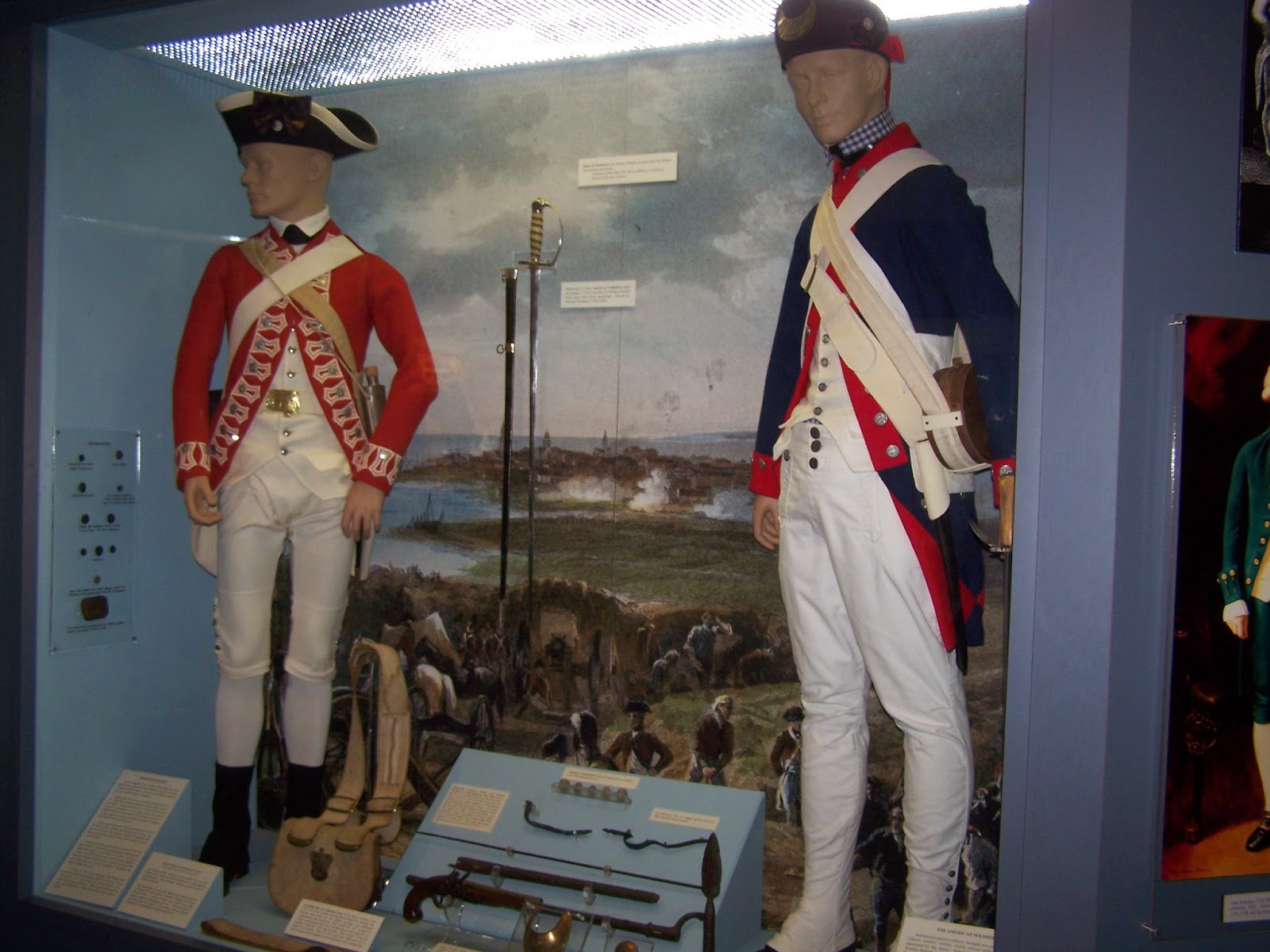
Siege of Charleston display at the Charleston Museum
The war had gone as far as it could in the northern colonies—the British held New York, Boston, and Philadelphia, the major cities. The British cast their eye to the South—for the second time, since an attempt at taking Charleston had failed in 1776. (Much is made of that in Charleston colonial history, in fact, with barely a mention of later events.) This time the effort began with Savannah, Georgia, a lesser port than Charleston, but also an easier target. Savannah fell to the British in late 1779, and the British then turned their sights on Charleston, arguably the most important port and the richest city in the colonies. With a combined offensive on land and sea, the British caught Charleston in a pinch and held it under siege for nearly two long months, March-May 1780.

When the city fell, May 12, 1780, Lord Earl Cornwallis was left to implement the next stage of the "Southern strategy": push into the backcountry while holding Savannah and Charleston. A good part of the populace was believed to be loyalist, but not as many as the British counted on. Their initial plan to establish a network of outposts went smoothly enough at first, but then trouble flared in the backcountry of South Carolina in particular, around Camden, with what became known as the Presbyterian Rebellion. (The trouble was chiefly among the Scotch-Irish Protestant population.)

General Washington sent a force southward, headed by Horatio Gates, and in August 1780 the two armies met just north of Camden, in the wee hours of a moonlit night. Fighting broke out at dawn, and a hot battle turned into a complete rout of the Continental forces, many of them unseasoned militia. Gates was summarily fired after having fled ahead of his troops, and Continental commissary officer Nathanael Greene, a former Quaker, was assigned the task of regrouping the Continental forces and finding ways of making the militia function under fire.

Greene, it turned out, had a genius for logistics—literally, wearing out the British army. Rather than win the war by military might, or number of battles won, he employed a strategy of cutting off supply lines and making it untenable for the British to hold their various outposts.

The force that turned the tide of a war ...
The patriot militia and Continentals won a few of their battles, notably Kings Mountain in October 1780 (a huge surprise, for being mostly Overmountain men untrained in battle) and Cowpens in January 1781 (where Greene found a way to persuade the militia to stand in the face of fire). Others weren’t a dead loss but also not a clear-cut victory on either side, such as Hobkirk Hill in May 1780 (the second battle at Camden) and Eutaw Springs in September 1781. Some were a nightmarish, bloody ordeal on both sides, like Guilford Courthouse in March 1781. Cornwallis reached too far and subjected himself and his troops to an awful, bloody race through North Carolina in the spring of 1781, which after Guilford Courthouse led to the British army limping off to Wilmington, North Carolina, until a fresh press northward to Yorktown, Virginia. By the time October 1781 rolled around, all British troops had withdrawn from South Carolina outposts and were holed up in Charleston. The British cause in the colonies was pretty well finished, and Cornwallis had little choice at Yorktown but to surrender.

These two years comprised possibly the bloodiest and most brutal of the war. Greene is quoted as saying, “Nothing but blood and slaughter has prevailed among the Whigs and Tories, and their inveteracy against each other must, if it continues, depopulate this part of the country.” The Southern Campaign is, I believe, what earned the Revolution the nickname of America’s first civil war. Not much calm and reason here, but passion and fury and vengeance, neighbor against neighbor and brother against brother.

Links of interest:

North Carolina Digital History's War in the South
Southern Campaigns of the American Revolution

All photos mine.

Wednesday, September 3, 2014

A Revolutionary War-era Cemetery Inspires an Author by Cynthia Howerter

The colonial historical fiction novel that I’m currently writing is set in Northumberland County, Pennsylvania during 1777. It was a frightening time for the settlers, many of whom were Scot-Irish Presbyterians, on what was then part of the American frontier. Deadly, lightning-fast raids conducted by British-allied Iroquois war parties swept across the rural county while General George Washington and the ragtag Continental Army of ordinary men did their best to battle the highly-trained professional British army in the east.


The British burned American homes
 during the Revolutionary War (photo by Cynthia Howerter)


The story of the people who tamed and defended Pennsylvania’s backcountry and fought in the Revolutionary War is dear to my heart—mostly because my ancestors were among them.    

After conducting eight months of intensive research about that era on the Pennsylvania frontier, I needed to create the characters for my novel—and desiring to make them realistic, I knew where to turn for inspiration. 

A previous visit to the old Warrior Run Presbyterian Church and burial ground in Northumberland County had impressed me with the number of church members who not only lived during the Revolutionary War period, but who served their fledgling country as soldiers in the war for independence. You may recall my July 2, 2014 Colonial Quills article ("The Warrior Run Presbyterian Church in Northumberland County, Pennsylvania") about this church.

Warrior Run Presbyterian Church (photo by Cynthia Howerter)


The first time I visited the historic church grounds, a well-maintained stone wall near the church caught my eye—and I knew I needed to investigate the enclosed cemetery more closely. 

View of the stone wall and enclosed Warrior Run burial ground (photo by Cynthia Howerter)


After parking my car underneath several ancient shade trees, I spotted an old iron gate.The metal latch was frozen in place from infrequent use, but I persevered until it released and allowed me to swing open the heavy gate and enter the peaceful enclosure.

The burial ground's iron gate (photo by Julie Kane Trometter)


Inside the wall was a neatly laid out cemetery, the final resting place of many of the area’s early Scot-Irish Presbyterian settlers.

Warrior Run burial ground's neatly laid out graves (photo by Cynthia Howerter)


I was intrigued by the numerous American flags held in place by metal markers and wondered which war the honored person had fought in. Walking past flag after flag, I was stunned by the number of men who had fought in the American Revolutionary War.

The peaceful resting place of American Patriots (photo by Julie Kane Trometter)


These were the very men who defended their communities from Iroquois war parties and battled the British so the American colonists would be able to govern themselves.

These men were not professionally trained soldiers. They were ordinary men—farmers, shopkeepers, husbands, fathers, sons, brothers, and friends—who did extraordinary feats to defeat the Iroquois and British Army—the most powerful Army on earth.

American boys and men of all ages fought for our right to live free (photo by Cynthia Howerter)


While some of these brave men traveled east and fought the British Army, others stayed home in Northumberland County and fought the British-allied Iroquois Indians whose goal was to destroy the homes and crops and lives of the settlers trying to eke out a living in the wilderness.

The men and women whose final resting place is inside the protective stone wall of the Warrior Run Presbyterian Church’s cemetery are the people whose lives inspired the characters in my colonial historical novel. In their honor, my characters bear a mixture of some of their first and last names. 

Let’s look at the gravestones of several American patriots and spend a quiet moment honoring those who put their lives on the line so that you and I can live a free life.

Patriot Thomas Wallace (photo by Julie Kane Trometter)


Patriot John Montgomery (photo by Julie Kane Trometter)


Patriot Thomas Barr (photo by Julie Kane Trometter)


Patriot John Caldwell (photo by Julie Kane Trometter)


A special and heartfelt thank you to my cousin and fellow DAR (Daughters of the American Revolution) member, Julie Kane Trometter, for driving to the Warrior Run Presbyterian Cemetery and taking photographs for this article.

Photographs ©2014 Julie Kane Trometter 
Photographs ©2014 Cynthia Howerter 


Award-winning author Cynthia Howerter loves using her training in education, research, writing, and speaking to teach and inspire others about a time in America that was anything but boring. A member of the Daughters of the American revolution (DAR), Cynthia believes history should be alive and personal.

Visit Cynthia's website: Cynthia Howerter - all things historical 


Monday, September 1, 2014

Devout Colonial Dog


On this Labor Day, I bring you a story about an ancestor's dog, originally posted on my genealogy blog, Relatively Speaking.

During the late 18th century, my husband’s five times great-grandfather, Lovell Clark and his wife, Mary, resided in the Milford, Massachusetts area. They were steadfast members of the Congregational church and adorned their profession by exemplary lives. They were sober, upright, industrious, unostentatious people, and justly held in solid esteem. Mr. Clark was a very strict observer of the Sabbath, and a devoted attendant on public worship. Nothing but absolute necessity would prevent his regular attendance on the services of the sanctuary.

The Clark family had a most remarkable dog — scarcely less pious than the rest of the household, especially in attendance on public worship, and deportment during the services. He equalled his master in punctuality and regularity. As surely as Sunday came and the Congregational church bell rung, he gravely proceeded to church, and posted himself directly under the pulpit, which was then supported by small pillars. There he remained during the services, invariably rising on his feet, as the congregation did, for singing, prayer, and benediction, and the rest of the time quietly sitting on his haunches, or lying recumbent. As to the Universalist church bell, he took no notice of it whatever — having due aversion for the heresy to which it summoned the reprobate.

At length his master was tempted so far from the path of rectitude as to tire of the dog’s company in the house of God. So he shut him up in close quarters at home during the hours of divine service. But this was too severe a privation for that canine devotee, who frequently made his escape, and repaired to his position under the pulpit, from which nothing but dire restraint could withhold him.
But he was getting old, and his master hired an executioner to dispatch him outright. One Thursday the exploit was attempted in the barn where the dog lay asleep. A terrible blow, presumed to be effectual, was given him on the head, which wounded him badly, but failed even to stun him. He leaped in agony from the presence of his would-be destroyer, ran away from the premises, and was supposed to have died on his flight. Yet he survived ; and lo! the next Sunday appeared at ch. again, to the astonishment of the family.

Poor abused worshipper! His master now relented, and tried to flatter him home with him, but could induce him to come only a part of the way. Finally one of the boys got him home, nursed his aching head, and it was unanimously resolved that his life should be held sacred. After this he lived several year., and attended church every Sunday regularly without molestation. Somehow at last he was lost on a journey to Providence, R.I., and never more found. Surely such a dog, if animals have immortality, ought to have a place among the blessed.

The transmigrationists might plausibly claim him as a strong illustration of their doctrine. Anyhow, he was no heterodox dog.

Source: History of the town of Milford, Worcester county, Massachusetts, from its first settlement to 1881

Friday, August 29, 2014

The Port Royal Earthquake of 1692!


In 1692 an earthquake struck the city of Port Royal Jamaica, a city that had been deemed the

Wickedest City in the World. Port Royal was a British outpost, a thriving shipping and merchant community. If you have seen the first pirate movie, you may remember Port Royal was the city Captain Jack Sparrow first sailed (or rather sunk) his ship into. With a population close to 6500, the city was larger than New York City at the time. Cramped, unhealthy, and wanton, the port town was settled for reasons purely of lust and greed and was filled with pirates, privateers, sailors, and other greedy sorts. There were a few honorable souls among the inhabitants, but they were in the minority. Two such honorable men were the Reverend Dr. Emmanuel Heath of Christchurch and Sir Hans Sloane.

On the morning of June 7th, Dr. Sloane and his son set out for the mainland by canoe to visit patients in Spanish Town. Dr. Heath attended his church as he did every morning trying to set an example for "a most ungodly, debauched people". Dr. Heath was on his way for lunch at the home of Captain Ruden, but he stopped at an Inn to have a glass of wormwood wine with a merchant friend

At approximately 11:40 am he felt the ground “rowling and moving” under his feet. His friend told him it was only an earthquake and would be over soon, but when Dr. Heath ran into the street, he felt two more larger jolts, and by the time he arrived at Captain Ruden's house, it had


vanished into the sea. Dr, Heath’s church fared no better. It rapidly descended into the sea, its tower collapsing in the process.

An eyewitness describes:
The sand in the street rose like the waves of the sea, lifting up all persons that stood upon it, and immediately dropping down into its; and at the same instant a flood of water rushed in, throwing down all who were in its way; some were seen catching hold of beams and rafters of houses, others were found in the sand that appeared when the water was drained away, with their legs and arms out.

Dr. Heath attempted to make his escape by running towards Morgan’s Fort, but he saw the sea “mounting in’.  Those who had survived the initial earthquake now faced a tidal wave from the south. Not good news for those still trapped in the wreckage of buildings. Dr. Heath headed for his house, which he found still standing, as most were in the eastern section of the city due to being built on an underlying corraline mass.

Meanwhile out in the harbor Dr. Sloane and his sons reported:

We were near being overwhelmed by a swift rolling sea, six feet above the surface, without any wind, but it pleased God to save us, being forced back to Linguanea, where I found all houses even with the ground, not a place to put one's head in, but in Negro houses. The terrible earthquake shook down and drowned nine-tenths of the town of Port Royal in two minutes time, and by the wharfside in less than one. Very few escaped there. I lost all my people and goods, my wife and two men, Mrs. B and her daughter. One white maid escaped who gave me an account that her mistress was in her closet, two pair of stairs high, and she was sent into the garret, where Mrs. B and her daughter were, when she felt the earth quake and bid her take up her child and run down, but, turning about, met the water at the top of the garret stairs, for the house sunk right down and is now under thirty feet of water

Two-thirds of the town, sank into the sea immediately after the main shock. According to Robert All the wharves sunk at once, and in the space of two minutes, nine-tenths of the city were covered with water, which was raised to such a height, that it entered the uppermost rooms of the few houses which were left standing. The tops of the highest houses, were visible in the water, and surrounded by the masts of vessels, which had been sunk along with them."
Renny in his 'An History of Jamaica' (1807): "

 It is believed that nearly 2000 people lost their lives in the actual quake and several thousand more in the disease and looting and starvation afterward.  Among the persons of note who perished were: Attorney-General Simon Musgrave, Provost-Marshal Reeves, Colonel Reade, Captain Ruden and Naval Officer Reginald Wilson. There were many narrow escapes and miraculous deliverances. One such miracle happened to Lewis Galdy who was first swallowed up and sucked out to sea by the first seismic wave then miraculously returned to land by the second.  A young Mrs. Akers was swallowed up in a gap in the land then ejected into the sea and within three  minutes was rescued by a ship.

The earthquake sank the narrow sandbar that connected Port Royal to the mainland and made it an island again. In the aftermath several hundred people found safety on the HMS Swam a royal navy ship that and been washed ashore. Dr. Heath  survived and was instrumental in helping rescue survivors and get them proper care.

Though many tried to rebuild Port Royal, it never returned to its former glory and most of the merchant business transferred to Kingston. History lovers and treasure hunters diving at Port Royal over the years have found many fascinating artifacts. One item of interest was a watch that had stopped at seventeen minutes before twelve: the time of the third and greatest shock.


My new release, The Ransom, takes place in Port Royal in 1692. It is a story of mystery, intrigue, honor, adventure, romance, with a few pirates added in for good measure.  Though it doesn't center around the earthquake, the plot drives the characters through a series of twists and turns up to that earth-shattering moment.

With over 80 5-star reviews, you might want to check it out!!   Click on the book for more information!
http://www.amazon.com/The-Ransom-Legacy-Kings-Pirates/dp/0991092120/ref=sr_1_3?ie=UTF8&qid=1399065223&sr=8-3&keywords=marylu+tyndall

Monday, August 25, 2014

Aprons and Ammunition

Elizabeth Zane (1765-1823)
Betty Zane delivering the gunpowder
 Library of Congress,
 Prints & Photographs Division, [LC-USZ62-2355]
     On September 11, 1782, Fort Henry in Wheeling, WVA, was under siege by the British and their Indian allies.
    Elizabeth (Betty) Zane’s family had taken refuge in the fort. Betty was loading a Kentucky rifle when her father was wounded and fell right in front of her.
     Soon after, the captain of the fort realized they were out of gunpowder. With no men or time to spare, Betty volunteered to retrieve the needed gunpowder from her family’s cabin a short distance away.
     Shocked at seeing a woman run out from the fort, the enemy didn’t try to shoot her on the way there. But, on the way back, they noticed that she was carrying gunpowder in her apron. They opened fire, barely missing her with arrow and musket shot. The new supply of gunpowder enabled the fort to hold off the attack until reinforcements arrived two days later. 
     Betty’s story is best told by John S. Adams, who wrote a poem called Elizabeth Zane, which he penned more than one hundred years after the event. (Many accounts of Betty's act of bravery say she wrapped the gunpowder in her apron. This poem says a tablecloth.)

This dauntless pioneer maiden’s name
Is inscribed in gold on the scroll of fame.
She was the lassie who knew no fear
When the tomahawk gleamed on the far frontier.

If deeds of daring should win renown,
Let us honor this damsel of Wheeling town,
Who braved the savages with deep disdain,
Bright-eyed buxom Elizabeth Zane.

‘Tis more than a hundred years ago,
They were close beset by the dusky foe;
they had spent of powder their scanty store,
And who should the gauntlet run for more?

She sprang to the portal and shouted,
“I. ‘Tis better a gril than a man should die!
My loss would be but the garrison’s pain
Unbar the gate!” said Elizabeth Zane.

The power was sixty yards away
Around her the foemen in ambush lay;
As she darted for shelter they gazed with awe
Then wildly shouted, “A squaw! A squaw!”

She neither swerved from left or right,
Swift as an antelope’s was her flight.
“Quick! Open the door!” she cried amain,
For a hope forlorn! ‘Tis Elizabeth Zane!

No time had she to waver or wait
Back must she go ere it be too late;
She snatched from the table its cloth in haste
And knotted it deftly around her waist,

Then filled it with powder –never, I ween,
Had powder so lovely a magazine;
Then scorning the bullets’ deadly rain,
Like a startled fawn, fled Elizabeth Zane.

She gained the fort with her precious freight;
Strong hands fastened the oaken gate;
Brave men’s eyes were suffused with tears
That had been strangers for many years.

From flintlock rifles again there sped
‘Gainst the skulking red-skins a storm of lead.
and the war-whoop sounded that day in vain,
Thanks to the deed of Elizabeth Zane.

Talk not to me of Paul Revere
A man on horseback with naught to fear;
nor of old John Burns with his bell-crowned hat
He’d an army to back him, so what of that?

Here’s to the heroine, plump and brown,
Who ran the gauntlet in Wheeling town;
Here is a record without a stain
Beautiful, buxom Elizabeth Zane.

      Betty Zane's great-grandnephew, the author Zane Grey, wrote a historical novel about her, titled Betty Zane, which includes an account of Betty’s bravery. Unable to find a publisher for it, he published it himself in 1903. Grey later named his daughter Betty Zane after his famous aunt.
     Betty was buried in the Walnut Grove Pioneer Cemetery in Martins Ferry, Ohio. Her heroism is remembered each year during Betty Zane Pioneer Days.

Susan F. Craft is the author of the Revolutionary War suspense, The Chamomile, which won the SIBA Okra Pick award. Her book, Laurel, a post-Revolutionary War suspense, will be released by Lighthouse Publishing of the Carolinas on January 12, 2015. Susan is represented by Linda S. Glaz, Hartline Literary Agency.