Announcements

10 Year Anniverary & New Releases Winners: Carrie Fancett Pagels' Butterfly Cottage - Melanie B, Dogwood Plantation - Patty H R, Janet Grunst's winner is Connie S., Denise Weimer's Winner is Kay M., Naomi Musch's winner is Chappy Debbie, Angela Couch - Kathleen Maher, Pegg Thomas Beverly D. M. & Gracie Y., Christy Distler - Kailey B., Shannon McNear - Marilyn R.
Showing posts with label Tools of the Trade. Show all posts

Friday, August 3, 2012

Tools of the Trade - The Road Trip


This past week my family took a road trip to Texas. And while I've flown to Texas before (and will again for the ACFW conference in September--woot!), I've never before driven through many of the states. From Maryland, the path to Dallas takes us first through the entire diagonal of West Virginia, then through Kentucky, then Tennessee, Arkansas, and finally Texas.

As we drove, I couldn't help but think of the beloved books I've read that take place in these areas. Laura Frantz's amazing colonials, for example, that are set in Kentucky. Many of the books I grew up on that were set in early Texas. I noticed the names that I knew from my own research, like Pulaski, who was apparently well revered by states other than Georgia. ;-)

And as I saw this 1200-mile cross-section of our country, I was hit again and again with how big it is. How diverse. How mysterious those territories must have been for the early settlers. We started our trip in the beautiful rolling mountains of the Appalachians, spending hours and hours driving up and down, around turns, dodging wildlife. When those mountains tapered into hills, we entered the beautiful horse country of Kentucky--where there is, of all things, a castle. Talk about a fun thing for the kids to see! Though the castle was built only 30-40 years ago, renovators today are apparently shocked by the detail given to medieval authenticity. Pretty cool, eh?
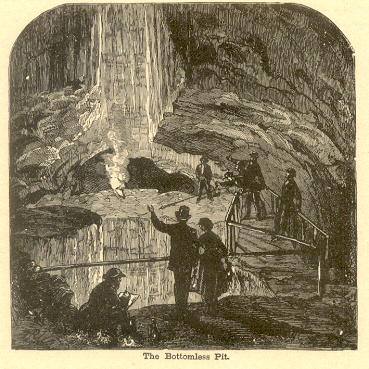
The Bottomless Pit in Mammoth Cave,
woodcut, 1887
 (Nuno Carvalho de Sousa Collection, Lisbon)
From the Lexington area we continued into Cave Country, with beautiful rock ledges and hidden wonders that I obviously couldn't see from the road, but which my imagination knew waited in those caves. I naturally had to look it up when we got home, and I discovered that Mammoth Cave, for instance, was discovered in 1797, our favorite era here at the CQ. Oh, how I would love to tour that cave and imagine myself as one of the earliest Americans, one of the first set of settler eyes to see it!

The land began to flatten out as we drove through Tennessee, and was particularly lovely around the Mississippi. No wonder, then, that civilization sprang up there! It was quite an experience to drive over that massive river and into Arkansas, where the straight, flat countryside was largely fields with trees along the border. 

This mountain-girl started yawning at all the flat, straight lines in Arkansas and Texas (sorry, natives!), but there was definitely something about the sheer vastness that made me able to see the allure. I could just imagine that the first travelers from the east, after navigating those treacherous mountains, finally reaching this and thinking, "Oh my. Just look at all that land!"

It's no wonder that this New World drew so many people. No wonder that they saw how it went on and on and got that itch in the feet that begged them to go explore. And one only has to follow in their footsteps to imagine all the stories that lived, breathed, worked, and yearned through every mile. Hello, inspiration!

~*~

Roseanna M. White grew up in the mountains of West Virginia, the beauty of which inspired her to begin writing as soon as she learned to pair subjects with verbs. She spent her middle and high school days penning novels in class, and her love of books took her to a school renowned for them. After graduating from St. John’s College in Annapolis, Maryland, she and her husband moved back to the Maryland side of the same mountains they equate with home.

Roseanna is the author of two biblical novels, A Stray Drop of Blood and Jewel of Persia, both from WhiteFire Publishing (www.WhiteFire-Publishing.com), Love Finds You in Annapolis, Maryland from Summerside Press, and the upcoming Culper Ring Series from Harvest House, beginning in March 2013 with Ring of Secrets.

She is the senior reviewer at the Christian Review of Books, which she and her husband founded, the senior editor at WhiteFire Publishing, and a member of ACFW, Christian Authors Network, HisWriters, and Colonial American Christian Writers. She is a regular blogger at Go Teen Writers, Colonial Quills, and her personal blog.

Friday, July 6, 2012

Tools of the Trade - YouTube


When you write historicals, it's easy to think that all your research has to be old-fashioned. Books, mostly. Visits to historical areas and recreationist sites. Museums. And all those are wonderful.

But you know what? Books don't give you visuals very often. We can't always go to the places we write about. And time won't always permit a museum trip. But in this lovely computer age, there are still options!

It was while working on one of my biblical novels that I first had the idea to check on YouTube for helpful videos. I found documentaries on Ancient Persia that gave me visuals of the land and palaces that still photos and drawings and descriptions just hadn't been able to convey. And I made a mental note to keep checking back for other projects.

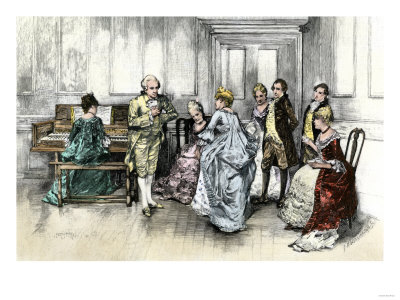
When I needed to know how to describe a minuet for Love Finds You in Annapolis, Maryland, that's where I went. I found a recreationist video of people in costume doing the dance, and I studied it. This allowed me to craft a fun, important conversation around the movements, having them move away and back together at appropriate times. Something I wouldn't have been able to do without watching and studying that dance.

I've used it again more often to take an online tour of some places I'm writing about. Monaco and Yorkshire, Williamsburg and Savannah. You type it in, and you'll find that someone else has gone there and made a video of it then posted it online. And often you can even find documentary-style videos with helpful narration.

Readers may not always wonder where we get our information, but as an author, it's always a new challenge to find this or that bit of research. Sometimes regular web searches or image searches just don't cut it. Sometimes books describe things but leave us scratching our heads when it comes to a specific detail. Sometimes we just wish for an instant transporter or a time machine so we can see what we need!

YouTube isn't exactly that, but it fills the gap rather admirably. And though you may not expect the same website that brings you "Kitty Playing the Piano" to teach you about a setting or action, one ought never discount it. Several times it's provided exactly what I need to allow for that extra authenticity to a scene or book.

~*~

Roseanna M. White grew up in the mountains of West Virginia, the beauty of which inspired her to begin writing as soon as she learned to pair subjects with verbs. She spent her middle and high school days penning novels in class, and her love of books took her to a school renowned for them. After graduating from St. John’s College in Annapolis, Maryland, she and her husband moved back to the Maryland side of the same mountains they equate with home.

Roseanna is the author of two biblical novels, A Stray Drop of Blood and Jewel of Persia, both from WhiteFire Publishing (www.WhiteFire-Publishing.com), Love Finds You in Annapolis, Maryland from Summerside Press, and the upcoming Culper Ring Series from Harvest House, beginning in January 2013 with Ring of Secrets.

She is the senior reviewer at the Christian Review of Books, which she and her husband founded, the senior editor at WhiteFire Publishing, and a member of ACFW, Christian Authors Network, HisWriters, and Colonial American Christian Writers. She is a regular blogger at Go Teen Writers, Colonial Quills, and her personal blog.
Friday, June 1, 2012

Tools of the Trade - The Perfect Moment in Time


by Roseanna M. White

When coming up with an idea for a historical, many of us get our first burst of inspiration from an actual historical event or setting. Something we read about or see on a documentary, something that spurs that "what if . . . ?" idea. Sometimes it's something we see at a museum or historical site, or even on a drive.

When that's how inspiration strikes, it's easy to find that perfect time frame to set a book in--it's already determined by real events and people. Oh, we still have to research--online, in books, firsthand--but the frame is already set up, and we're then just selecting the perfect scene to paint within it.

But sometimes our inspiration comes from a more nebulous idea--a character, for instance, or perhaps someone in a given profession that could have lived during a pretty vast stretch of decades. When that happens, we have to figure out where to put them--and that can be a challenge.

When I've found myself in that situation, I've tried a few different means of determining my precise time period. I've done Google searches for years and found timelines that include the most important events worldwide. I've tried looking up events I knew were somewhere in the general neighborhood and seeing if they could fit in with my idea. I've tried looking up people it would be cool for my historical characters to interact with, or when given things were invented.

But what I've found works best takes me waaaaay back to my middle school education. Remember the definition of "setting"? It's time + place. Pretty interesting that it's not one or the other, right? It's the combination, because as any astrophysicist worth his neutrons can tell you, you can't change one without altering the other.

So assuming I already know where want something to be set--which I usually do--researching that place helps me pinpoint the exact months during which I'll want to set my story. Looking up the City of New York during the Revolution, for example, told me that Ring of Secrets would have to take place between November 1779 and October 1780. Refreshing myself on the history of Annapolis right after the Revolution made it clear that Love Finds You in Annapolis, Maryland would have to span that time between November 1783 and March 1784.

Why? Because that's when things happen where my people are.


Simple, but effective. =) For more detailed discovery, I usually get more specific in my places-search. For instance, I recently read up on the history of the College of William & Mary, which helped me define some plot points for a sequel I'm planning. When I can find such information, I'll look up a specific house or building that plays into the story and note its historical events (fires, repointings, rebuildings, additions, etc.), who owned it when, and what people of import visited it. For instance, by looking specifically at the church my characters would have attended in Annapolis, I discovered that the building had been torn down just before the Revolution and hadn't yet been rebuilt, so the congregation met in the old theater. Something I never would have known by researching the city in general!

You just never know when one of those details will provide exactly what you need to turn a general idea into an in-depth work of fiction. But it's exactly that sort of discovery that makes the job so much fun. =)

**

Roseanna M. White grew up in the mountains of West Virginia, the beauty of which inspired her to begin writing as soon as she learned to pair subjects with verbs. She spent her middle and high school days penning novels in class, and her love of books took her to a school renowned for them. After graduating from St. John’s College in Annapolis, Maryland, she and her husband moved back to the Maryland side of the same mountains they equate with home.

Roseanna is the author of two biblical novels, A Stray Drop of Blood and Jewel of Persia, both from WhiteFire Publishing (www.WhiteFire-Publishing.com), Love Finds You in Annapolis, Maryland from Summerside Press, and the upcoming Culper Ring Series from Harvest House beginning in January 2013 with Ring of Secrets.

She is the senior reviewer at the Christian Review of Books, which she and her husband founded, the senior editor at WhiteFire Publishing, and a member of ACFW, Christian Authors Network, HisWriters, and Colonial American Christian Writers.

Friday, May 4, 2012

Tools of the Trade ~ The Classics

by Roseanna M. White

One of the first lessons students are taught at St. John's College (a.k.a The Great Books School) is that there's nothing like an original text--and that we ought not refer to anything but the texts we've read together when in class. And so begins an education steeped in all things classic--an education that works its way not only into my writing, but into my outlook on how to research.

I've been thinking about this in recent weeks because each review I've gotten lately on Love Finds You in Annapolis, Maryland mentions my use of language and how it feels historical--something I achieved solely through reading texts from my time period. And a fellow St. John's graduate who'd just finished it emailed me the other day to say "I have to say, when you pulled out Pascal, I thought, 'Roseanna is such a Johnnie!'" 'Tis true, 'tis true. =) And in my next book, Ring of Secrets, I draw even more on my classical education thanks to a hero who's a professor at Yale (in 1780) in the subjects of philosophy and chemistry.

What I love about the Colonial, Revolutionary, and early Federalist periods is the rich literary culture. They not only had the ancient texts to draw on, they had more modern philosophers, political theorists, and some oh-so-fun scientific discovery happening under their very noses. 

And yet, I confess, whenever I have a character reaching for a book, I have to stop and think, "What would she be reading?" I often have to do some searches to remind myself of when certain books were published, or which authors were more popular at a given time. And though I often use ones I've read, occasionally my characters' literary taste diverges from my experience. No matter what I write, my characters will always find an occasion to delve into the classics--and since most people don't have a shelf full of the books from St. John's reading list (ahem--I know I wouldn't had I not gone there, LOL!) I figured it would be fun to draw together a small smackerel for anyone interested. =)

Fiction Popular in the 18th Century

Don Quixote by Cervantes - a bit of a parody of the chivalric tales popular way-back-when

Gulliver's Travels by Jonathan Swift - another parody, of course

Iliad by Homer (especially the Alexander Pope translation)

Odyssey by Homer (also the Pope translation)

Gargantua and Pantagruel by Rabelais (not for ladies of delicate sensibilities! Far too much talk of cod-pieces for the gentler sex)

Anything Shakespeare, of course

The Aeneid by Virgil - did you know Caesar Augustus ordered the writing of The Aeneid solely to give the Greek version (Iliad) some competition?

Ovid's Metamorphosis (not to be confused with Kafka's)

The Misanthrope and other works by Moliere

Paradise Lost etc. by Milton

Dante's Divine Comedy - most of us found the Inferno to be far more interesting than Paradisio, LOL

Non-Fiction Popular in the 18th Century

(Since most of these fellows wrote a number of treatises, I'll list authors and subject matter rather than particular titles.)

Pascal - this guy was a certifiable genius whose salvation led him to turn his considerable brain-power to convincing others of the logic and reason behind Christianity. Fun stuff!

Descartes - though best known for his philosophical works (such as the one with the famous "I think, therefore I am") he also wrote scientific works that are, um, less credible when one actually experiments upon the objects he discusses.

Hobbes - a political theorist whose works played a major role in the shaping of America's political system

Adam Smith - an economic theorist who may put you to sleep but who, again, greatly shaped America's early systems

Montesquieu - a political theorist who first devised the separation of powers now taken for granted.

Francis Bacon - political and scientific theorist most remembered for creating the scientific method

Locke - political theorist

Hume - political theorist and skeptic

Spinoza - essays laid the foundation for the Enlightenment; a biblical critic

Rousseau - political theorist

Newton - scientific and mathematical genius

Huygens - scientist who made breakthroughs especially in the behavior of light

Lavoisier - scientist of the 1770-90s who introduced the idea of elements into chemistry which led to the periodic table


There are many more, but for those curious about where the Founding Fathers got their ideas, that'll give you a great starting place!

**

Roseanna M. White grew up in the mountains of West Virginia, the beauty of which inspired her to begin writing as soon as she learned to pair subjects with verbs. She spent her middle and high school days penning novels in class, and her love of books took her to a school renowned for them. After graduating from St. John’s College in Annapolis, Maryland, she and her husband moved back to the Maryland side of the same mountains they equate with home.

Roseanna is the author of two biblical novels, A Stray Drop of Blood and Jewel of Persia, both from WhiteFire Publishing (www.WhiteFire-Publishing.com), Love Finds You in Annapolis, Maryland from Summerside Press, and the upcoming Culper Ring Series from Harvest House beginning in January 2013 with Ring of Secrets.

She is the senior reviewer at the Christian Review of Books, which she and her husband founded, the senior editor at WhiteFire Publishing, and a member of ACFW, Christian Authors Network, HisWriters, and Colonial American Christian Writers.

Friday, April 6, 2012

Newfangled Tech for Olde Fashioned Whatnot

First of all, I hope everyone is in the midst of a Holy Week and Good Friday of reflection and realization ~ may the Lord shed His light upon you! (Now on with the post.)


I confess it: I'm organizationally challenged. This would come as no surprise to anyone who had stepped foot in my humble abode. And if one were to look at my desk, that piece of furniture which ought to be the center of my professional world, one would find books on historic Annapolis shoved on top of books about the Mafia in Chicago, print-outs on 18th century fashion sharing space with forms from the Board of Education for home schooling. My daughter's school books--same shelf as my prayer journals.

My computer is a bit more organized, with folders for my complete manuscripts, my works-in-progress, my ideas. Folders for research, folders with links and files and notes. But still, images always gave me trouble--they don't always paste well into a document, after all, and who wants to fill up their hard drive with them? Yet they're an incredible inspiration while writing, and are often a huge help to the staff at a publishing house when it comes time for cover design--I in fact just got an email from my editor saying she'd passed the link to the cover designers, and they were glad to have all the images to reference.

And so, when friends turned me on to Pinterest, I slowly got an idea of how this newfangled site could help me with my old-fashioned needs. For those who may not know, Pinterest is an online bulletin board, basically. You can download their app to your computer so that whenever you're on a website and see an image you want to bookmark, you push their "pin it" button and post to one of your bulletin boards. Then, voila! Whenever you need to remember that image, there it is, handily linked back to the site from which you found it.

Now allow me to say now that I don't use Pinterest as a social networking site, though some do--to me, it's a way to gather my visual research and make it available to whomever may be interested in viewing it. And I'm certainly not the first Quiller to put it to such use! I invite everyone to check out Laura Frantz's beautiful boards; they have lovely images of books and things featured in her fabulous stories.

So when I find that perfect gown for my heroine to wear . . . I pin it.

When I find that perfect actor to play my hero . . . I pin it.

When I find an image of how invisible ink looks once developed . . . you guessed it--I pin it. =)

For someone who writes almost exclusively in the past, who gets used to thinking in terms of no electricity, slow communication, and having to redip one's pen every few words, it's sometimes strange to think of how to use technology both old and new to bring my stories to life and make my writing easier.

But I'm having fun with it. And whenever I feel lacking of inspiration, I can now hop over to my Pinterest page and see what inspired me to begin with.

Friday, February 3, 2012

Tools of the Trade - The Contraction Chart


I'm an editor. A grammarian. A bonafide word nerd. I do an etymology post on my blog once a week because I'm so intrigued by the history of words. When I prepare to write a book set in a given era, my research includes reading books written within that window, so that I can get a feel for how the people of the time spoke. I update it a bit when necessary to make it accessible to modern readers, but I really try to capture the cadence, the feel of speech. It's important to me.

That's why I chose to write my biblical-set novels without using any contractions. It was a conscious decision I made to reflect the fact that the languages they would have spoken at the time didn't have contractions to help them convey formal vs. informal--that had to be done through word choice and arrangement. It was a challenge I enjoyed . . . but when I moved to Love Finds You in Annapolis, Maryland, set in 1783, I went, "Phew! I get to use contractions again!!"

So I sat down with some writing by Benjamin Franklin. Some Jefferson. A small smattering of other founding fathers. And thought, I can do this. No problem. A little updating here, a little informalizing there, and we'll be good.

You can imagine my gasp when my editor sent her first round of notes that said this: "You use too many contractions for the era. Rework the dialogue."

What?? ME???? Too many contractions? That's just . . . why, that couldn't possibly . . . hmmm. Much as I hated to admit it, she may have a point--I may have gone too far the other direction. Well, my education taught me how to reason through a problem, and how to solve it. This one required some simple research and exploration. A scientific approach. Data.

So I got down to work. With the assistance of Google books, I did advanced searches on books from 1700 to 1790. I searched for every . . . single . . . contraction I had used in my book. I deleted. I edited. I inserted a few new, fun ones (like 'tisn't and shan't and 'twouldn't--I mean, who could pass those up?). And I made myself a chart--I wanted to be able to assure my oh-so-wise editor that the ones I used were perfectly legitimate, and that I had taken care of any that weren't.

My chart has a few columns: In Use, Not in Use, and Sparingly. Pretty self explanatory, I suppose. =) I went through and checked my dialogue (and narrative too) line by line to make sure my language matched up with this--and thus far, I've gotten a lot of comments from other editors on how dead-on the language is, so that pleases me to no end. =)

I do realize this chart makes me a genuine word-nerd. And I'm okay with that--especially if some of you might find it useful, too, if you write Colonial-set stories . . . or just interested, if you're curious as to when our most common contractions came into standard use. I enjoyed doing the work--hopefully you all enjoy the fruits.


Friday, January 6, 2012

Tools of the Trade - The Great Map Search

I love Annapolis. I love the old-world charm, I love the maritime beauty, I love the ancient facades (or as ancient as facades can get in America) of the buildings. I love that when I walk along City Dock during boating season, I can hear conversations in German and French and Italian as well as Spanish and English. I love seeing the Midshipman bustling along in their pristine whites, I love seeing the Johnnies amble along with a book in front of them--yes, the students from my college sometimes read and walk at the same time. I've seen it, LOL.

Annapolis is a city very proud of its colonial heritage, of its importance in the wars that came after, in how it has stood strong even as Baltimore outgrew it. And I love it for that. That's one big reason I decided to pitch a historical set there to Summerside Press.

One problem . . . at the time of Love Finds You in Annapolis, Maryland, it wasn't just a tourist spot for the yachting community. The Naval Academy wasn't there yet. There was no St. John's College. Which made me ask all knew questions. Like . . . what was College Creek called, then? Or, more importantly, College Avenue?

See, College Avenue slices right through the middle of town, a rather important thoroughfare if you're dealing at all with the State House--which I am. In fact, one of my primary characters lives on North Street (which connects to College Ave) and teaches at King William's School, which was (wanna take a guess?) on the other side of College Ave.

I looked everywhere I could think to. I searched through the old book I had on Annapolis. In three more provided by Google Books. I searched for maps from the era. But I couldn't find the answer to that question. I discovered what Main Street used to be called, I discovered that College Creek used to be Deep Creek (and that Spa Creek used to be Acton's). I learned any number of other useful facts about what was what back then--but not as concerns College Ave. Aaaaagggghhhh!

Then I found a promising link in the Maryland State Archives, which are blessedly online. A map--not quite old enough to help, but there were links to other, older maps. I clicked on the oldest one--still 90 years after my book, but the closest I could get online. And it looked good. It looked promising. That street crossing town definitely did not say College Ave. It said . . . crease?


Aaaaaagggghhhhh! Yes, this scanned map had a terrible crease RIGHT THROUGH THE NAME I NEEDED!!!!! All I could make out was "Tab" and "cle." But that was enough to ding the bell of memory (an adage not in use in 1783, by the way, ha ha). Tabernacle! It was Tabernacle Street!!!

So, in a way that my middle school math teachers would fully approve of, now that I had my answer, I worked backward to check my work. I searched for Tabernacle Street in Annapolis, and voila! Documents verifying this was indeed what I needed. (Though heaven forbid they come up in my original searches--noooooooo.)

See how exciting historical research can be? ;-) You just never know how and where you might find what you need.

Friday, December 2, 2011

Research On A Shoestring: Books


Writers aren't made of money. Unfortunately for us. While the Internet--specifically Google Books--has become an invaluable resource, sometimes Google doesn't have the answer you need.

There are many instances where the library won't do either. A book we're after can be used for multiple projects, you can't find it in a library system and don't want to wait x number of weeks for it to arrive via World Cat or inter-library loan.

So what's a writer to do when you need to buy a book, but the price on Amazon is enough to cause a heart attack? I experienced that about eight months ago when I stumbled across The Cotton Planter's Manual by J.A. Turner. I found it for free on Google Books, but I also looked for it on Amazon. All the sellers wanted nearly $30 for it! That's unreal.

But there's another trick I want to share with you. What do you do when Google lets you down and the price on Amazon makes you faint? Panic attacks over price are not outside the realm of possibility for those of us who write in more... obscure time periods and settings.

Used.addall.com is a researcher's other best friend. Many of you have probably never heard of it. I only know about it because I'm a Nancy Drew, Judy Bolton and Hardy Boys collector. In the world of children's series books, Addall is a gold mine. It searches every reputable used book store on the Internet, including some you've never heard of.

There are multiple ways to use Addall. You can search for a specific title, a specific author, or just by keyword. Since Google Books is always my first stop I usually know exactly what book I'm after. The research book I'm reading now, The End of An Era: New Orleans, 1850-1860, is $25 new. My research budget isn't even big enough to be called a shoestring, so that was too much. I hopped over to Addall and found a gently used copy for $5.

One caveat. I recommend you make sure the box for Alibris is NOT checked. Alibris is notorious for over-pricing. Serious book collectors don't do regular business with Alibris sellers.

Next time you're pulling your hair out over your skyrocketing research budget and Google lets you down, Addall is your new best friend.

Friday, November 25, 2011

John Winthrop: Another Unsung Hero


Title: John Winthrop, America’s Forgotten Founding Father
Author: Francis J. Bremer
Publisher: Oxford University Press, 2003

If good intentions could save a person’s soul, then there would be no doubt about John Winthrop’s soul.

John Winthrop was a man of vision. He sought to create a new land, pure from the corruption found in the Church of England, but his desire to do so came while he lived in England. A complex historical character, Mr. Winthrop is quoted by presidents, by scholars, and by laymen to support their ideology—whether or not Mr. Winthrop would have agreed.

In this book, we begin to grasp how the state of England, Christianity within the country, and the passion of life formed Mr. Winthrop’s own ideologies and theology.

I believe social pressures also formed much of Mr. Winthrop’s theology, more so perhaps than the Bible itself. An example of this is his own conclusion: “God Almighty in his most holy and wise providence hath so disposed of the condition of mankind, as in all times some must be rich, some poor; some high and eminent in power and dignity, others mean and in subjection.” (p. 92-93) In life at this time, we see how some held more authority and privileges than others. This would be in contrast to the Apostle Paul’s letter to Philemon where Paul encourages the man to count his runaway slave, Onesimus, as an equal brother.

Even in England, Mr. Winthrop found himself in religious debate. In his home country the foundation was laid for some of the problems he would face in New England. Problems with such people as Anne Hutchinson, who would oppose the “covenant of works” she felt many of the Puritans held to.

But Mr. Winthrop did not seem so different than Mrs. Hutchinson, except perhaps in fervency to please God by his actions. He prayed that God “would give me a new heart, joy in his spirit; that he would dwell with me, that he would strengthen me against the world, the flesh, and the Devil, [and] that he would forgive my sins and increase my faith.” (p. 96) From my perspective, that sounds very consistent with Romans 10:9-10, 13:
That if thou shalt confess with thy mouth the Lord Jesus, and shalt believe in thine heart that God hath raised him from the dead, thou shalt be saved. For with the heart man believeth unto righteousness; and with the mouth confession is made unto salvation….For whosoever shall call upon the name of the Lord shall be saved.
Also with II Corinthians 5:17:

Therefore if any man be in Christ, he is a new creature: old things are passed away; behold, all things are become new.
Thus he began his role as a Godly magistrate, a man bent on having a right fellowship with God. A few years later he was asked to join the Massachusetts Bay Company. This seemed agreeable to him since he had interest in carrying the gospel and the culture of England to different countries. In preparation for the trip across the Atlantic to New England, men gathered in the Church of the Holy Rood and sermons were given. An assumption is that John Winthrop’s famous A Modell of Christian Charity was given at this time, which contained the phrase “City upon a Hill.”

Today many see the Puritans as almost evil in their desire to establish a place wherein Christian values and morality would be upheld. Yet, for anyone who might grieve over the wicked state of our current world, one might find such an attitude refreshing. God, however, wants people to seek Him of their own free will. To be forced to follow Him via commands and human traditions was never the plan.
“Stand fast therefore in the liberty wherewith Christ hath made us free, and be not entangled again with the yoke of bondage.” Galatians 5:1
Perhaps we judge the Puritans so harshly because we do not understand their passion to remove themselves from evil. Yes, there were extremists. Isn’t there in every movement, whether political or religious or social? But for those who love God, who seek to please Him, and who long to one day go to their heavenly home, we can have empathy for their desire for good and not evil to reign. Perhaps we cannot agree with their methods, but we should be able to agree with their desire for purity and holiness and their longing for their heavenly home.

John Winthrop served as a governor for the Massachusetts Bay Colony through some tumultuous times. He saw God’s hand at work, despite man’s failings and imperfections.

When he neared death, Rev. John Cotton called for prayers for him saying about Governor Winthrop, “a governor who has been unto us a brother, not usurping authority over the church, often speaking his advice…often contradicted, even by young men and some of low degree, yet not replying, but offering satisfaction also when any supposed offenses have arisen…been unto us as a mother, parent-like distributing his goods to brethren and neighbors at his first coming, and gently bearing our infirmities without taking notice of them.” (p. 377).

John Winthrop died shortly after, on March 26, 1649. His legacy lives on, however, through our American values, and by those (like President Ronald Regan) who see John Winthrop's words worth repeating.

Friday, November 18, 2011

Research On A Shoestring: Fashion


We writers are a cheap lot. Many of us don't have a big budget for our research books. And let's face it, not everything we need or want or think we need can be found on the Web. In four years of managing the gift shop at Kent Plantation House in Alexandria, Louisiana, I gleaned some great, cheap fashion resources.

For the writer on a tight budget, Dover Publications is one of your very best friends. There's a ton of cheap, great resources there for nearly any time period and subject you can think of. But this post is dedicated to fashion, so I'm going to share a few tips for building your fashion research library without breaking the bank.

Tom Tierney. He is a costume historian, and an artist. Among other things, he does paper dolls for Dover. As of this writing when you type his name into the search box at Dover's website it comes back with 160 results. He's done everything from classic movie stars to American presidents and the musical Mikado.

But I want to specifically point your attention to his American Family series. He's done a variety of periods, including American Family of the Colonial Era and American Family of the Federal Era. If you read this blog, these two are must haves for your library.

What makes these paper dolls truly stand out is multiple generations of the family are represented. There are grandparents, parents, older teens and grade school age. The dolls are in period correct undergarments and each page of costumes includes a detailed description. Best of all they're $6.95. Coloring books are usually $3.95.

There are dozens of other gems hidden at Dover. Fashion plates from Godey's Lady's Book turned into paper dolls. Coloring books for anything you can imagine, paper dolls of Queen Victoria and Empress Eugenie, Emperor Franz Joseph, Byzantine era, French Baroque, American Family in the Pilgrim Era, Marie Antoinette, ancient Egypt, Shakespeare, Henry VIII and his wives, Carmen Miranda and Vivian Leigh. And I've barely scratched the surface here! You can even get reprints of Sears catalogs. I have one of fashion from the 1920's.

Dover is a great resource no matter what you're researching. And if you're a homeschooling mom, the coloring books are an excellent learning tool. My mom has at least fifty Dover coloring books that we used as part of school. And just looking through the search right now to write this post, I see at least three coloring books that I "need" for my own research purposes. (and so I can color in them)

Friday, November 11, 2011

THE DAYS OF WOODEN SHIPS AND IRON MEN

“There was a time before our time,
It will not come again,
When the best ships were the wooden ships
But the men were iron men.”

Clipper Ships and Captains
By
Rosemary and Stephen Vincent Benet

Veteran’s Day should be a day when all Americans take time to reflect on and be thankful for the service of so many men and women throughout our 236 years as a nation. I am appreciative not only for those who have served our great country over all these years but particularly for two sons and a son-in-law who are currently serving in the military.

Midshipman Henry G. Taylor
Ours was a Navy family; but it also included men who served in almost all branches of the armed forces. My oldest son graduated from the Naval Academy in 2001, and like his father, grandfather and great-grandfather before him is a naval officer. As a girl I remember my grandfather, a retired Navy Admiral, referring to the good old days of “iron men and wooden ships. His stories of attending the Naval Academy 1903-1907, and sailing with The Great White Fleet fascinated me. I loved exploring the Academy in Annapolis, MD and reading about its history as well as the origins of the U.S. Navy.

Prior the Revolution, there were colonists who served in the British naval campaigns against Spain and France. By 1775 Americans were growing disenchanted with British rule and realized that any conflict with Britain would mean that the Atlantic Ocean would very likely become a theater of war. On October 13, 1775 the Continental Congress authorized two armed vessels to sail and search for munitions ships that were supplying the British Army in America.

It was not Congress’ intent to contest Britain’s control of the seas, only to wage attacks on their merchant shipping with the goal of cutting off their supplies to support their war efforts. The Continental Congress built up its fledgling navy by new construction, purchases and conversion of existing ships to twenty warships during the course of the war. Most of them were later destroyed by the British or by Americans to prevent their capture.

Peale’s portrait
John Paul Jones
It would be Scottish born John Paul Jones, a seafaring man with a history of serving on British ships and some run-ins with the law, a sympathizer with the colonial cause who would provide America with some crucial victories. He was commissioned as a lieutenant in the Continental Navy in December of 1775 and given the command of The Alfred. Over the next six years he had command of several ships and experienced numerous victories. It was while serving at the helm of the Bonhomme Richard in 1779, he captured the HMS Serapis. As his ship sunk beneath him he notably uttered “I have not yet begun to fight!”

After accepting a position in the Russian navy in 1788, he ran afoul of Empress Catherine’s military leaders and returned to Paris. In 1790 he was offered a military commission by George Washington, but his health had already begun to fail. In 1792, President George Washington and Thomas Jefferson signed a commission making John Paul Jones an official citizen of the United States and appointing him American consul to Algeria to clean up the piracy problems along the Barbary Coast. A month later at the age of forty-five the self proclaimed “citizen of the world” died and was buried in a leaden coffin in a cemetery for foreign Protestants in Paris where he would remain for 114 years.

In 1899 American Ambassador to France General Horace Porter began an intensive search through Paris for John Paul Jones grave, finally locating it after nearly six years. President Theodore Roosevelt charged Congress with appropriating the funds needed to exhume the American hero. The arduous task of retrieving the body and the subsequent autopsy validated his identity, made easier because the body had been preserved in brandy.

Annapolis was eventually chosen as John Paul Jones’ final resting place. In 1906 Jones was finally given the military honors he so often sought during his lifetime, first with an elaborate procession through Paris, by train to Cherbourg, then by transatlantic crossing with a fleet of eleven military vessels, and finally with a grand ceremony at Annapolis.

Painted scene of the Great
White Fleet from Silk Banner
The 1906 celebration of the “Father of the American Navy” was part of a larger public relations move on the part of President Roosevelt to promote US Naval sea power. In 1907, the same year my grandfather graduated from the Naval Academy, the President sent The Great White Fleet on a fourteen month circumnavigation of the world. Ensign Taylor was one of the 14,000 naval and marine personnel on twenty-eight ships that embarked from Hampton Roads to see the world.


John Paul Jones’ Crypt at the
U.S. Naval Academy
Photo courtesy of Travelbeat.net
The US Naval Academy Chapel, “The Cathedral of the Navy” was completed in 1912. John Paul Jones was laid to rest below the chapel in a dimly lit crypt watched over by an honor guard, where the ornate marble sarcophagus is supported by four bronze dolphins. Many inlays in the floor and glass cases along the walls display artifacts and facts of his remarkable life. This is a stop you don’t want to miss while touring the Academy yard.


Friday, November 4, 2011

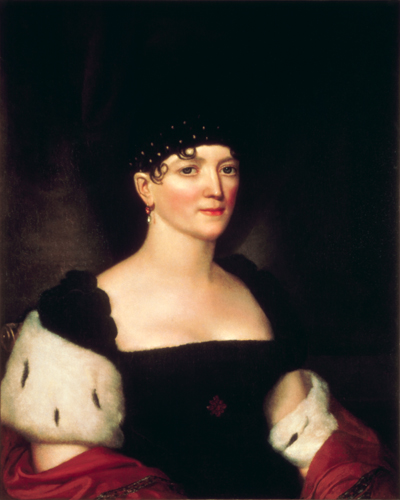
Tools of the Trade: Portraits ~ First Ladies


As a historical fiction author, the lives of those who came before us are especially meaningful. The lives of the first ladies of the 18th and early 19th centuries are intriguing, their strength to hold their families and marriages tightly bonded through adverse times is a legacy each woman should ponder.

In my novel, Beside Two Rivers, to be released in the fall of 2012, there are five female cousins to my heroine, Darcy Morgan. Darcy's name alone is irrevocably early American. Her cousins are all named after first ladies. Martha, Abigail, Dolly, Lizzy, and Louisa. Martha is the oldest, the most controlled of the five. Abigail is more outspoken. Dolly is young and demure. Lizzy shy but interested in gaining suitors. Louisa is reserved and not yet old enough to find affairs of the heart her pursuit. Darcy, on the other hand, possesses all of these qualities.

When planning a novel, I have a file of photos and paintings that reflect how I imagine my characters. This gives me a wonderful inner visual. Alongside the pictures I have the names of the characters and a few sentences about their personalities.

Here are the finest portraits of the first ladies. They were all born during the Colonial Era and lived through the Revolution. Art has and will always be a source of research for writing historical fiction. These paintings inspire as well as educate a writer on clothing, hair style, and if you look closely demeanor.

Martha Washington


Abigail Adams


Dolly Madison


Elizabeth Monroe


Louisa Adams

Friday, October 7, 2011

Tools of the Trade: Newspaper Clips - Duty, Honor, and Liberty


Baron von Steuben

Writing historical fiction takes a love for history. As an author, I find the lives of people from the past fascinating. Perhaps because they lived so differently than today.

I found the wording from this clip from 101 years ago in my local newspaper interesting.

101 years ago - A congregational meeting was held at the Evangelical Lutheran church last night. The resignation of the pastor, Rev. Dr. Charles F. Steck, to

take effect January 31, 1910, was read and accepted. “Our beloved pastor, Rev. Charles F. Steck, D. D., having received a call to labor in another portion of the Master’s vineyard, and having announced his desire to accept that call and tendered his resignation as pastor of this congregation, to take effect on the last on January, 1910.”

I am always curious as to the history of such people. When I read these clips, I often wonder about their lives. So, I did a bit of research on Rev. Steck and this is what I found. Apparently he went on to labor at the Evangelical Lutheran Church of the Epithany in Washington, DC and was the minister that gave in invocation to the unveiling of the statue in memorial of Baron von Steuben who served Washington during the Revolution.

There is a congressional book about the unveiling that is interesting. Here is what is printed within its yellowed pages.

BRONZE STATUE OF WASHINGTON'S GREAT DRILLMASTER UNVEILED IN LAFAYETTE PARK


German societies take part in big parade — Chorus of 1,000 voices is heard in patriotic songs — Miss Helen Taft draws cord — Addresses by the President, the German Ambassador, and Representative Bartholdt, of Missouri.

Delegations from New York in weather perhaps as bleak as that which enfolded the cheerless camp of the great commander in chief at Valley Forge, when barefoot Colonials tracked their course in blood over the pitiless snow, the United States of America, 133 years later, this afternoon, at the Capital of the Nation, unveiled the statue of Frederick William Augustus Henry Ferdinand, Baron von Steuben, the adjutant general of the armies of Frederick the Great, the friend of Washington, and the great inspector of the Colonial Army that wrested its independence from the British Crown.

Surrounding the tribute of bronze were thousands of Von Steuben's countrymen, proud of heart and exultant at the honor conferred upon their great representative, who, in his time, conferred honor upon their adopted country and gave to it all the force of his military wisdom and skill in its fight for liberty. Not the barefoot and disorganized stragglers of the patriotic Army of long ago, but officers and troops of an Army and Navy second to none in Christendom, were gathered with them, while on all sides Americans to the manner born joined with all in the tribute to the memory of the great man who yet lives in the proudest annals of their native land. After a ringing chorus by nearly a thousand voices of the Northeastern Singers' Association and the invocation by Rev. Dr. Charles F. Steck

By: Rita Gerlach
Homepage: http://ritagerlach.blogspot.com/
Blog: InSpire: http://inspire-writer.blogspot.com/
The Daughters of the Potomac Series coming to bookstores in 2012.

Friday, September 30, 2011

Tools of the Trade: On Site Research - Visiting Valley Forge


By: Laura Frantz

This past July I had the privilege of going on tour with The Providence Forum and experiencing historic Philadelphia. Since Valley Forge isn't far, we spent a day there, too. Growing up, my vision of Valley Forge was limited to this image of George Washington praying in the snow. Legend says that a Quaker was walking in the woods and found Washington on his knees. Since Quakers hold to truthfulness as one of their tenets, I tend to believe this did happen. George Washington was a Christian, not a deist, and America's winning of the Revolutionary War was no small miracle.


Washington and his troops stayed at Valley Forge during a very brutal winter. I was here on a scorching summer's day so it was hard to imagine the cold and suffering that took place in 1777-78. This is the actual place he walked, talked, and made critical decisions that affected the course of the war. But he refused to move into this sturdy house until all his men finished building the huts that housed them first. They numbered in the thousands.

Washington's bedchamber at Valley Forge.

Martha spent the winter here also, encouraging her husband and the aides and officers surrounding him, several of whom had their wives in residence. How they all fit into this small house is a mystery but it's said they wiled the winter away together trying to make merry and even danced!

Headquarters where Washington and his aides worked daily excepting
the Sabbath.  This is the room at the back of the house on the first floor.

A desk, quill, ink and other necessities of that busy winter.

The kitchen is reached through a breezeway and isn't connected to
the main house. Notice the little oven within the hearth itself,
sometimes called a beehive, for baking bread.

The officers' quarters upstairs. Everything is displayed as if the
officers had just stepped out of the room. So lifelike!

Officer's quarters, same bedchamber, another view.
Love the Revolutionary War uniforms!

 Officers' quarters, second bedchamber at the top of the stairs.

The front room downstairs, yet another place for
conducting the business of war.

Valley Forge, though a very famous historic spot, offers a lingering lesson for today. I found it so moving to hear that this was the very place Washington thought about giving up the fight and surrendering to the British. Several close friends, including a beloved pastor, advised the general to abandon a hopeless effort to win American freedom. Though no war was waged between soldiers at Valley Forge, a fierce inward struggle transpired here. It became a battle of doubt, discouragement, and near defeat. Washington trimuphed in the end but we'll never know what he suffered during his time here. I think about it often now when I'm tempted to give up or give in to something that's troubling me.


Can you name a historic spot that is moving to you or holds a lasting lesson for us today?