Announcements

10 Year Anniverary & New Releases Winners: Carrie Fancett Pagels' Butterfly Cottage - Melanie B, Dogwood Plantation - Patty H R, Janet Grunst's winner is Connie S., Denise Weimer's Winner is Kay M., Naomi Musch's winner is Chappy Debbie, Angela Couch - Kathleen Maher, Pegg Thomas Beverly D. M. & Gracie Y., Christy Distler - Kailey B., Shannon McNear - Marilyn R.
Showing posts with label Puritans. Show all posts

Friday, December 28, 2018

Christmas Banned in Massachetts

We hear a lot of talk these days about the war on Christmas. About businesses and government offices that won't allow any decorations, the playing of Christmas carols, or even wishing "Merry Christmas" to people who enter. It's a bit disconcerting for those of us who grew up in the traditions of a festive Christmas season. But it's not new.
A Puritan governor disrupting Christmas celebrations.
In 1659 the Puritans passed a law against anyone celebrating Christmas in Massachusetts. A law banning Christmas! They put muscle behind their law with a five-shilling fine to anyone caught celebrating.

To understand their desire to ban Christmas, we need to understand a bit about the Puritans. They were, as their name suggests, purists about their Christianity. There is nothing in the Bible about celebrating the nativity. They were correct about that. The Bible also never tells us the season, much less the date, on which Jesus was born. They were correct about that as well. The date chosen by the Catholic Church to celebrate Christmas was - in fact - the same date that the pagan Romans used to celebrate Saturnalia. They were correct about that, too.

But it was more the way Christmas was celebrated that infuriated the Puritans of Massachusetts. “Men dishonor Christ more in the 12 days of Christmas than in all the 12 months besides,” wrote 16th-century clergyman Hugh Latimer.

To say there was nothing holy about their methods is an understatement. Drunken feasting, vandalism, and even violence were not unknown at the time. The celebration was more of a frat house party than a solemn occasion. Feasting, drinking, gambling, and other unsavory pastimes were the norm.

The prohibition on Christmas lasted until 1681 when King Charles II threatened to revoke the Puritan's charter if they didn't relax their intolerant laws, which included the ban on Christmas. Yet for years after this - well into the 1800s - schools and businesses stayed open on Christmas in Massachusetts. It wasn't until 1856 that the state recognized Christmas as a public holiday.


Wednesday, November 23, 2016

A Thanksgiving Prayer

In 2012, I posted this prayer from Valley of Vision, a collection of Puritan prayers. So while the words are some you may have seen before, I wanted to revisit them and dwell on them in this tumultuous year.


Monday, June 6, 2016

What's in a name?


As a writer of Colonial fiction, one of funnest things to do is choose names for characters. More and more I see the huge influence the Puritans had on what became common names in the American colonies. They also had a lot of names that didn't rise in popularity as some of the Bible names did, but still hold a lot of meaning...and sometimes a chuckle (like 'Search-the-Scriptures', 'Joy-in-sorrow' or 'Sorry-for-Sin')

Here are a few of my favorites:

For girls: (Besides the usual Bible names)
Berenice 
Charis
Charity
Chastity
Comfort
Constance 
Chloe
Clemence
Damaris
Drusilla
Eunice 
Faith 
Felicity
Fidelity 
Honor
Hope
Jemima
Mercy
Modesty
Patience
Prudence
Tacita
Temperance 
Thankful
Unity

(Really, any virtue you can think of...including Virtue!)

For boys: (Besides the usual Bible names)
Abner
Abiel
Ariel
Ajax
Amzi
Ansel
Constant (You could name twins Constance and Constant...but that would get confusing!)
Cyrus
Ebenezer
Experience
Garvan
Gawen
Fortune
Gershom
Increase 
Lovell
Prospero
Reason
Tenacious
Theophil
Truth
Winthrop


I had a lot of fun in The Scarlet Coat, the first book in my Hearts at War series, as the hero remembers nothing about who he is at the beginning... not even his name. Rachel Garnet, weary of having nothing to call him, hopes that if he hears his name he might recognise it.


     “How about Thomas?” she asked.
     He shook his head.
     “James, Andrew, Simon, John?”
     “Are you listing common British names or the Apostles of Christ?” He smiled at her.
     “Well, you do seem to be Christian, and they are quite common names here. I’m not British—at least, not anymore—so you tell me which names are popular in England.”
     “No, let us continue with this.” He flipped through the pages of the Bible. “You are correct. I am Christian. I do not remember it, exactly, I simply...I know it. My belief in Christ seems to run deeper than memories or thoughts. It is the core of who I am, as though I would cease to exist without that sense of faith in the Lord. For ‘who shall separate us from the love of Christ? Shall tribulation or distress or...’” He looked to her with a sheepish smile. Pulling himself up a little more, he redirected his attention back to the Bible. “Shall we continue? What are some of the other names?”
     The sizzle of batter meeting a hot skillet was followed by a mouthwatering aroma.
     His stomach pinched and churned. Had it been most of a day since he had eaten last? The pain in his thigh had been distracting enough until now.
     “Do you want them from the Old Testament? There’s Adam, Jacob...Ezekiel, or, perhaps,” she flashed him a grin, “Nebuchadnezzar?”
     “Nebuchadnezzar? Do you really think that fits?” He shook his head. “Perhaps we should start with the New Testament. I am sure you agree I look more like a Herod or Pilate?”
     “I wasn’t planning to say anything, but I think you’re right.” She shot him a disapproving glare. “We’re wasting time. Let’s be serious."
     “I thought we were.”


Thanks for joining me today! Let me know in the comments what your favorite Colonial names are.


A Woman Compelled by Christian Charity
Surrounded by the musket fire of the American Revolution, Rachel Garnet prays for her family to be safe.  When the British invade the Mohawk Valley, and her father and brother don't return from the battle, she goes in pursuit of them. She finds her brother alive but her father has been killed at the hand of the enemy. Amidst the death, how can she ignore a cry for help...? Rachel reluctantly takes in a badly wounded British officer. But how long can her sense of Christian duty repress her hatred for his scarlet coat?

A Man Lost to the Devastation of War
Passages of Scripture and fleeting images of society are all Andrew Wyndham recalls after he awakens to the log walls of his gentle prison. Even his name eludes him. Rachel Garnet insists he is a captain in the British army. He mourns the loss of his memory, but how can he hope to remember war when his “enemy” is capturing his heart?

A Scarlet Uniform Holds the Power to Unite or Divide

Andrew’s injuries are severe, his memory slow to return, and the secret of his existence too perilous to ignore. As Rachel nurses him back to health, his hidden scarlet coat threatens to expose the deeds of her merciful heart, and Andrew is forced to face a harrowing decision—Stay hidden and risk losing the woman he loves or turn himself in and risk losing his life.

Now available for preorder on Amazon!


Angela K Couch is an award-winning author for her short stories, and a semi-finalist in ACFW’s 2015 Genesis Contest for her Revolutionary War novel that will be published by Pelican Book Group. As a passionate believer in Christ, her faith permeates the stories she tells. Her martial arts training, experience with horses, and appreciation for good romance sneak in there, as well. Angela lives in Alberta, Canada with her “hero” and three munchkins. www.angelakcouch.com

Friday, August 28, 2015

Early American Music

Music came to this country with the Pilgrims. They sang from the Book of Psalms by Henry Ainsworth, 1612 edition. One of the hymns they sang was Old One Hundred, but it wasn't the Doxology we know today. 

Shout to Jehovah, all the earth.
Serve ye Jehovah with gladness;
before Him come with singing-merth.
Know, that Jehovah, He God is.
(Try it to the tune of the Doxology - it works!)

The Pilgrims also brought instruments with them. As did the Puritans. While the Puritans didn't allow instruments to be used in their church services, they placed great importance on singing. Cotton Mather wrote in his Direction for a Candidate of the Ministry "for I would not have a day pass without singing." He also did not discourage instruments in general, only in the church services. Instrumental music outside of the church was allowed and ... dare I speculate ... enjoyed!

The Puritans set about to make their music better. The third publication of any kind printed in the colonies was the Bay Psalm Book in 1640. This book included the lyrics only, no music. In 1698 they put out Ninth Addition of the Bay Psalm Book and included music for two voices. In between the first and ninth printings, many revisions were made to make the music better and easier to sing. The Puritans very much cared about their music.

So the next time you read a story about our dour and grim colonial ancestors who never cracked a smile or sang a tune ... you'll know better.


Wednesday, October 22, 2014

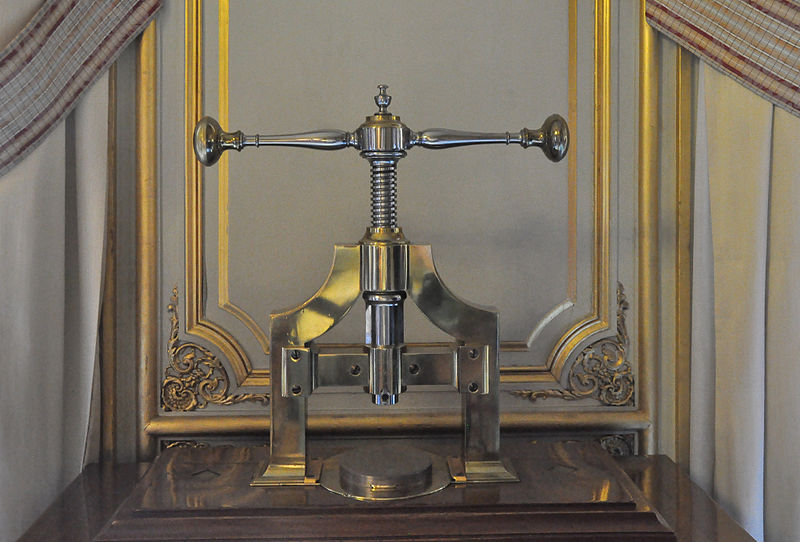
The Screw that Saved America


The year was 1620. The crowd of passengers crammed into the small vessel numbered 101. Among them were adventurers, seekers of fortune...and a group of Separatists who wanted a fresh start in a new land where they could worship as they saw fit. 

We've all heard the story of the Mayflower. But I confess that for many years it was just a tale trotted out at the end of November, and I had always been far more interested in making paper-bag Indian vests and coloring my cornucopia than in some of the finer details of the Pilgrims' journey. Of course, that was before I became a history nerd, so it's only to be expected that now, as I'm reading those old stories to my kids in our homeschool curriculum, they're the ones coloring happily away while I pause in my reading to go, "Wow, I never knew that! Just think of it..."

Just think of it. This collection of Separatists who called themselves Pilgrims were starting an entirely new life in a new, unfamiliar world. They had to bring with them anything they might need for the first year

Food.
Seeds for planting.
Cloth.
Books.
A printing press.
A fishing boat, to set up a trade.
Candles.
Lamps and oil.
Blankets.
Furniture.

The Pilgrims saw God in every aspect of their lives, every event that took place. They trusted Him to deliver them to their new home in His way. But I imagine as the storms rocked the small Mayflower, as they had to batten the hatches and huddle together in a space the size of a volleyball court yet again, a few of them probably wondered if they'd made the right choice.
Mayflower in Plymouth Harbor by William Halsall, 1882

But this storm was worse than the ones that had come before. This storm howled and raged. The Mayflower was tossed through the waves. Boards groaned. Wind ripped. Small children whimpered and hid their faces in their mothers' skirts.

Hushed assurances turned to panic when the Mayflower rolled to her side. They would go down, surely. The lanterns swung. The hull moaned. Then boom!

A sailor rushed belowdeck. "Watch out, everyone!" he called to the frightened mass of people. "The crossbeam that supports the main mass has cracked! It could give way at any moment!"

Everyone hurried to help. All the men tried to hold that crucial timber into place. But this was beyond what mere arms could do. Brewster and Bradford, leaders of the Pilgrims, looked to the wide-eyed captain.

"We must pray," Bradford said.

They did. And the idea came instantly to Brewster. "The printing press! We must find it!"

Now, as an author, I'm all for words saving the day. But in this case, it wasn't what the press could produce that saved the Mayflower, the Pilgrims, and hence America as we know it. It was the press itself.

The people scrambled to the hold where they'd stored all their furniture and larger items, and soon enough a shout came out that they had found the press. Brewster hurried to it and took off the enormous screw that was the press, the thing that applied pressure to put ink on page. This giant screw was then hauled into place on the cracked beam.

"Slowly," Brewster cautioned. "Carefully."

And it worked. The screw pushed the beam back into place--and held it there. The Mayflower survived the storm, and at that point she was closer to the New World than the old. They pressed onward. Forward.

To a land that would soon become home to so many.

I'm not sure when Brewster could reclaim his screw press, but you can be sure he did--the Pilgrims put high stock in education and the written word. A mere 16 years later, they founded Harvard College. And helped forge a nation that would never forget them.

~*~


Roseana M. White pens her novels beneath her Betsy Ross flag, with her Jane Austen action figure watching over her. When not writing fiction, she’s homeschooling her two small children, editing and designing, and pretending her house will clean itself. Roseanna is the author of 9 historical novels and novellas, ranging from biblical fiction to American-set romances to her new British series. Spies and war and mayhem always seem to make their way into her novels…to offset her real life, which is blessedly boring. You can learn more about her and her stories at www.RoseannaMWhite.com.

Wednesday, August 21, 2013

Sarah Returns


Dear friends, thank you for your gracious return. Do please accept my apologies for cutting our time short last month. I fear my emotions overwhelmed me. My dear Nathaniel—he’s my husband, for you new friends—encouraged me to try again. He says I have much to offer, for he tells me that in the last days many will undergo what my family had and much worse. The strength I found, he tells me, may help those who suffer the same.
            Please bear with me as I take my time and try to also share the joy. For what are memories if you cannot find joy in them?
            I was quite young when we left Wales for the land claimed by the Massachusetts Bay Colony. I remember little of the place except once passing beneath the window of our town’s mayor. Some men from the king visited him, seeking the names of the families leaving for America. The mayor was a tall man with a fierce face and a pointed beard. His very presence frightened me. I cannot remember why I should have ventured beneath his window, but I did.
            “…condemned wretches, poor gentleman, libertines, those fitter to spoil Wales and England than to help raise the commonwealth…” he had sputtered.
            At first I did not understand, but when my father’s name was mentioned, I scurried away confused that he should be listed with such men. My father, the youngest son of a lawyer, had become a vicar. However, he had discovered the truth of salvation by grace alone. ‘Twas then he had attached himself to those of the dissenting Puritans. Rather unusual in Wales, ‘tis true. He soon lost his vicarage and ‘twas shortly after this that he attached himself to Dr. John Clarke. When Dr. Clarke decided to cross the Atlantic with other Puritans, my father and my mother determined they should follow. Baptists were still feeling the sting of their brother, Edward Wightman, who died at the hands of the monarch in 1611 for stating, “That the baptizing of infants is an abominable custom; that the Lord’s Supper and baptism are not to be celebrated as they are now practiced in the church of England, and that Christianity is not wholly professed and preached in the Church of England, but only in part.”[i]
            If my memory serves me correctly, Dr. Clarke was a member of a Baptist church in Bedfordshire, England. Yes, a great distance from Wales, but not when one finds brethren of like-faith. Though Dr. Clarke associated with other Pedobaptists, he stood on the side of freedom of conscience. He was a gracious man, and like so many who came to New England, he sought the freedom to worship God according to his conscience.
            ‘Twas the banishment of Rev. Whellwright and Mrs. Ann Hutchinson that led to the separation between Dr. Clarke and my father. Dr. Clark chose to help the Hutchinsons, while my father chose to step aside and let justice take its course. Perhaps, when the leaders of the colony of Massachusetts claimed their country to be infested with no less then eighty-two heretical opinions, my father decided to speak out his beliefs.
            On First Days (I believe you call them Sundays), Father began to raise questions regarding the rules by which the Puritans expected all to live. One such First Day a traveler passed through our village. No one would open his door to the man at sunset. Our First Day began at sunset on what is Saturday, but my father welcomed him. A great lover of music, my father entertained this stranger until the constable banged upon our door and threatened to arrest him. Father questioned the law, but at that time did not press the situation and excused the customs of our village to the stranger, who graciously accepted the invitation to retire early without further noise.
            Soon Father’s acts of rebellion became noised about by gossips and those who felt it their duty to correct his poor behavior. If he spoke in town, he would be countered by another who claimed offense to his words.
            I too began to notice the children refusing to play with me, the girls drifting away or turning their backs, and any act of kindness my sweet mother attempted to perform was met with sour faces.
            One day, I asked my mother how she kept her cheery disposition. Her answer, “We are buried with him by baptism into death: that like as Christ was dead by the glory of the Father, even so we also should walk in newness of life.”[ii] She sighed at the confused look upon my face and continued. “If I have died with Christ, what offense can one bring me? My life is not here but with Christ Who resides in Heaven. They can do me no harm with their words or actions, because I do not live in this world, though my body be present here. I live with Christ in Heaven. ‘But God, who is rich in mercy, for his great love wherewith he loved us, even when we were dead in sins, hath quickened us together with Christ, (by grace ye are saved;) and hath raised us up together, and made us sit together in heavenly places in Christ Jesus.’”[iii]
            While I understood her words, I did not fully grasp her meaning until the day I stood before those who sought to have me whipped.
            Alas, I see our time is running out. Forgive me dear friends, for leaving you again, but you see Nathaniel returns today from Virginia and I promised to stand at the shore in Newport to meet him.
            Godspeed, one and all.
______________________________________________________
Sarah speaks the truth when she said the mayors and others sought to reassure the king that the populating of America would not weaken the Commonwealth by stating only those of little value were going.
England was in the midst of much change, a reformation and the beginnings of discontent that would lead to a civil war. I believe to understand those who came to America in the 1600’s you must also understand England at that time. The colonists brought with them the values and attitudes of their home country.


[i] Hammet, Doug. The History of Baptists, Challenge Press, Emmaus, PA 2004, p. 200.
[ii] Romans 6:4
[iii] Ephesians 2:4-7

Wednesday, June 19, 2013

Nathaniel Griffith's Perspective of the "City upon a Hill"

Trouble brewed in the Massachusetts Bay Colony in 1649. But before I give you the next of my memoirs, please take this seat beside me overlooking my wife's garden. I, Nathaniel Griffith, would not have the pleasure of this great garden view (which overlooks the Narragansett Bay) had it not been for the grace of God.

Let me first be charitable to my father and those Puritans who first came to this land. Their intentions were good, desiring to establish a model community in and around the Boston area. Zealous for pure living among all church members (especially of the clergy) and for the church of England to be completely pure of Catholic influence, John Winthrop led a group of men to America. His was a tumultuous life--though I suppose any leader experiences such--but he served his people well and with the best of intentions.

I was a young man when John Winthrop died in 1649. My father insisted I should learn these words from this great man:

"...we shall be as a City upon a Hill. The eyes of all people are upon us."

And indeed, the world did watch to see if these Puritans would succeed. Those who crossed the Atlantic with John Winthrop believed they entered into a covenant with God.

Yea, I am shaking my head. Woe unto us who dare to think we have power to influence God by our right living, for righteous we are not. Nay, they learned through strife that one cannot be the conscience of another and not easily fall into sin oneself. Perhaps not the sin of the man they judge, but a sin even greater in believing they could act in God's stead.

After much labor one day, I rested against the stone fence my father insisted I build. You see, we had two horses which loved to wander. We kept them near on a picket line. What is that you asked? 'Tis a rope we strung about chest level between trees. We tied our horses to this line. We also used a high line, which is simply a picket line hung above the horses' heads. The high lines allowed the horses to graze and not get tangled in their lead. But I digress.

Behind my fence, three men walked. They spoke of those burned at the stake in England for beliefs contrary to the clergy, and then they spoke of those dissenters infecting the churches here in New England. Roger Williams was banished in 1635, Anne Hutchinson was banished, taking with her a number of other colonists to settle Portsmouth, Rhode Island. John Wheelwright was also banished then founded the town of Exeter, New Hampshire. And the list continues. Trouble brewed in England as well and the English Civil Wars began, leading to the beheading of King Charles I.

As I listened, I quaked with fear for Sarah Brown, the woman I loved. Her father had stood with Roger Williams against some of the teachings of the Puritans. Her father also stood in support of Anne Hutchinson and considered leaving with her when she was banished. Instead he stayed, his quiet manner seeming to appease those who opposed the teachings of salvation by grace alone and clung to the necessity of infant baptism. But he soon died and left Sarah. My father then took her in as a maid for my sister. A charitable act driven by a sense of guilt, for he was not without fault for the death of Goodman Brown.

These men that passed my fence determined to purify the Massachusetts Bay Colony of any and all who did not hold to their tenements. As the year progressed, they would seek out any who held a meeting outside of the church and arrest them. Indeed, in the years following some believe those who were tried for witchcraft were not witches, but those who claimed the Holy Spirit communicated with their spirit. And perhaps the most shaking of revelation to these staunch Puritans was the dissension of Henry Dunster in 1653. And one mustn't forget the hanging of Mary Dyer, a Quaker, in 1660, Boston.

I knew I needed to do something to keep Sarah from having the same fate of Anne Hutchinson and others who spoke freely of beliefs contrary to that of the religious leaders of the time. I thought perhaps if I could marry her, I could protect her, but my father would never let me marry beneath my station. Nor did I believe Sarah would have me, a wretched sinner.

Alas, the sun is setting. Perhaps Sarah will share with you next month. And thank you for listening to me ramble on about those days. I fear I lacked great courage and faith, but God would work despite me.
______________________________________________

Here is the timeline of the events Nathaniel mentions:

1630 John Winthrop writes the sermon "A Model of Christian Charity," which includes the section known as "The City upon a Hill." Winthrop then sails to New England

1631 Roger Williams arrives in Massachusetts

1635 William and Anne Hutchinson follow John Cotton to the New World

1635 Roger Williams is banished

1636 Harvard College is established

1637 Rev. John Wheelwright preaches a controversial sermon

1637 Anne Hutchinson and her followers are tried and banished

1638 John Wheelwright is banished

1642 English Civil Wars begin

1649 King Charles I is executed

1649 John Winthrop dies

1651 John Clarke, Obadiah Holmes, and John Crandall arrested for conducting an illegal worship service

1653/54 Henry Dunster, first president of Harvard College, abandons the Puritan view of infant baptism

1654/55 Henry Dunster exiles himself

1659 William Robinson and Maramaduke Stevenson were hung in Boston for returning to the Massachusetts Bay Colony after banishment (they were Quakers)

1660 Mary Dyer is hung in Boston

1660 Parliament asks Charles II to assume the throne thus restoring the monarchy in England.

1661 Executions of Quakers halted by Charles II

This is a very small list of acts the men, whom Nathaniel overheard, had seen and would see in the years to come. It is a quick overview of the struggle those early colonists went through, growing pains of the freedom we now enjoy. Many look at this list and become angry with Christians, but I don't think that is an accurate reaction. Without the Bible to guide our forefathers in an understanding of what true freedom of conscience is, we would never have seen the constitution we have today. I believe the colonists needed to go through these struggles before they could gain an understanding of what America was to become. Without experiencing the trials some of these men endured, they would not have known the importance of their own discovery of true freedom. These men did not look at their current situation, but at the future in which their children would live. They fought for a better place and a better life for those who would live after them.

In my opinion, I think we need to tread carefully before we pass judgment on those in this era. These people were mere men seeking to accomplish something greater than themselves, not realizing they couldn't do it without God's grace.