Announcements

10 Year Anniverary & New Releases Winners: Carrie Fancett Pagels' Butterfly Cottage - Melanie B, Dogwood Plantation - Patty H R, Janet Grunst's winner is Connie S., Denise Weimer's Winner is Kay M., Naomi Musch's winner is Chappy Debbie, Angela Couch - Kathleen Maher, Pegg Thomas Beverly D. M. & Gracie Y., Christy Distler - Kailey B., Shannon McNear - Marilyn R.
Showing posts with label colonial period. Show all posts

Friday, March 5, 2021

American Colonial History and the Rest of the World in 1620

I've always enjoyed looking back at one aspect or period of history and reminding myself of all the other things happening at that same time. You know...taking a look at the bigger picture going on around the world. 

Take for instance the year 1620, the date which generally marks the beginning of the American colonial period. In that year 102 pilgrims embarked from Plymouth, England on the Mayflower along with 30 crew bound for the new world. Later that same year those pilgrims signed the Mayflower Compact and established Plymouth Colony. We tend to look at most of the world's happenings back then through the lens of what the pilgrims were doing. That's the way we learned it as kids.

Plymouth Rock

When I was a child trying to grasp history, I had the unfounded notion that the pilgrims were the only Europeans in North America at the time. The "New World" was really new! I relegated the Spaniards to explorations in Central America far, far way (another thing I had wrong). The rest of the world ceased turning in light of the colony being established in Massachusetts. 

But in fact, by the time the Pilgrims landed, there had already been a lot of exploration going on just to the north (in Canada), across the Great Lakes, and down the Mississippi to the Gulf. The French had been working at establishing themselves on the North American continent for many years before the pilgrims arrived. In 1620, whilst our intrepid pilgrims were setting sail away from Europe, Henri II, Duc de Montmorency was named Viceroy of New France. With Samuel de Champlain as his lieutenant, he began construction of Fort Saint Louis on the cliffs of Quebec. He then formed a company that was granted an 11-year fur trade monopoly in the New World.

If you remember my earlier posts, you'll recall that fur was the cornerstone on which the entire North American economy was built, so France definitely had the first foothold.

Meanwhile, King James I got it in his mind to commission William Alexander to reclaim New France and Acadia, and the coureur des bois (the free fur traders) founded the trading post called Palace Royal in present-day Montreal. 

All while the Pilgrims were just trying to survive their first year on North American shores.

I mention all this because of of how very important it is to understand our developing nation as a whole. While the arrival of the pilgrims was a huge event that we look to when we consider the colonial period, North America was already being shaped by others, some indigenous, and others as explorers, businessmen, priests, soldiers, and adventurers.   
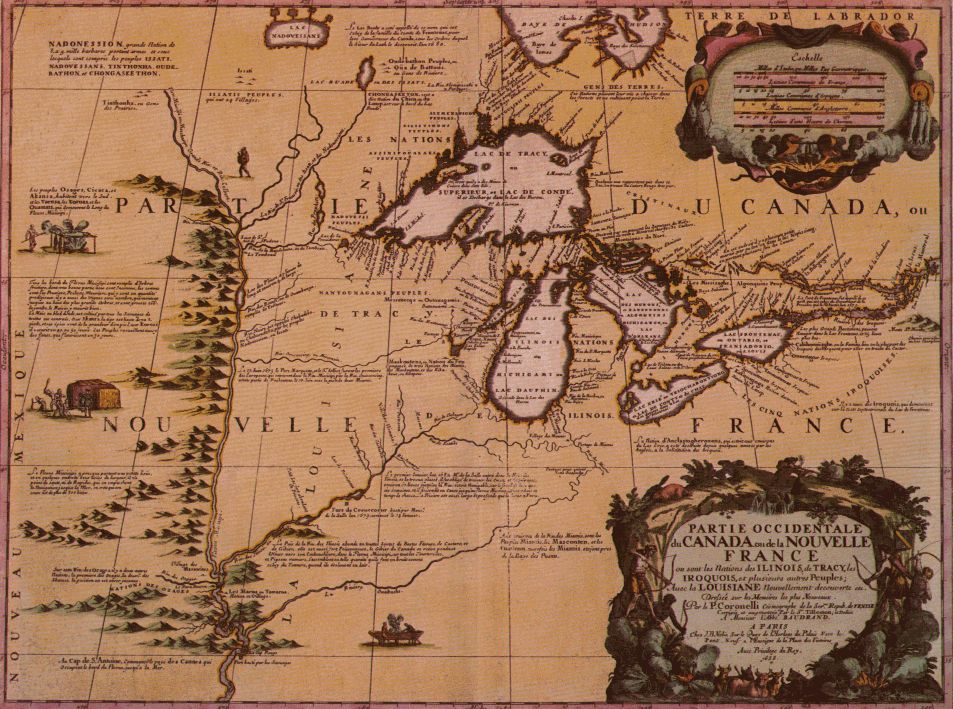

Just for fun and further insight, here are a handful of other important events that took place around the world in 1620:
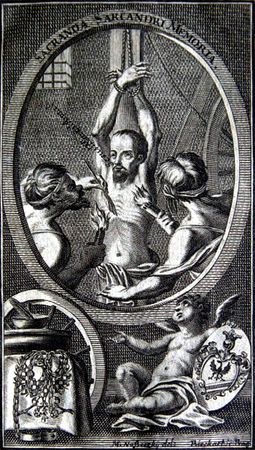
A 1715 etching depicting the torture of John Sarkander

*St. John Sarkander, a Polish-Moravian priest, died of injuries sustained by prolonged torture. It's a long story, connected by ongoing conflicts between Catholics and Protestants in Europe's Thirty Years War, which had begun only two years earlier.*The first merry-go-round was seen at a fair in Turkey.

*The mother of Johannes Kepler, German astronomer, mathematician, and astrologer, was arrested for witchcraft.

*Witch hunts also begin in Scotland.

*The modern violin was developed.

*An navigable undersea boat (type of submarine) was  demonstrated in the Thames River, England.

*A sign alphabet was developed by Juan Pablo Bonet, a teacher of deaf children in Spain.

~~~~~

Are there periods of history or specific historical events that you enjoy studying within the larger context of what was taking place in the world at that time?

Naomi Musch

https://naomimusch.com/


Monday, September 9, 2013

Dyeing and Blocking- The history behind Printed Fabrics by Debra E. Marvin


In the 18th Century, among the many fascinating items Europeans began to ‘need’ from the far east were printed fabrics. “Fast Printed” meant the colors were not supposed to run, not the speed of creation. By 1700 English, French, and Dutch craftsmen had figured out how to fix their dyes and create prints with the use of elaborate carved woodblocks, but they were slow to catch imports for their desirability.  
Of course, the labor was backbreaking – cold, dark workrooms with boiling vats of dye. Bleak, monotonous work for very long days. Sadly, few samples of the earliest of prints survive. Cotton took dye best and natural fabrics deteriorate unless kept under the best of situations.
The Madder Plant. Roots were the source of red dye

Most dying centered around two major colors – red and blue and were created by the use of MADDER for red and INDIGO for blue.

THE PROCESS:
It’s incredible to see the intricate details carved on old woodblocks.  Dots worked into the patterns (or not) helped the worker line up the block from spot to spot. A block was colored (think of stamping –rolled on, or pressed onto the dye) and pressed against fabric, then imprinted with a tap from a mallet. The process continued, block by block down the yards and yards of fabric. Consider that in a yard and a half , the process on 45” material would have been done 91 times alone with a 4”  sq. block.  (note-45” wide material is the norm now, not then!)

If you are like me, you love TOILE. Here’s an excellent representation of detail but done in one color.


Imagine the work that went into this fabric!

Amazing printed fabric from 1775-1800
http://www.marquise.de/database/dbout.php?name=hindelopen1.jpg&lang=.

Block printing was not perfect and that’s the charm of it. A discerning seamstress might well pass on fabric that was not lined up properly, or had the occasional smear, but someone would use it.  It’s not surprising that prints were not found on the clothes of servants and the working class in the 18th Century!

CREATING THE WOOD  PATTERN BLOCKS was a time-consuming enterprise, starting with a thick block of wood made from sycamore / planetree or pear wood (primarily  in England). They had to be of quality to resist warping when wet, and were backed with two or three other layers of wood, often pine. Grains ran in opposite directions in each layer to further prevent warping.

The block was sanded completely flat and smooth before accepting the sketched on design which was transferred on.  The design started on paper, as it had to be copied over to other blocks if the design had multiple colors. For each color the area of the design was left and the balance carved away. I understand the process from making printing blocks out of a linoleum type material, but the skill involved to make a multi-colored block amazes me.

At times, small details had to be made in metal and added to the block, as small cuts tend to wear away or chip off. The use of copper added a very intense amount of work in such cases.

The process to print continues with the choice of a good cloth, fast dyes, and steady hands. And patience!

For a multi-color print, the entire bolt of fabric had to be hand printed in one color and allowed to dry. A second, third or fourth color could be added with different blocks for the same pattern and additional stamping and drying time. In some cases, if a color was only used in a small part, it was hand painted on.

For many years in England, import of printed fabric was illegal. People loved it but it took away from the domestic fabric industry—until British craftsmen could compete with Indian craftsmen!  Textiles from India led the market for a long time. India muslin and calico remained in high demand even after British mills were rolling out cotton fabric.

Here are few more ways to create printed cloth:
Mordant Dyeing (chemical fixatives stamped to the cloth which was then put into a pot of dye)
Resist Dyeing (placing a resist material, like a wax, on the fabric where dye was not to attach)
Hand Painting!

Flower designs were popular, and still are. Fabric printing by mid 18th century was done to mimic embroidery.  Later, bolder patterns of twisting stems and lines came along but so did small designs which were much easier and cheaper to produce! Now the working class could wear  simple prints.

The term Calico represents printed cotton and may have originated in America as the general term for cotton prints coming from the port of Calicut, India. Chintz, another popular cotton print (generally with a more polished cotton thread and therefore a shinier fabric) is believed to have come from the Hindi word Chint which meant variegated.

I won’t take for granted the classic look of printed cotton when I consider its not so humble beginnings.
For anyone creating period clothing, it is important to look at what materials were used at the time.

Wednesday, August 7, 2013

Rural Colonial Houses by Cynthia Howerter


When one thinks of houses built during the Colonial Period, the fine buildings at Colonial Williamsburg or Thomas Jefferson’s exquisite house at Monticello are some that usually come to mind. However, not everyone in colonial America lived in such beautiful dwellings. With no access to bricks or saw mills, colonists in rural areas turned to logs.
 Foxfire Museum

In the frontier areas, most early log cabins needed to be quickly assembled to provide shelter. These cabins tended to be small one-room dwellings that were usually one- or one-and-a-half stories high.


 Foxfire Museum
Due to the heaviness of logs, two or three men were required to assemble a cabin. Large straight trees were selected, felled, trimmed of branches, and dragged to the building site. There, logs were notched and laid on a stone foundation if possible. Logs laid directly on the ground risked rotting. Note the two small openings on the side of the dwelling pictured above. This cabin was built in an area so remote that glass for windows was not available. The bottom "window" was cut out of the mud chinking while the upper window was cut out of a log.

 Foxfire Museum
Fireplaces and chimneys were usually built of stone, although wattle and daub, a composition of small pieces of wood and mud, was sometimes used to build a chimney until stone could replace it.

Blue Ridge Parkway, Southern Virginia

After the logs were laid horizontally, there could be gaps, especially if the logs weren't cut straight.


Foxfire Museum

This photo shows small stones and mud used to fill the gap between logs. The filler between logs is referred to as "chink." Every fall, the cabin owner would make repairs in the chink so heat wouldn't escape through holes during the winter.

 Foxfire Museum
Chinking helped keep the cabin snug from weather and free from insects and small animals. During Indian attacks, chink prevented arrows from entering inside the cabin. The reddish-colored chinking in the above photo reflects the red clay found in this area of northeast Georgia.  

 Foxfire Museum
Doors were handmade. Although sturdy, they lacked the design and color of those usually found in established towns.

 Oconaluftee Village, Cherokee Indian Reservation, North Carolina
While many cabin roofs were covered with wood shakes, such as the one above, sod roofs proved less ignitable and flammable when hit with flaming arrows during Indian attacks.    

Most of the cabins featured in this article are located at the Foxfire Museum in Mountain City, Georgia, which has a collection of original log houses and structures from the late-colonial period. These buildings were disassembled at their original location, then shipped to Foxfire’s property where they were rebuilt. One cabin photo was taken in southern Virginia on the Blue Ridge Parkway. The final photograph was taken at the Oconaluftee Village on the Cherokee Indian Reservation in North Carolina.


All photographs ©2013 Cynthia Howerter


Award-winning author Cynthia Howerter loves using her training in education, research, writing, and speaking to teach and inspire others about a time in America that was anything but boring. A member of the Daughters of the American revolution (DAR), Cynthia believes history should be alive and personal.

Visit Cynthia's website: Cynthia Howerter - all things historical