Announcements

10 Year Anniverary & New Releases Winners: Carrie Fancett Pagels' Butterfly Cottage - Melanie B, Dogwood Plantation - Patty H R, Janet Grunst's winner is Connie S., Denise Weimer's Winner is Kay M., Naomi Musch's winner is Chappy Debbie, Angela Couch - Kathleen Maher, Pegg Thomas Beverly D. M. & Gracie Y., Christy Distler - Kailey B., Shannon McNear - Marilyn R.
Showing posts with label The Green Veil. Show all posts

Friday, December 4, 2020

How the Beaver Wars Aided European Conquest of North America (PLUS a Free Novel Download)

Last month, I began a series about the historic fur trade on the American continent, introducing it as the trade that shaped the colonies. To our modern way of thinking, it may seem strange that trapping was such a powerful force on the developing continent, but for many decades, the rush for fur drove the North American economy and pushed nations that had colonized along the ocean shore ever deeper into the interior.

The fur trade began among the indigenous people of America themselves. Native American tribes had been trading among themselves for untold numbers of generations, and often the currency was furs. Meanwhile, the Europeans source for fur was often Russia or Scandinavia. After Europeans began expanding their interests here on this continent, it wasn't long before war broke out between Indian nations seeking to establish alliances that would help them monopolize their own powers of trade. These wars that went on intermittently throughout the 17th century, but principally from 1650-1655, became known as the Beaver Wars.

The Beaver Wars are a study in themselves. It was a period of time when the powerful Iroquois confederation sought to expand territory and control the fur trade. They established a pact among themselves that they called "the Great Peace"; however, against their enemies, the Iroquois--led by the powerful Mohawk--carried on their own form of genocide. They either brutally killed their enemies or else took them captive, absorbing them into their tribes. The Iroquois were supplied with firearms by their allies, the Dutch (and later on, the English). 


Meanwhile, the Iroquois' Algonquin enemies--remnants from tribes like the Neutrals, Tobacco (Tionontati) Erie, Susquehannock, and others who were allied with the French--had no guns, only missionaries who lived among them, attempting to convert them to Catholicism. To flee massacre, they were pushed further inland, seeking refuge along the shores of the western Great Lakes. Even there, however, the Iroquois nations sought their destruction. The Mohawks, in particular, were known for the ferocity of their raids. (The Dutch used the Mohawks as weapons of terror against the French and Hurons, while at the same time keeping a wary, untrusting eye on these so-called allies.) There is more that can be said about the Mohawks. They were the last tribe to negotiate peace, as they held out the longest in trying to hold the reins of the fur trade with the Dutch. But the Mohawk's power grab ultimately led to fractures in the Iroquois confederacy. (This after further wars and manipulations.)

While the Mohawks achieved a monopoly on trade with the Dutch, they were unable to gain control of any of the trade with the French in Montreal. The French had turned their attentions further west toward the Ojibwa nations. These included the Chippewas, Missisaugas, Ottawas, and Potawatomis. These people, along with the Miami, gave the French access to lands still rich with furs, so much so that the French government was highly motivated to support them in their confrontations against the campaigns of the Iroquois. 

With French support of the Ojibwe and Miami, the Iroquois went on to suffer heavy defeats in present-day Michigan and Wisconsin. Meanwhile, English warships sailed up the Hudson to claim New Netherland in 1664. The Dutch surrendered New Netherland along with Fort Amsterdam and the town of New Amsterdam on the island of Manhattan. With their political collapse on the continent, the Mohawks lost their special powers of alliance. This further weakened the Iroquois league, though it didn't break it completely. Nevertheless, as a consequence, both England and French conquest in North America was strengthened.

At the end of the Beaver Wars, the internal struggles between Indigenous nations to secure the power of trade only weakened them and served the ends of the Europeans rather than they themselves. 

~~~~~~~~~~

Have you been attending this 3-day party, happening now? If not, come join me and a host of authors (40 in total!) for a Christmas Extravaganza, December 3rd, 4th, 5th.

AND Saturday through Monday, December 5th-7th, you can download my historical novel The Green Veil FREE!


I wish you a Merry Christmas, and pray God's peace and blessings upon you in 2021!

Naomi

https://naomimusch.com/


Friday, August 7, 2020

Old Tools of Lumbering and Homesteading from By-Gone Years

Recently two paper mills owned by the Versa Paper Company were shut down in Wisconsin and Minnesota. One was in my hometown in central Wisconsin. It was a fixture there for decades before I was born (under different names) and the primary employer in the city. The other was in Duluth, not far from where I've lived most of my adult life. Hundreds of people lost their jobs.

TWILIGHT OF VERSA PAPER MILL, WISCONSIN RAPIDS

It's hard for me to imagine such a decades-old industry just closing it's doors. Paper mills have been a part of our nation's economic infrastructure since its inception. In fact, logging's roots in America stretch back to the early 1600s. Begun by the driving need of lumber for shipbuilding, the role of logging expanded with the industrial revolution. The first American paper mill was built in Germantown, Pennsylvania in 1690--although at that time paper was mostly produced from rags and other materials, hence the popularity of stories with the word Ragpicker in the title. That's also the reason my mom, a retired school teacher, used to warn her students against chewing on paper (a bizarre childhood habit of some): "because it might have been someone's dirty underwear." Thanks for that imagery, Mom. I've never forgotten. 😬 

By the mid-1800s the process of making paper from pulp wood was established. (Whew! Go ahead and chew your notebook, if you're so inclined.)

Soon settlers moved westward, and the broad ax became a staple tool of every man, both for carving his farm out of the forests and for cutting the logs he'd use to build his home.

Nowadays, logging is still a hundreds-of-billions of dollars-per-year business, so it sends shock waves through a community when a huge mill closes its doors. Everything has its time and its purpose though. Hopefully some entrepreneur will open the mills again.

All that brings me to a continued look from last month's post about old tools. Today I have some pictures to share of a few old logging tools here on our farm. This first one we bought at an auction when we were first married. Living here in the north woods, in the very land of Lumberjacks and Tall Tales, this tool has, no doubt, seen its share of use. At our house, its merely meant for hanging on the wall for decoration.

BROAD AX
This thing is weighty! It takes a lot of muscle to wield it. This will soon be hanging on the wall behind our wood stove.
PICKAROON

This is an interesting type of pick. Rather than have an ax opposite the pick head like a pickax, it's back end is flat. A pickaroon is used for easier handling of cut logs known as rounds. My husband has been using this to chip away at this giant cedar stump. Every now and then, our grandsons come along and give it a few whacks too. If the stump is ever gone, this little pickaroon is going on the wall with the broad ax.

TWO-MAN CROSSCUT SAW

You might not recognize this man-about-the-farm (my hubby Jeff), but you'll likely recognize the fact he's holding a two-man crosscut saw. Can you imagine the work it took to cut down those big trees back in the day? This item will soon be on our living room wall. (That's a honey-do job, Jeffrey.) The mystery item next to it in the grass is shown closeup below.

MATTOCK (head)

This was a real find! Jeff found this out in woods, beneath a layer of soil, where he happened to be getting firewood. Who knows how many years this mattock head lay buried there? A mattock is pick on one side and adze on the other. It's used for digging, prying, and chopping. A great tool, not only for loggers, but for homesteaders clearing a bit of ground. I'm happily accepting ideas for a cool way to display this piece or re-purpose it. It's heavy!

Like many paper mills these days, these tools are largely retired. You can still purchase modern versions of some that come without the reminisce factor. A couple of other old logging tools I'd like to get a hold of are a cant hook and a peavey. I could've sworn we had a cant hook somewhere, but apparently I imagined that. With slight variations, both are tools that consist of a handle with a swing hook and are used for gripping, moving, and separating logs. In my novel The Green Veil, the hero, Manason Kade, and his crew use these tools for their work, though when it comes to giving some no-good tree-thieves their comeuppance, they depend mostly on their brawn.   


I didn't set out originally to collect logging tools, but it became an interest as I wrote set within the parameters of my state history. Have you ever begun any collections in an unusual way?

Enjoy your summer!
Naomi


Sunday, July 5, 2020

Old Barn, Old Tools ~ Farming in By-Gone Days

Sometimes looking into the more recent past gives a better glimpse of by-gone days. Join me on a brief tour of my family's old barn and a few old-time tools that were shaped from the past.


Barns were often built into hillsides so that the upper story could be at ground level, and equipment could be pulled right up to the doors and unloaded directly into the hayloft. Animals were housed in the cooler basement of the barn.


And now the tools...


In the video, I mistakenly referred to the piece at the end--our paper towel holder--as used in haying, but what I should have said was that it was for hauling ice blocks. Not really sure what I was thinking there.


I'm off to work on my bird feeder / bird bath project. Thanks for joining me on this brief tour.

For the summer months, I'm offering two of my series starters for 99¢ each. Both are full-length historical romances. The Green Veil is the first in the Empire in Pine series, set in 1800s Wisconsin, and The Deepest Sigh is book one in the Echoes of the Heart WWI and post war, early '20s series. I hope you'll give one or both a try during these languid, summer days!


Naomi Musch


Friday, May 1, 2020

The “Great Fires” of American History—and the Deadliest of All: Peshtigo

Springtime is notoriously one of the worst times of year for wildfires. Here in places like the one where I live, the snow is gone, but the greening up hasn’t begun in earnest. The ground is covered with dried leaves and brittle pine needles. Branches and other wooded detritus make for tinder that needs only a spark to ignite. Here in Wisconsin, in fact, the Department of Natural Resources has suspended burning permits for the foreseeable future. The concern is that, since more wildfires begin in the spring, eliminating ignition sources on the landscape will reduce the wildfire risk which can lead to more person-to-person contact and possible higher vulnerability to certain populations during the Covid-19 pandemic.

Viruses aside, this got me wondering about the so-called “Great Fires” that raged across the land and our nation’s early history.

There is a lot of study and speculation about whether or not and why those native to the continent may (or may not) have used burning to clear the forests. We do know for sure, however, that when the first European settlers came to this continent, it didn’t take long for fire to begin taking its toll on the colonies.

In January 1608, a devastating fire destroyed most of the colonist's provisions and lodgings. Captain James Smith made a concise assessment of the situation:

"I begin to think that it is safer for me to dwell in the wild Indian country than in this stockade, where fools accidentally discharge their muskets and others burn down their homes at night."

In 1736, Benjamin Franklin—who had a lot of first-hand knowledge of volunteer fire-fighting by this point—founded the Union Fire Company in Philadelphia, which became the standard for volunteer fire company organization in many other places. And firefighting was needed all throughout the colonies.

November 18, 1740, Charleston, South Carolina suffered a horrendous conflagration fueled by turpentine, tar, and rum that moved quickly, swallowing up wharves, commercial buildings, and houses in its path. The wasn’t Charleston’s first licking by fire. Founded in 1689, “Charles Towne” experienced its first blaze in 1698 and lost one-third of its settlement’s buildings. The city went on to suffer other fire catastrophes in 1778, 1788, 1796, 1799, 1810, 1819, and 1826.

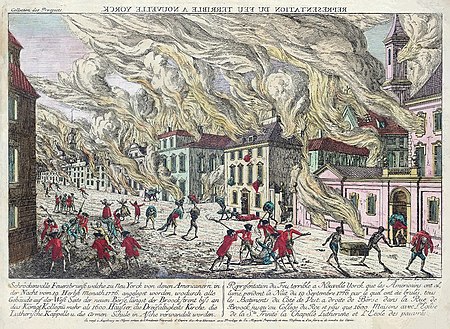
Elsewhere, meanwhile, the night of September 20th, 1776, fire burned New York’s West Side at the southern end of Manhattan Island. This was during British occupation of the island during the Revolutionary War, and there was much debate and blame cast over whether the fire was started by the British or the revolutionaries. 10-25 percent of the buildings in the city were destroyed and other parts were plundered in the chaos.

Artist's Depiction of the Great Fire of New York (1776), Wikipedia Commons

In spring of 1788, fire swept through New Orleans, destroying 856 of its 1100 structures. If that first “Great Fire” wasn’t bad enough, only six years later, another fire roared through the area now known as the French Quarter destroying 212 more structures, including the jail, in what became known as the Great Fire of 1794. The schooner Nuestra Señora del Cármen, anchored off-shore, was rented as a jail for several months following.

The 1800s saw fire’s devastation in many American cities and across its vast countryside. New York, Philadelphia, St. Louis, San Francisco—and who could forget Chicago—saw the massive affects of fire on populations crowded together in wooden structures. In all of these fires, there was some loss of life, making the stories even more tragic.

But of all the fires of our history, none was so destructive and deadly as 
The Great Peshtigo Fire. 

Peshtigo—called the worst wildfire in history—happened when? 
In 1871, on the night of October 8th. 

But isn’t that the night of the Great Chicago Fire, you ask? 
Why, yes, it is. 

But I’ve not heard of this fire, you say. 
That is highly probable, because Chicago was a much bigger city, and resources had been directed from Wisconsin to Chicago to help. 

Meanwhile, tiny little Peshtigo, in the northeast corner of the state near Lake Michigan, not only saw 1.2 million acres go up in flame, but the entire town was turned to ash, and more than 1152 people were killed, compared to Chicago’s loss of life of some 300. Many estimates say that the Peshtigo death toll was likely closer to 2500, and some say 3000. It was difficult to account for the many lumberjacks, railroad men, farm family immigrants, and others who populated the north woods and were itinerant.

"Making for the River", Artist's Depiction of The Great Peshtigo Fire, Wikipedia Commons

Horrifically, the Peshtigo Fire claimed more lives than any other forest fire in US history, before or since. Many of those people lie together in a mass grave. Many others’ bodies dissolved to ash and were never recovered, such was the total annihilation across the landscape.

https://www.amazon.com/gp/product/B087QRZ1CV/


I have always wanted to tell Peshtigo’s tragic story through the eyes of characters in a work of fiction. Using the recorded stories of several actual survivors and other historians, I’ve tried to be true to their accounts, while also sharing a love story. My novel THE RED FURY re-released this week. I hope you’ll visit my website, or check out the book on Amazon to learn more about it.

The characters in The Red Fury are some of my favorite I’ve ever written. When lumberman’s daughter Lainey Kade, and brothers—Civil War veterans—Zane and Kelly Beaumont, stepped into my writer’s heart, I felt as if they were actually there in Peshtigo, in the past.

The Red Fury can be read alone, but it would be better to read The Green Veil first.


Take care now, and God bless,
Naomi
www.naomimusch.com
Amazon author page

Monday, March 30, 2020

Colonial Quills Nine Year Anniversary! And Celebration of New Releases!


Welcome to our 9 Year Anniversary Party! We're celebrating at Jamestown, Virginia. Come on in and have some tea and treats!

Gabrielle Meyer:

I am honored to be here today celebrating the ninth anniversary of the Colonial Quills Blog! Congrats to all the wonderful contributors and readers. This is such a fun place to gather and share in all sorts of book love.

Today, I'm sharing my newest release Virginia Company Bride in The Heart's Stronghold Collection. This beautiful book released this month with Barbour Publishers (aren't the new covers amazing?!). My story is joined by phenomenal stories from Amanda Barratt, Angie Dicken, and Kimberley Woodhouse.

Here's a little about Virginia Company Bride: In September 1608, Anne Burras is the only woman in Jamestown when her mistress dies upon arrival. Laborer John Layton is one of only thirty-eight colonists who survived the first year in the colony. Both want Anne on the supply ship returning to England in three months, but neither foresee the difficulties they will face just to stay alive—or the painful sacrifices they will make to stay together.

I had the privileged of visiting Jamestown last year to do research for this story. What a treat to see the oldest English settlement in America! This story is especially dear to me because I have several ancestors who were a part of the early colonization of Jamestown. My earliest ancestor, William Powell, arrived in 1609 and was instrumental in removing an Indian chief who had tried to kill John Smith the year before. William was put in charge of the Jamestown defenses for his services and became the lieutenant governor in 1617.


Jamestown is a unique place to visit, because they have a reconstructed fort, as well as the original site where they are currently doing archaeological research. The first picture at the top of this post is taken at the reconstructed fort and the one above is of me at the original site. I'm standing where the chapel stood. This was important to me because John Layton, the hero of my story, was a carpenter in Jamestown and he's credited with building the second chapel for the fort.

In honor of the blog anniversary and the release of The Heart's Stronghold, I will be offering two copies, one here and one on the Facebook party. The winners will have the choice between a signed copy or an ebook.

Gabrielle Meyer lives in central Minnesota on the banks of the upper Mississippi River with her husband and four children. As an employee of the Minnesota Historical Society, she fell in love with the rich history of her state and enjoys writing fictional stories inspired by real people, places, and events. You can learn more about Gabrielle and her books at www.gabriellemeyer.com.

Shannon McNear:

Greetings and salutations! I hope all is well with our gentle readers in these uncertain times.

NINE YEARS! I can hardly believe it! I'm blessed and honored to have been a part of this wonderful blog for six of those nine years. But with no further ado, it's with joy (and given the subject matter, not a little trepidation!) that I present The Blue Cloak, #5 of Barbour's ambitious True Colors historical suspense series. It's set in the fledgling states of Tennessee and Kentucky, 1797-99, and centers around the account of the terrible Harpes, considered our country's first recorded serial killers.

The story: Daughter and sister of trading post owners, Rachel Taylor watches her best friend Sally's marriage turn to horror before the entire family disappears. Virginia native Benjamin Langford seeks the whereabouts of his missing cousin and uncovers a reign of terror all up and down the Wilderness Road. In their shared grief, the pair join the effort to bring the Harpes' murder spree to an end and rescue Sally from a criminal's life.

To celebrate the March 1 release of The Blue Cloak, I'm offering two signed copies of the book, one here on the blog and one at the Facebook party! If you'd like to be entered, please mention BLUE CLOAK in your comment below. Thank you so much!

Transplanted to North Dakota after more than two decades in the Deep South, Shannon McNear loves losing herself in local history. As the author of four novellas and three full-length novels, with her first novella, Defending Truth in A Pioneer Christmas Collection, a 2014 RITA® finalist, her greatest joy is in being a military wife, mom of eight, mother-in-law of three, and grammie of three. When not cooking, researching, or leaking story from her fingertips, she enjoys being outdoors, basking in the beauty of the northern prairies.

Connect with her at shannonmcnear.com and on various social media.

Naomi Musch:

Hello, Colonial Quills friends! There couldn't be a better time for an online party, could there? Thanks for celebrating with us. 

I'm thrilled to reintroduce THE GREEN VEIL, a book that's been out of print for some time and has just been newly re-released. It's the first in a three-book saga that spans the lives of three generations of women, their hopes, loves, and adventures in the new rough-and-rugged state of Wisconsin.

Here’s The Green Veil:

1841 ~ Lumberman's daughter, Colette Palmer has always loved timber cruiser Manason Kade, though she's too young for him to consider seriously. Leaving Michigan with her family to settle in the Wisconsin wilderness, and separated from him by miles and years, she grows into a woman. When her heart is broken, she makes her vow to another.

Manason longs to plant roots of his own in Wisconsin Territory, although an alluring female tempts him to do otherwise. Given the opportunity, he strikes out and forms the new Kade Forest Works. When his fresh crew challenges the illegal log harvesting of a rival company, however, it is Colette's husband who will stop at nothing to ruin him.

Logging enterprises collide as the territory nears statehood, and dangerous schemes threaten those Colette holds dear. Then Manason and Colette finally meet again, and when they do, the battle between lumber kings reaches new heights. Now she will have to choose between her first love and her commitment to her marriage vows, while her dreams, her faith, and an empire in pine hang in the balance.

To celebrate the Colonial Quill 9-year blog anniversary, I have something for everyone. For two days--the day of the party and the day following (March 30-31)--you'll be able to download a Kindle copy of The Green Veil FREE!  I hope you'll take advantage of the opportunity and ENJOY!

~Please feel free to spread the word about the free book, too.~

If you’d like updates about the release of Books Two and Three in the series, coming soon, sign up for my newsletter here.

Naomi is an award-winning author who believes a perfect day is spent writing, reading, roaming about the farm, snacking out of the garden, relaxing in her vintage camper, and loving on her passel of grandchildren. Connect with her via her website www.naomimusch.com and on social media around the web.


Pegg Thomas

Greetings History Friends!


'Tis a fine day to gather for a celebration. 'Twas but a short few years past that I was allowed to join these illustrious authors on the blog. It has been an honor and a privilege to write alongside them. To celebrate, I'm giving away one signed paperback copy of my May 1st release The Blacksmith Brides. (to a U.S. address only) My story in the collection is set in Philadelphia at the start of the Revolutionary War. Loyalties were questioned and families were torn apart as our country embarked on its quest for independence, even as it continued to grow into its western frontier. Comment using the word IRON here on the blog to be entered for that drawing.


As always, there will be a shawl giveaway with this release! One subscriber to my newsletter will win Forged Embers, one of my signature wool shawls made from my own flock of sheep. I shear the sheep, wash and dye the wool, card it (prepare for spinning), spin it, wash it again, knit the shawl, and then give it a final wash and blocking. In the entire process, the only power tool used is my sheep shears. My poor old hands can't take using the hand shears anymore. The drawing for Forged Embers will be on May 31st. To be entered, simply subscribe to my newsletter. Subscribe early and find out how to earn extra chances to win!


Pegg lives in Northern Michigan - which is south of Upper Michigan - on a hobby farm with her husband of *mumble* years, a flock of sheep, a flock of chickens, and Murphy the spoiled rotten dog. PeggThomas.com - Writing History with a Touch of Humor


Carrie Fancett Pagels
In the nine years since we launched the Colonial Quills blog, I've had twenty publications (click here to see my website Books Page.) Above is the cover of my most recent publication, a novella in a lovely collection from Barbour. I've been so blessed by this blog and the many bloggers who have helped keep this effort going! I'm giving away one of my in-print books to one of our commenters.


Also, I have MORE codes for FREE audiobooks of Mercy in a Red Cloak! So if you would like a code to listen to my novella set on colonial Mackinac Island, put "Mercy Audio" in your comment and leave me your email address! Thank you for being a Colonial Quills follower and attending our blog party!

Janet Grunst

What a pleasure to celebrate Colonial Quill's 9th Anniversary with you.
I’m excited to share about the October release of the third story in my Revolutionary War series, Setting Two Hearts Free. It takes place towards the end of the war and is about the younger generation.
Donald Duncan joined the Patriot cause for noble reasons, battling the British while enduring deprivation and hardship on every side. The war has changed him, and now the battle is internal. Returning home to Virginia is in sight where a new life and his Mary wait for him.

Mary Stewart spends the war years with her family at Stewarts’ Green, helping them operate their ordinary. Daily, she prays for Donald’s safe return, eagerly waiting for him … until that day the evil side of war touches her.

Two hearts changed by a war that dragged on for six years. Two hearts left hurting and struggling to find the love and trust they once knew. Is there a path for them to rekindle what was lost, Setting Two Hearts Free?

In celebration of Colonial Quill's 9-year anniversary, I will be giving away a Kindle version of whichever of the first two stories A Heart Set Free or A Heart For Freedom (winner's choice) to one commenter on the blog.

Janet is a wife, mother of two sons, and grandmother of eight. She
lives in the historic triangle of Virginia (Williamsburg, Jamestown, Yorktown) with her husband. A lifelong student of history, her love of writing fiction grew out of a desire to share stories that communicate the truths of the Christian faith, as well as entertain, inspire, and encourage readers. You can follow her at  https://JanetGrunst.com


Denise Weimer

Since joining Colonial Quills blog, I've published a number of novels, both historical and contemporary, and become a managing editor for Lighthouse Publishing of the Carolinas' historical imprints. Today on the blog, I'm giving away an e-book copy of my most recent historical romance, The Witness Tree, which starts in 1805 with a Moravian marriage of convenience in Old Salem, North Carolina, and leads to a dangerous assignment in Cherokee Territory. Would you like to be entered for the drawing? Leave a comment about the Moravians in the comments below.

During the Facebook party, I'll be giving away the winner's choice of an e-book of my two March contemporary releases, Spring Splash and Traces. See you at 8:15 p.m. EST! https://deniseweimerbooks.webs.com


FACEBOOK PARTY
Please join us on Facebook from 7-9:15 PM Eastern Time on Monday March 30 as we celebrate with a number of our current CQ bloggers! (Click here to join)