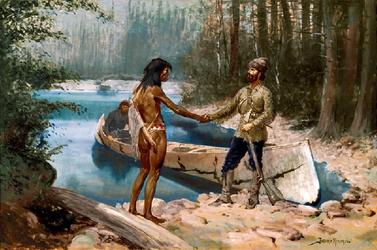
Announcements

10 Year Anniverary & New Releases Winners: Carrie Fancett Pagels' Butterfly Cottage - Melanie B, Dogwood Plantation - Patty H R, Janet Grunst's winner is Connie S., Denise Weimer's Winner is Kay M., Naomi Musch's winner is Chappy Debbie, Angela Couch - Kathleen Maher, Pegg Thomas Beverly D. M. & Gracie Y., Christy Distler - Kailey B., Shannon McNear - Marilyn R.
Showing posts with label Radisson and Groseilliers. Show all posts

Friday, July 2, 2021

The Ship You Probably Haven’t Heard of That Had the Impact of the Mayflower

I’m going to share with you a tich of history that some Canadians are probably more familiar with than most Americans are, but given what it led to, the impact was felt across the North American continent—and in Europe as a whole.

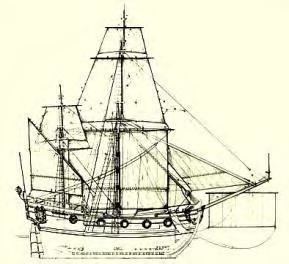
In 1650, in Wivenhoe in Essex England, a small ship was built christened Nonsuch (Other such battle ships were given the name later on.) The original Nonsuch, a ketch, which is a two-masted ship carrying square sails, was commissioned by the Navy as HMS Nonsuch, meaning “unequaled”. During it's time in the navy, the ship was captured by the Dutch, but eventually it was put on the market and sold to Sir William Warren in 1667 for 298 Pounds (that’s 71,000 British Pounds today, or $98,000 USD). This is when its story takes an interesting turn.

Sketch of a replica of the Nonsuch. Photo credit: Alchetron, the Free Social Encyclopedia

Sir William purchased the ship on behalf of a group of men, including England's Prince Rupert, who were interested in exploring Hudson’s Bay for the possibility of establishing trade. They specifically selected the Nonsuch because of its small size, capable of traversing the Atlantic while also being easier to navigate on Hudson Bay and James Bay. It's size also made it possible to be removed from the water in winter to avoid being crushed by ice.

The ship was captained by Zachariah Gillam, a man from Virginia who belonged to a family of New England sea captains. He later became infamously involved in trade in a number of ways, both legally and illegally. He was probably involved in the incident known as Culpeper’s Rebellion, though it was unable to be proven in court, and he was in Virginia at the time of Bacon’s Rebellion and reported the burning of Jamestown. But I digress.

The Nonsuch began its new epoch at a critical moment in history. Two storied explorers I’ve written about before, Pierre Esprit-Radisson and his brother-in-law Medard Chouart, Sieur Des Groseilliers, had already scoured the best routes to get into the region. In the process, they hauled back a profitable cache of furs for France. Though they had probably saved the infant French colony from financial ruin, they were fined, and Des Groseilliers was tossed into jail. Go figure. Upon his release, the pair decided to abandon France and head to England for support of their discoveries instead.

King George II was intrigued by their proposition to outfox France to delve deeper into the area for trade via the Hudson Bay route. This, at the very moment when the financiers of the Nonsuch, who included the king’s cousin Prince Rupert, were preparing their plans. 

The ship was captained by Zachariah Gillam, a man from Virginia who belonged to a family of New England sea captains. He later became infamously involved in trade in a number of ways, both legally and illegally. He was probably involved in the incident known as Culpeper’s Rebellion, though it was unable to be proven in court, and he was in Virginia at the time of Bacon’s Rebellion and reported the burning of Jamestown. But I digress.

Captain Gillam was given orders by Prince Rupert to follow the succinct instruction of Radisson and Groseillier for the journey, and the ship set sail from Gravesend on June 3, 1668. 118 days later, September 29th, Captain Gillam dropped anchor in the southern end of James Bay near the mouth of the river he promptly named for Rupert. There, the crew built a cabin and weathered a long Canadian winter, but during that time they were discovered by Cree Indians who came to trade. By the following year, they returned to England with enough beaver pelts to prompt the formation of the Hudson Bay Company—which has been in operation ever since—and which led to the formation of other competing companies such as the Northwest Company, the XY Company, and John Jacob Astor’s American Fur Company.

The battle for conquest of the New World's resources was heavily underway, and it all began with the Nonsuch and men who envisioned an empire.
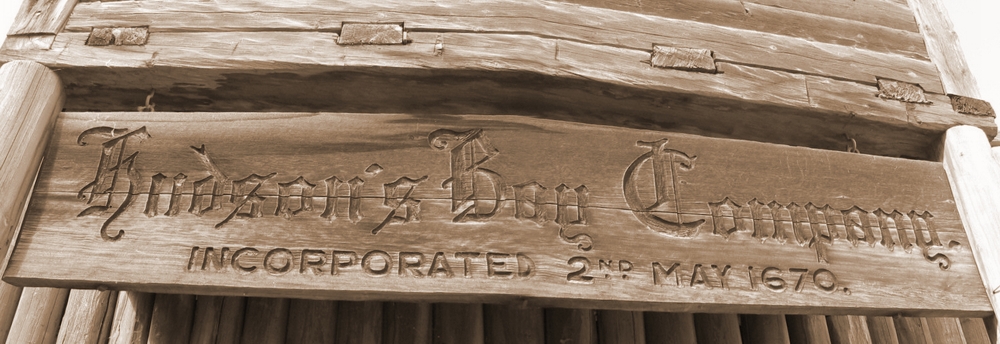



To reflect the history and heroic efforts of the fur traders, the Hudson's Bay Company commemorated those events in 1970 by building a replica of the Nonsuch. To tour the rebuild and see it's contribution to the Manitoba History, and to get a glimpse of replica Nonsuch in action, watch the video.

P.S. If you'd like to know even more history about the Nonsuch, here's an even more in-depth video: https://www.youtube.com/watch?v=2n_83JqlgI4

Friday, January 1, 2021

First European Dwelling on the "Delightfullest Lake in the World"

I have a new novel coming out about a year from now, and the setting may not be entirely familiar to some readers. For that reason, I've embarked upon a series of posts meant to shed light on the history of the fur trade around Lake Superior, and in particular, along the northern Wisconsin (Ouiscansainte) shore and northeastern shore of present-day Minnesota. I hope to give readers an inside look into a rugged world long past--and to also glimpse a beautiful part of the country you can still discover today.

Last month, I wrote about how the Beaver Wars aided in European conquest of North America. Prior to the Beaver Wars, a few Jesuit priests and trappers, as well as some famous explorers like Nicolet, La Salle,  and Joliet reached Wisconsin. But long years passed until other white men came to the country. Finally, as those earlier wars died out, Europeans pushed further into the wilderness once again, including the intrepid entrepreneurs Pierre-Esprit Radisson and his brother-in-law Medard Chouart, Sieur des Groseilliers. (You have to wonder about the wives of such explorers. Perhaps they deserve a novel of their own. Hmm...) I digress. 

Pierre-Esprit Radisson

Radisson and Grosseilliers famously explored the Lake Superior region, including the upper Mississippi River between Wisconsin and Minnesota. Radisson became particularly well-known, since he was the first to author colorful descriptions of my state (Wisconsin) and of his experiences in the wilderness.

In 1659, upon reaching Lake Superior the first time, Radisson--who had previously travelled all over Europe, including to Italy--remarked, "We embarked ourselves on the delightfullest lake in the world." For such a traveler to call Lake Superior the delightfullest says something about the grandeur of the location.


Photo by Paul Ewing on Unsplash

Although other traders had come into the region, it's been purported that Radisson and Grosseilliers were the first white men to establish themselves for any duration, settling for about a year on Superior's pristine Chequamegon Bay, around which can now be found the towns of Ashland, Washburn, and Bayfield. It's said they built a dwelling here--a wooden cabin and a crude stockade--near where Ashland is today. 

I used to live in Ashland. Oh, how I wish I had known the history of the area prior to my living there when I was only nineteen!


This marker commemorates the first dwelling and stockade at the mouth of Fish Creek, where it empties into Chequamegon Bay. The creek was called Wikwedo-Sibiwishen by the Indians, meaning Bay Creek. There was a large village of Ottawa who raised Indian corn near here at one time. 

The temporary home built by the explorers was likely quite a crude cabin with a three-sided stockade. Radisson described it as having a door facing the water, and the pine-poled stockade itself was laid about with piles of boughs in which they'd strung a cord laced with little trade bells to give them warning of marauders, possibly the Huron for whom there was some apparent distrust. However, it was never put to the test, as they were never robbed or assaulted. 

A copyrighted drawing depicting what the building might have looked like can be viewed on the Wisconsin History site here. 

Surrounding Chequamegon Bay are beaches, red sandstone cliffs, and thick pine forests that stretch for hundreds of miles south and west, and all the way to Lake Michigan to the east. Myriad rivers wind through these dense woods, some coming so close to one another that Wisconsin became an intersecting highway all the way to the Mississippi and south to the Gulf, and via the Great Lakes northeast to Hudson's Bay and eastward to the coast--ideal routes for those who traded in fur for decades to come.

Radisson and Groseilliers were true coureur du bois (see my 2019 article), later credited with establishing the Hudson Bay Company, which still exists today. After passing their first long winter on the bay and trading with Ojibwe and Huron from they region, they then journeyed westward, following trails and rivers far into the Mille Lacs region of Minnesota, many miles away. The following spring, they returned again to Chequamegon Bay and built another shelter in a new location, this time possibly on a long sandspit. From there, after trading and adventuring as far northwest as Lake Assiniboine, they finally returned home to Quebec.

One thing is certain. The work done by Radisson and Grosseilliers paved the way for many more fur traders and missionaries to follow. Yet, the French eventually lost their foothold in this amazing country, due largely to their own king's lack of vision. Even Radisson and Grosseillier eventually turned their loyalties to the English when they were not only not recognized for their accomplishments, but actually punished for exceeding their granted authority.


Today, Ashland, Wisconsin is a small city that stands just east of their Fish Creek location. It is known as the mural capitol of Wisconsin. Life-sized scenes like the one above depicting Wisconsin's history are painted all throughout the city.


Wouldn't it be fun to travel to all the historical locations we read about in our favorite novels? Have you ever traveled somewhere just because it was in a location you read about in a novel? I don't travel much, but here I am dipping my toes in Chequamegon Bay. I wonder if Radisson and Grosseiliers ever lounged about, doing the same.

Here's to exciting explorations and discoveries for each of us in the coming new year!

Naomi


Friday, March 1, 2019

The Coureur Des Bois -- Rebel Adventurers of the Colonial Frontier

When we think of the explorers who opened up our vast continent, we tend to think of the great frontiersmen like Daniel Boone or overland adventurers like Lewis and Clark. But there was another type of explorer who, while less famous individually, collectively made untold inroads into the North American continent. They were the many intrepid Frenchman or Scots called simply, the Coureurs Des Bois.

Picture

Their English counterparts on Hudson Bay would have been called "woods-runners", and to the Anglo-Dutch of Albany they'd have been known as "bush-lopers". What was common between all of them was that they were drawn into the independent fur trade by the lure of adventure, freedom, and money.

A coureur des bois in the painting, La Vérendrye at the Lake of the Woods, circa 1900-1930 by Arthur H. Hider (1870-1952)

Note: The name Coureurs Des Bois is occasionally interchanged with that of the voyageurs, but while some coureurs des bois may have been enlisted as voyageurs, in fact, the coureurs des bois predated the influx of the voyaguers who were the canoe travelers hired to work for the big fur companies like the North West Company, the Hudson's Bay Company, the XY Company, or the American Fur Company.

While licensed fur traders had the blessing of the government and the fur companies, the coureurs des bois were unlicensed to trade, though trade they did. That's right. They were the rebels of the forest.

The French King, in an attempt to regulate trade, had created laws which forbade anyone to go into Indian country to trade except those of the monopoly company. Licenses were granted, but only to a select few. The government preferred the native population to bring their furs directly to French merchants. But as population increased, more and more young men looked to the fur trade for their living, and with only minimal licenses being issued, that meant they had no choice but to work independently. Young men began deserting their assigned seignories (farms) in New France and escaped to the wilderness, drawn by the prospect of fortune as well as the lure of an unstructured life in the Indian villages. It has been estimated that, by the end of the seventeenth century, possibly as may as one-third of able-bodied men had chosen the life of the coureur des bois, choosing to break the law and escape to the wilderness to trade for furs themselves. Once they had a taste of the free-roving, adventurous life of the coureur des bois, they seldom returned to the colonies or their farms, even though the punishment, if caught, would be severe.

These independent traders thought that operating outside government regulation a risk worth taking and a life worth living. They genuinely enjoyed the camaraderie of the First Nations people with whom they often settled and raised families, and they became fluent negotiators and adept guides.

You might think that since the coureurs des bois did their work illicitly, colonists would refuse to trade with them. However, not only did the colonists trade with them, when times were tough, colonists often took part in the trade and became coureurs des bois themselves.

You may recall in my article last month, I wrote of the explorer Du Luth, who belatedly recalled that'd he'd gone on his adventure without the proper license, and made a hurried attempt to remedy the situation by claiming all the land he explored for the King of France. There were some other famous explorers who began as coureur des bois as well. Here are several of the most notable:

  • Radisson and Groseilliers were brothers and coureurs des bois credited with establishing the Hudson Bay Company.
  • Étienne Brulé was the first European to see the Great Lakes.
  • Jean Nicolet explored the region around Green Bay and established peace with the Indians there.


etienne_brule
Etienne Brulé
The coureur des bois were itinerant bush-rangers, whose explorations and inroads into the continent paved the way for many to follow.

Imagining the adventure~
Naomi Musch

https://naomimusch.com/