Announcements

10 Year Anniverary & New Releases Winners: Carrie Fancett Pagels' Butterfly Cottage - Melanie B, Dogwood Plantation - Patty H R, Janet Grunst's winner is Connie S., Denise Weimer's Winner is Kay M., Naomi Musch's winner is Chappy Debbie, Angela Couch - Kathleen Maher, Pegg Thomas Beverly D. M. & Gracie Y., Christy Distler - Kailey B., Shannon McNear - Marilyn R.
Showing posts with label spies. Show all posts

Friday, March 20, 2015

Washington's Spies Review - By Pat Iacuzzi


Washington’s Spies

The Story of America’s First Spy Ring

Alexander Rose

            I recently joined an American Wars discussion group at my local Barnes and Noble. The group, made up of veterans of more recent wars, and re-enactors of early American wars, is a great outlet for research. And I was happy to find out the first book they were discussing was Washington’s Spies.  

A lot has been written about the heroes of the American Revolution—but few take an in-depth look into the secret world of America’s first spy ring. Certainly little recognition was given to these men who risked their lives for liberty; their belief as strong as the men who fought on the forefront of battle. Spies, if caught, would be hanged by the enemy, and never acknowledged by their own side.    
            Spying, as we know it today….living among the enemy as one of them, gathering secrets, developing codes and seeing information got to the American side, was first developed by the Culper Ring, a group of men led by Abraham Woodhull who used the code name “Samuel Culper Sr.” and Robert Townsend (“Samuel Culper Jr.”). Smart, articulate men hand-picked by Washington, they were the first to break out of the mold where soldiers merely “observed” troop movements from a distance. Instead, they were able to create a convincing “cover” in order to live among the British and collect information, yet faced constant danger should they be discovered.
            This non-fiction narrative had me hooked from the beginning as Rose discussed such incidents as Nathan Hale’s enlistment as one of Washington’s spies, before the development of the Culper Ring. Hale, an idealistic, trusting young man of twenty-one, and acting alone, was quickly captured by the British and hanged. Rose does so well developing insight into Hale’s character from his personal letters and journals, I almost hoped what we’d learned in our history books about his fate wasn’t true—that he had somehow survived.
            The only problem I saw with this book was a hint, perhaps, of a rather liberal or revisionist attitude in his style of writing. There are certain adjectives, adverbs and personal comments he makes about our American heroes that, if you research their personal papers, you will find the true reasons for their actions. Example: “For political cover, Washington passed the buck to Congress; if there were to be fallout in later years, the general needed to be able to claim he was following the directions of the nation’s elected representatives.”
Washington wasn’t “passing the buck” as a personal cover. Nor it seems would he be the type to say “I was just following orders”. He was a man of leadership and integrity, who applied to a newly-created Congress for aid in getting supplies and report to the people, through their elected representatives. He also could not say should there be “fallout in later years”…
For by applying to the members of Congress as often as he did, Washington not only endangered himself but all of them.  

Rose also leaves out mention of female spies, only naming women as spouses of the agents. And there were female spies during the American Revolution, including Sally Townsend, sister of Robert Townsend who was able to intercept a message to John Andre about the attack on West Point.
Though it was made into the AMC series “Turn”, my rating: 4 stars.           

Wednesday, April 23, 2014

Colonial Spies, Fact and Fiction

by Roseanna M. White

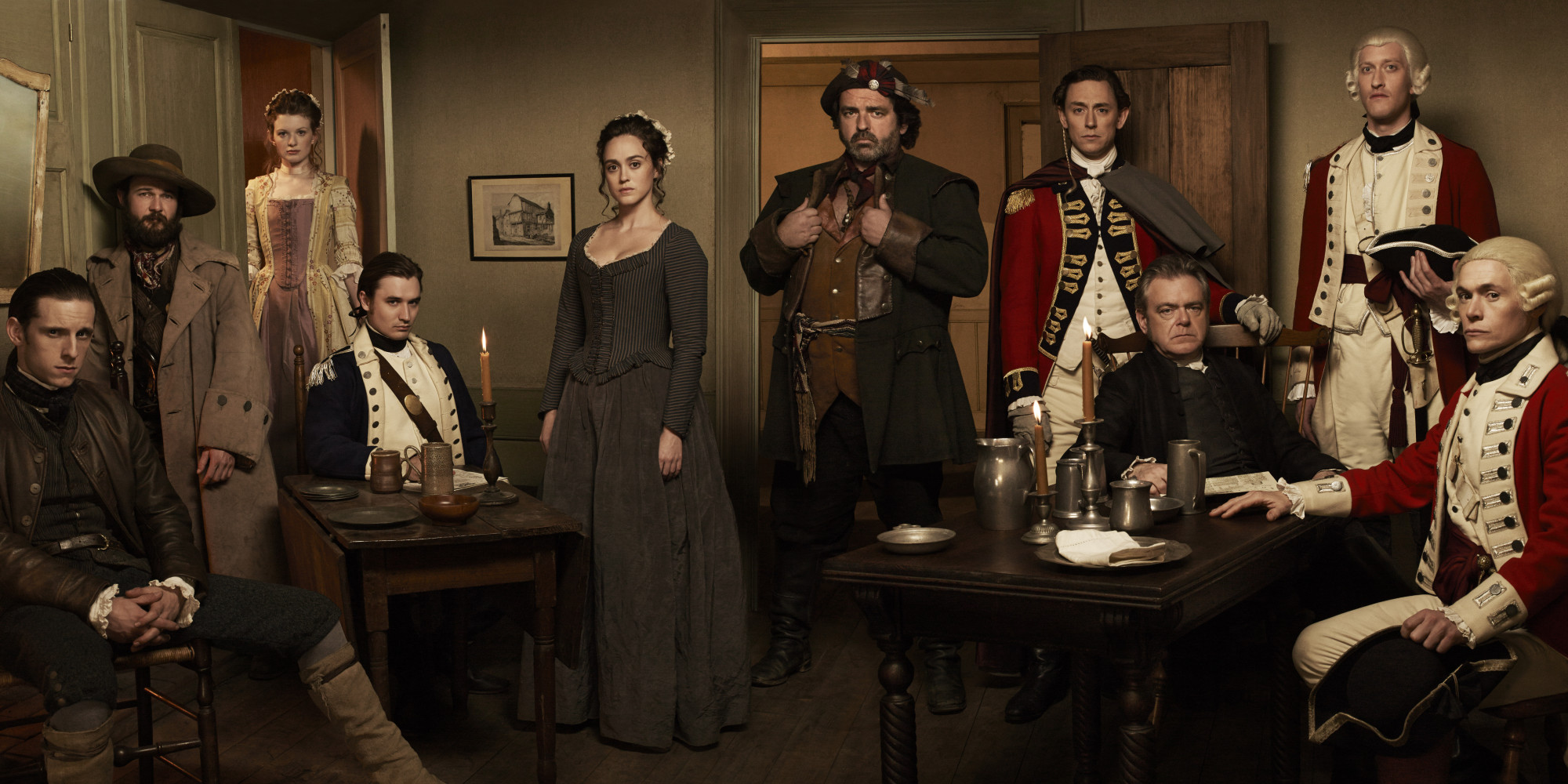
Many of us with a love for Colonial history have been very excited about the premiere of AMC's Turn. Based on the exploits of the Culper Ring as researched and expounded by Alexander Rose in Washington's Spies, Turn (Sunday nights, 9 p.m. on AMC) promised action, drama, adventure, and espionage.

They also deliver violence, which was a bit much for many viewers I've spoken to. I seem to have an immunity to TV violence and honestly scarcely noticed it, so...I'm not the one to talk about that, LOL. Instead, I wanted to touch on some of the fun ways I noticed that Turn has taken fact and heightened it into good fiction.

Because I already researched this history for Ring of Secrets, I was largely familiar with the story they'll be telling. But because it was several years ago, I had to break out my copy of Washington's Spies and do some fact checking--which made me grin, because I'm that kind of geek.
The major players in AMC's Turn

The most important thing to note when viewing this or any other show based on  history, is that facts get bent. And that's good, because in reality the events are dragged out over years, and tension isn't always high. As viewers, we would get bored and soon be flipping to another station. I give the writers of Turn a lot of kudos for putting together major players in the Revolution that didn't (so far as we know) actually meet up, for creating backstory and emotional investment to explain actions and make the characters relatable...and for asking a lot of what ifs.
My version of what ifs are a bit different...but based on the same history

Thus far in Turn, we've been focused largely on Abraham Woodhull, who was the primary operative in the Culper Ring during its first years of operation. He was, in fact, given the code name of Samuel Culper, after whom the whole group of intelligencers was named. In the show, Abraham's father is a judge in Setauket--and loyal to the Crown. By choosing farming above the law, Abraham had introduced strained relations long before the first scene opens. Added to it is the fact that his loyalties are torn.

In reality, Abraham was from a farming family (though he himself became a magistrate and judge after the war!), and he was the primary caretaker of his aging parents on the family farm after his two older brothers are killed in the early days of the war. This, combined with the death of his uncle, who was a Patriot general, are what spurred Abe to take on the role his childhood friend asked him to consider--namely, gathering all the information he could on British movements and passing it along toward Washington.

Also in the show, Abe is married to a lady named Mary but was once engaged to Anna, who's now married to Selah Strong. In reality, Abe wasn't married, and Anna was a neighbor a decade his senior (so no young love there, LOL), who did indeed aid him in his clandestine tasks, and even posed as his wife when he was running information--married couples traveling together were not often halted and searched by the British, but single men always were. It wasn't until 1781 that Abe got engaged to Mary (a relative of Anna's, actually), at which point he more or less resigned from the Culper Ring so he wouldn't risk bringing calamity down on his family.

And according to the history, Abe was never torn in his loyalties. Though he knew how to bite his tongue to keep from drawing the attention of the British, his writings make no secret of his very Patriotic bent...and also make it clear that this quiet young farmer took great pleasure from tricking the British overlords plaguing his town.

As a writer of fiction, I can certainly appreciate how the TV writers have tweaked fact to make a good show. And as a history nut, I always love noting where the differences are.

Wednesday, February 27, 2013

Calling All Revolutionary Spies!

Ever wonder how spies get their aliases? Well, I can't speak for modern-day ones, but I happen to know how George Washington and company came by the names for those in the Culper Ring, the first organized American spy ring. And as part of the launch for Ring of Secrets, I thought it would be fun to lay it all out so we can all come up with our own code names!

I'm Evelyn Pitt... Who are you?

How the Culpers came to be the Culpers

George Washington and his intelligencers, when looking to assign code names to their primary agent, started with the initials of the head of intelligence—Charles Scott, C.S. Then they reversed them—S.C. This would be the initials of the primary Culper officer. For the “C,” Washington chose a place he had fond memories of, Culpeper County, Virginia, where he worked as a lad. Then he shortened it to Culper. For the “S,” Tallmadge (the head officer of the ring) decided on “Samuel,” his younger brother’s name, and a good friend of the man who would be adopting the identity. So there we have it! Samuel Culper, the creation that became the bane of the British.


Let's Create Our Name!

  1. Start with a name of a teacher, parent, or boss  

I'm going to pick Patricia Egan, one of my favorite bosses from my college days

2. Take their initials and reverse 'em

So P.E. becomes E.P.


3. Think of a place important to you that starts with the second initial  

I'm going to pick Pittsburgh, because it's the closest major city whose sports teams we like

4. Shorten, lengthen, or otherwise alter the place name into a surname   

So Pittsburgh becomes Pitt. No relation to Brad, ahem. ;-)


5. Think of a family member or friend whose name begins with the first initial
(not the same one you got the name from!)

E, in my family, is for Evelyn.
My great-grandmother's name, and the middle name of my grandmother, mom, and daughter.

So there you have it! Who are you??


~*~

Roseanna M. White pens her novels under the Betsy Ross flag hanging above her desk, with her Jane Austen action figure watching over her. When she isn’t writing fiction, she’s editing it for WhiteFire Publishing or reviewing it for the Christian Review of Books, both of which she co-founded with her husband.

Friday, August 31, 2012

Tools of the Trade: Nonfiction Books - Washington's Spies


by Roseanna White

I'll confess it from the start--I don't read much non-fiction. Why? Because I read so much of it during college that I just got burned out on it. But apparently it's now been long enough since then (where did that time go, anyway?) that I can read it again without feeling at all put out about it. Handy, since in looking up info about the subject of my newest idea, I came across a very interesting-sounding book that I knew would be helpful: Washington's Spies by Alexander Rose.

My library didn't have this one, but thanks to the wonders of ILL, they had it for me in three days, and I cracked it open with genuine enthusiasm. I haven't read any non-fiction on the Revolutionary War since college (and then it was more political treatises of the era, not history of the war), so I found this to be a wonderful refresher on the history in general. Better still, it focused entirely on the use of espionage in the war, by both sides. And really, what could be more fun than that? ;-)

Rose doesn't follow a strict chronology in this--he follows stories, usually about the particular people, and uses those to take him from point to point. Which means you know exactly where to flip back to if you need to remind yourself about where someone was born, or who his father was, but locating a date for a particular action of his requires the help of the index.

The writing of this book was never dry and at times downright witty. I actually chuckled at several places. And at several others I found it necessary to interrupt my reading to share a particularly interesting factoid with my hubby. Mr. Rose found many ways to integrate little-known facts from the day that only had the smallest thing to do with the main subject; and he integrated them in such a way that you knew without doubt he had submersed himself fully in this era as he wrote the book. Something I, as I writer, certainly appreciate.

I did find a few typos in the dates given, like saying something happened in 1778 that happened in 1780. Typos, which I understand, but which confused me endlessly, LOL.

Overall, if you're a history buff who loves reading about lesser-known portions of well-loved times, this is a fabulous book. It presents a fair, honest picture of what life was like from 1776-1784, not embellished by glamorous ideas or romance.

But no worries--I plan to embellish with plenty of romance when I write a novel set in the time. ;-)

Wednesday, March 21, 2012

Francis Cabot Lowell: Businessman, capitalist, spy

After winning physical independence from England, economic independence was next. And that independence was tied to textiles.

In the 1760's, a British businessman, Richard Arkwright, committed industrial espionage to establish his waterframe spinning jenny and his power loom. These two machines revolutionized the textile industry in England and led to the invention of the cotton gin by Eli Whitney in order to keep up with demand for raw cotton. Before the gin cotton fabric cost as much as 60 cents a yard. After, 10 cents a yard.

In 1810, Francis Cabot Lowell (1775-1817)  from Massachusetts took a trip to Europe and ended up in Manchester, England. For his health he said. His real purpose was to tour the Manchester mills and bring the machinery schematics back to America. A successful venture capitalist and businessman from an old Boston mercantile family, he graduated from Harvard the same year Whitney invented the gin, in 1795.

At first Lowell tried to legally obtain the machinery plans. When that didn't work he drew on his fascination and aptitude with machines--and his photographic memory--to commit the intricate looms and spinning jennys to memory. There is some speculation he may have used secret compartments in his steamer trunks to hide notes from the very thorough British customs officials. If those notes did indeed exist, he destroyed them.

He returned to Boston in 1812 and began the task of recreating what he'd seen. And improving and speeding up the machinery. Both tasks were accomplished and left elite engineers and mathematicians of the day in awe of his mechanical genius. Two years later he presented the first working model. By 1815, over 27 million pounds of cotton had been spun and woven in the United States.

He built his first mill in Waltham, Massachusetts, on the Charles River. This picture is that building. It was the first mill to cover the entire production--from raw fiber to finished cloth--in one building. 

The town of Lowell, Massachusetts--the center of the 19th century cotton textile industry--was his vision, but he did not live to see it built. The filthy, dangerous, deadly conditions in Manchester appalled Lowell and he knew it would never work in America. Using the paternalistic mindset common in his social class he created an entirely different model for a mill town.

After his death in 1817 Lowell'ss brother-in-law, Patrick Tracy Jackson, moved the mill 30 miles north of Boston on the Merrimack River, to a place where the river fell 32 feet in less than a mile. This down slope provided the water power for the mills. Now known as the Merrimack Manufacturing Company, it dominated the textile industry here for close to 100 years.

Next time you wear your favorite cotton dress or shirt or even your favorite pair of jeans, thank Francis Cabot Lowell's photographic memory and skills as a spy.