Announcements

10 Year Anniverary & New Releases Winners: Carrie Fancett Pagels' Butterfly Cottage - Melanie B, Dogwood Plantation - Patty H R, Janet Grunst's winner is Connie S., Denise Weimer's Winner is Kay M., Naomi Musch's winner is Chappy Debbie, Angela Couch - Kathleen Maher, Pegg Thomas Beverly D. M. & Gracie Y., Christy Distler - Kailey B., Shannon McNear - Marilyn R.
Showing posts with label Espionage. Show all posts

Wednesday, April 23, 2014

Colonial Spies, Fact and Fiction

by Roseanna M. White

Many of us with a love for Colonial history have been very excited about the premiere of AMC's Turn. Based on the exploits of the Culper Ring as researched and expounded by Alexander Rose in Washington's Spies, Turn (Sunday nights, 9 p.m. on AMC) promised action, drama, adventure, and espionage.

They also deliver violence, which was a bit much for many viewers I've spoken to. I seem to have an immunity to TV violence and honestly scarcely noticed it, so...I'm not the one to talk about that, LOL. Instead, I wanted to touch on some of the fun ways I noticed that Turn has taken fact and heightened it into good fiction.

Because I already researched this history for Ring of Secrets, I was largely familiar with the story they'll be telling. But because it was several years ago, I had to break out my copy of Washington's Spies and do some fact checking--which made me grin, because I'm that kind of geek.
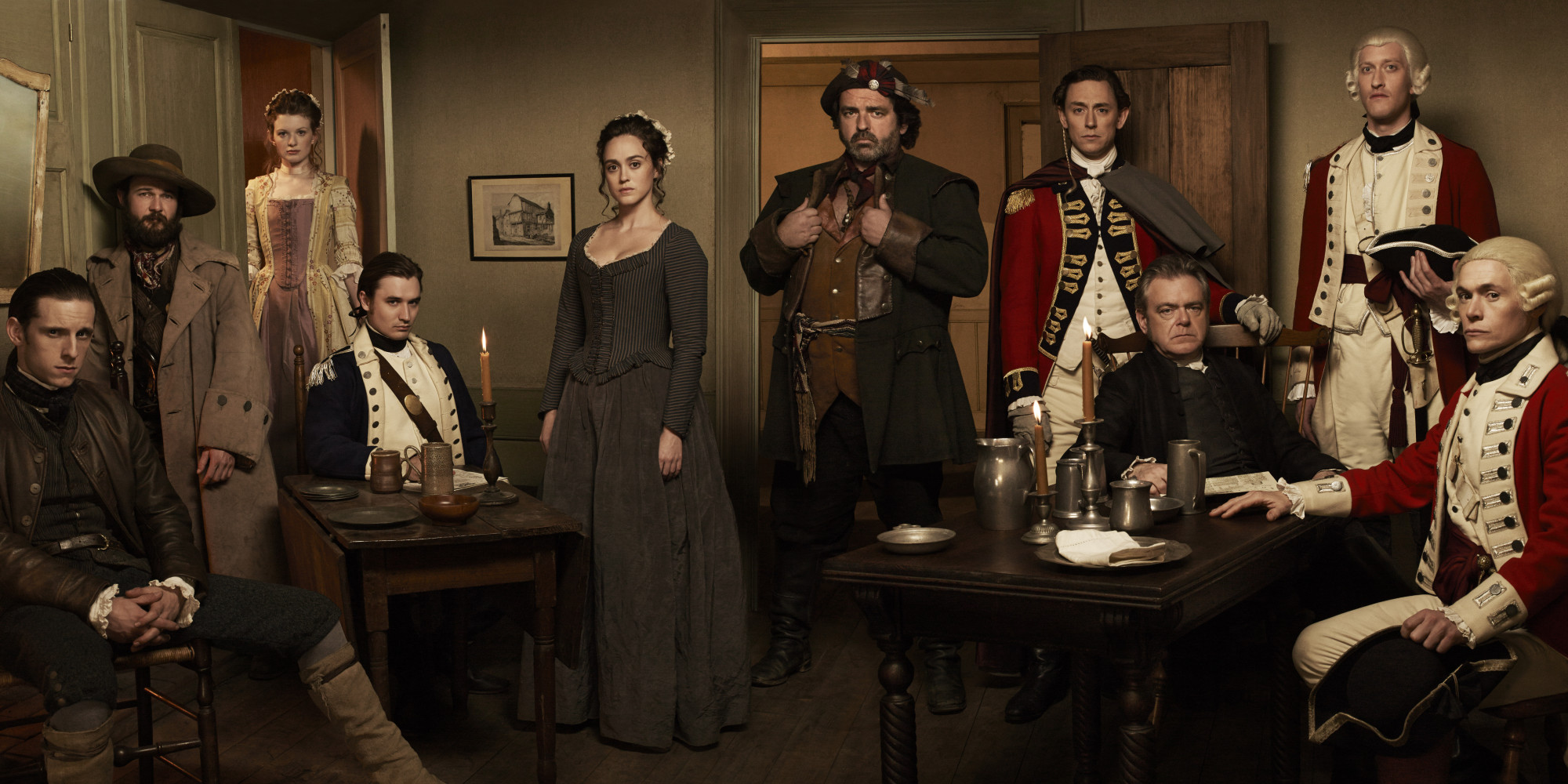
The major players in AMC's Turn

The most important thing to note when viewing this or any other show based on  history, is that facts get bent. And that's good, because in reality the events are dragged out over years, and tension isn't always high. As viewers, we would get bored and soon be flipping to another station. I give the writers of Turn a lot of kudos for putting together major players in the Revolution that didn't (so far as we know) actually meet up, for creating backstory and emotional investment to explain actions and make the characters relatable...and for asking a lot of what ifs.
My version of what ifs are a bit different...but based on the same history

Thus far in Turn, we've been focused largely on Abraham Woodhull, who was the primary operative in the Culper Ring during its first years of operation. He was, in fact, given the code name of Samuel Culper, after whom the whole group of intelligencers was named. In the show, Abraham's father is a judge in Setauket--and loyal to the Crown. By choosing farming above the law, Abraham had introduced strained relations long before the first scene opens. Added to it is the fact that his loyalties are torn.

In reality, Abraham was from a farming family (though he himself became a magistrate and judge after the war!), and he was the primary caretaker of his aging parents on the family farm after his two older brothers are killed in the early days of the war. This, combined with the death of his uncle, who was a Patriot general, are what spurred Abe to take on the role his childhood friend asked him to consider--namely, gathering all the information he could on British movements and passing it along toward Washington.

Also in the show, Abe is married to a lady named Mary but was once engaged to Anna, who's now married to Selah Strong. In reality, Abe wasn't married, and Anna was a neighbor a decade his senior (so no young love there, LOL), who did indeed aid him in his clandestine tasks, and even posed as his wife when he was running information--married couples traveling together were not often halted and searched by the British, but single men always were. It wasn't until 1781 that Abe got engaged to Mary (a relative of Anna's, actually), at which point he more or less resigned from the Culper Ring so he wouldn't risk bringing calamity down on his family.

And according to the history, Abe was never torn in his loyalties. Though he knew how to bite his tongue to keep from drawing the attention of the British, his writings make no secret of his very Patriotic bent...and also make it clear that this quiet young farmer took great pleasure from tricking the British overlords plaguing his town.

As a writer of fiction, I can certainly appreciate how the TV writers have tweaked fact to make a good show. And as a history nut, I always love noting where the differences are.

Wednesday, August 28, 2013

Espionage in Early America

I've blogged about my different discoveries in historical espionage before, but I've never put them all together before for the Colonial Quill. And since this fall I'm teaching a home school class to my local group about the different historical methods of spying, I figure it'll be fun to get a head start here. ;-)

By the time of the Revolution, spying in Europe had reached some rather hilarious levels. It was so common in the different courts that they all knew other countries' men were intercepting their messages and copying them. The "Black Chambers" of these master spies were located nearby the courts. The spies would steal incoming correspondence, make a copy, and slip the original back into the post. Codes had become common too, but these dudes got their jobs by being able to break them, quickly and efficiently. So it was just all one big puzzle that they were playing, knowing well their opponents were evenly matched.
A page from the real Culper Ring's code book

One story I read and loved was of a spy who mistakenly sent along his copy instead of the original message. The recipient knew right away what had happened and sent it back to him, demanding his original in its place--proving that they all knew exactly who was doing what and took very little issue with it after so long.

But in America, espionage was like so many other things--new and experimental. And when the Revolution was in full swing and General Washington found himself in need of reliable intelligence, he had no Black Chamber to rely on. He had only a few trusted men with no background in spying and no training in the covert. They dubbed themselves the Culper Ring and answered to one of Washington's most trusted officers, Benjamin Tallmadge.

My personal experiments with heat-developed inks
Today we look at the cyphers and codes that the Culper Ring developed and shake our heads at how amateur they were. But they did the job, and because of the ingenuity of the brothers Jay and their "sympathetic stain" (invisible ink), the British never even saw the code to crack it. Until then, they had to use heat-developed inks for messages, which anyone with a flame could develop. But this stain required a particular counter agent. This level of security is what kept their secrets throughout the war. And what made my Ring of Secrets a lot of fun to write. ;-)

By the War of 1812, another intelligence tool had made its way to America--the mask, or grille. This was a piece of paper with a shape cut out of it. The writer of a message would put this mask down upon a blank piece of paper, write his true message within the hole, and then remove the mask and fill in the lines around the message so that the real words would be innocuously hidden within innocent sentences. In order to know what the message was, the recipient would have to also have the mask, which would be sent in a separate batch of correspondence.


In the Civil War, codes were the feature of the day, and there were a lot of them. Members of the Knights of the Golden Circle, for instance, would come up with codes for each occasion. Simple phrases to let each other know if a particular outcome had happened as expected or not. Other codes used a key--a book, usually a dictionary, that both sender and receiver had. They would use numbers to indicate words. So you might see something like this: 192.15.26

These numbers stood for page, line, word on line. If they were encoding something like a name that wouldn't be in a dictionary, they would spell it out using a forth number to indicate a letter within the word.

Now my question to you today:

Do you think you could have been a spy in early America?

~*~
Roseanna M. White pens her novels under the Betsy Ross flag hanging above her desk, with her Jane Austen action figure watching over her. When she isn’t homeschooling her small kids and writing fiction, she’s editing it for WhiteFire Publishing or reviewing it for the Christian Review of Books, both of which she co-founded with her husband.