Announcements

10 Year Anniverary & New Releases Winners: Carrie Fancett Pagels' Butterfly Cottage - Melanie B, Dogwood Plantation - Patty H R, Janet Grunst's winner is Connie S., Denise Weimer's Winner is Kay M., Naomi Musch's winner is Chappy Debbie, Angela Couch - Kathleen Maher, Pegg Thomas Beverly D. M. & Gracie Y., Christy Distler - Kailey B., Shannon McNear - Marilyn R.
Showing posts with label colonial american Thanksgiving. Show all posts

Wednesday, November 25, 2015

Let Us Give Thanks


When you ask people what they're thankful for at this time of year, you're going to get a variety of answers. But for most us, they'll center around a few things:

Our families
 
Our homes
 
Having enough to provide

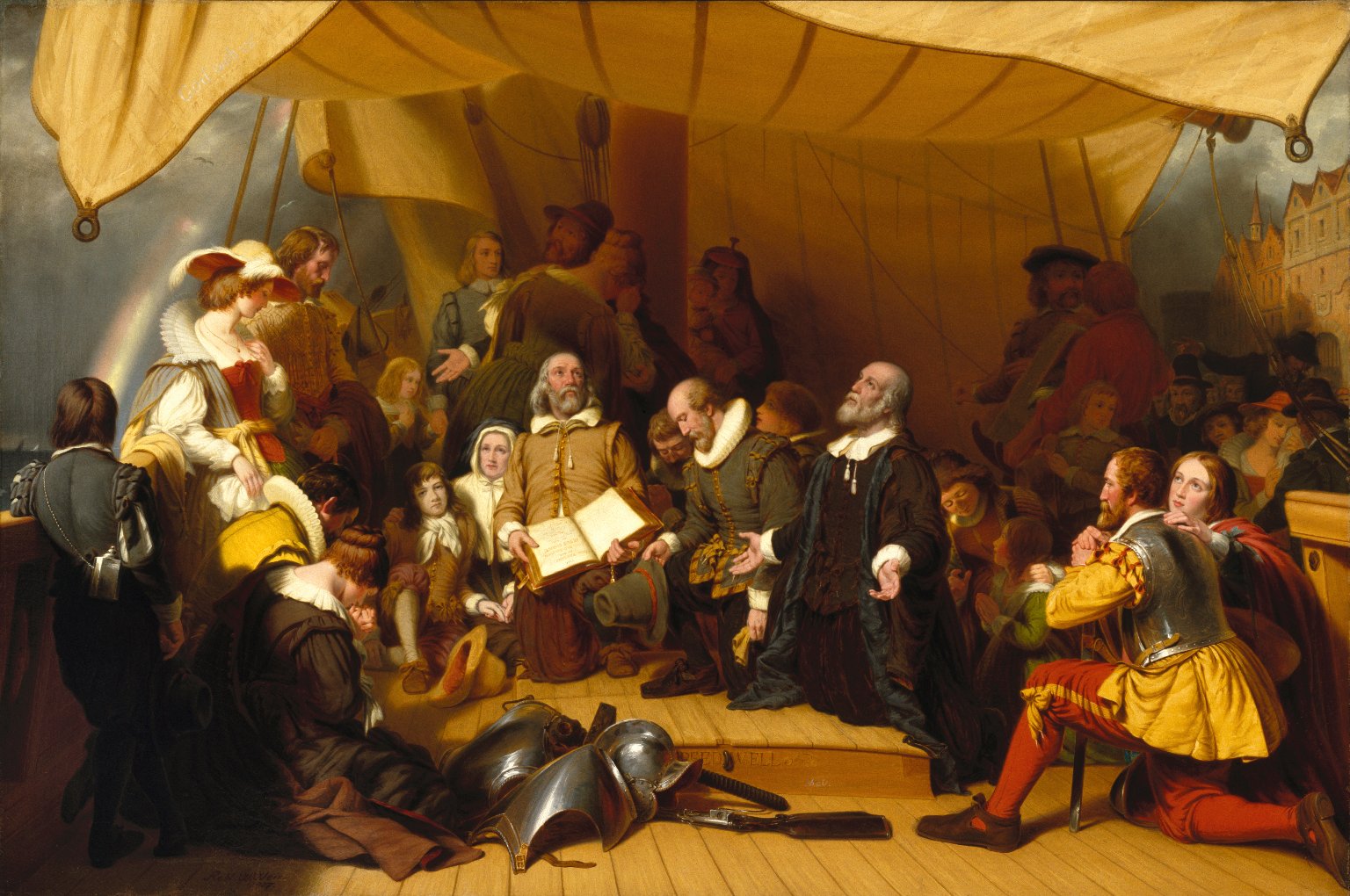
Last year as I was learning more about the first few Thanksgiving celebrations the Pilgrims held in Plymouth, my husband shared some information that I hadn't considered before...and which shed new light on those things we're most thankful for.

That first terrible winter the Pilgrims endured saw nearly 50% of them dying from disease, starvation, and exposure. In exact numbers, it was 45 out of 102. I had never paused to consider which of the 102 died...but it certainly wasn't in whole family groups.

Children lost parents.

Parents lost children.

Husbands lost wives.

Wives lost husbands.

There was no family left intact. No homes to speak of. They didn't have enough to provide.

The first Thanksgiving came less than a year after these terrible tragedies. So what were the Pilgrims thankful for, I wonder? Just a bountiful harvest?

No.

These settlers knew that family, that covenants and bonds were the most important things. They knew that to survive, they had to work together. And so, children who lost their parents were taken in by parents who had lost their children. Widowers marries the widows. New families were created. New homes built. New futures forged.

This year as we sit down to our bountiful tables and look at the loved ones around us, it is, as always, important to thank the Lord for them. For the food. For the homes. For having enough.

But it's also important to remember that even during those years when we don't have family, don't have homes, don't have enough...He is still worthy of our gratitude. He is still deserving of our praise. This is yet another lesson we can learn from the Pilgrims. That we aren't just thankful for the bounty...we're thankful for opportunity. For His guidance. For His salvation. We're thankful for freedom. For Jesus. For the yesterday that may have been ugly, and for the tomorrow that could be beautiful.

George Muller, a missionary who served in England during the 1800s, once thanked the Lord for empty plates--because they were an opportunity for Him to fill them in ways beyond human understanding.

This Thanksgiving, let's try to remember not just to thank Him for the full places...but also for the empty ones.

Friday, November 20, 2015

The Real History of the Pilgrims


by Tamera Lynn Kraft

Since next week is Thanksgiving, I thought you might be interested in the history of the pilgrims that isn’t taught in school. Most of us were taught that pilgrims came to America to flee religious persecution. That’s not exactly true. Puritans were persecuted for believing that Christians could have a personal relationship with Jesus separate from the Church of England. But they traveled to Holland to flee the persecution, not America. Pilgrims applied for immigration to Holland in 1607. Holland allow religious freedom that England did not. Although England didn't allow people to flee, Holland approved the immigration. Bands of Pilgrims moved to Holland in 1607 through 1608.

So why did they travel to America? There were many reasons, but the main reason is they felt compelled by God to come to America and establish a colony of people that honored God. Many called this colony, New Jerusalem, believing that God had established this new land to spread the gospel to the world. William Bradford wrote in his journal that the motivation came from “a great hope for advancing the kingdom of Christ.”

Pilgrims and Puritans were not the same. Pilgrims were Puritans who were also separatists. They believed they should separate themselves for the Church of England and the world systems and set up their own churches. Puritans believed in working within the system. Pilgrims are the ones who came to America on the Mayflower to set up a government that honored God. Puritans soon followed Pilgrims on the journey to America. Once they came to America, Puritans wanted to set up a theocracy according to their beliefs. Pilgrims were more democratic and created a covenant that everyone signed and agreed to live by called the Mayflower Compact. Because of this, Pilgrims were more likely to extend the freedom of religion they wanted to others. Pilgrims wanted freedom of religion to protect the church from the government, not to protect the government from the church.

Many schools teach that Thanksgiving was a secular celebration, but letters written by the Pilgrims tell a different story. God was such a part of their everyday life that they included God in everything. One such letter states that Thanksgiving was a celebration called so that “God be praised” for what He had brought them through. They invite the Patuxet tribe of Native Americans to join them because they had a good relationship with this tribe. The tribe helped them plant their crops and defend themselves from other more hostile tribes.

John Winthrop called New England a City on a Hill in one of his sermon. He, as well as many other Puritans and Pilgrims, believed they had made a covenant with God to be a new nation that was a model of Christianity to the world. William Bradford believed that America was called to spread the gospel to the world. Since the Pilgrims and Puritans came to America, the United States of America has sent missionaries to more nations and more remote places in the world than any other nation on Earth. Could it be they were right?

Wednesday, November 26, 2014

Our Five Kernels of Thanksgiving

by Roseanna M. White

We all know the story of the first Thanksgiving, and it's one I've enjoyed reading to my kids again this year. All those old familiar tales of Squanto and the Pilgrims, of neighborliness and sharing.

But even more stirring was when I read about the Second Thanksgiving the Pilgrims celebrated.

After that first harvest we've all read about, the Pilgrims wisely stored food to see them through the winter. And they had plenty. Certain that it wouldn't be a repeat of the previous winter, where so many had died of hunger and illness, they settled in to their settlement to await spring.

But another ship came, bearing more settlers...and with no food supplies. Suddenly they had far more mouths to feed than they had stores with which to feed them. But it wasn't their way to turn anyone away. Instead, they accepted these newcomers and divided their rations again. They adjusted as best they could.

And they grew hungry. At one point, each person's daily ration was five kernels of corn a day. Five kernels!

The Pilgrims knew they couldn't survive on this meager allotment. But they had nothing to trade for food, no other ships were due with supplies. And they, unlike those in the Virginia Colony to the south, weren't about to steal and kill for it. Instead, they prayed. They humbled themselves. They searched their hearts for any sin and appealed to God for salvation.

He provided it. A ship unexpectedly entered Plymouth harbor, on its way from the southern colonies to England. Though they didn't have extra food, they did have goods that they traded for the Pilgrims' beaver pelts. And with those goods, the Plymouth colony could trade with the Native Americans for more food.

They survived the winter without one death. When spring came, they planted. In summer, they tended. In the fall, they reaped in an admirable harvest.

Again, they declared a feast of Thanksgiving. Again, they invited the natives that played such a vital role in their survival. But there was something different at this feast.

This time, around each plate, they put five kernels of dried corn. A reminder of all they had been through...and of all the Lord had done to save them.

As we reflect on Thanksgiving this year, let's put our kernels before the Lord. They don't just represent the blessings He heaps on us...they represent the hardships He sees us through. They represent His faithfulness.

What are your kernels this year?

Monday, November 12, 2012

Part 2 of A Forted Frontier Holiday: A Colonial America Fiction Anthology - A Providential Proposal By Susan Craft


A Forted Frontier Holiday:
A Colonial American Fiction Anthology
While harvesting, the German settlement near New Market, Virginia, receives warning of an impending attack by French and Indian war parties. They flee to a quickly cobbled refuge, Fort Providence—for they will surely need to rely on God’s Provision. The forted colonials long to celebrate the holidays and await the arrival of visitors. 
Each CQ contributor to this serial will bring their characters into the fort from throughout colonial America. Join us for A Forted Frontier Holiday each Monday on CQ for the next two months!
ENJOY!!! This is our Christmas gift to our faithful followers on Colonial Quills. Many blessings to all of you during this season. And may God bring provision to our northern neighbors hit so hard by the storm.


Part Two

A Providential Proposal

Shenandoah Valley, November 1753

Climbing out of the back of the covered wagon that had been her family’s home for a month, Allison Cameron gripped the wagon bed and searched with the toe of her boot for the step-down slat. Entangled in her skirts, she careened backward, stifling a yelp when a pair of hands clasped her waist, lifted her like a feather, and settled her to the ground.
            She whirled around to find her nose planted against the buckskin-covered chest of the wagon master. Rabbit fur tickled her nostrils as she breathed in the pleasant aroma of pinewood campfires and tobacco. Her eyes traveled upward, past the collar of his linsey-woolsey shirt, to the blue flannel scarf bunched around his neck. A strand of his shoulder-length hair, the color of cattails in the fall, clung to his bottom lip, a bit fuller than the upper one. She gazed into familiar eyes, blue like the flowers that top flax stalks in June. A closely planted field of those flowers so resembled water that flying ducks would try to land on them. As flummoxed as those birds, she swallowed the words of chastisement she’d been prepared to wield against the liberty taken upon her person.
            Douglas McCallum grinned and ran his finger along the brim of her ruffled cap tucked underneath the hood of her cloak. “You must take better care, Miss Allison.” A mist punctuated each word as his warm breath mingled with the freezing air.
            Weeks ago, after she had repaired a tear in his jaw ripped by an angry bear, they’d given each other permission to use their given names. But he insisted on adding the Miss; his way of teasing her. She studied the scar. It would soon fade, for she had used the tiniest of stitches fashioned with a silky thread of her finest hetcheled flax. Though her fingers ached to caress his face, their relationship had only begun to blossom, and she felt too shy. Instead, she clasped the bear claw hung around her neck with a length of rawhide
his thank you gift.
            Allison frowned. “Delayed again. Will we ever reach South Carolina?”
            “Aye, lass. ‘Twill take time. For now, we must wait out the weather.”
            Allison caught his furtive glance toward the fort’s gates. “It isn’t simply the weather, Douglas. I’ve heard about the threats of attack."
            “Allison?” her sister, Katherine, called from the wagon. “Are you ready for Drew?”
            Allison turned around. “Yes, dear.”
            “Allow me,” said Douglas.
            Allison hovered, unsure if she could trust arms powerful enough to lift a log that had crashed down in front of their wagon to handle her one-year-old nephew. When he cuddled the blanket-wrapped bundle against his chest before depositing the sleeping babe into her arms, her worries vanished.
            “Now, you, Mrs. Hutchinson.” He swept her from the wagon and cradled her as tenderly as he had her child.
            If anyone else but her sister had clasped his neck, Allison would have bristled with jealousy, but she glimpsed the dark circles under Katherine’s eyes and the newly etched wrinkles in her forehead. Her sister had endured the unthinkable. Her young husband had succumbed to a fever on the first leg of their journey. For two long days and nights, Allison had nursed her sister back from the brink of death, but the loss of her adored husband had almost broken Katherine’s spirit. She looked so forlorn dropping her head against Douglas’ shoulder.
            What a dependable, rock of a man. Someone easy to cling to.
            She had witnessed his broad shoulders taking on much responsibility during their journey from Philadelphia. Midway through Virginia, steady rains had turned the Great Wagon Road into a river of mud. Sparing the horses, travelers unloaded their cargo and toted it up the hills. Douglas, knowing how much she treasured her spinning wheel, disassembled and tucked into straw-lined crates in her parents’ wagon, had moved the boxes personally. He had also carried the kegs of flax seeds which had survived her family’s voyage from Ireland and meant more to them than gold.
            Each evening around the campfire, Allison’s dah shared his dreams of harvesting those seeds along the Catawba River. Allison would spin it. Her mah would weave it into linsey-woolsey or crisp white linen for cravats. Katherine would tat the silkiest yarn into lace. The men would fashion the fibers into sails and ropes for ships and church bell towers.
            Allison couldn’t believe how quickly she had come to respect
and yes, lovethe kind, steadfast wagon master. For his part, he had taken every opportunity to position himself by her side, engaging her in conversation or simply passing time with her in comfortable silence.
            Do his feelings match mine?
            Drew wriggled in his sleep, wrenching Allison from her woolgathering. She tightened her grip on him and noticed her parents a few paces ahead. They hastened toward a sturdy looking building amid a spattering of lean-tos and military tents that made up the hastily erected Fort Providence. Members of their small group joined them after circling their wagons around the fort’s perimeter. Her dah waited for her, while her mother walked alongside Douglas and fussed over her daughter.
            Mr. Cameron, a tall, wiry man with warm, moss green eyes, held open his arms. “Give him to me.”
            He hiked his grandson up onto his shoulder, but before continuing on, he gazed at Allison with one of his auburn eyebrows raised.
            Strange, he looks at me as if he knows something I don’t, she thought with a shrug.
            Relieved of her burden, she offered assistance to a woman who labored under the weight of a sack draped across her chest while she hung on to her twin boys. Allison slipped the sack onto her own shoulder and grabbed the elbow of the nearest boy, who scuffled until she dug her fingers into his skin and glared at him.
            Douglas chose that moment to come through the doorway in time to see the scowl on her face. “Let me.” He took the bag from her and bent down to whisper, “I can’t abide unruly children either.”
            She chuckled, released the boy, and stepped inside where the aromas of roasted sweet potatoes, cinnamon, rabbit stew, and rhubarb pie wafted around her.
            She sighed. “Heavenly.”
            Douglas stood beside her, and they watched refugees from the impending danger plop down on the floor, happy to be inside, even happier to be alive. A man even larger and taller than Douglas stood and, in a heavy German accent, introduced himself and his wife, a diminutive woman far along in her pregnancy. Following his lead, the head of each family made their acquaintances. Allison curtsied when her father called her name. Douglas acknowledged his introduction with a nod.
            They’d been standing a while when Allison realized that Douglas stared at her intently as if studying her. A sudden warmth pulsed through her veins and her cheeks flushed so hot she pressed her cool hands against them. Searching the room for an escape, she spotted her mah waving. She approached her family as they made themselves comfortable near the fireplace where a woman bent down to stir the bubbling contents of a pot hanging from a hook and swung it back over the flames.
            Claire Cameron, a petite woman, barely reached her daughter’s shoulder, but her body was the only thing wee about her. Her love of God could fill the universe. Her voice boomed with laughter, and back home in Ireland when she chastened her daughters, children two doors down in the borough cringed. Mr. Cameron often spoke of drowning in his bride’s big, dark eyes. Allison prayed that one day she would be blessed by a love like theirs.
            Claire cupped Allison’s cheek. “A stór, you will go to our wagon and return with bear meat and the makings for dumplings? We must offer our fair share.”
            Allison found her mah’s lilt pleasing as well as the way she formed her requests into questions, as if one had the choice to obey.
            “I’ll accompany her,” said Douglas, startling Allison who hadn’t realized he was so near.
            Outside, they stopped next to her parents’ wagon and leaned against the wheel.
            Douglas removed her mitten and circled her palm with his thumb. “Your mother called you something. A stór?”
            “Yes. It means my treasure.”
            “Ah.” He took a deep breath and let it out slowly. “I desire so much to call you my treasure.”
            Allison’s heart fluttered like the pedals of her spinning wheel. “I

            “I love you and have, I think, since the moment we met. Your serenity. Your lovely expressive eyes. Your generosity.” He raced on. “I even like it when you’re cantankerous. Which you can be. You know?”
            She laughed.
            “What’s even more splendid. I like you.” He kissed her palm. “Will you be my wife …my treasure?”
            Joy spun its way through her like gossamer threads weaving a tapestry of images so delightful she buried her face into his neck. “Yes. Oh, yes, my love.”
            He scooped her up, and they laughed with such abandon the people across the compound laughed with them. He captured her lips in a kiss that warmed her to her toes.
            “Day after tomorrow we celebrate Thanksgiving.” He paused. “I hear a parson is coming to bless the meal.”
            She trembled from his meaning. “’Twould make a glorious wedding day.”
            He put her down and tucked her into the crook of his arm. “I plan to thank God in a mighty way. Today, tomorrow, and each day for the rest of our lives.”

The End, Part 2
Look for Part 3 of A Forted Frontier Holiday on Nov. 19th.

Giveaway:  A copy of Susan F. Craft's award winning book "The Chamomile" will be given away to one commenter.  Drawing will be done November 23 and announced that day at our Tea Party.  Skip Black Friday shopping, put your feet up, and enjoy tea and colonial treats with us instead!  

QUESTION: Do you think that a wedding really will occur inside Fort Providence or not?  Why or why not?
______________________________________________________________
A history lover, Susan F. Craft researches for her novels with the same excitement as Alan Quartermain hunting for King Solomon’s Mines and with the persistence of Lewis and Clark. She enjoys the chase when a clue leads her from one “treasure” to the next, to the next .... Her novel, The Chamomile, a Revolutionary War romantic suspense, takes place in Charleston, SC. Susan, who lives in Columbia, SC, has a degree in Broadcast Journalism. Her 40-year career includes working for SC Educational Television, the SC Department of Mental Health, the SC College of Pharmacy, and currently for the SC Senate. This is the fourth book she has authored. The first two were S.C. State Library award-winning professional works in the field of mental health, and the third, published in 2006, was A Perfect Tempest, a historical fiction set in Columbia during the Civil War. Susan is represented by Linda Glaz of Hartline Literary Agency.