Announcements

10 Year Anniverary & New Releases Winners: Carrie Fancett Pagels' Butterfly Cottage - Melanie B, Dogwood Plantation - Patty H R, Janet Grunst's winner is Connie S., Denise Weimer's Winner is Kay M., Naomi Musch's winner is Chappy Debbie, Angela Couch - Kathleen Maher, Pegg Thomas Beverly D. M. & Gracie Y., Christy Distler - Kailey B., Shannon McNear - Marilyn R.
Showing posts with label 1700s Georgia. Show all posts

Monday, December 9, 2019

Another Colonial Abolitionist

Earlier this year, I wrote of John Laurens and his efforts to speak out against slavery. Tamera Kraft wrote about abolition in early America, and then Roseanna White shared how Georgia was first seen as opportunity to show charity to London's poor. While researching on the roots of slavery in our country for my new release, The Rebel Bride (a Civil War story, part of Daughters of the Mayflower), I discovered murmurs that the South, despite stereotypes to the contrary, was actually at one time opposed to slavery, while it was New England merchants and ship owners who saw the trade as most lucrative. (I think my personal writing brand should be, "Exploring the Contradictions of History" ...)

Statue of Oglethorpe in Augusta, Georgia
Further digging revealed that James Edward Oglethorpe, founder and trustee of the colony of Georgia, not only envisioned using the land and its resources to extend help to the less fortunate in England, while encouraging industry and trade (a somewhat brilliant idea, even if it failed in execution), but was stridently antislavery in the process. It's remarkable that together with the other Georgia Trustees he managed, at least at first, to ban slavery in the colony--and to promote fair trade with the native peoples.

Shortly after his departure for England, however, in 1744, the other trustees caved to demands to legalize slavery. Oglethorpe remained outspoken against slavery for the rest of his life, and also argued on behalf of the colonies during the American Revolution.

~*~*~*~

For more reading:


Friday, August 21, 2015

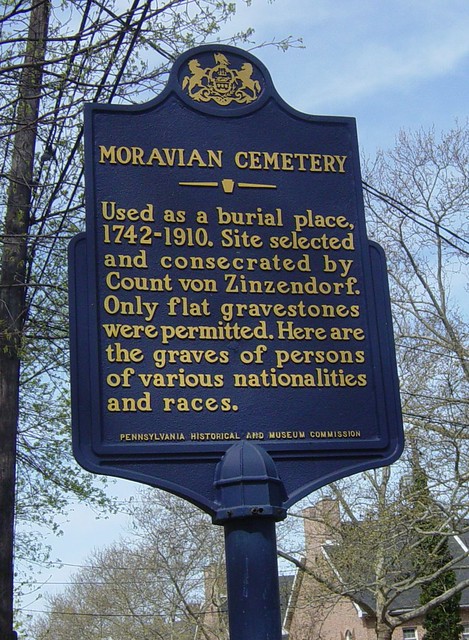
How a Small Group of Moravian Missionaries Changed America


The Moravian Church is a small Christian denomination in the United States, but it had a major influence on the spiritual life of Colonial America. On August 13th, 1727, a revival broke out with a small sect of Christians in Germany called the Moravians. On that day, they started a 100 year round-the-clock prayer meeting that launched the missionary movement that is still going strong today.

A group of persecuted Moravians first landed in Pennsylvania and another group in Savannah, Georgia in 1735. The ship to Georgia also carried John and Charles Wesley, brothers who planned to preach in America. During the voyage a fierce storm caused havoc, but John Wesley noticed the Moravians, even the women and children, weren’t afraid. When he asked a Moravian pastor about it, the pastor said that his people were not afraid because they knew Jesus. Wesley admitted that, although he knew about God, he didn’t have a witness within him that he was saved. Wesley credited this conversation with his eventual salvation. The Moravian colony in Savannah didn’t last long. Within a few years, the Moravians fled Georgia because of pressure to serve in militia to defend Florida against Spanish raids.

Christian Henry Rauch started the first mission to convert native peoples in New York City. Mahican chiefs Tschoop and Shabash invited Rauch to visit their village and teach them. Two of the chiefs became Christians, and within two years, the first native Christ congregation was established.

Several missionaries and their families joined Rauch, including Gottlob Buettner and his daughter Anna, and more missions were established. Rumors were started that the Moravians were really Catholic Jesuits allied with the French, and in 1744, Governor Clinton expelled the missionaries from New York.

In Pennsylvania, Revivalist George Whitefield invited the Moravians to Pennsylvania to preach. There they established a colony in Nazareth, but when they had a falling out with Whitefield, they moved on to other colonies. Pennsylvania had religious freedom in its charter, so the Moravians did better there. They founded also established colonies in the towns of Bethlehem, Nazereth, Emmaus, and Lititz there. The Moravians also established colonists in Maryland and North Carolina.

Many of the Pennsylvania Moravians learned the language of the Lenape (Delaware) Indians and translated a Bible into a written language for them. When the Lenape were forced into Ohio, some of the Moravians moved with them and founded the first Ohio settlement (Schoenbrunn) and school in 1772. A year later, they founded another nearby settlement of Gnadenhutten. Converted Lenape populated much of the villages and sat on the councils for the towns.


Schoenbrunn Village
During the Revolutionary War, the leader of the Moravian villages in Ohio, David Zeisberger, was accused by the British of passing along information to the colonial army. Although the Moravians were pacifist and wanted to remain neutral, the accusations were probably true. The Moravian villages were forced to relocate in 1781. The following year, a band of Moravian Lenape went back to Gnadenhutten to harvest their crops and collect food and supplies they left there.

160 Pennsylvania militia led by Lieutenant Colonel David Williamson surprised the Christian Lenape, rounded them up, and accused them of raiding towns in Pennsylvania. Although the Lenape denied the charges, Williamson held a council that voted to kill them. Some of the militiamen left the area, outraged by the decision.


Gnadenhutten Massacre Memorial
The Lenape were informed and requested time to prepare themselves. They spent the night praying and singing hymns. The next morning, the militia brought the Lenape to two buildings called killing houses, the men in one and the women and children in another. The militia murdered and scalped 28 men, 29 women, and 39 children before piling their bodies in the mission buildings. Then they burned both Moravian villages to the ground. Two boys, on of who had been scalped, survived and lived to tell about it.

Reactions from the massacre were mixed. Some were appalled at the way Christian men, women, and children were treated. Others figured the Lenape were deserved no better because they were Indians. The Lenape of the area decided to fight with the British against the Americans causing further deterioration of Indian relations.

Although Moravians continued to minister in America and established missions in Alaska and Canada, many missionaries from the Moravian Church decided to focus their efforts on Africa, but they influenced our nation's early days. They brought awareness of the treatment of Native Americans. They made a profound impact on preachers of the Great Awakening like the Wesleys and George Whitefield. The missionary movement they started moved through the United States which became the nation with the largest amount of missionaries throughout the world. The Moravian denomination continues today in 18 states with headquarters in Bethlehem and Winston-Salem.
 
In A Christmas Promise, you can read a fictional novella about the Moravian missionaries in Schoenbrunn.

Wednesday, July 22, 2015

Georgia - A Charity Case

by Roseanna M. White

I learned a lot this year, teaching my kids early American history--and one of the things I'd never known before was about how the colony of Georgia came to be.
James Oglethorpe

It began in the mind of General James Oglethorpe, who was greatly disturbed by all the poor he saw in London--and the drunkeness. He as his friends had been discussing the woeful situation for quite a while, with no ready solution coming to mind. Then one day they saw a map of North America, and they noticed a large swath of land still unclaimed on the Eastern seaboard, between English South Carolina and Spanish Florida.

In their minds, claiming this land as a charity colony would solve two problems at once--form a barricade between Spanish lands and the rest of the English colonies, and give them a place to send some of London's poor. It was, they determined, a brilliant idea! In short order, they had it all planned out: they would set up silk farms in this colony, which would enable Britain to get its silks from an English-held source instead of foreign countries. They were absolutely sure they could plant mulberry trees in Georgia and introduce silk worms onto them.
The silkworm

By the numbers given by Sir Thomas Lombe--silk expert--the men estimated that they could employ 40,000 in this pursuit, thereby giving livelihoods and means to the poor. They would soon be providing all of England's silk needs. Then selling it to the rest of the world! Certain of the beauty of this plan, they proposed naming the colony Georgia after the reigning King George II--and the king, liking what he heard, heartily agreed and granted a charter.

Now comes the but...

But this was all theory. None of these men had ever gone to Georgia, certainly not with any notoriously finicky silkworms. These creatures are strange and delicate, feeding exclusively on the leaves of white mulberry trees.
A black mulberry tree

And the mulberry trees growing in Georgia? Black. Black mulberry trees, and the silkworms wouldn't have anything to do with them.

The founders of Georgia had already advertised for the most "distressed, virtuous, and industrious" of London's poor, and they'd made them sign contracts committing to planting X-amount of mulberry trees. These contracts stipulated that the people didn't own the land...or the tools...or the clothing...or the food.

Reality, of course, was far different from this utopia envision by Oglethorpe and his friends. The first group of settlers arrived in 1732 and were promptly scorched by heat far worse than to what they were accustomed. And when the silk crop failed, the settlers were blamed, not helped to find other crops. By the time of the Revolution, Georgia was the most sparsely populated and poorest colony in the Americas. A wonderful vision, poorly executed.

~*~


Roseanna M. White pens her novels beneath her Betsy Ross flag, with her Jane Austen action figure watching over her. When not writing fiction, she’s homeschooling her two children, editing and designing, and pretending her house will clean itself. The Lost Heiress is Roseanna’s tenth published book. Her novels range from biblical fiction to American-set romances to her new British series. She lives with her family in West Virginia. Learn more at www.RoseannaMWhite.com

Tuesday, June 16, 2015

Creek Indians in Revolutionary War-era Georgia


The research for what will be the final novel of my Restoration Chronicles Trilogy, Witch: 1790 (www.deniseweimerbooks.webs.com) has included learning about the Creek Indians. My Georgia Gold Series featured some late Cherokee history just prior to the Trail of Tears, but until I moved out of the foothills to the Georgia Piedmont, I knew little about this area of the state’s early residents. So who were they? And what were they like? In a series of articles I’ll share some of my findings on Creek Indian towns, appearance, beliefs, Colonial war in Piedmont Georgia and the charismatic half-blood Supreme Chief Alexander McGillivray (by the way, someone needs to write a novel about him). Today’s article will serve as an introduction.

Musgrove & 3rd husband Rev. Bosomworth negotiating for Creek
Before the middle of the 16th Century, the Creek Indians (Muscogee, Muskogee, or traditional spelling Mvskoke), Mississippian Culture mound-builders, controlled most all of present-day Georgia. Following the battle of Slaughter Gap against their neighbors, the Cherokee, the Creek moved past the Etowah River. Another battle in 1755 determined the later Creek-Cherokee border with the Creek south of the Chattahoochee River in Georgia and west of the Coosa River in Alabama. This began the period of referring to the Upper and Lower Creek tribes. Piedmont or Middle Georgia was the home of the Lower Creek. Mary Musgrove, daughter of an English trader and a Muscogee woman from the Wind Clan, helped her husband John run a fur trading post and became the main interpreter for the first governor of Georgia. Under these favorable conditions, peace and deerskin trade flourished.

 
During the French and Indian War, the Upper Creek sided with the Cherokee against the English. The peace conference in Augusta, Georgia, in 1763, gave the victorious English colonies a large section of Indian lands. White settlement began. By 1773, Georgians demanded payment of the trade debts accrued by the Native Americans. This occurred at a land cessation meeting in Augusta.

Even after the land cessations, many Creek farms remained on open-to-settlement land. True Muscogean speakers sometimes looked down on Yuchi or Hitchiti speaker members of Creek Nation, calling them “stinkards.” Hitchiti considered Muscogees interlopers from the west in the past who had moved closer to traders and trapped and hunted year round to satisfy their desires for white goods. From 1716 on, many Creek Indians fled the land pressures in Georgia for Florida, becoming Seminole Indians. Seminole was a corruption of the Spanish word Cimarron, meaning “runaway” or “wild one.”

On the eve of the American Revolution, the Spanish to the south, French to the west and Cherokee and Creek on the frontier placed Georgia in an insecure position. Even though the Lower Creeks were more a loose confederation of independent towns than a unified people, they could have overpowered the still randomly populated state. Supreme Creek Chief Alexander McGillivray, son of a wealthy Scottish trader and planter whose property had been confiscated by the state of Georgia, pushed the Upper Creek to ally with the British, fighting alongside the Chickamauga (Lower Cherokee) warriors of Dragging Canoe. Meanwhile, McGillivray’s ex-trading partner George Galphin had some success in persuading the Lower Creeks to remain neutral. However, after the capture of Savannah by the British, they became nominal allies. Muscogee warriors also fought with the British in the campaigns of Mobile and Pensacola.

Following the war, a series of treaties between the new U.S. government or the State of Georgia and the Creek Nation led to misunderstanding and frustration on both sides and were not recognized by McGillivray and the main body of Creek Indians. By 1786, war had been declared on the Georgia frontier, one that would rage for many years.