Announcements

10 Year Anniverary & New Releases Winners: Carrie Fancett Pagels' Butterfly Cottage - Melanie B, Dogwood Plantation - Patty H R, Janet Grunst's winner is Connie S., Denise Weimer's Winner is Kay M., Naomi Musch's winner is Chappy Debbie, Angela Couch - Kathleen Maher, Pegg Thomas Beverly D. M. & Gracie Y., Christy Distler - Kailey B., Shannon McNear - Marilyn R.

Friday, May 17, 2013

New York State and the Quartering Act of 1765

After the close of the French and Indian War, the British amassed troop population in the colonies to thwart further problems with the French and warring Natives. As these soldiers' numbers grew, the problem of where to house them grew, too. 

The Stamp Act, signed March 22, 1765, sought to collect money from colonists for this standing army. Then, under the Quartering Act of March 24 1765, barracks were to be constructed at colonists' expense, and communities were to provide ale, cider, bedding, fire, vinegar, salt, candles and other specific items to the soldiers. If the barracks proved insufficient, the soldiers were to be biletted at inns, taverns, barns, and even private residences of those selling wine or alcohol, and at livery stables, plus uninhabited residences and outbuildings.

Several forces were at play: transfers away from the frontier drew British fort soldiers to New York, Philadelphia, and other eastern cities and towns. Also, the crown's reticence to pay out retirements to the soldiers from the French and Indian War led to creating new work in the colonies for an army. If an influx of veterans returned to England it would create a great tax burden upon the loyal citizens there. Let them stay in the colonies and be compensated for the protection they provided.

From the Colonists' point of view, this boded trouble. They felt they didn't need the so-called protection of a standing army, but that it only existed to enforce compliance to the crown. More accustomed to militias who could be assembled for crisis and then disbanded, the colonists resented these soldiers. Militiamen were self-sufficient and could raise their own food and livelihood. These soldiers were akin to parasites, feeding off their harvests, lodging in their beds. It created no small burden on colonial communities.
Local NY City government officials refused to quarter arriving British troops at first, resulting in a minor skirmish.

Thomas Gage by John Copley
 In January 1766, the New York assembly voted to short fund the amount required to house Thomas Gage's expanding army. New Yorkers bore the brunt of the burden, since the greatest population of British soldiers resided there. By autumn the assembly decided not to fund them at all. Both sides became entrenched and embittered. 

“every Act of Oppression will sour their Tempers . . . and hasten their final Revolt” Benjamin Franklin

The Stamp Act was repealed in March of '66, but Parliament then passed the Declaratory Act giving itself the power to make whatever laws suited them, whether the colonists liked it or not. Its actual wording: “make laws . . . of sufficient force and validity to bind the colonies and people of America . . . in all cases whatsoever.”

 In March 1767, Britain responded by putting a moratorium on assembly meetings until their troops were fully funded. They gave New York until August. The NY assembly acquiesced in June. 

A. F.,” The New York Journal; or the General Advertiser, 10 September 1767; reprint of letter printed in The Boston Gazette after news arrived of the threatened suspension of the New York assembly.

Let us rise then with one voice and declare like true Englishmen, we abhor slavery and such as would enslave; we love Liberty and her friends; and that we will encourage the one and depress the other by all justifiable means in our power. ⎯ Let us call upon our sister colonies to join with us in so glorious a work. Let no man think his influence too small to assist in it, but let everyone use his best endeavors to render it universal. Then shall we obtain our wishes and put to shame our enemies, who would gladly see us run into mad disorder and wild confusion at this critical juncture. ⎯ Let us pursue steadily this point without giving heed to their promises or threats, which are designed to lead us into error, and in the end destroy us. Tho’ the Press, that sure and grand support of Liberty and Right, should be threatened with the summary proceedings of the Star Chamber, 4 and our righteous opposition to slavery be called rebellion, yet will a true Englishman pursue his duty with firmness, and leave the event to Heaven.
4 Star Chamber: secret English court in the 1600's that prosecuted crimes without regard to the constitutional rights of Englishmen.

A second Quartering Act came in 1774. It was less burdensome than the first in that it didn't require colonists to provide provision to the troops. 
These were examples of the Intolerable Acts that led to the uniting of the colonies against British tyranny. 

The suffering and indignity of the Quartering Acts was so great that the third amendment to the constitution expressly forbids the forcible quartering of troops in private residences without consent.

Wednesday, May 15, 2013

Nathaniel's Folly at Mount Woolaston

God bless you, my friends for joining me this morn. For those new, I am Nathaniel Griffith of Newport in the colony of Rhode Island, 1670. I see you noticed my lame leg. Aye, the Lord gave it to me to remind me of my folly. I was not always the God-fearing man I am now.

Come now, though. Sit by the fire. 'Tis cool this May rain. Not uncommon for Newport this time of year, but I'll be glad to see the summer warmth. Through the winter my hip aches with sharp pains radiating down me legs like burning knives. But at least I have my legs and my life.

Nigh thirty years ago I had an affinity for all things contrary to my father's Puritan ways. Me tad thought I might reform if I went to Harvard. I believe he hoped I'd be a clergyman when 'twas clear I had no taste for the sea or the shipping company. But the strict rules and teachings of Harvard only strengthened my resolve to rebel.

On break one winter I set out from the college to return home a different way, to my shame. I set out to find a wench at  Mount Woolaston (renamed Merry Mount by Thomas Morton for a time and later the town was called Braintree). Martin Saunders kept a house of entertainment there where a young man such as myself could enjoy a drink of wine. Aye, Mount Wollaston, er, Braintree could soothe my conscience as well for there resided the notable Anne Hutchinson. I also met the respectable William Coddington with whom I would join here in Newport in later years.

Who is Anne Hutchinson, you ask? She was a woman who dared to stand against the Puritans for their works-driven faith. Aye, but she also did not correct me in my wayward ways. Perhaps if she had . . . but I stray from my story.

'Twas late when I finally said goodbye to my wench. Martin Saunders had kept my glass full through the night so as to keep me from being cold on my ride. Folly, that be. I mounted my horse and swayed a top it. It staggered under my weight but steadied itself and turned home. An ice storm had come through and the roads were slippery. The horse slid. I felt the fall would never end as he scrambled to get his footing, tossing me about the saddle. Then as though the hand of God swatted it, the horse fell to its side, catching my leg beneath it and wrenching my hip. In my drunken stupor I hardly felt the pain, but I must have cried out for Reverend John Wheelwright found me and helped me to his home.

Not for several weeks did I return to my father's house, and that in shame. My father could not stand the sight of me. I had ruined my chances of ever being a clergyman and marred his stature in our town. I was ruined. Like Jacob in the Bible, I would spend the rest of my life walking with a halt. By God's mercy, He stopped my folly and soon after my sweet wife, though at the time she was my sister's handmaid, showed me a better way.

That story shall wait for another day. My goodwife, Sarah, has been encouraging me to write my story down. I should say our story, for her role is equal to, and perhaps greater than, mine. Suffice it to say for now the slipping of that horse changed the course of my life, and I am a better man today for it.


Lynn Squire here. Mount Wollaston did exist at what is now Qunicy, MA. Though the name changed several times through the years, the first half of the 1600's the area had a reputation for 'unholy' living. Martin Saunders did receive permission from the Puritans to have a house of entertainment in 1639 where he could sell wine (1640). As to a wench? Well, the reputation of the area was one of loose morals.

Braintree, MA and the surrounding area was home to many well-known characters, not only of the 17th century, but of later individuals, like John Adams and John Hancock.

As to the horse falling and injuring Nathaniel...can I have Nathaniel tell a story without me having a similar one? I also had a horse slip, fall on its side, and trap my leg beneath it. My ankle was seriously injured. After a great deal of physical therapy in an attempt to restore its strength, my doctor concluded I would spend the rest of my life wearing a brace. I spent perhaps a month in that brace. The Lord had a work for me to do, and I would be hindered if I were to wear the brace. One morning I decided to toss the brace aside and go about my business as the Lord deemed necessary. I praise the Lord that today I walk well without a brace or crutch of any sort. No one would know of the injury (except perhaps via x-ray or to look closely at the shape of the ankle and the scars). And I must add that when the horse fell on me I was of sound mind--not drunk or otherwise. To God be all glory.

Monday, May 13, 2013

Barbary Pirates, Naval Hero Stephen Decatur, and the Burning of the Philidelphia!

Many Americans don't realize that the 21st century is not the first time our country has had to fight against Muslim extremists. In fact, our young nation was terrorized for years by the Barbary Pirates.


The Barbary pirates, also called Barbary corsairs or Ottoman corsairs, were pirates who operated off the North African coast. Their hunting grounds consisted of the Mediterranean, the coast of  West Africa, South America, and into the North Atlantic as far north as Iceland, but they primarily operated in the western Mediterranean. They seized ships and also raided coastal towns in pursuit of goods and Christian slaves for the Islamic market.  After American became a new nation in 1776, the Barbary pirates began attacking our ships until a deal was made in which we paid them an annual ransom which amounted to  20% of United States government annual expenditures in 1800, if they would leave our ships alone. (Hard to believe our great nation ever paid an extortion fee to pirates!)

However by 1804, the pirates were getting the upper hand and Congress sent a modest fleet to quell the recent attacks out of Tripoli. Unfortunately, the US Frigate, Philadelphia ran around and was captured by the pirates and they then turned into one of the most fearsome pirate vessels ever to sail. Now, not only was the US Navy severely depleted, but they had to endure being attacked by their own ship!

But the US wanted their ship back. The problem was it was under guard in the well-fortified Tripoli Harbor. They may not be able to recapture it, but they must ensure the pirates didn’t use it against them anymore.

Burning of the USS Philadelphia
by Edward Moran (1897)
Intrepid depicted in foreground
Commander Stephen Decatur was chosen to lead the raid. He had recently captured a small pirate ketch, Intrepid. The plan was to sail into the harbor under the ship’s original pirate colors.  Decatur set out from Syracuse on February 3, 1804 and sailed into Tripoli by moonlight on February 16, 1804. With most of the crew hid below, Decatur asked permission to come tie alongside the Philadelphia..  Permission was granted, and before the pirates knew what was happening, Decatur and his men swarmed the decks. The pirates jumped overboard and swam for shore, and in 20 minutes Decatur had set the Philadelphia ablaze. Back on the Intrepid, they rowed out of the harbor as they watched the Philadelphia burn to the waterline. 


Decatur became a national hero and went on to distinguish himself during another raid on Tripoli in August 1804. He also served honorably in the War of 1812  and finally returned to Tripoli in May of 1815 to sign peace treaties with the Barbary pirates, effectively ending their reign.

I hope you found this little piece of our history as fascinating as I did! 

Friday, May 10, 2013

Cynthia Howerter Shares About Her Ancestor - Revolutionary War Colonel John Kelly


Colonel John Kelly - Pennsylvania Historical Marker


No matter where a person lived in America during the Revolutionary War, difficulties were commonplace. My fourth great-grandparents, Sarah and Colonel John Kelly, lived in the Pennsylvania frontier on land they purchased from the Penn family. They worked hard to build a life and home for their growing family.

In early July 1778, word reached Sarah and John that British and Indians were attacking and massacring settlers in Pennsylvania’s not too-distant Wyoming Valley. Two days later, the enemy descended upon the West Branch of the Susquehanna River, the area the Kelly family called home.

Sarah and John understood that the price of staying in one’s home during Indian attacks was often a person’s life. Unable to take possessions, Sarah and her children—four-year old John and two-year old James—left their house. Taking a final look at their large log cabin, Sarah wondered if the British and Indians would burn it to the ground.  

With John leading the way, the young family hurried to the Susquehanna River—several miles away. There, Sarah and the boys climbed onto a hastily built raft and paddled to the middle of the river where they hoped enemy arrows and bullets could not reach. Sarah and her small sons floated downriver, either to the safety of Fort Augusta or further south to where Harrisburg now stands. They remained in exile for an extended period--until peace returned to the area. John, a Colonel in the Pennsylvania Militia, remained behind and commanded a group of rangers charged with protecting the area from enemy attack.

Over two hundred years later, my husband and I faced leaving our house during difficult circumstances. After my husband lost his job during the severe 2008 recession—with no sign of new employment on the horizon—we made the heartbreaking decision to sell our house rather than risk running out of money and not being able to make the mortgage payments. We faced possible homelessness until a relative offered to allow us to live with them.  

During our two years of unemployment, our future appeared hopeless. At times, I despaired of ever returning to a good life. I often thought of Sarah and John whose trust in God sustained them when their world turned upside down with no guarantee of survival. Their faith and perseverance in the face of life-threatening dangers encouraged me to keep going in spite of the overwhelming odds against my husband finding another job and our family buying another home.

Eventually, the British and Indians stopped warring on Pennsylvania settlers, and Sarah and John returned home where their lives continued and prospered. And when God deemed the time right, not only did my husband find a job, but He provided another house for us.


Cynthia Howerter's new book (available for pre-order), God’s Provision in Tough Times—co-authored by La-Tan Roland Murphy—is an anthology containing 25 true stories about the ways God provided for each of our 17 writers during difficult times. God’s Provision in Tough Times is available for pre-order at Amazon.com. Colonial Quills founder and writer Carrie Fancett Pagels contributed a story to the book.

Wednesday, May 8, 2013

Ethan Allen—Hero, Prisoner-of-War, Patriot


I must confess to ignorance concerning Ethan Allen. The sum of my knowledge concerning this historical figure in American history was pretty much summed up in the phrase, “Ethan Allen and the Green Mountain Boys.” As is usually the case, there is so much more to the story.

Born in January of 1738 in Litchfield, CT, Allen was the oldest of eight children. He was recognized as a young man of “precocious” intelligence and a love of reading, which prompted his father to arrange for tutoring with the hope of admission to Yale. That plan was put on permanent hold when Allen turned seventeen; the death of his father necessitated that he return to manage the family farm.

Allen married at the age of 24 and he and his wife had five children. During the decade of the 1760’s, Allen and his brothers became involved in land speculations, in particular the area of the Green Mountains between New York and New Hampshire. These “New Hampshire Grants” were cause for dissension between the colonies as New Hampshire and New York both claimed the area of Vermont as their own.

When Allen relocated to this area in dispute, he used his military training learned in the French and Indian War to gather fellow settlers and form the militia group known as the Green Mountain Boys. This group effectively controlled Vermont between 1771 and 1775. So when the American Revolution officially started in 1775, Allen and the boys were ready.

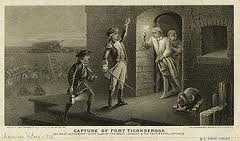
The colonel commandant and his militia began planning the seizure of Fort Ticonderoga from the British. On the eve of the planned assault, Colonel Benedict Arnold showed up to take over. Loyal to their existing officer, the Green Mountain Boys threatened to return home, which forced Arnold to share command with Allen. On the eve of May 9, 1775, Allen and Arnold planned the assault for the next morning.


Arriving at the lake opposite Fort Ticonderoga, the army had difficulty obtaining boats to cross over to the fort. With dawn fast approaching, Allen knew that successful assault required immediate action—yet only 83 of the 230 Green Mountain boys had as yet crossed. In his own narrative years later, Allen recounts his speech to the 83 members of his militia:

“Friends and fellow soldiers, you have, for a number of years, been a scourge and terror to arbitrary powers. Your valor has been famed abroad, and acknowledged, as appears by the advice and orders to me (from the General Assembly of Connecticut) to surprise and take the garrison now before us. I now propose to advance before you, and in person conduct you through the wicket gate; for we must this morning either quit our pretension to valor, or possess ourselves of this fortress in a few minutes; and, in as much as it is a desperate attempt (which none but the bravest of men dare undertake), I do not urge it on any contrary to his will. You that will undertake voluntarily, poise your firelocks.”

Leading the ranks in front and center, Allen took the fort that day, stating to the surrendering officer (Captain Delaplace) that he took the garrison “In the name of the Great Jehovah and the Continental Congress.”

Allen continued to lead the militia group, but four months later, they were engaged in fighting near Montreal when they were captured as prisoners. Thus began two and a half years of horror in prison as he and his men were transported first to England, then Halifax and finally to New York. During this time they were forced to survive in excrement-filled holds and forced to witness atrocities against captured patriots in New York. Concerning his first transport to England, Allen later wrote, “what is the most surprising is that not one of us died on passage.”

His imprisonment vacillated between inhumane conditions, then occasional reprieves by some officers who treated him in a more civil manor, since he was a colonel. At one point when imprisoned in New York, he was abruptly wined and dined by a British officer of rank and offered money and a tract of land if Allen would embark with General Burgoyne and “assist in the reduction of the country.”

Allen wrote, “I viewed the offer of land to be similar to that which the devil offered Jesus Christ, ‘To give Him all the kingdoms of the world if He would fall down and worship him.’”

On the third of May, 1777, Allen was taken out under guard and taken to a sloop in the New York harbor. Again, for two days, he was suddenly treated in a “polite manner” and given fine food and drink. A day later, this unexpected turn of events became clear: Allen was being exchanged for a British prisoner.

“I sailed to Elizabethtown-Point, and in a transport of joy, landed on liberty ground, and as I advanced into the country, received the acclamations of a grateful people.”

Taken to Valley Forge, Ethan Allen was “courteously received” by General Washington. Allen offered the general his further service on behalf of his country, “as soon as my health (which was very much impaired) would admit.”
http://www.ethanallenhomestead.org/

“I then bid farewell to my noble General and set out for Bennington (Vermont) the capital of the Green Mountain Boys, where I arrived the evening of the last day of May to their great surprise; for I was to them as one rose from the dead and now both their joy and mine was complete.”

Allen was given the rank of major general in the Vermont militia but his health was severely impaired by his years of imprisonment.  His first wife died in 1783, the year the Revolution ended. The following year he remarried and his young wife gave birth to three children.

In 1777, Vermonters had formally declared their independence from Britain and their fellow colonies and created the Republic of Vermont. Ethan Allen spent the rest of his life petitioning the Continental Congress to grant statehood to his beloved Vermont.

Even after the war concluded in 1783, New York, Massachusetts, and Connecticut all laid claim to the land in Vermont.

Allen died on February 12, 1789, at the age of 51, on his farm along the Winooski River in the still independent Republic of Vermont. The area was admitted to the Union two years later as the 14th state.  His youngest child was only two years old at the time of his death.