Today is a big day in my house--I'll have my first knitting lesson at my church, along with my daughter (who has had lessons before). Being a history buff, I don't think of it as learning a new skill so much as learning an old one, and glimpsing a history long handed down from mother to daughter (my mother will be in these classes too, as it happens).
One of the things I best remember from a trip I took to a Colonial-era village is the way housewives in rural areas had to create their homespun cloth. During the Revolution, wearing homespun became a thing of pride--because true Patriots would refuse to purchase cloth imported from Europe.
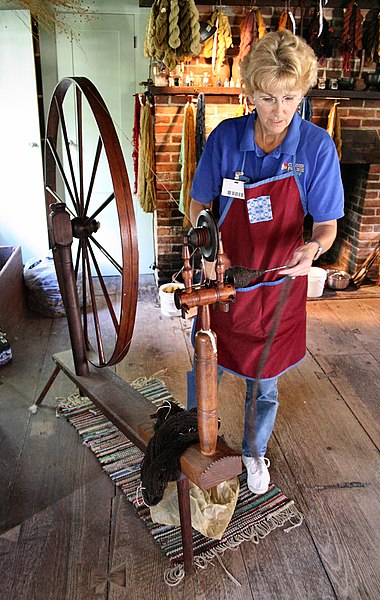
Inside this historic house,
Visitors get a glimpse of the spinning process. They have a huge spinning wheel set up, called a walking wheel, great wheel, or wool wheel. These spinning wheels are usually about 5 feet in diameter--so big that you have to
walk back and forth about six feet as you're spinning, hence the name.
(Exercise while you work!)
The wool ends up on a spool, which is then detached from the big wheel, and spun onto the weasel, which puts it into skeins. It takes
150 rotations to equal one skein--and because the brilliant creators of
this device knew well no one was going to sit there counting to 150 all
day, the weasel pops after 150 revolutions. Sound familiar? Altogether
now: "Here we go round the mulberry bush, the monkey chased the weasel .
. ." =)
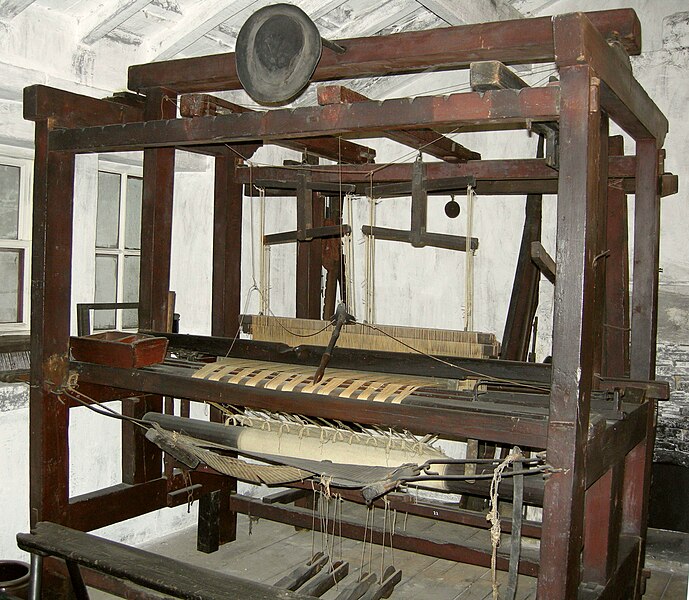
This process would give you your yarn or thread...but then what? The loom, of course.
When European settlers first arrived in America, they brought with them hand looms of a style that had been in use since the 1300s. Plantations would have loom-houses set up where slaves produced the cloth for servant clothing, bedding, etc. In smaller households, not everyone had a loom--but there was generally one in a neighborhood, and colonials often traded goods and services to the wife who had one in return for her turning their wool into cloth for them.
(Side note--in my homeschool last year, we read a novel [aimed at kids but enjoyable for all] called
Calico Bush that includes this aspect of Colonial life.)
We today often look at this laborious process and think that producing cloth was very labor intensive and difficult--a sentiment shared by many of our forebears! Hence why those who could afford to do so bought cloth imported by Europe.
~*~
Roseanna M. White pens her novels beneath her Betsy Ross flag, with
her Jane Austen action figure watching over her. When not writing fiction,
she’s homeschooling her two children, editing and designing, and pretending her
house will clean itself. Roseanna's 10th book, The Lost Heiress, just released.