Announcements

10 Year Anniverary & New Releases Winners: Carrie Fancett Pagels' Butterfly Cottage - Melanie B, Dogwood Plantation - Patty H R, Janet Grunst's winner is Connie S., Denise Weimer's Winner is Kay M., Naomi Musch's winner is Chappy Debbie, Angela Couch - Kathleen Maher, Pegg Thomas Beverly D. M. & Gracie Y., Christy Distler - Kailey B., Shannon McNear - Marilyn R.
Showing posts with label tobacco. Show all posts

Monday, May 9, 2016

Tobacco: a mainstay of colonial economics

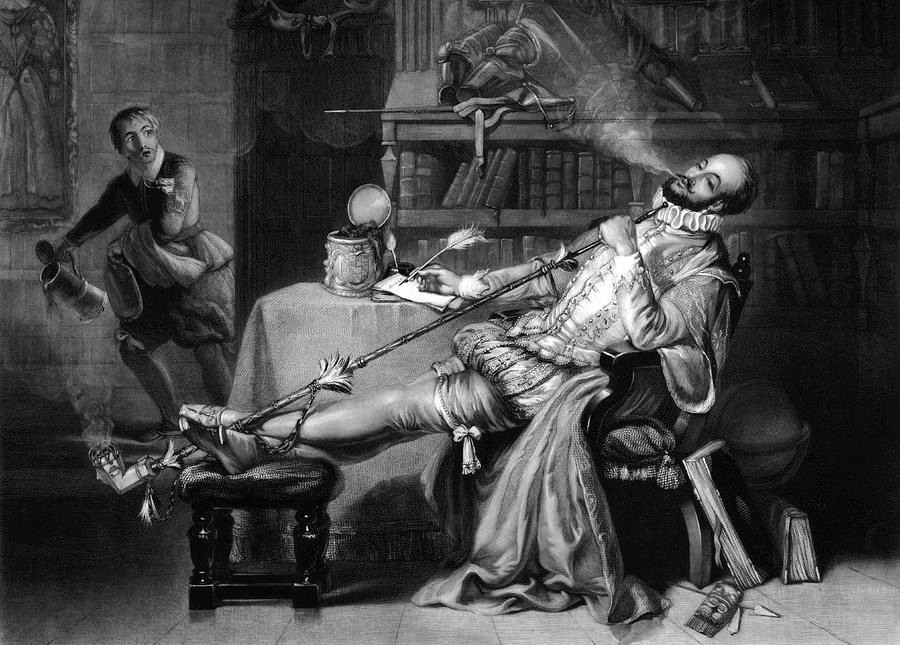
"Raleigh's first pipe in England" - Wikipedia
A stray mention of chewing tobacco in a friend's manuscript (which I can't wait to share with y'all! very soon!!) recently sent me down an interesting path of research. Being the research nerd I am, I immediately wondered, when did chewing tobacco per se become an actual thing?

Anyone who's studied colonial history for any length of time knows that tobacco use was pretty well ubiquitous. Even casual archaeology of the time bears witness to the profusion of clay pipes.

The growing of tobacco as America's first cash crop is pretty well covered in a previous post so I won't get into too much detail here, but after the first terrible year or two, the early settlers in Jamestown grew tobacco as a way to support themselves in trade. Columbus had found tobacco cultivation and use already well established in central America, and although tobacco was among the first gifts offered him and his men, they didn't know what to do with it, and threw it away when they got back to their ships!

Some other factoids about tobacco:

Tobacco use was slow to catch on in Europe, but when it did, doctors hailed it as something of a cure-all.

Sharing snuff in "The Monk of Calais" (1780)
By the mid 1500's, the use of snuff (powdered or pulverized smokeless tobacco) became widespread in Europe, and was the method of choice among the elite. Colonists preferred pipe smoking, except among the elite, and then the taking of tobacco as snuff evolved to tucking the pulverized leaves inside the cheek. (Which is considered the precursor to actual chewing tobacco, if anyone needs to know.)

Tobacco leaves were used as a type of currency, and supposedly helped fund the American Revolution.

Some religious groups did oppose the use of tobacco--the Puritans, for instance, and at least one pope threatened to excommunicate users of snuff. Some rulers outlawed it, while others were devoted users, themselves.

While native Caribbean and South American peoples are reported to have used tobacco in all its forms, from snuff to smoking rolled leaves (essentially, cigars), native North Americans are said to have reserved tobacco use to sacred and ceremonial use. Hence, the popular image of the peace pipe.

What surprised me:

The prevalence of growing tobacco from the beginning. Tobacco established the plantation culture in Virginia as the later cultivation of rice did in South Carolina.

The prevalence of tobacco as ... chewed! Many people found carrying a quid and tucking a piece in one's cheek (or actually chewing it) more convenient than pipe smoking.

And overall, though it probably shouldn't surprise me, I found myself amazed all over again at the changes in societal attitudes toward things like tobacco use, which despite the stigma in modern culture (especially some church cultures), was definitely a mainstay of both economic and social life in colonial times.

Reference and further reading:
 http://academic.udayton.edu/health/syllabi/tobacco/history.htm
 https://en.wikipedia.org/wiki/History_of_tobacco
 http://archive.tobacco.org/History/Tobacco_History.html

Wednesday, June 27, 2012

Guest Post - Julian Charity of Shirley Plantation on Slavery in Colonial Times


Our guest post today is by Julian Charity, Historian for Shirley Plantation in Charles City, Virginia.  Julian also has a new book release that we will be giving away to one lucky visitor this week.  We will be reviewing his book, about war at Shirley Plantation from the American Revolution, soon.

Slavery at Shirley Plantation 

by Julian Charity


Plantations in the New World supplied the English empire with an abundance of tobacco.  Cultivation of tobacco was labor intensive and cost prohibitive unless it is produced in large quantities. In order to keep the cost down and the production quantity up, indentured servants and slaves provided an economical labor force.  With indentured servants and slaves, the plantations became the economic backbone of the English empire.

The first record of servants at Shirley Plantation dates to 1616 when John Rolfe documented that Captain Isaac Madison commanded 25 men in planting and curing tobacco. These men were all white and indentured servants, also called indentures. Indentured servants were the original labor force at Shirley as well as in the rest of the English colonies. Indentured servants were people of various races who were contractually obligated to become laborers for a specified period of time in exchange for debt repayment, food, lodging, transportation to the colonies, and the teaching of a trade. Indentured servants were brought from Africa, the Caribbean islands, Scotland, Ireland, and England. In some of the British colonies of New England, servitude took the form of apprenticeships, in which an individual was a servant in exchange for learning a craft. In Virginia and throughout the southern colonies, where the economy was primarily agricultural, most indentured servants were field hands who tended tobacco fields. Though indentured servitude sounded appealing, the lives of these men and women were very difficult. They faced harsh punishments for petty crimes and transgressions against their masters. Penalties included whipping, hanging, shooting, and even burning the indenture alive. Masters could extend servants contracts and they had little recourse, legal or otherwise.

Africans first arrived in Virginia in 1619. The majority of these Africans likely became indentured servants though records from this era were unclear regarding their fates. The first documented African slave in Virginia came in 1640. John Punch, an African indentured servant, ran away from his master and a Virginia court ordered that Punch’s punishment be a lifetime of service to his master. In 1622, records for Shirley Plantation first mention an African or islander when documents indicated that eleven men including “One Negar,” had died since April.

Until Virginians committed to slave labor, indentured servants comprised the majority of the workforce.  Edward Hill I, the first Hill Carter family member to live at Shirley, probably took part in the indentured servant system. He imported 43 people in 1661. These people were likely indentures because the indentured servant system was more cost-effective and practical than the African slave system.

In The Making of New World Slavery:  From the Baroque to the Modern, 1492-1800, Robin Blackburn argued that indentured servants were a better investment until the end of the 1600s for several reasons. The high mortality rate of new arrivals to the New World was a contributing factor. An indentured contract may have only called for three or four years of service, but if the person only lived three or four years, then investing in more servants and fewer slaves was more cost efficient. White indentures were more popular because their masters knew their language and their work habits. Credit for purchasing servants was more easily received when buying white indentured labor (Blackburn 241-242). By the end of the seventeenth century, these issues became irrelevant and slaves began replacing indentures.

Bacon’s Rebellion in 1675 was a major contributing factor to the demise of the indentured servant system. Former and current indentured servants supported Nathaniel Bacon in his uprising. Colonial elite no longer favored the indentured servants after their collaboration with Bacon. Still in need of inexpensive labor, the importation of slaves to the colonies increased.

Read the entire article by clicking here.

GIVEAWAY:  Leave a comment below for a chance to win a copy of Julian's book.