Announcements

10 Year Anniverary & New Releases Winners: Carrie Fancett Pagels' Butterfly Cottage - Melanie B, Dogwood Plantation - Patty H R, Janet Grunst's winner is Connie S., Denise Weimer's Winner is Kay M., Naomi Musch's winner is Chappy Debbie, Angela Couch - Kathleen Maher, Pegg Thomas Beverly D. M. & Gracie Y., Christy Distler - Kailey B., Shannon McNear - Marilyn R.
Showing posts with label oxen. Show all posts

Tuesday, February 2, 2016

The Use of Oxen in Colonial Times by Cynthia Howerter


During a visit to Colonial Williamsburg several years ago, I encountered a man driving a pair of yoked oxen down Duke of Gloucester Street. The late Darin Tschopp was not only a caring oxen driver, he was also an excellent teacher with a vast knowledge of oxen and their use in colonial America.


Having never seen oxen before, I stopped and listened as Mr. Tschopp spoke to onlookers about his team.


Like the rest of the gathering crowd, I stood well away from the bovines, mostly because their horns looked intimidating and they were huge animals, but also because I lacked knowledge about the temperament of such powerful-looking beasts.
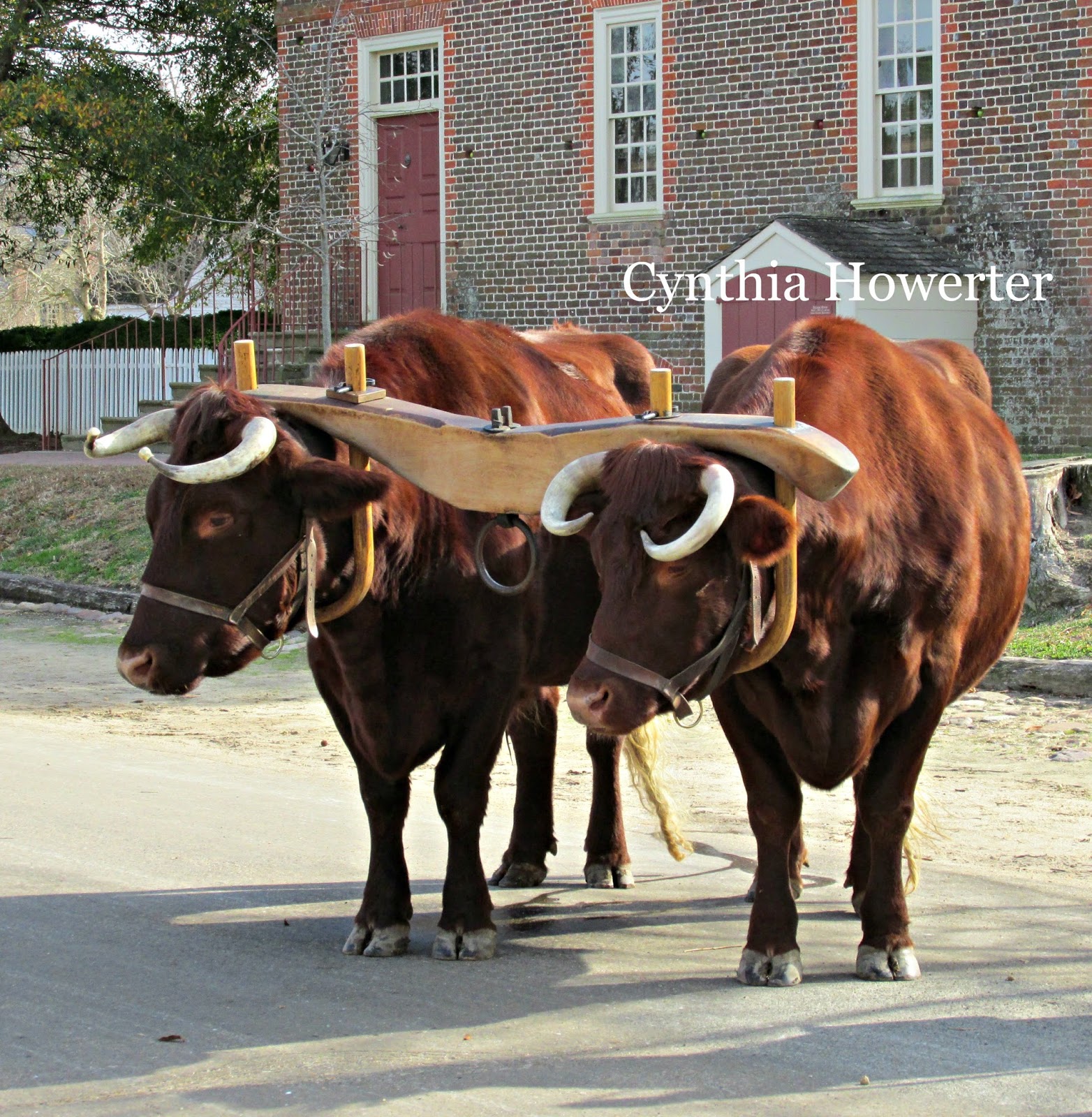


Mr. Tschopp explained that oxen are gentle, but I was dubious until a young boy stepped forward. The animals stood still and contented while the lad stroked their heads and ears. This was a point of favor with the colonists who needed animals to perform all of the heavy labor without being aggressive to their handlers.


Mr. Tschopp explained that oxen are smart. Capable of learning twenty verbal commands, training begins when they are calves. Small yokes pair two young oxen together to get them used to working as a team. Unless something happens to one, the same two are generally always teamed together. As oxen grow, they're given light loads to pull that don't cause injuries to the still immature bodies. They reach maturity at about four years of age. After that, it's their job to handle heavy chores.

Because of their size and strength, colonists used oxen for strenuous work on farms and in towns. On another visit to Colonial Williamsburg, I observed a team of oxen yoked to a cart loaded with firewood. I took the photo below after the cart had been emptied next to a summer kitchen.


Settlers in the colonies' backcountry discovered that Indians were less likely to steal oxen than horses. On farms and plantations, oxen's great strength enabled them to pull heavy objects like downed trees and bulky stones as well as drag plows through fields. Capable of pulling several tons, oxen teams transported supplies for the Continental Army during the Revolutionary War over rough terrain and crude paths that served as roads. Washington's army depended on these animals.

Eventually, Mr. Tschopp and his team made their way to a small field at the edge of town where I observed these beautiful animals responding to their master's commands. The oxen driver used no whip on the animals, just words which he spoke in a gentle but firm manner.


In memory of Colonial Williamsburg's oxen driver Darin Tschopp 
who allowed me to observe that gentleness comes in all sizes.
1966-2014


Photographs ©2017 Cynthia Howerter


Award-winning author Cynthia Howerter grew up playing in Fort Rice, a Revolutionary War fort owned by family members, and lived on land in Pennsylvania once called home by 18th century Oneida Chief Shikellamy. Hunting arrowheads and riding horses at break-neck speed across farm fields while pretending to flee from British-allied Indians provided exciting childhood experiences for Cynthia and set the stage for a life-long love of all things historical. A descendant of a Revolutionary War officer and a member of the Daughters of the American Revolution (DAR), history flows through Cynthia's veins.


You can find Cynthia Howerter on Facebook, Pinterest, Twitter, and Google+.


Monday, April 13, 2015

Handling oxen, colonial style

A team of ten pairs of oxen in Australia (Wikipedia)
 When developing the setting and details for The Highwayman, I had to decide whether my hero and his cousin made their trips up and down the Great Wagon Road with horses or oxen. Horses would have been an easy choice, since I practically grew up on horseback ... but silly me, I decided I wanted the challenge of researching oxen.

My standby research source, a Yahoo discussion group for all things 18th century, turned up some unexpected and delightful resources. Who remembers Almanzo, from Laura Ingalls Wilder’s Farmer Boy, training his pair of calves to be good oxen when they grew up? I was surprised to find that my memories of the process, gleaned years ago from that story, were fairly accurate.

What are oxen, you might ask? They are, by mere definition, working bovines. Not even any special breed, and either bulls or cows can be used, although bulls are usually castrated to make them easier to handle. Training begins early, with teams chosen as calves, handled and gentled so they grow into the calm, dependable, but powerful sources of energy.

Karel Dujardin, 1622–1678: A Smith Shoeing an Ox (Wiki)
It’s been fun over the years to meet various people who dedicate themselves to practicing various ancient life-skills, either for living history demonstrations or just for the personal satisfaction of keeping some dying knowledge alive a little longer. I knew many who work with teams of horses and wagons, but didn't realize so many focus on handling yoked oxen.

I'm indebted to several on the 18cLife Yahoo group who took the time to answer questions and point me to various online sources, but especially one gentleman, Bob Sherman of Charleston, SC, a historic interpreter at Middleton Place who works with many aspects of colonial agriculture and technical skills. He shared the following resources online:


https://www.youtube.com/watch?v=ul2PFDdeJ2k - a video on the basics of training oxen, from Rural Heritage

http://thefarmersmuseum.blogspot.com/2011/03/lippitt-farmstead-in-winter-new.html - scroll down for a photo of oxen in harness and yoke

http://www.history.org/Foundation/journal/Spring08/oxen_slideshow/ - various photos from Colonial Williamsburg

I also found this charming set of videos featuring working oxen in Ross, Nova Scotia: https://www.youtube.com/user/cooper68ns/videos ... scroll wayyy down past the personal farming stuff, which is also interesting. Especially check out "ox on road," featuring several yoked oxen taking a stroll, with their drovers, down a modern highway:  https://www.youtube.com/watch?v=hSqQ0XDvwws

Prairie Ox Drovers is another site I happened upon that might provide a good primer on working oxen.

Zebu oxen in Mumbai, India (Wikipedia)
Though treated as a quaint oddity in our country, oxen are still very much in use in many parts of the world. I'm so glad I took the time to research this fascinating method of colonial travel and freight hauling. I'd have missed learning some of the quirks and charms of working cattle--how they are less temperamental than horses, but still very attuned to the emotional state of their handlers. How they are such creatures of habit, some teams have been known to head for the barn a certain time of day with or without their handler, and pairs often insist on sharing a stall or at least being stabled next to each other.

Makes me almost want to go out and find my own pair to train and work!

Wednesday, October 17, 2012

Trampled! Loading Oxen on a Barge

Welcome dear friends. Come sit in the shade of this old oak tree by the milk cow field. Have I told you about a time we loaded ten oxen on a barge to be transported to across the bay? No? Well, settle down and me brother-in-law, Davis Owen, will share ye his experience.

Thank ye, Nathaniel. I chuckle for I know you, brother, ye seek to show me a fool, but ye are as much a one as I.

We were both anxious about the rumors of piracy and the accusations made against our own ships being used for such crimes. Yeah, it seemed even God was angry with us for the weather was wet and the footing slick. I’m sure our anxiety transferred to the oxen, making them all the more nervous.

Beach along Narragansett Bay
We’d made a v-shaped pen down the rocky beach to where the flat-bottomed freight boat was beached. As the oxen drew close to the barge, Nathaniel would slide a post behind two or three to keep them from turning around and rushing away from the barge. I drove them into the narrow part of the pen with a cane on their backs and plenty of shouting.

Now Nathaniel knows a thing or two about cattle, but sailors don’t. The tide was coming in and the waves rolled under the barge causing it to rock.

I heard the bawl of an oxen and the shout of a man and looked up to see a sailor slip down behind an animal that balked at the movement of the barge. His actions spooked the ones next in line. One reared up and spun around, his front legs landing on the head of one behind him.

At that moment the oxen in front of me backed up. “Whoa,” I yelled, but feeling me falter, the ox rushed back.

I waved my cane to no avail. My foot slipped, and I landed on my back, mud and sand splashing all around me.

The bullock, now free of the narrow aisle, turned and leapt over me.

I heard a crack like the breaking of wood and pulled myself into a ball. The air moved over me while another ox sailed above me. Hooves drummed around me and mud, rocks, and sand slid to and away from me like grapes under the feet of a crusher.

When the last oxen flew over me, I jumped to my feet. I had no thought for myself but that the frightened beasts would push the weak gate at the end of the pen and get away.

I began to work my way around the herd when I heard men roaring in laughter. I looked up and there was Nathaniel and two sailors holding their jiggling bellies.

Nathaniel waved his hand at me and said, “We thought you were a dead man.” He jumped over the fence and jogged to my side. “Always knew you were tougher than you looked.”

Aye, ‘tis true, Davis. Few would have known your noble background when you were covered from head to toe in mud and manure.

Me? I should remind you of the time…

Save it for another day, brother. These gentle people need to be one their way. Good day to you all and Godspeed.

Aye, Godspeed to you all.

______________________________________

A Word from Lynn Squire

Perhaps you find the story hard to believe, but it comes from personal experience. I’ve been trampled at least four times in my life from what I remember. One, very similar to Davis’s experience. We were loading calves onto a truck to take to market and something spooked the ones at the front of the shoot. They turned, knocked me down and jumped over me. Worried about lost time and the blame being put on me, I jumped to my feet and began chasing them back up the shoot. Then I heard my dad and sister laughing. They thought for sure I’d have been hurt.

Another time we were bringing in the horses, about sixty head. It was winter, and the ground was frozen, and I was bundled up so tight I could barely move. While closing the gate on the last horse, I stumbled and fell. Something had spooked the herd, and I had a good fifteen head leap over me in a rush to get out of the catch pen. Then too I jumped to my feet, knowing my clumsiness just cost a lot of time.

Why did I not get hurt in either situation? Because horses and cows would rather leap over a danger than run on top of it.

However, the third time I was not so lucky. I was leading a three year old thoroughbred filly when an electric fence sparked. She spooked, knocked me over and used me for a launching pad. I ended up with several broken ribs and a punctured lung. Had that happened to Davis Owen, he would not have lived to tell the story. I did, and we all have a good chuckle for there are so many stories to go along with that punctured lung (just a hint, I was no more than three weeks a newlywed).