Announcements

10 Year Anniverary & New Releases Winners: Carrie Fancett Pagels' Butterfly Cottage - Melanie B, Dogwood Plantation - Patty H R, Janet Grunst's winner is Connie S., Denise Weimer's Winner is Kay M., Naomi Musch's winner is Chappy Debbie, Angela Couch - Kathleen Maher, Pegg Thomas Beverly D. M. & Gracie Y., Christy Distler - Kailey B., Shannon McNear - Marilyn R.
Showing posts with label puritan marriage. Show all posts

Friday, February 24, 2017

A Puritan Marriage in New England

The Puritans of New England opposed anything the Anglican Church revered, save Christ alone. It's no surprise, therefore, that they viewed marriage differently as well. 

In England, marriages were generally arranged by the parents, but in the colonies, young people were encouraged to choose their own courtships, carried out under the watchful eyes of their parents. The Puritan marriage contract was to be agreed to by both the young people and their parents. Parents could not, however, arbitrarily withhold such consent. If they did, the young people could apply to a magistrate to agree in the parents' place.

The practice of a "bundling board" for courting couples was commonly used. The suitor would spend the night with the young lady in her bed, a wooden board between them, to allow them time and privacy to talk and get to know each other, with her parents close by. It wasn't fool-proof and occasionally a hasty followed . . . to prevent an illegitimate birth.

In 17th Century Massachusetts, the average age of the groom was 26, the bride 23. It's unclear why they were older in Massachusetts than in the other colonies. At whatever age, marriage was the desired path for most people. Records show that 94% of women and 98% of men married.

In another break from England, the Puritans didn't see marriage as a religious institution, but a civic contract. Marriages were not "performed" by church clergy, they were "agreed" upon in front of a magistrate. As such, they were also open to divorce. The Puritans allowed divorce under certain conditions, like abandonment, adultery, failure to provide, and physical abuse. 

A typical wedding took place in the bride's home with her family and a few friends. The ceremony was very short, a single question asked of both bride and groom, to which they both answered yes. No rings were exchanged, no holy vows, this was a contract between two agreeable parties. After the ceremony, the family provided a modest meal for the guests and they sang a psalm. No dancing - of course!

Puritans in the 17th Century viewed marriage as a close and compassionate relationship designed to meet the physical and financial needs of both partners, a mutually beneficial union of harmony.


PeggThomas.com

Embattled Hearts will release in April 2017 as part of The Pony Express Romance Collection from Barbour - Colonial story coming in January 2018


Wednesday, August 12, 2015

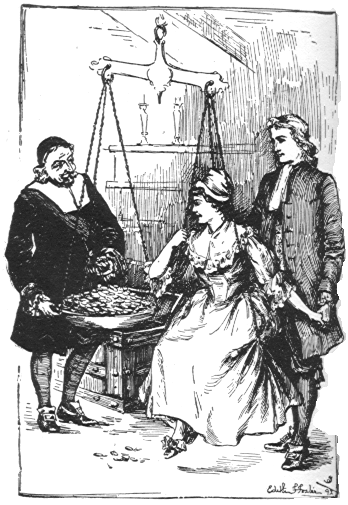
Hannah Hull's Dowry

Her Weight in Gold by Jean Leon Jerome Ferris


There is a charming tale called The Pine-Tree Shilling told by 19th century author, Nathaniel Hawthorne, in The Whole History of Grandfather's Chair (1840). It tells the story of a colonial maiden and how her father ascertained the worth of her dowry.

Miss Hannah Hull was the only daughter of one of the wealthiest men in Boston, Mintmaster John Hull and his wife Judith. In 1652, due to the increase in trade in the Colony, uncertain conditions with England, and to prevent fraudulent money, John Hull, a silversmith, and Robert Sanderson were authorized to erect “a mint for coining shillings, sixpences and three-pences.” Hull guaranteed that each of the Pine-Tree Shillings contained 15 ounces of silver. Massachusetts was the only one of the thirteen colonies that had a mint before the Revolution and it's Pine-Tree shilling circulated up until that time. John Hull’s share in the profits of the mint was fifteen pence of every twenty shillings. He rapidly amassed a fortune.


When twenty-four year old Samuel Sewell came courting and wished to marry Hannah, eighteen, the matter of her dowry came into the picture.


"She saw me when I took my degree and set her affection on me,
though I knew nothing of it until after our marriage, which was Feb 28th. 1675/76."

~ From The Diary of Samuel Sewell

Tradition says that John Hull placed his daughter in one of the scales and heaped in the other with silver, filling it with Pine-Tree shillings until the scales balanced. The wedding present amounted to a dowry of £500. The weight of this amount being 125 pounds may very well have approximated the bride's weight, giving credence to Hawthorne's tale. Samuel received a portion of the dowry seventeen days prior to the marriage nuptials and the remained a fortnight after the wedding. Hannah's marriage to Samuel gave him early wealth, an established merchant business, and a start to his illustrious career in public office. Yet biographers have attested that the marriage was built on mutual happiness and shared love and faith.


"Then the great scales were brought, amid laughter and jest,
And Betsy was called to step in and be weighed;
But a silence fell over each wondering guest
When the mint-master opened a ponderous chest
And a fortune of shillings displayed.
"By handfuls the silver was poured in one side
Till it weighed from the floor blushing Betsy, the bride;
And the mint-master called: 'Prithee, Sewell, my son,
The horses are saddled, the wedding is done;
Behold the bride's portion; and know all your days
Your wife is well worth every shilling she weighs.'"
 ~ Poem by Florence Royce Davis,
Historic Shrines of America, John T. Farris


You may read about the marriage of Hannah Hull and Samuel Sewall online in Puritan Family Life: The Diary of Samuel Sewall by Judith S. Graham.