
These days there's a lot of talk of going "paperless." Why? Because paper clutters things up. We have stacks upon stacks of it. Reams sitting, waiting to be used. In my house, there are desks full to bursting with sketches and crayon drawings on paper of all weights and colors and sizes. Need a bookmark? Grab a slip of paper. Need to make a note? Grab a Post-It. Everywhere we look, there it is: paper.
But paper wasn't always so bountiful, nor was it cheap, nor was it made from wood pulp like today's paper usually is. Paper, in Colonial days, was like most things: precious, and coming as a result of much toil.
Important documents were often written on parchment, which is made from lamb skin. That would be what the final version of Declaration of Independence is written on--but not the earlier drafts. No, those were on the same thing most books, newspapers, and correspondence would use--what might have been called rag paper, linen paper, or cotton paper.
The process began with people collecting the materials that would be used. Often old sails and rope from sailboats would be sold to papermakers, to be turned into rag. Never ones to waste, even within a household what cloth that was no longer useful for other tasks would be saved for paper.
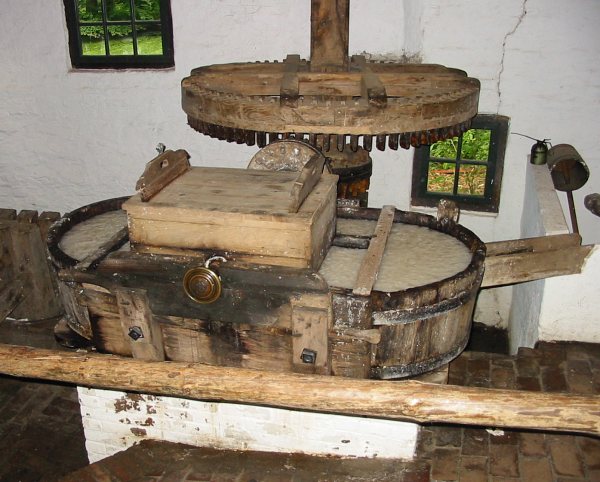 |
Once a papermaker had a large amount of these rags, his apprentices would roll them all up into a ball and pound them to turn them into a pulp with stamping mills. They were washed, dried, and stored for later use. Once its time came, the rag pulp would be mixed with water and stirred constantly so that the pulp didn't settle onto the bottom of the vat.
The next step would be to take a wooden frame with a metal mesh or grill attached to it and lower it into the vat.

Most early paper was cream or darker, sometimes gray. The whiter the paper, the higher quality it was considered.
From the mill, the paper would travel to stationers and people all over--just waiting to receive the ink that usually didn't last nearly as long as the paper onto which it was put. Rag paper is incredibly strong, hard to tear when dry--and though it can be torn when wet, you can mend it, and it will be as strong as ever when it dries again.
Photo credit - "Hollander" by Original uploader was Hdekroon at nl.wikipedia - Originally from nl.wikipedia; description page is/was here.. Licensed under CC BY-SA 3.0 via Wikimedia Commons - https://commons.wikimedia.org/wiki/File:Hollander.jpg#/media/File:Hollander.jpg
