
 |
| Eliza's grandson's wife is pictured here-- there are no known portraits of Eliza surviving. |
I recently attended the Francis Marion Memorial Days at Camp Bob Cooper near
The station that caught my eye was the one where Peggy Chiappetta presented the story of Eliza Lucas Pinckney and demonstrated how to dye cloth with indigo and various other herbs and plants.
Famous South Carolinian, Eliza Lucas, who was born in Antigua in 1722, took charge of her father’s plantation near Charles Town, SC, when he, as a British Army officer was called back into the military. She was only sixteen. Her mother was ill, so Eliza ran the estate and cared for her mother and younger sister.
She traveled to England South Carolina , she received indigo seeds from her father in the West Indies . Her knowledge of botany gave her a great advantage as she experimented for three years ways to make a high-quality blue dye from the indigo plant.
 |
| Mrs. Peggy Chiappetta |
Mrs. Chiappetta gave the following fascinating account of how indigo was processed.
The three- to four-foot tall bushes would be cut and thrown into a pond where they were allowed to rot. That pond would be drained into an empty pond, taking with it the purple water and leaving behind the rotted plants. Slaves would then beat the surface of that pond with sticks, stirring up the oxygen which interacted with the water, forming particles that sunk to the bottom. When ready, that pond would be drained, leaving behind purple clay that was fashioned into bricks, which is how the dye was sold.
 |
| Mrs. Chiappetta demonstrates how to dye with indigo. |
Historian Edward McCrady wrote: "Indigo proved more really beneficial to Carolina than the mines of Mexico or Peru were to Spain
In 1744, Eliza married a widower, Charles Pinckney, a Chief Justice of the Province, and they had four children, Charles Cotesworth, Thomas, another son who died, and a daughter, Harriott.
After her marriage, Eliza continued experiments with hemp and flax and revived the silk culture in the Lowcountry. She took over management of her husband's several plantations and Charles Town properties after his death in 1758.
Her two sons became national figures: Charles Cotesworth Pinckney, who was a general in the Revolutionary War and a signer of the United States Constitution; and Thomas Pinckney, also a Revolutionary War officer, later a general, and the United States Minister to Spain and to Great Britain.
Eliza died in 1793, and President George Washington, who had been so impressed years earlier by his meeting with her, requested to be a pall bearer.
The Charleston City Gazette, in Eliza Pinckney's obituary, wrote, "Her manners had been so refined by a long and intimate acquaintance with the polite world, her countenance was so dignified by serious contemplation and devout reflection, and so replete with all that mildness and complacency which are the natural results of a regular uninterrupted habit and practice of virtue and benevolence that it was scarcely [possible] to behold her without emotions of the highest veneration and respect. Her understanding, aided by an uncommon strength of memory, had been so highly cultivated by travel and extensive reading, and was so richly furnished, as well with scientific, as practical knowledge, that her talent for conversation was unrivalled. . . .”
Here are more pictures of the Francis Marion Memorial Days.
 |
| Colonial woman's flint candle lighter. |
 |
| Colonial gentleman's rope of tobacco. |
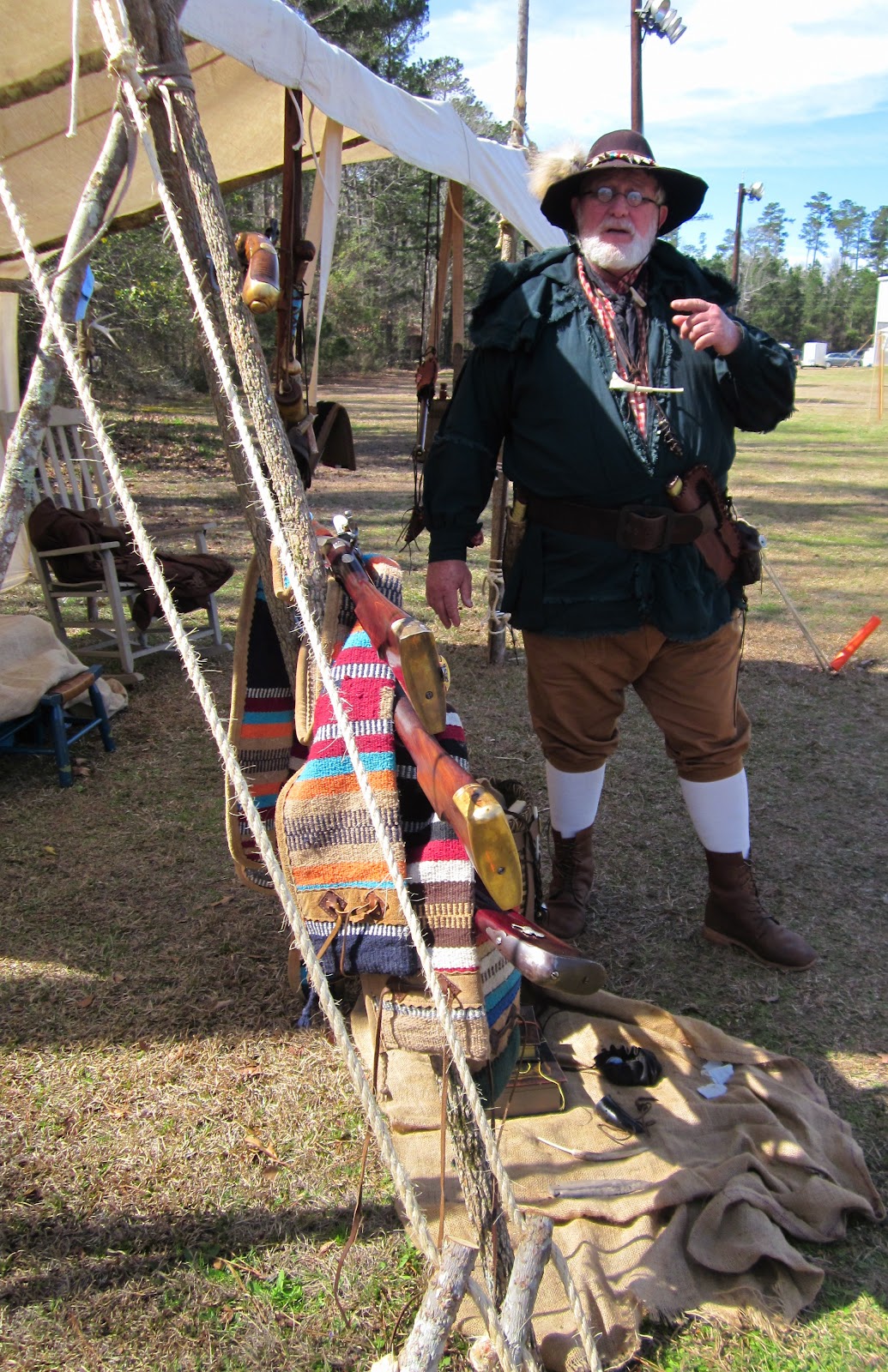 |
Mr. Holloway from TN explains how to make char
cloth and how to start a fire with flint.
|
