
Eighteenth-century colonists got up with the sun and worked until the sun went down in order to utilize the daylight. Once the sun slipped past the horizon, candles provided the only means of illumination - but it was dim lighting, at best, as seen in the photo below.
 |
| Multiple candles provided the only lighting for this 18th century evening concert |
Townspeople could purchase candles from a local tradesman known as a "chandler" or a merchant, but people living in the rural areas needed to make their own tapers.
Candles were made by using metal molds or by the dipping method. Molds produced uniformly shaped candles, but could only be made in small quantities.
Candles were made by using metal molds or by the dipping method. Molds produced uniformly shaped candles, but could only be made in small quantities.
 |
| This pewter candle mold can produce 32 uniformly-made candles |
Dipped candles were less uniform in shape, but several hundred could be made in an afternoon. Multiple wicks were repeatedly dipped into hot tallow until candles reached their desired thickness, then hung on a candle tree to harden.
 |
| This young lad is dipping multiple candles into a kettle of hot beeswax |
How could a candle-maker tell when a dipped candle had reached the desired diameter? He poked candles through a hole in a gauge - a piece of wood with different size holes that represented various candle diameters. When the candle fit perfectly in a hole, no more dippings were required for it.
All candles require a wick to hold the flame. During the colonial period, wicks were made by twisting strings of flax and linen on a spinning wheel. Because twisted wicks do not burn away as the wax melts, they needed to be trimmed frequently with scissors.
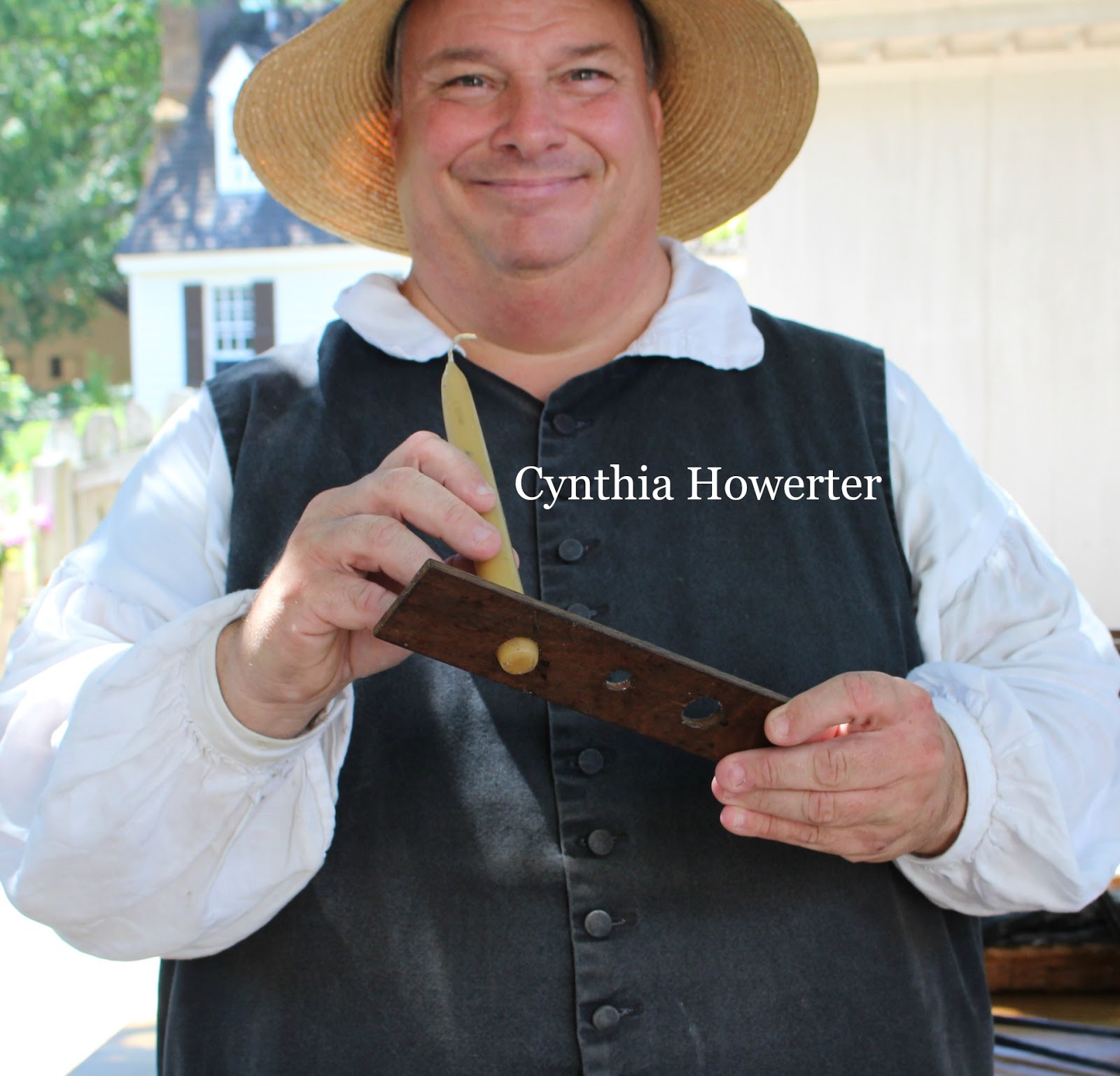 |
| This chandler is holding a wood gauge used to help make dipped candles a certain diameter |
All candles require a wick to hold the flame. During the colonial period, wicks were made by twisting strings of flax and linen on a spinning wheel. Because twisted wicks do not burn away as the wax melts, they needed to be trimmed frequently with scissors.
 |
| Candle wicks were made by twisting flax and linen on a spinning wheel |
Most colonists made candles from tallow or beeswax, although bayberry candles were also popular.
Tallow candles are produced from animal fat and were used in country homes because fat could be readily acquired from cows, sheep, deer, or other animals. Butchering mostly took place during autumn, so candles made from tallow were usually made at that time.
 |
| Candle-making day |
While tallow candles were inexpensive to make, they had a strong, objectionable odor and produced a lot of smoke as the candle burned. They also had a tendency to drip a lot.
Beeswax candles were preferred by colonists because they had a pleasant scent and produced little smoke. They also burned brighter than tallow candles. Many rural colonists kept beehives as much for the sweet honey as the beeswax. After removing beeswax from a hive and scraping off as much honey as possible, the wax was melted and made into candles.
Bayberry candles required an enormous amount of work. In the southern colonies, bayberries were picked from wax myrtle bushes in November. Ten pounds of the tiny greenish-gray berries produce one pound of bayberry wax.
 |
| Tiny bayberries from a wax myrtle bush |
It took colonists hours to hand-pick this amount. Although their herbal scent is heavenly, the amount of work and time required to make bayberry candles made them impractical for daily use.
Whether candles were made from tallow, beeswax, or bayberry wax, the candle making process was similar. The tallow or wax was heated in a kettle over a fire until it liquefied. Impurities could be removed by pouring the heated tallow or wax through muslin or cheesecloth. Then the purified fat or wax was either poured into candle molds or used for dipping.
How long can candles burn? An 8-inch long tallow candle takes about 45-60 minutes to burn down while the same size beeswax candle burns down in about three-and-a-half hours. Most families would have used at least one candle per night. Considering that, it's easy to see that a single colonial household required lots of candles.
All photographs ©2017 Cynthia Howerter
Cynthia's been absent from Colonial Quills recently because she became a grandmother for the first time! Miss Reese Kelly made her debut into the world on July 31. Reese's middle name, Kelly, is a family surname that has been passed down by each generation of our family since the 1600s.
All photographs ©2017 Cynthia Howerter
Cynthia's been absent from Colonial Quills recently because she became a grandmother for the first time! Miss Reese Kelly made her debut into the world on July 31. Reese's middle name, Kelly, is a family surname that has been passed down by each generation of our family since the 1600s.

Award-winning author Cynthia Howerter grew up playing in Fort Rice, a Revolutionary War fort owned by family members, and lived on land once called home by 18th century Oneida Chief Shikellamy in Pennsylvania. Hunting arrowheads and riding horses at break-neck speed across farm fields while pretending to flee from British-allied Indians provided exciting childhood experiences for Cynthia and set the stage for a life-long love of all things historical. A descendant of a Revolutionary War officer and a member of the Daughters of the American Revolution (DAR), history flows through Cynthia's veins.

Are you going through difficult times or know someone who is? Do you need encouragement to get through a tough situation? There's nothing like 25 true stories from people who have been in your shoes and succeeded. To purchase a copy from Amazon of the award-winning non-fiction anthology that Cynthia co-authored along with La-Tan Roland Murphy, click here > God's Provision in Tough Times Available in paperback and Kindle.
