Announcements

10 Year Anniverary & New Releases Winners: Carrie Fancett Pagels' Butterfly Cottage - Melanie B, Dogwood Plantation - Patty H R, Janet Grunst's winner is Connie S., Denise Weimer's Winner is Kay M., Naomi Musch's winner is Chappy Debbie, Angela Couch - Kathleen Maher, Pegg Thomas Beverly D. M. & Gracie Y., Christy Distler - Kailey B., Shannon McNear - Marilyn R.
Showing posts with label 1770s hair. Show all posts

Monday, April 17, 2017

Big Hair of the 1770s – Decorations

by Denise Weimer


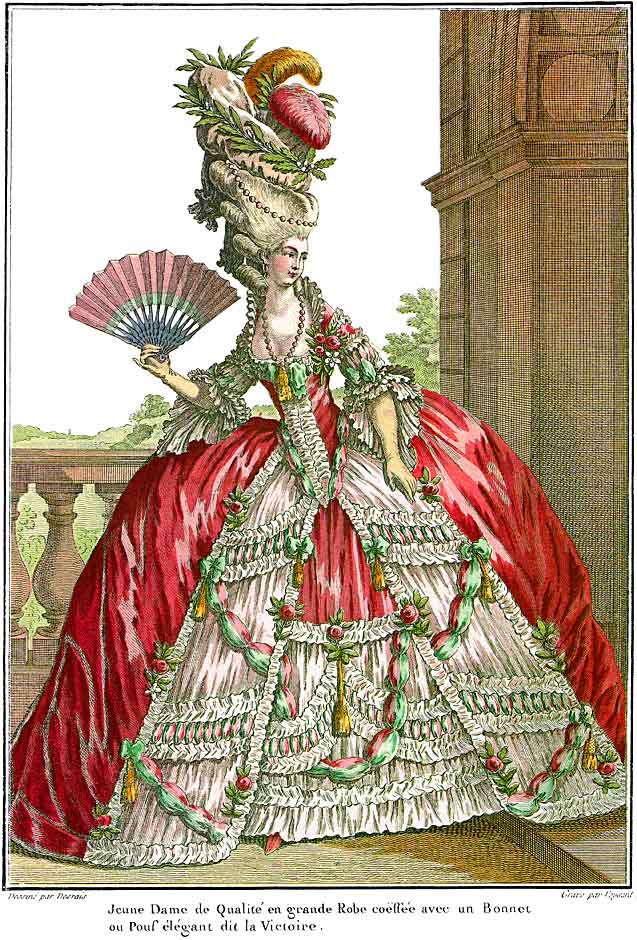
In my last post, I confessed to a long-standing curiosity about the high court women’s hairstyles of the 1770s and shared some of my findings about maintenance and style. But we could not rightfully conclude any discussion of this quirky topic without exploring the icing on the cake, so to speak … the bounty of decorations with which courtiers of the period topped their tresses.
“The number of ladies' hair-dressers increased so much, that there were no less than 1200 of them in Paris in 1769” (The Eighteenth Century: Its Institutions, Customs, and Costumes, by Paul La Croix, 1876, New York and London). French court hair-dressers like Rose Bertin (marchandes des modes to Queen Marie Antoinette, who became head of the Fashion-Makers Guild in 1776) and Léonard set fashions other copied. “Léonard was the inventor of the wonderful modes of wearing the hair which were in vogue for more than ten years” (La Croix).
Bertin created the pouf a la circonstance, a little bonnet or round fabric on which various decorations like flowers, feathers, jewels, fruit or even landscapes or bird cages could be placed. Consider the pouf a charm bracelet for the head. Its decorations could reflect the attachments of the wearer, the season or national events. Yes, la belle poule really included the recreation of a ship as part of a headdress worn at the court of Louis XVI. And a hot air balloon style celebrated scientific experiments along the same lines.
Regular citizens without need to imitate the eccentricity of courtiers still attempted to heighten their hair. Sketches from the period show even bar maids with small caps crowning heaps of tresses. Formal portraits most often depict height with a string of pearls.
Before we become too judgmental about 1770s hair, how many of us sported a 1960s beehive or hair sprayed our locks to heaven in the ‘80s? We had to balance out those shoulder pads just like the 1770s ladies did with their paniers, right? 

Some online sources consulted: Démodé: Historical Costume Projects & Research Sources, Specializing in the 18th Century, “Women’s Hairstyles & Cosmetics of the 18th Century: France & England, 1750-1790. Two Nerdy History Girls Blog, “The Truth about the Big Hair of the 1770s,” August 18, 2015. On Pins and Needles Blog, “Le Pouf: Fashion and Social Satire in the 1770s-1780s,” by Landis Lee, February 1, 2012.

Monday, February 20, 2017

Big Hair of the 1770s – Maintenance and Style


by Denise Weimer

 As a researcher of mainly 1800s fashion – whose Colonial writing so far has focused on the frontier – I confess to harboring a curiosity of ignorance on the subject of 1700s high court fashions. Chiefly, the opulent ladies’ hairdos. Anyone else willing to admit the same? Let’s explore this quirky topic together, and for those experts among us, please feel free to add interesting tid-bits in the comments section. This post will focus on maintenance and basic style, while my April post will delve more into decoration.
My initial survey on big hair of the 1770s uncovered some pertinent basic information. As expected, fashion tended to flow from France to England. Simpler 1750s fashions like tête de mouton (“sheep’s head”) with tight curls in rows on top gave way to more egg-shaped creations in the 1760s. By the next decade, a much taller, pyramid shape prevailed. The opulence of style served to balance the wide paniers of the skirts. While men of the 1700s often wore full wigs, women employed partial wigs or false hair heaped on padding or toques constructed of fabric or cork. These forms might be shaped like a heart or spear.  

Maintenance of the tresses included irregular washing with just water or soap. The drying effects of the soap sometimes required pomade for shine. Mostly, pomatum (animal fat plus fragrances – one recipe called for mutton fat, pig lard, essence of lemon and clove oil) was worked in, then power was added. A wealthy person might use finely ground starch of beef or sheep bones plus orris root for scent (The Toilet of Flora, 1772), while a poor person might make do with corn or wheat flour. Professional powder application included the use of a bellows and face mask and smock.
While stories of careless hussies sleeping in their ‘dos using large pins and night caps for days on end gave rise to rumors of mice and vermin invaders, a conscientious lady probably did her hair daily. With a good ladies’ maid or coiffeur, this process should have taken no more time than a modern application of blow dryer or curling iron.
Some online sources consulted: Démodé: Historical Costume Projects & Research Sources, Specializing in the 18th Century, “Women’s Hairstyles & Cosmetics of the 18th Century: France & England, 1750-1790. Two Nerdy History Girls Blog, “The Truth about the Big Hair of the 1770s,” August 18, 2015. On Pins and Needles Blog, “Le Pouf: Fashion and Social Satire in the 1770s-1780s,” by Landis Lee, February 1, 2012.