
It was July 2, 1776.
 Exhausted and muddied, the frail yet determined man stumbled
into the doorway of the chamber where the second Continental Congress was
meeting. Making his way to the desk where the delegates from Delaware sat, he
slumped into his wooden chair. Soaked to the skin, he breathed with some
difficulty. He had a bandage covering the cancerous sore on his face. But the
48-year-old major general of the Delaware militia, Caesar Rodney, voted with
the passion of a man who would ride through any storm to let his desire for
liberty lead to the adoption of the Declaration of Independence.
Exhausted and muddied, the frail yet determined man stumbled
into the doorway of the chamber where the second Continental Congress was
meeting. Making his way to the desk where the delegates from Delaware sat, he
slumped into his wooden chair. Soaked to the skin, he breathed with some
difficulty. He had a bandage covering the cancerous sore on his face. But the
48-year-old major general of the Delaware militia, Caesar Rodney, voted with
the passion of a man who would ride through any storm to let his desire for
liberty lead to the adoption of the Declaration of Independence.
Without his vote, the United States of America would likely
not exist.
So who was Ceasar Rodney?
He was born the son of a Delaware farmer in 1728. When only
seventeen, his father died and the teen was placed under the guardianship of a
clerk of the peace in Kent County, Delaware. Through his guardian’s influence,
Rodney became interested in politics.
At the young age of twenty-seven, Rodney was named Commissioner
High Sheriff of Delaware. Other offices that he held in subsequent years were
Registrar of Wills, Recorder of Deeds, Clerk of the Orphan’s Court, and Justice
of the Peace.
By the time he was thirty, he was elected to the Colonial
Legislature at Newcastle, Delaware.
In 1765, Rodney was a delegate to the Stamp Act Congress,
the first official gathering of several colonies fighting against the higher
taxes being enacted by Great Britain. The battle cry of that Congress was “No
taxation without representation.”
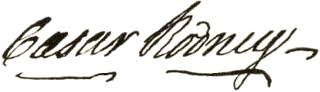 |
| Rodney's Signature on the Declaration of Independence |
Named a delegate to the Continental Congress, Rodney
retained his position as a military leader in the colonial militia…and this was
what drew him back to Delaware in June of 1776. He had just finished voting on
an important resolution for independence in Congress when he was notified that
there was a threatened uprising among those loyal to the king living in Sussex
County, Delaware.
The final vote in Philadelphia on whether or not to adopt
the Declaration of Independence was approaching and delegate Thomas McKean was
beginning to panic. He knew that delegate George Read would vote “Nay” to
independence. If there were only two votes from Delaware, they would cancel
each other out. Delaware needed Rodney’s third vote for the majority. McKean
was desperate and he sent a messenger to retrieve Rodney.
 |
| Caesar Rodney Statue, Rodney Square, Wilmington, Delaware |
Rodney received the message on the evening of July 1. He
left immediately for Philadelphia, 80 miles away
According to Russ Picket (russpicket.com), it was an
“agonizing ride” through a severe thunderstorm, terrible heat, over mud-filled
roads and across swollen creeks. All the while, Rodney suffered from asthma and
the pain of a cancerous tumor on his face.
He arrived in Philadelphia on the afternoon of July 2, in
time for the Congressional vote.
Rodney continued to serve his new country. He held the office
of Speaker to the Upper House of the Delaware Assembly until the day he died,
June 26, 1784.
Rodney never received proper treatment for his cancer. He
put aside his personal pain to save his country. He was truly a hero, not just
of Delaware, but of the United States.
Watch this interesting depiction of the arrival of Caesar
Rodney to Congress, from the musical “1776.”
Click here.


