Announcements

10 Year Anniverary & New Releases Winners: Carrie Fancett Pagels' Butterfly Cottage - Melanie B, Dogwood Plantation - Patty H R, Janet Grunst's winner is Connie S., Denise Weimer's Winner is Kay M., Naomi Musch's winner is Chappy Debbie, Angela Couch - Kathleen Maher, Pegg Thomas Beverly D. M. & Gracie Y., Christy Distler - Kailey B., Shannon McNear - Marilyn R.
Showing posts with label Virginia Dare. Show all posts

Monday, March 8, 2021

John White: Artist For the New World and First Governor of Virginia

"The pictures of sondrye things," the inscription reads, "collected and counterfeited [copied] according to the truth in the voyage made by Sir Walter Raleigh knight for the discovery of La Virginea. In the 27th yeare of the most happie reigne of our Soveraigne lady Queene Elizabeth. And in the yeare of Lord God 1585."

These are the words and hand of John White, appointed first as professional artist and mapmaker to three separate voyages to the New World.


We know him best as first Governor of Virginia, the name given to territory claimed on behalf of the Virgin Queen, Elizabeth, but his first experience in the New World was in 1577, on an expedition led by Martin Frobisher to what is now known as Newfoundland. A single watercolor survives of that adventure, showing the English explorers under attack by Inuit warriors. One of those warriors, as well as an Inuit woman and child, were carried back to England and put on display. White sketched and later colored portraits of these unfortunate people, and I was delighted to find images of all in the online archives of the British Museum.

It has been commented that White not only portrayed the indigenous peoples of the New World with a realism uncharacteristic of the era, but with sensitivity and grace.

Don't you just love the face of the baby peeking out of his (her?) mother's hood?


In 1584 and 1585, White accompanied two other expeditions, both to Virginia. His map of the coast was remarkably accurate, by modern standards:


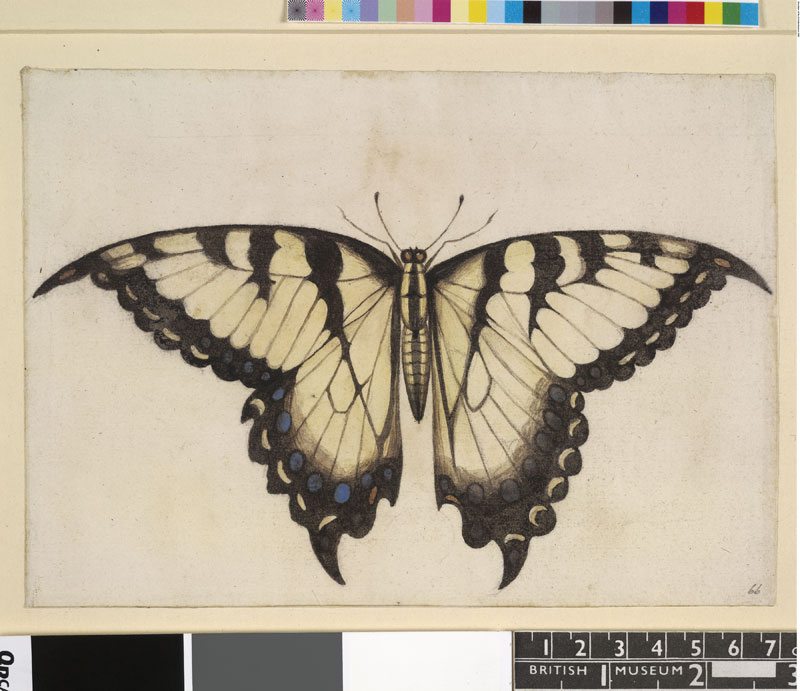
Dozens of his watercolor sketches also survive of various flora and fauna, presumably of England as well as the New World. The man had an amazing eye for detail, and the patience to reproduce it for the world to see.


Once again, however, it's his portraits of the people of the New World--of what would become North Carolina, here--that I find most arresting. Charged with "painting to life" the land and peoples, he did so, capturing faces and scenes from the Caribbean up through Florida as well as the dress and manners of the Carolina Algonquin peoples. In so doing, he provides the only view we have of this time and region.

He sketches and paints with so much realism, in fact, that it's somewhat problematic for modern sensibilities. This Algonquin woman, identified by White as "one of the wyves of Wyngyno," a weroance or chief of Secotan, stands in a pose that every woman ever will easily recognize. Thomas Harriot, a prominent scientist and mathematician who worked alongside White during the 1585 expedition, described it as "maydenlike modestye." Indigenous manner of dress accommodates the bare essentials of modesty, at least in summertime, but only barely. I can imagine what they must have thought of the English with their many layers! We know from their writings that the English regarded them to varying degrees as very much lesser peoples.

Interestingly, though, some--Harriot included--felt the Algonquin peoples had much to teach the English, not the least of all that they ate much more healthfully and without the excess the English were prone to. In his written account, A Briefe and True Report of the New Found Land of Virginia, first published in 1590 with woodcut prints of White's sketches, Harriot commented that the only area where they seemed deficient was their understanding of spiritual things, and told of his efforts to explain to them the basics of Christianity. He also speaks in scathing terms of those who went to the New World only to look for gold and silver and cared for nothing else, or who were of delicate upbringing and could not handle the primitive conditions of the New World.
For those who read my last post on our visit to Roanoke Island Festival Park, these next two prints illustrate what the park attempts to bring to life in their Algonquin life displays:

"The broyling of their fish over the flame of fier"


... and the town of Secotan, a coastal Algonquin community:


The complaint is made that Harriot's writings, and White's work as well, was only carried out with an eye to the economic feasibility of supporting an English colony in the New World, but both men could be credited with seeing the Algonquins as a people in their own right and worthy of respect and dignity, even when others did not.

For John White, this respect served him well as Governor of Virginia, however short-lived was his time there in 1587. We know from his own account how grieved he was to leave, and how intensely he desired his colonists to live with love and friendship with the Croatoan people and their neighbors.

For further study:


All images © The Trustees of the British Museum. Shared under a Creative Commons Attribution-NonCommercial-ShareAlike 4.0 International (CC BY-NC-SA 4.0) licence.

Friday, July 10, 2015

America’s Oldest Unsolved Mystery


I recently had the opportunity to visit the Outer Banks of North Carolina and fulfill a 40 year wish to see the production of The Lost Colony on Roanoke Island. This popular summer attraction was first performed seventy-eight years ago, making it the oldest outdoor symphonic drama in the country.

On the way to the Outer Banks, I recalled my parents telling me about another drama that took place that same summer on Roanoke Island. That event occurred seventy-eight years ago to the day I would be attending the play.

On an early June day in 1937, a young Naval Lieutenant stationed in Norfolk, Virginia planned on taking his sweetheart on a picnic to propose marriage.
July 1937
That couple in their mid twenties was my parents. Whether it took my father hours to work up his courage or whether it was his intent, they ended up driving all the way to
Roanoke Island, North Carolina. A 200 mile round trip was no small Saturday excursion in 1937. It was also the subject of a lot of teasing over their 43 year marriage, since, at the time, transporting a single female across a state line was a felony.

So now, seventy-eight years later, I had tickets and was on my way to see the play I’d been waiting so long to see. The Lost Colony, a Tony award winning play was written by Pulitzer Prize winning playwright Paul Green.

The musical pageant is based on accounts of Sir Walter Raleigh's attempts to establish a settlement on Roanoke Island, then part of the Colony of Virginia. Early in the play we watched Raleigh lead a group of men in 1585 to Roanoke on primarily a military mission. These settlers returned to England with two Indian leaders, Manteo and Wanchese, because of a shortage of food and altercations they had with other natives.
Opening Scene for "The Lost Colony"

John White, Governor of the new colony, led another group of 117 men, women and children in July 1587 to the existing Roanoke Island settlement. The next month, the Governor’s daughter, Eleanor Dare, wife of Ananias Dare gave birth to Virginia Dare, the first English child born on American soil. Ten days later John White sailed back to England for a fresh load of supplies. During this time a major naval war broke out between England and Spain. Queen Elizabeth I insisted every ship would be needed to confront the invading Spanish Armada. Governor White was not able to return to his wife, daughter, granddaughter and other settlers at Roanoke until August 1590. When he arrived, no trace was found of the colony or its settlers. The only clue was the single word “Croatoan” carved into a wooden post. In the past 428 years there have been many scenarios speculated on what happened to these colonists, but no one really knows. At the time the settlers did enjoy a friendlier relationship with the local Indians, so it is possible that they joined with the friendly Croatoan natives in order to survive.

The Lost Colony production was first rate and priced at $30 a ticket. It had elaborate Elizabethan costumes, particularly for the scenes taking place in London. Watching the scene transitions was fascinating. The singing and dancing were nothing short of a Broadway play. I was particularly moved by the Christian emphasis in the Colonist’s hymns, prayers and dialog.

Memorial Stone to the original Roanoke Settlers
Given that our nation was in the midst of the Great Depression when this award winning production was written, it is no surprise that it focuses on the ideals of freedom, struggle and perseverance. The names of the people who lived there so long ago are memorialized everywhere in the towns and on street signs throughout Roanoke Island.