Announcements

10 Year Anniverary & New Releases Winners: Carrie Fancett Pagels' Butterfly Cottage - Melanie B, Dogwood Plantation - Patty H R, Janet Grunst's winner is Connie S., Denise Weimer's Winner is Kay M., Naomi Musch's winner is Chappy Debbie, Angela Couch - Kathleen Maher, Pegg Thomas Beverly D. M. & Gracie Y., Christy Distler - Kailey B., Shannon McNear - Marilyn R.
Showing posts with label early Virginia. Show all posts

Monday, March 8, 2021

John White: Artist For the New World and First Governor of Virginia

"The pictures of sondrye things," the inscription reads, "collected and counterfeited [copied] according to the truth in the voyage made by Sir Walter Raleigh knight for the discovery of La Virginea. In the 27th yeare of the most happie reigne of our Soveraigne lady Queene Elizabeth. And in the yeare of Lord God 1585."

These are the words and hand of John White, appointed first as professional artist and mapmaker to three separate voyages to the New World.


We know him best as first Governor of Virginia, the name given to territory claimed on behalf of the Virgin Queen, Elizabeth, but his first experience in the New World was in 1577, on an expedition led by Martin Frobisher to what is now known as Newfoundland. A single watercolor survives of that adventure, showing the English explorers under attack by Inuit warriors. One of those warriors, as well as an Inuit woman and child, were carried back to England and put on display. White sketched and later colored portraits of these unfortunate people, and I was delighted to find images of all in the online archives of the British Museum.

It has been commented that White not only portrayed the indigenous peoples of the New World with a realism uncharacteristic of the era, but with sensitivity and grace.

Don't you just love the face of the baby peeking out of his (her?) mother's hood?


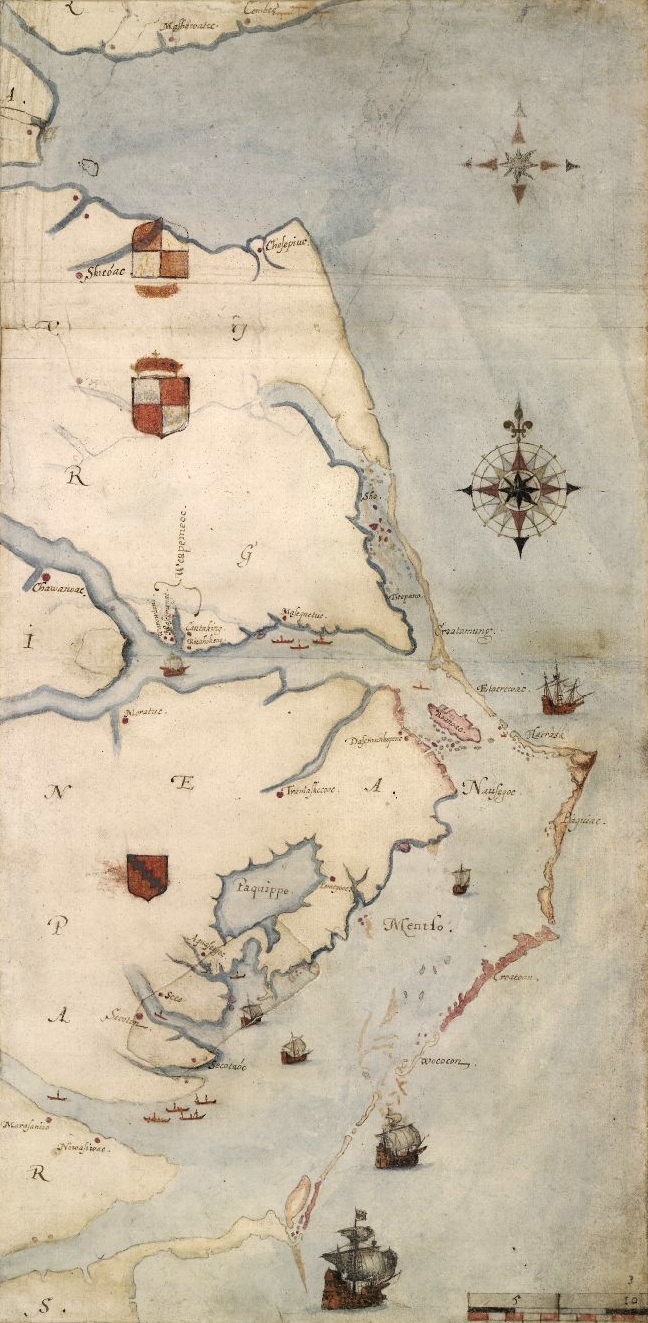
In 1584 and 1585, White accompanied two other expeditions, both to Virginia. His map of the coast was remarkably accurate, by modern standards:


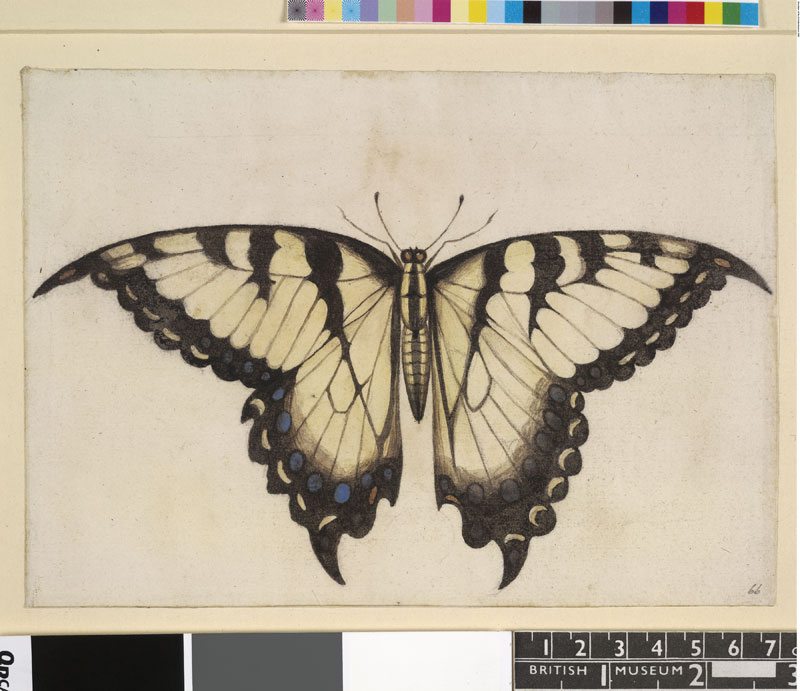
Dozens of his watercolor sketches also survive of various flora and fauna, presumably of England as well as the New World. The man had an amazing eye for detail, and the patience to reproduce it for the world to see.


Once again, however, it's his portraits of the people of the New World--of what would become North Carolina, here--that I find most arresting. Charged with "painting to life" the land and peoples, he did so, capturing faces and scenes from the Caribbean up through Florida as well as the dress and manners of the Carolina Algonquin peoples. In so doing, he provides the only view we have of this time and region.

He sketches and paints with so much realism, in fact, that it's somewhat problematic for modern sensibilities. This Algonquin woman, identified by White as "one of the wyves of Wyngyno," a weroance or chief of Secotan, stands in a pose that every woman ever will easily recognize. Thomas Harriot, a prominent scientist and mathematician who worked alongside White during the 1585 expedition, described it as "maydenlike modestye." Indigenous manner of dress accommodates the bare essentials of modesty, at least in summertime, but only barely. I can imagine what they must have thought of the English with their many layers! We know from their writings that the English regarded them to varying degrees as very much lesser peoples.

Interestingly, though, some--Harriot included--felt the Algonquin peoples had much to teach the English, not the least of all that they ate much more healthfully and without the excess the English were prone to. In his written account, A Briefe and True Report of the New Found Land of Virginia, first published in 1590 with woodcut prints of White's sketches, Harriot commented that the only area where they seemed deficient was their understanding of spiritual things, and told of his efforts to explain to them the basics of Christianity. He also speaks in scathing terms of those who went to the New World only to look for gold and silver and cared for nothing else, or who were of delicate upbringing and could not handle the primitive conditions of the New World.
For those who read my last post on our visit to Roanoke Island Festival Park, these next two prints illustrate what the park attempts to bring to life in their Algonquin life displays:

"The broyling of their fish over the flame of fier"


... and the town of Secotan, a coastal Algonquin community:


The complaint is made that Harriot's writings, and White's work as well, was only carried out with an eye to the economic feasibility of supporting an English colony in the New World, but both men could be credited with seeing the Algonquins as a people in their own right and worthy of respect and dignity, even when others did not.

For John White, this respect served him well as Governor of Virginia, however short-lived was his time there in 1587. We know from his own account how grieved he was to leave, and how intensely he desired his colonists to live with love and friendship with the Croatoan people and their neighbors.

For further study:


All images © The Trustees of the British Museum. Shared under a Creative Commons Attribution-NonCommercial-ShareAlike 4.0 International (CC BY-NC-SA 4.0) licence.

Monday, November 16, 2020

America's Oldest Unsolved Mystery: Solved?

"The Lost Colony," Sheppard & Linton
 A few months ago I wrote about America's earliest colonial history (including a post about French Huguenot efforts and the conflict with Spain), and I referenced Janet Grunst's post on the Lost Colony. For much of this year I've been awash in research on this particular slice of history, in preparation for my upcoming novel, Elinor, first of a new series titled Daughters of the Lost Colony. What an amazing journey it's been so far!

Shortly after my visit to the Outer Banks, I discovered Scott Dawson, an author native to Hatteras Island, where many believe the Lost Colony settlers removed to after leaving Roanoke Island. Frustrated with Lost Colony myth, much at odds with local history, Dawson embarked upon a quest to prove what so many already suspected: that after John White, governor of the first official English colony on American shores, unhappily returned to England to plead their case to Raleigh and the court of Queen Elizabeth I, the settlers took shelter with their own known allies of the time, the Croatoan tribe. These were the family and people of Manteo, the Native American who accompanied the previous two expeditions between England and the New World, and who later accepted baptism into the Christian faith and the title of "Lord of Roanoke." (See more at the Wiki article on the Roanoke Colony.)

Eventually aided by an archaeological team out of England's University of Bristol, Dawson chose a site and started digging. (He stated in a recent online talk I attended that his grandmother told him where to dig.) In his recent book, The Lost Colony and Hatteras Island, he describes the years-long process, and the layers of artifacts encountered, as well as artifacts and clues from other sources. The main thing he wanted to prove, he says both in the article "The Lost Colony Wasn't Really Lost" from the Outer Banks Voice and the recent talk, is that when John White returned in 1590 and saw the word "CROATOAN" carved head-high on a tree, there was no big mystery on where the colony had gone, at least not in the immediate sense. White had given them very clear instructions on how to leave word, and he knew this referred to both the people and the place of their residence--what is now known as Hatteras Island. There was no trace of any mark that would have indicated distress or trouble. The colonists had known before White's reluctant departure for England that Roanoke Island would not support them, and their best chance for survival lay with the only people who might be sympathetic to them, people who knew well how to fish, hunt, and make a good living from the Outer Banks.
If this seems disappointing and anticlimactic, well, it really isn't. There is still plenty of scope for adventure and mystery. Many historians, Dawson included, discuss the likelihood of division among the settlers, and the possibility of some moving to the mainland. Until very recently (the Dare Stones notwithstanding--more about those later!), there was no solid evidence as to where they might have gone. Just a couple of weeks ago, however, I found the article "Lost Colony Moved Inland," from Coastal Review Online. I am eager to see more on this effort!

In the meantime, take a gander at Scott Dawson's group, the Croatoan Archaeological Society. Fascinating stuff for us early American history geeks!

Monday, June 15, 2020

The Earliest Colonial History

The coast of "Virginia," by John White
DISCLAIMER: Our country's own recent events might make us shy from terms such as "colonial," but I seek only to report history as described by contemporaries of whatever time period I am examining. In no way do I condone the actions of men (or women) who lived in those times. The fact is, certain events took place, and certain actions resulted from those events, and political corruption has always been a thing. Just within the past two weeks, while researching for this post and even while watching things for entertainment, I'm reminded that genocide was practiced even among those who considered themselves civilized (note the English subjugation of Ireland in the 1500's) and colonization was certainly not the sole purview of Europeans (note the Japanese takeover of Korea in the early 1900's). Making such observations might sound like I'm excusing the actions of (some of) my own forebears, but I assure you it is not. I only say so to address the belief that injustices are a primarily "white" problem. The entirety of history is just awful in so many ways.

So ... what do we think of, in the context of America, when someone says "Colonial History"? Most of us, I'm sure, think of the War for American Independence, possibly of Daniel Boone, and before that, of the Mayflower, Plymouth Rock, and Jamestown.

Our country's European roots go even further than that, however. Though the period between Columbus and the Mayflower is usually viewed as a misty void, the English quest to colonize the New World was first fueled by Queen Elizabeth I, who sought lands not already claimed by Christian rulers to add to the fame and fortunes of Britain.
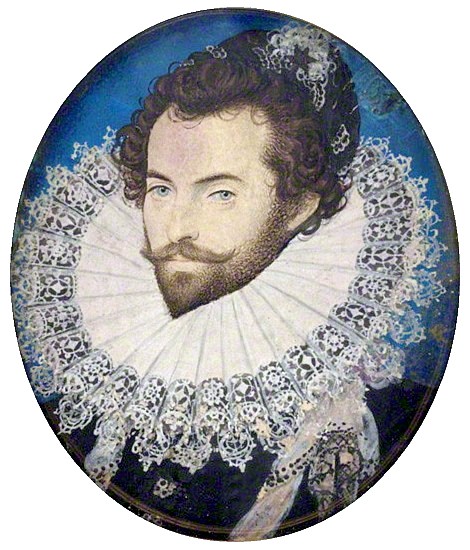
A very dapper Sir Walter Raleigh

After the 1583 voyage to Newfoundland by Sir Humphrey Gilbert ended in disaster (Gilbert perished at sea on his way home), the patent passed to his younger half brother, Sir Walter Raleigh. Wasting no time, Raleigh sent an expedition to what was then known as Virginia--named after Elizabeth herself, the "Virgin Queen." The first colonist--more a military endeavor than a serious permanent settlement yet--landed on Roanoke Island in 1585, on the Outer Banks of what is now North Carolina. Those original colonists returned to England shortly after, just missing their supply ship. This second wave left a contingent of 15 men to hold the area.

The next serious attempt at colonization took place in 1587, and the group of 117-some included women and children. These brave souls comprised what would later be called "the Lost Colony." A brief introduction to that story was provided by our own Janet Grunst, in her post "America's Oldest Unsolved Mystery."

More on that later, as over the next few months, I'll be looking at some of the key players in these early attempts at colonizing North America. :-)